Page 26 of 44
Alternate Procedure 2 (Remove Service Plug)
• Do not remove the service plug without always wearing appropriate Personal
Protective Equipment (PPE) to help protect the responder from serious injury or death
by electrical shock.
• Immediately cover the service plug socket with insulated tape. The high-voltage
battery
retains high-voltage power even when the service plug is removed. To avoid
electric shock, NEVER touch the terminals inside the socket. To avoid unintended reinstallation and risk of electrical shock and severe personal injury
or
death, the rescuer should carry the service plug on his/her person while work is in
progress.
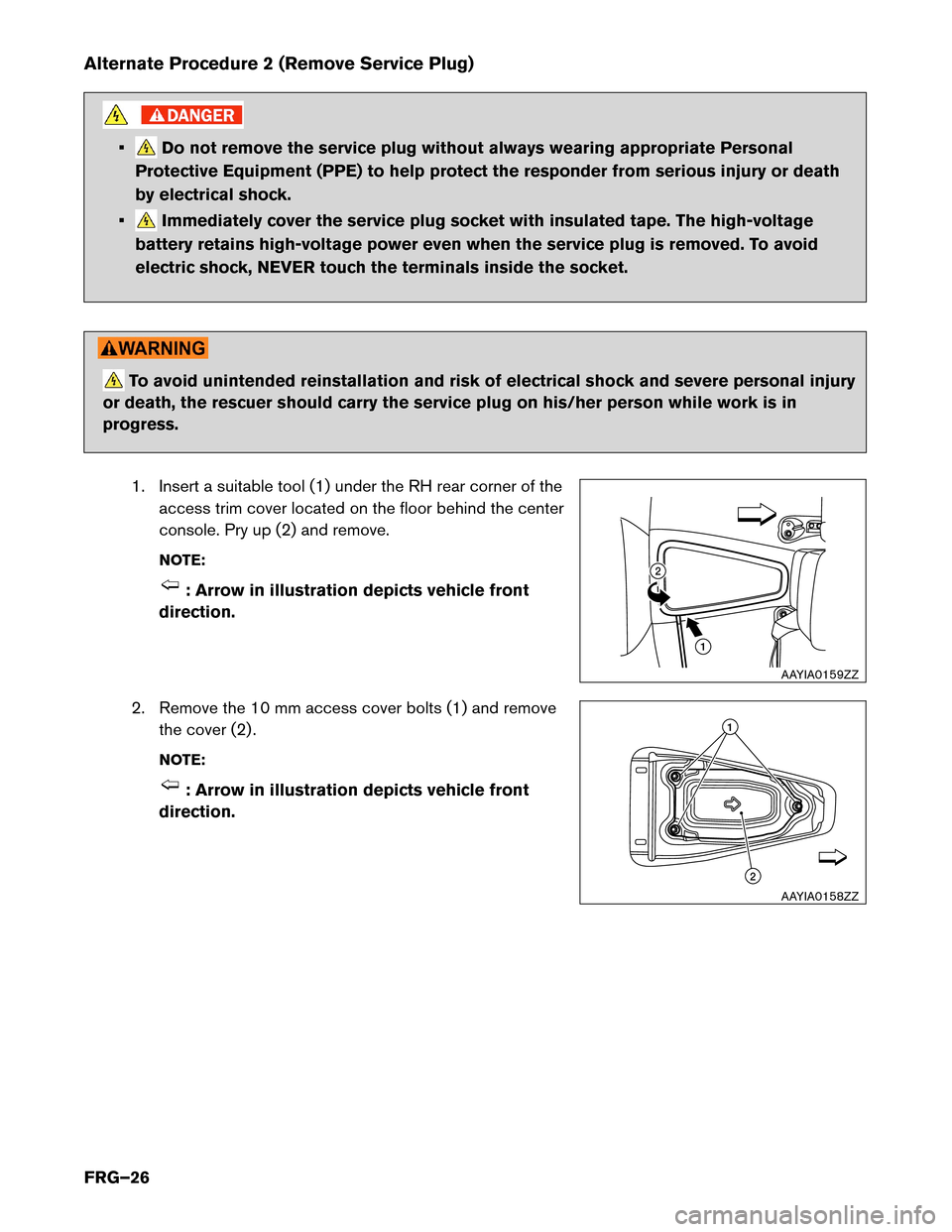
1. Insert a suitable tool (1) under the RH rear corner of theaccess trim cover located on the floor behind the center
console. Pry up (2) and remove.
NOTE: : Arrow in illustration depicts vehicle front
direction.
2.
Remove the 10 mm access cover bolts (1) and remove
the cover (2) .
NOTE: : Arrow in illustration depicts vehicle front
direction. 12
AAYIA0159ZZ
1
2
AAYIA0158ZZ
FRG–26
Page 27 of 44
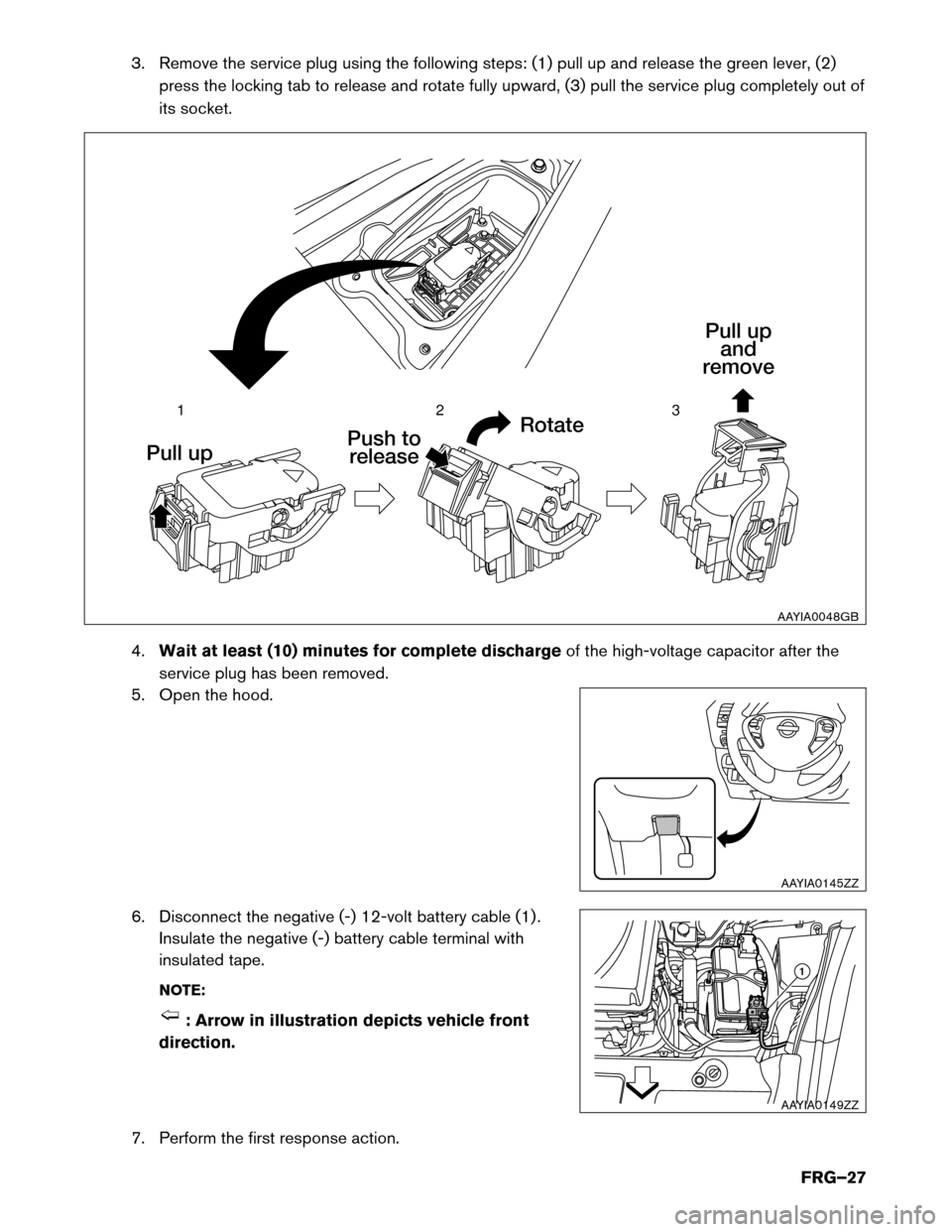
3. Remove the service plug using the following steps: (1) pull up and release the green lever, (2)
press the locking tab to release and rotate fully upward, (3) pull the service plug completely out of
its socket.
4. Wait at least (10) minutes for complete discharge of the high-voltage capacitor after the
service plug has been removed.
5. Open the hood.
6. Disconnect the negative (-) 12-volt battery cable (1) . Insulate the negative (-) battery cable terminal with
insulated tape.
NOTE: : Arrow in illustration depicts vehicle front
direction.
7.
Perform the first response action. 1
2
3
Pull up Rotate
Push to
release Pull up
and
remove
AAYIA0048GB AAYIA0145ZZ
1
AAYIA0149ZZ FRG–27
Page 28 of 44
3-3.2 Water Submersion
Damage level of submerged vehicle may not be apparent. Handling a submerged
vehicle without appropriate Personal Protective Equipment (PPE) will result in serious
injury or death from electrical shock. • The power switch of the submerged vehicle must be turned OFF first, if possible.
Then
the vehicle must be completely out of the water and drained to avoid electrical
shock.
• Always wear appropriate Personal Protective Equipment (PPE) and remove/drain
water
before removing the service plug when working on a vehicle after a fire or
submersion to avoid electrical shock.
• If the vehicle is in the water, to avoid electrical shock NEVER touch the high-
voltage
components, harnesses or service plug. PPE must always be worn when
touching or working on high-voltage components.
3-3.3 Vehicle Fire • Always utilize full Personal Protective Equipment (PPE) and self-contained breathing
apparatus
during fire fighting operations. Smoke from a LEAF vehicle fire is similar to
smoke from a conventional vehicle fire.
• In the case of extinguishing a fire with water, large amounts of water from a fire hydrant (if possible) must be used. DO NOT extinguish fire with a small amount of water. In the event of a small fire, a Type ABC fire extinguisher may be used for an electrical fire
caused
by wiring harnesses, electrical components, etc. or oil fire.
Fire attack should follow standard fire fighting practices.
If you must walk away from the vehicle, notify an appropriate responder or a rescue person of the fact that
the vehicle is an electric car and contains a high-voltage system and warn all others.
During overhaul operations (late stage fire suppression process to examine for remaining sources of heat) ,
make sure the battery is fully cooled to avoid fire re-ignition. The battery could reignite if it is placed near fire.
To avoid possible electrical shock and serious personal injury, do not breach the high-voltage battery case.
FRG–28
Page 29 of 44
3-3.4 Cutting the Vehicle Body
• Do not cut into high-voltage related areas to avoid severe personal injury or death.
• Do not cut into the high-voltage battery to avoid severe personal injury or death.
• When removing parts, NEVER touch the high-voltage parts or the insides of the
exposed orange-colored high-voltage cables to avoid severe personal injury or death.
Personal Protective Equipment (PPE) must always be worn when touching or
working on high-voltage components. • Do not cut air bag parts to avoid unintended deployment of the air bags and the risk of
severe
personal injury or death.
If at least ten (10) minutes have passed since the rescuer shut down the high-voltage system (refer to
3-3.1 High-voltage System Shut-Down Procedures (FRG–17)) , then the rescuer can cut the vehicle
except
for the high-voltage battery. If the rescuer cannot wait the full ten (10) minutes or shut down the high-voltage system,
absolute
care must be taken to avoid cutting HV parts and appropriate Personal Protective
Equipment (PPE) must always be worn.DO NOT cut the high-voltage battery due to
possible electrocution risk and electrolyte solution leakage.
FRG–29
Page 30 of 44
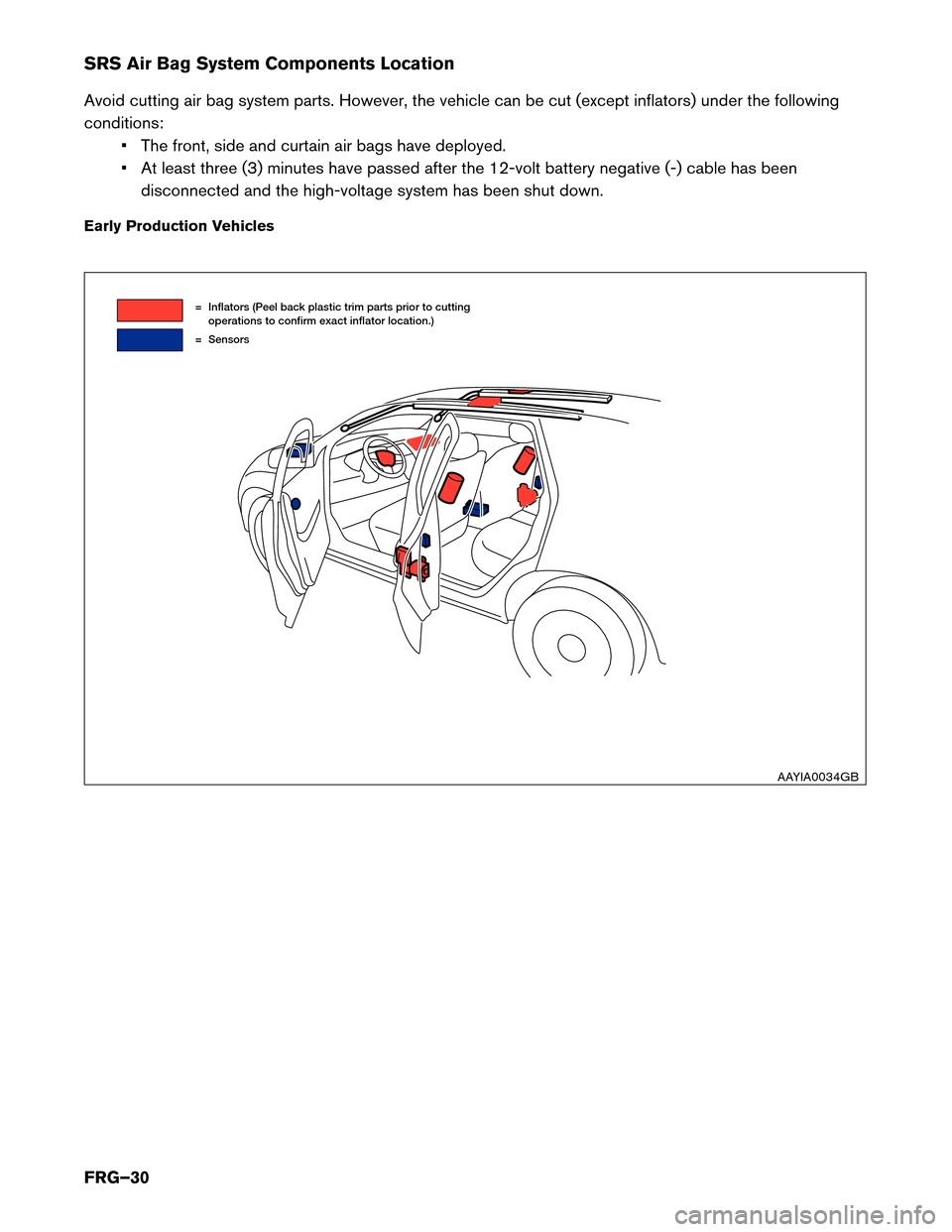
SRS Air Bag System Components Location
Avoid
cutting air bag system parts. However, the vehicle can be cut (except inflators) under the following
conditions: • The front, side and curtain air bags have deployed.
• At least three (3) minutes have passed after the 12-volt battery negative (-) cable has beendisconnected and the high-voltage system has been shut down.
Early Production Vehicles = Inflators (Peel back plastic trim parts prior to cutting�
operations to confirm exact inflator location.)
= Sensors
AAYIA0034GB
FRG–30
Page 36 of 44
3-3.5 High-voltage Battery Damage and Fluid Leaks
The high-voltage battery contains electrolyte solution. To avoid exposure to electrolyte
solution
and serious personal injury, always wear appropriate solvent resistant Personal
Protective Equipment (PPE) and read the following precautions:
• Electrolyte solution is a skin irritant.
• Electrolyte solution is an eye irritant – If contact with eyes, rinse with plenty of water and see a doctor immediately.
• If electrolyte leak occurs, wear appropriate solvent resistant PPE and use a dry cloth to clean up the spilled electrolyte. Be sure to adequately ventilate the area.
• Electrolyte solution is highly flammable
• Electrolyte liquid or fumes that have come into contact with water vapors in the air will create an oxidized substance. This substance may irritate skin and eyes. In these
cases, rinse with plenty of water and see a doctor immediately.
• Electrolyte fumes (when inhaled) can cause respiratory irritation and acute intoxication. Move to fresh air and wash mouth with water. See a doctor immediately.
If electrolyte solution leakage, or damage such as any problem with the high-voltage battery casing are
observed, first responders should attempt to neutralize the battery by applying a large volume of water to the
battery pack while wearing appropriate Personal Protective Equipment (PPE) . The neutralization process
helps stabilize the thermal condition of the battery pack but does not discharge the battery.
High-voltage Battery Electrolyte Solution Characteristics: • Clear in color
• Sweet odor
• Similar viscosity to water
• Since the high-voltage battery is made up of many small sealed battery modules, electrolyte solutionleakage should be minimal.
NOTE:
Other fluids in the vehicle are the same as those in a conventional internal combustion
vehicle.
FRG–36
Page:
< prev 1-8 9-16 17-24