2017 NISSAN JUKE tires
[x] Cancel search: tiresPage 373 of 416

9-6Maintenance and schedules
CHASSIS AND BODY MAINTENANCE
Brake lines and cables:
Visually inspect for proper installation. Check for
chafing, cracks, deterioration, and signs of
leaking. Replace any deteriorated or damaged
parts immediately.
Brake pads and rotors:
Check for wear, deterioration and fluid leaks.
Replace any deteriorated or damaged parts
immediately.
Exhaust system:
Visually inspect the exhaust pipes, muffler and
hangers for leaks, cracks, deterioration, and
damage. Tighten connections or replace parts
as necessary.
In-cabin microfilter:
Replace at specified intervals. When driving for
prolonged periods in dusty conditions, replace
the filter more frequently.
Propeller shaft(s):
Check for damage, looseness, and grease
leakage. (AWD)
Steering gear and linkage, axle and sus-
pension parts, drive shaft boots:
Check for damage, looseness, and leakage of oil
or grease. Under severe driving conditions,
inspect more frequently.Tire rotation:
Tires should be rotated every 5,000 miles
(8,000 km) according to the instructions under
“Explanation of general maintenance items”
(P.9-2) . When rotating tires, check for damage
and uneven wear. Replace if necessary.
Transmission fluid/oil, differential oil and
transfer case oil:
Visually inspect for signs of leakage at specified
intervals.
If using a car-top carrier, or driving on rough or
muddy roads:
.
Replace the manual transmission gear oil
every 20,000 miles (32,000 km) or 24
months.
. Replace the CVT fluid every 60,000 miles
(96,000 km) or request the dealer to inspect
the fluid deterioration data using a CON-
SULT. If the deterioration data is more than
210,000, replace the CVT fluid.
Off-road maintenance:
Check the following items frequently whenever
you drive off-road through deep sand, mud or
water:
. Brake pads and rotors
. Brake linings and drums .
Brake lines and hoses
. Differential, transmission and transfer case
oil
. Steering linkage
. Propeller shaft(s) and front drive shafts
. Engine air filter
. Clutch housing drain (AWD only)
Page 386 of 416

10 Technical and consumer information
Capacities and recommended fluids/lubricants ............. 10-2Fuel information ................................................................ 10-4
Engine oil and oil filter recommendation .................... 10-7
Air conditioning system refrigerant and
lubricant recommendations ............................................ 10-8
Specifications ........................................................................\
.. 10-9
Engine ........................................................................\
......... 10-9
Wheels and tires .............................................................. 10-9
Dimensions and weights ............................................. 10-10
When traveling or registering in another country ....... 10-10
Vehicle identification ........................................................... 10-11 Vehicle Identification Number (VIN) plate ............... 10-11
Vehicle identification number (chassis number) .... 10-11
Engine serial number .................................................... 10-11
F.M.V.S.S./C.M.V.S.S. certification label ................. 10-12
Emission control information label ............................ 10-12
Tire and Loading Information label ........................... 10-12
Air conditioner specification label ............................. 10-13
Installing front license plate .............................................. 10-13 Vehicle loading information .............................................. 10-15
Terms ........................................................................\
...... 10-15
Vehicle load capacity ................................................. 10-15
Loading tips .................................................................. 10-17
Measurement of weights ........................................... 10-17
Towing a trailer .................................................................... 10-18
Flat towing ........................................................................\
.... 10-18 Continuously Variable Transmission (CVT) .......... 10-18
Manual Transmission .................................................. 10-18
Uniform tire quality grading .............................................. 10-19
Treadwear ..................................................................... 10-19
Traction AA, A, B and C ........................................... 10-19
Temperature A, B and C ........................................... 10-19
Emission control system warranty .................................. 10-20
Reporting safety defects .................................................. 10-20
Readiness for Inspection/Maintenance (I/M) test ...... 10-21
Event Data Recorders (EDR) .......................................... 10-22
Owner’s manual/service manual order information ..... 10-22
Page 394 of 416

ENGINE
ModelMR16DDT
Type Gasoline, 4-cycle, DOHC
Cylinder arrangement 4-cylinder, in-line
Bore 6Stroke in (mm) 3.138
63.193 (79.7 681.1)
Displacement cu in (cm
3)98.78 (1,618)
Firing order 1-3-4-2
Idle speed rpm
No adjustment is necessary.
Ignition timing (B.T.D.C.) degree/rpm
Spark plug StandardDILKAR7C9H (for NISMO RS models)
DILKAR7E9HS (except for NISMO RS models)
Spark plug gap (Normal) in (mm)0.035 (0.9)
Camshaft operation Timing chain
This spark ignition system complies with the Canadian standard ICES-002.
WHEELS AND TIRES
Road wheel
TypeSize Offset in
(mm)
Conven-
tional 17
67J 1.85 (47)
NISMO
models 18
67J 1.85 (47)
Spare 16
64T 1.18 (30)
NISMO RS
models 17
64T 1.18 (30)
Technical and consumer information10-9
SPECIFICATIONS
Page 401 of 416

10-16Technical and consumer information
STI0447
Steps for determining correct load limit
1.Locate the statement “The combined
weight of occupants and cargo
should never exceed XXX kg or XXX
lbs” on your vehicle’s placard.
2.Determine the combined weight of
the driver and passengers that will be
riding in your vehicle.
3.Subtract the combined weight of the
driver and passengers from XXX kg
or XXX lbs.
4.The resulting figure equals the avail-
able amount of cargo and luggage
load capacity. For example, if the XXX
amount equals 1400 lbs. and there
will be five 150 lb. passengers in your
vehicle, the amount of available cargo
and luggage load capacity is 650 lbs.
(1400í750 (5 x 150) = 650 lbs) or
(640 í340 (5 x 70) = 300 kg.)
5.Determine the combined weight of
luggage and cargo being loaded on
the vehicle. That weight may not
safely exceed the available cargo
and luggage load capacity calculated
in Step 4.
Before driving a loaded vehicle, confirm
that you do not exceed the Gross Vehicle
Weight Rating (GVWR) or the Gross
Axle Weight Rating (GAWR) for your
vehicle. (See “Measurement of weights”
(P.10-17) .)
Also check tires for proper inflation
pressures. See the Tire and Loading
Information label.
Page 404 of 416
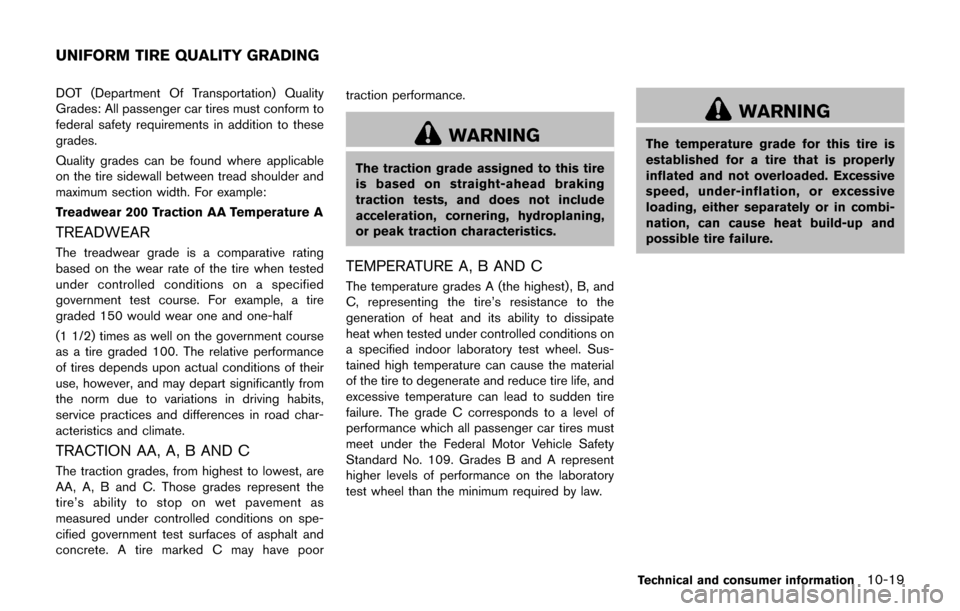
DOT (Department Of Transportation) Quality
Grades: All passenger car tires must conform to
federal safety requirements in addition to these
grades.
Quality grades can be found where applicable
on the tire sidewall between tread shoulder and
maximum section width. For example:
Treadwear 200 Traction AA Temperature A
TREADWEAR
The treadwear grade is a comparative rating
based on the wear rate of the tire when tested
under controlled conditions on a specified
government test course. For example, a tire
graded 150 would wear one and one-half
(1 1/2) times as well on the government course
as a tire graded 100. The relative performance
of tires depends upon actual conditions of their
use, however, and may depart significantly from
the norm due to variations in driving habits,
service practices and differences in road char-
acteristics and climate.
TRACTION AA, A, B AND C
The traction grades, from highest to lowest, are
AA, A, B and C. Those grades represent the
tire’s ability to stop on wet pavement as
measured under controlled conditions on spe-
cified government test surfaces of asphalt and
concrete. A tire marked C may have poortraction performance.
WARNING
The traction grade assigned to this tire
is based on straight-ahead braking
traction tests, and does not include
acceleration, cornering, hydroplaning,
or peak traction characteristics.
TEMPERATURE A, B AND C
The temperature grades A (the highest) , B, and
C, representing the tire’s resistance to the
generation of heat and its ability to dissipate
heat when tested under controlled conditions on
a specified indoor laboratory test wheel. Sus-
tained high temperature can cause the material
of the tire to degenerate and reduce tire life, and
excessive temperature can lead to sudden tire
failure. The grade C corresponds to a level of
performance which all passenger car tires must
meet under the Federal Motor Vehicle Safety
Standard No. 109. Grades B and A represent
higher levels of performance on the laboratory
test wheel than the minimum required by law.
WARNING
The temperature grade for this tire is
established for a tire that is properly
inflated and not overloaded. Excessive
speed, under-inflation, or excessive
loading, either separately or in combi-
nation, can cause heat build-up and
possible tire failure.
Technical and consumer information10-19
UNIFORM TIRE QUALITY GRADING
Page 412 of 416

S
SafetyChild seat belts .................................................... 1-16
Reporting safety defects ................................. 10-20
Seat adjustment Front manual seat adjustment ............................. 1-3
Front seats ............................................................... 1-3
Seat belt(s) Child safety ........................................................... 1-16
Infants ..................................................................... 1-17
Injured persons .................................................... 1-12
Larger children ..................................................... 1-17
Precautions on seat belt usage ....................... 1-10
Pregnant women .................................................. 1-12
Seat belt cleaning .................................................. 7-7
Seat belt extenders ............................................. 1-15
Seat belt hooks .................................................... 1-15
Seat belt maintenance ....................................... 1-15
Seat belt warning light ....................................... 2-20
Seat belts .............................................................. 1-10
Seat belts with pretensioners .......................... 1-52
Shoulder belt height adjustment ..................... 1-14
Small children ....................................................... 1-17
Three-point type .................................................. 1-12
Seat(s) Heated seats ........................................................ 2-45
Seats .......................................................................... 1-2
Security system (NISSAN Vehicle Immobilizer
System) , Engine start ................................................ 2-34
Security system, Vehicle security system ............. 2-33
Servicing air conditioner ........................................... 4-35
Setting climate eco .................................................... 4-34
Shift lever Shift lock release ................................................. 5-18
Shift lock release Transmission ......................................................... 5-18 Shifting
CVT (Continuously Variable Transmission) .... 5-14
Manual transmission ........................................... 5-19
Shoulder belt height adjustment, For
front seats .................................................................... 1-14
Siri
ŠEyes Free ............................................................ 4-76
SOURCE select switch ............................................ 4-73
Spare tire .......................................................... 8-41, 10-9
Spark plugs .................................................................. 8-13
Speedometer ................................................................. 2-7
Standard maintenance ................................................ 9-7
Starting Before starting the engine ................................ 5-12
Jump starting ........................................................... 6-9
Precautions when starting and driving ............. 5-2
Push starting ......................................................... 6-11
Starting the engine ............................................. 5-13
Status light, Front passenger air bag .................... 1-46
Steering Electric power steering ...................................... 5-34
Steering wheel switch for audio controls ..... 4-73
Tilting steering column ....................................... 3-20
Storage ......................................................................... 2-47
Sun visors ..................................................................... 3-21
Supplemental air bag warning labels .................... 1-54
Supplemental air bag warning light ........... 1-54, 2-20
Supplemental restraint system ................................ 1-38 Precautions on supplemental
restraint system .................................................... 1-38
Switch Audio control steering wheel switch .............. 4-73
Autolight switch ................................................... 2-40
Fog light switch ................................................... 2-44
Hazard warning flasher switch ............................ 6-2
Headlight switch .................................................. 2-40
Power door lock switch ........................................ 3-5 Rear window and outside mirror
defroster switch ................................................... 2-38
Turn signal switch ................................................ 2-43
Vehicle dynamic control (VDC) off switch .... 2-44T
Tachometer ..................................................................... 2-9
Temperature display ................................................... 2-12
Temperature gauge, Engine coolant
temperature gauge ..................................................... 2-10
Text messaging ........................................................... 4-93
Theft (NISSAN Vehicle Immobilizer System) ,
Engine start .................................................................. 2-34
Three-way catalyst ....................................................... 5-3
Tilt steering column .................................................... 3-20
Tire pressure, Low tire pressure warning light .... 2-18
Tires
Flat tire ...................................................................... 6-3
Low tire pressure warning system ..................... 5-3
Tire and Loading information label .... 8-30, 10-12
Tire chains ............................................................. 8-37
Tire dressing ............................................................ 7-4
Tire pressure ......................................................... 8-28
Tire pressure monitoring
system (TPMS) .............................................. 5-3, 6-3
Tire rotation ........................................................... 8-38
Types of tires ........................................................ 8-36
Uniform tire quality grading ............................. 10-19
Wheel/tire size ..................................................... 10-9
Wheels and tires ................................................. 8-28
Tonneau cover (see cargo cover) .......................... 2-49
Touch screen ................................................................. 4-4
Towing Flat towing ........................................................... 10-18
Tow truck towing ................................................. 6-13
Towing a trailer ................................................... 10-18
11-5
Page 413 of 416

11-6
TPMS, Tire pressure monitoring system ................ 5-3
TPMS, Tire pressure warning system ..................... 6-3
Trailer towing ............................................................ 10-18
TransmissionContinuously Variable Transmission
(CVT) fluid ................................................................ 8-8
Driving with CVT (Continuously
Variable Transmission) ....................................... 5-14
Driving with manual transmission .................... 5-19
Transmission shift lever lock release .............. 5-18
Transmitter, With Intelligent Key system
(See Intelligent Key system) .................................... 3-12
Traveling or registering in another country........ 10-10
Trip computer .............................................................. 2-13
Turn signal switch ....................................................... 2-43
U
Underbody cleaning ..................................................... 7-3
Uniform tire quality grading ................................... 10-19
USB (Universal Serial Bus)
connection port ............................................... 4-57, 4-67
V
Vanity mirror ................................................................. 3-23
Variable voltage control system .............................. 8-12
Vehicle Dimensions and weights ................................. 10-10
Identification number (VIN) ............................. 10-11
Information display.................................... 2-11, 2-12
Loading information .......................................... 10-15
Recovery (freeing a stuck vehicle) .................. 6-15
Security system .................................................... 2-33
Vehicle dynamic control (VDC) off switch .... 2-44
Vehicle dynamic control (VDC) system ......... 5-37
Ventilators ..................................................................... 4-27 Voice command .......................................................... 4-91
Voice Prompt Interrupt .............................................. 4-91
W
Warning
Hazard warning flasher switch ............................ 6-2
Lights ...................................................................... 2-16
Tire pressure monitoring
system (TPMS) .............................................. 5-3, 6-3
Warning lights, indicator lights and
audible reminders ................................................ 2-15
Warning labels, Air bag warning labels ................ 1-54
Warning light Air bag warning light ............................... 1-54, 2-20
Anti-lock braking system (ABS)
warning light ......................................................... 2-16
AWD warning light .............................................. 5-31
Brake warning light ............................................. 2-16
Door open warning light .................................... 2-17
Electric power steering warning light ............. 2-17
Intelligent Key system warning light ............... 2-18
Low fuel warning light ........................................ 2-18
Low tire pressure warning light ....................... 2-18
Seat belt warning light ....................................... 2-20
Warranty, Emission control system warranty .... 10-20
Washer switch Rear window wiper and washer switch ........ 2-37
Wiper and washer switch ................................. 2-36
Washing .......................................................................... 7-2
Waxing ............................................................................ 7-3
Weights (See dimensions and weights) ........... 10-10
Wheel/tire size ............................................................ 10-9
Wheels and tires ........................................................ 8-28 Care of wheels ........................................................ 7-4
Cleaning aluminum alloy wheels ......................... 7-4
Window washer fluid ................................................... 8-9 Window(s)
Cleaning .................................................................... 7-3
Power windows .................................................... 2-50
Wiper Rear window wiper and washer switch ........ 2-37
Rear window wiper blade ................................. 8-16
Wiper and washer switch ................................. 2-36
Wiper blades ........................................................ 8-15
Wiper and washer switch ........................................ 2-36
X
Xenon headlights ........................................................ 2-39
Page 415 of 416
FUEL INFORMATION:
Except for NISMO RS models:
NISSAN recommends the use of unleaded
premium gasoline with an octane rating of at
least 91 AKI (Anti-Knock Index) number (Re-
search octane number 96) .
If unleaded premium gasoline is not available,
you may use unleaded regular gasoline with an
octane rating of at least 87 AKI number
(Research octane number 91) , but you may
notice a decrease in performance.
For NISMO RS models:
Use unleaded premium gasoline with an octane
rating of at least 91 AKI (Anti-Knock Index)
number (Research octane number 96) .
If unleaded premium gasoline is not available,
unleaded regular gasoline with an octane rating
of at least 87 AKI number (Research octane
number 91) may be temporarily used, but only
under the following precautions:
.Have the fuel tank filled only partially with
unleaded regular gasoline, and fill up with
unleaded premium gasoline as soon as
possible.
. Avoid full throttle driving and abrupt accel-
eration. Use unleaded premium gasoline for max-
imum vehicle performance.
CAUTION
.
Using a fuel other than that speci-
fied could adversely affect the emis-
sion control system, and may also
affect warranty coverage.
. Under no circumstances should a
leaded gasoline be used, because
this will damage the three-way cat-
alyst.
. Do not use E-15 or E-85 fuel in your
vehicle. Your vehicle is not designed
to run on E-15 or E-85 fuel. Using E-
15 or E-85 fuel in a vehicle not
specifically designed for E-15 or E-
85 fuel can adversely affect the
emission control devices and sys-
tems of the vehicle. Damage caused
by such fuel is not covered by the
NISSAN new vehicle limited war-
ranty.
. U.S. government regulations require
ethanol dispensing pumps to be
identified by a small, square, orange and black label with the common
abbreviation or the appropriate per-
centage for that region.
For additional information, see “Capacities and
recommended fluids/lubricants” (P.10-2) .
ENGINE OIL RECOMMENDATION:
For NISMO RS models:
. Genuine “Nissan Motor Oil 5W-30 SN”
Except for NISMO RS models:
. Genuine “Nissan Motor Oil 0W-20 SN”
See “Capacities and recommended fluids/lubri-
cants” (P.10-2) for engine oil and oil filter
recommendation.
COLD TIRE PRESSURES:
The label is typically located on the driver side
center pillar. For additional information, see
“Wheels and tires” (P.8-28).
NEW VEHICLE BREAK-IN PROCE-
DURES RECOMMENDATION:
During the first 1,200 miles (2,000 km) of
vehicle use, follow the recommendations out-
lined in the “Break-in schedule” (P.5-27) of this
Owner’s Manual. Follow these recommenda-
tions for the future reliability and economy of
your new vehicle.
GAS STATION INFORMATION