2017 NISSAN JUKE fuel type
[x] Cancel search: fuel typePage 93 of 416

2-14Instruments and controls
JVI1327X
Type A (if so equipped)
SIC4600Type B (if so equipped)
Torque vectoring AWD (AWD model)
The Torque vectoring mode shows the current
amount of torque distributed to each wheel.
Each torque indicator is displayed as a bar
graph
*1divided into 3 segments. The upper
indicator displays the current amount of torque
distribution (left and right) for the front wheels.
The lower indicator displays the current amount
of torque distribution (left and right) for the rear
wheels. The number of segments shows the
amount of torque currently distributed to each
wheel.
Resetting displays
For Type A (if so equipped):
When the average fuel consumption or TRIP B
is displayed, push the trip computer mode
switch
*Afor longer than 3 seconds. The
average fuel consumption and trip odometer
(TRIP B only) displays will be reset at the same
time.
For Type B (if so equipped):
When the average fuel consumption, elapsed
time or TRIP B is displayed, push the trip
computer mode switch
*Afor longer than 3
seconds. The average fuel consumption,
elapsed time and trip odometer (TRIP B only)
displays will be reset at the same time.
Page 153 of 416
3-18Pre-driving checks and adjustments
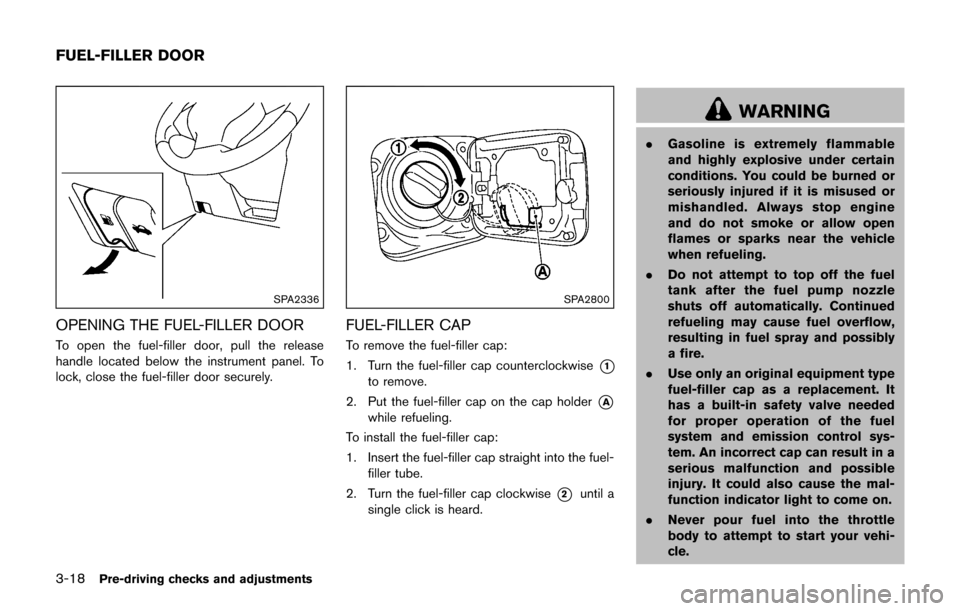
SPA2336
OPENING THE FUEL-FILLER DOOR
To open the fuel-filler door, pull the release
handle located below the instrument panel. To
lock, close the fuel-filler door securely.
SPA2800
FUEL-FILLER CAP
To remove the fuel-filler cap:
1. Turn the fuel-filler cap counterclockwise
*1
to remove.
2. Put the fuel-filler cap on the cap holder
*A
while refueling.
To install the fuel-filler cap:
1. Insert the fuel-filler cap straight into the fuel- filler tube.
2. Turn the fuel-filler cap clockwise
*2until a
single click is heard.
WARNING
. Gasoline is extremely flammable
and highly explosive under certain
conditions. You could be burned or
seriously injured if it is misused or
mishandled. Always stop engine
and do not smoke or allow open
flames or sparks near the vehicle
when refueling.
. Do not attempt to top off the fuel
tank after the fuel pump nozzle
shuts off automatically. Continued
refueling may cause fuel overflow,
resulting in fuel spray and possibly
a fire.
. Use only an original equipment type
fuel-filler cap as a replacement. It
has a built-in safety valve needed
for proper operation of the fuel
system and emission control sys-
tem. An incorrect cap can result in a
serious malfunction and possible
injury. It could also cause the mal-
function indicator light to come on.
. Never pour fuel into the throttle
body to attempt to start your vehi-
cle.
FUEL-FILLER DOOR
Page 259 of 416

4-100Heater, air conditioner, audio and phone systems
AUDIO SYSTEM VOICE COMMANDS
To access the audio system voice commands:
1. Push the
button.
2. Say “Audio”.
3. Speak a command from the following available commands:
. Play (AM, FM, etc.)
Allows user to select radio band
. Tune AM (number)
Allows user to tune directly to a desired AM
frequency
. Tune FM (number)
Allows user to tune directly to a desired FM
frequency
. SXM channel (number)
Allows user to tune directly to a desired
SXM station (if so equipped)
. CD Track (number)
Allows user to select track to be played
. Play Song (name)
Allows user to select song name to be
played
. Play Artist (name)
Allows user to select artist to be played
. Play Album (name)
Allows user to select album name to be
played For more information about the audio system,
see “FM-AM-SAT radio with Compact Disc (CD)
player (Type B)” (P.4-62) .INFORMATION VOICE COMMANDS
The following voice commands are available for
the information functions of the Navigation
System:
.
Traffic
. Fuel Prices
. Stocks
. Movie Listings
. Current Weather
. Weather Map
. 5 — day Forecast
. 6 — hour Forecast
For more information about these commands,
see the separate Navigation System Owner’s
Manual.
MY APPS VOICE COMMANDS
Many Apps can be accessed using this voice
command. See “NissanConnectSMApp smart-
phone integration” (P.4-75) .
HELP VOICE COMMANDS
The following voice commands can be spoken
to have the system provide instructions and tips
for using the NISSAN Voice Recognition sys-
tem.
. List Commands
. What Can I Say?
. General Help
. Quit
. Exit
TROUBLESHOOTING GUIDE
The system should respond correctly to all voice
commands without difficulty. If problems are
encountered, follow the solutions given in this
guide for the appropriate error. Where the
solutions are listed by number, try each solution
in turn, starting with number one, until the
problem is resolved.
Page 372 of 416

The following descriptions are provided to give
you a better understanding of the scheduled
maintenance items that should be regularly
checked or replaced. The maintenance sche-
dule indicates at which mileage/time intervals
each item requires service.
In addition to scheduled maintenance, your
vehicle requires that some items be checked
during normal day-to-day operation. Refer to
“General maintenance” (P.9-2) .
Items marked with “*” are recommended by
NISSAN for reliable vehicle operation. You are
not required to perform maintenance on these
items in order to maintain the warranties which
come with your vehicle. Other maintenance
items and intervals are required.
When applicable, additional information can be
found in the “8. Do-it yourself” section of this
manual.
NOTE:
NISSAN does not advocate the use of non-
OEM approved aftermarket flushing sys-
tems and strongly advises against per-
forming these services on a NISSAN
product. Many of the aftermarket flushing
systems use non-OEM approved chemicals
or solvents, the use of which has not been
validated by NISSAN.For recommended fuel, lubricants, fluids,
grease, and refrigerant, refer to
“Capaci-
ties and recommended fluids/lubricants”
(P.10-2) of this manual.
EMISSION CONTROL SYSTEM MAIN-
TENANCE
Drive belts*:
Check engine drive belts for wear, fraying or
cracking and for proper tension. Replace any
damaged drive belts.
Engine air filter:
Replace at specified intervals. When driving for
prolonged periods in dusty conditions, check/
replace the filter more frequently.
Engine coolant*:
Replace coolant at the specified interval. When
adding or replacing coolant, be sure to use only
Genuine NISSAN Long Life Antifreeze/Coolant
(blue) or equivalent with the proper mixture.
(Refer to “Engine cooling system” (P.8-4) to
determine the proper mixture for your area.)
NOTE:
Mixing any other type of coolant or the use
of non-distilled water may reduce the
recommended service interval of the cool-
ant. Engine oil and oil filter:
Replace engine oil and oil filter at the specified
intervals. For recommended oil grade and vis-
cosity refer to “Capacities and recommended
fluids/lubricants” (P.10-2) .
Engine valve clearance*:
Inspect only if valve noise increases.
Adjust valve clearance if necessary.
Evaporative emissions control vapor
lines*:
Check vapor lines for leaks or looseness.
Tighten connections or replace parts as neces-
sary.
Fuel filter
Periodic maintenance is not required (in-tank
type filter) .
Fuel lines*:
Check the fuel hoses, piping and connections
for leaks, looseness, or deterioration. Tighten
connections or replace parts as necessary.
Spark plugs:
Replace at specified intervals. Install new plugs
of the type as originally equipped.
Maintenance and schedules9-5
EXPLANATION OF SCHEDULED
MAINTENANCE ITEMS
Page 387 of 416

10-2Technical and consumer information
The following are approximate capacities. The actual refill capacities may be a little different. When refilling, follow the procedure
instructed in the “8. Do-it-yourself” section to determine the proper refill capacity.
Fluid typeCapacity (Approximate)
Recommended Fluids/Lubricants
Metric
Measure US
Measure Imperial
Measure
Fuel 2WD model 50 13-1/4 gal 11 galÂSee “Fuel information” (P.10-4).
AWD model 45 11-7/8 gal 9-7/8 gal
Engine oil
*1With oil filter change For NISMO RS model 4.3 4-1/2 qt 3-3/4 qt For NISMO RS models
ÂGenuine “Nissan Motor Oil 5W-30 SN” is recommended.
 If the above motor oil is not available, use an equivalent motor oil that matches the above
grade and viscosity. For additional information, see “Engine oil and oil filter recommendation”
(P.10-7).
Except for NISMO RS models
ÂGenuine “Nissan Motor Oil 0W-20 SN” is recommended.
 If the above motor oil is not available, use an equivalent motor oil that matches the above
grade and viscosity. For additional information, see “Engine oil and oil filter recommendation”
(P.10-7).
Drain and refill
*1: For additional in-
formation, see
“Changing engine
oil and filter” (P.8-6). Except for NISMO RS model 4.5 4-3/4 qt 4 qt
Without oil filter
change For NISMO RS model
4.1 4-3/8 qt 3-5/8 qt
Except for NISMO RS model 4.3 4-1/2 qt 3-3/4 qt
Engine coolant With reservoir For NISMO RS modelCVT model 8.1 8-5/8 qt 7-1/8 qt
ÂPre-diluted Genuine NISSAN Long Life Antifreeze/Coolant (blue) or equivalent
MT model 7.9 8-3/8 qt 7 qt
Except for
NISMO RS
model CVT model 8.7 9-1/4 qt 7-5/8 qt
MT model 8.5 8-3/8 qt 7 qt
Reservoir 0.6 5/8 qt 1/2 qt
Continuously Variable Transmission (CVT) fluid — — — For NISMO RS models
ÂGenuine NISSAN CVT Fluid NS-2
 NISSAN recommends using Genuine NISSAN CVT Fluid NS-2 (or equivalent) ONLY in
NISSAN CVTs. Do not mix with other fluids. Using fluids that are not equivalent to Genuine
NISSAN CVT Fluid NS-2 may damage the CVT. Damage caused by the use of fluids other
than as recommended is not covered under NISSAN’s New Vehicle Limited Warranty.
Except for NISMO RS models
ÂGenuine NISSAN CVT Fluid NS-3
 NISSAN recommends using Genuine NISSAN CVT Fluid NS-3 (or equivalent) ONLY in
NISSAN CVTs. Do not mix with other fluids. Using fluids that are not equivalent to Genuine
NISSAN CVT Fluid NS-3 may damage the CVT. Damage caused by the use of fluids other
than as recommended is not covered under NISSAN’s New Vehicle Limited Warranty.
CAPACITIES AND RECOMMENDED
FLUIDS/LUBRICANTS
Page 392 of 416

JVT0159X
For NISMO RS models
JVT0351X
Except for NISMO RS models
*1API certification mark
*2API service symbol
ENGINE OIL AND OIL FILTER RE-
COMMENDATION
Selecting the correct oil
It is essential to choose the correct grade,
quality, and viscosity engine oil to ensure
satisfactory engine life and performance, see
“Capacities and recommended fluids/lubricants”
(P.10-2) . NISSAN recommends the use of an
energy conserving oil in order to improve fuel
economy.
Select only engine oils that meet the American
Petroleum Institute (API) certification or Interna-
tional Lubricant Standardization and Approval
Committee (ILSAC) certification and SAE vis-
cosity standard. These oils have the API
certification mark on the front of the container.
Oils which do not have the specified quality
label should not be used as they could cause
engine damage.
Oil additives
NISSAN does not recommend the use of oil
additives. The use of an oil additive is not
necessary when the proper oil type is used and
maintenance intervals are followed.
Oil which may contain foreign matter or has
been previously used should not be used.
Technical and consumer information10-7
Page 395 of 416
![NISSAN JUKE 2017 F15 / 1.G Owners Manual 10-10Technical and consumer information
Tire
TypeSizePressure
PSI (kPa)
[Cold]
Conven-
tional P215/55-
R17 93V33 (230)*1
36 (250)*2
35 (240)*3
NISMO
models 225/45R18
95Y 33 (230)*1
35 (240)*3
Spare T1](/manual-img/5/527/w960_527-394.png "NISSAN JUKE 2017 F15 / 1.G Owners Manual 10-10Technical and consumer information
Tire
TypeSizePressure
PSI (kPa)
[Cold]
Conven-
tional P215/55-
R17 93V33 (230)*1
36 (250)*2
35 (240)*3
NISMO
models 225/45R18
95Y 33 (230)*1
35 (240)*3
Spare T1")
10-10Technical and consumer information
Tire
TypeSizePressure
PSI (kPa)
[Cold]
Conven-
tional P215/55-
R17 93V33 (230)*1
36 (250)*2
35 (240)*3
NISMO
models 225/45R18
95Y 33 (230)*1
35 (240)*3
Spare T135/80-
D16
101M*1*2
60 (420)
T135/90-
D16
102M*3
NISMO RS
models T135/70-
D17 92M
*1: 2WD MT model
*2: 2WD CVT model
*3: AWD model
DIMENSIONS AND WEIGHTS
Overall length in (mm) 162.8 (4,135)*1 162.4 (4,125)*2
164.0 (4,165)*3
163.8 (4,160)*4
Overall width in (mm) 69.5 (1,765) 69.7(1,770)*5
Overall height in (mm) 61.8 (1,570)
Front tread in (mm) 60.0 (1,525)
Rear tread in (mm) 60.0 (1,525)*6 59.3 (1,505)*7
Wheelbase in (mm) 99.6 (2,530)
Gross Vehicle
Weight Rating
(GVWR) lb (kg)
See the F.M.V.S.S. or
C.M.V.S.S. certification
label on the driver’s
side center pillar.
Gross Axle
Weight Rating
(GAWR)
Front lb (kg)
Rear lb (kg)
*1: With front license plate bracket
*2: Without front license plate bracket
*3: With front license plate bracket (NISMO mod- els)
*4: Without front license plate bracket (NISMO models)
*5: NISMO models
*6: for 2WD model
*7: for AWD model
When planning to travel in another coun-
try, you should first find out if the fuel available is
suitable for your vehicle’s engine.
Using fuel with an octane rating that is too low
may cause engine damage. All gasoline vehicles
must be operated with unleaded gasoline.
Therefore, avoid taking your vehicle to areas
where appropriate fuel is not available.
When transferring the registration of your
vehicle to another country, state, province
or district, it may be necessary to modify the
vehicle to meet local laws and regulations.
The laws and regulations for motor vehicle
emission control and safety standards vary
according to the country, state, province or
district; therefore, vehicle specifications may
differ.
When any vehicle is to be taken into
another country, state, province or district
and registered, its modifications, transpor-
tation, and registration are the responsi-
bility of the user. NISSAN is not
responsible for any inconvenience that
may result.
WHEN TRAVELING OR
REGISTERING IN ANOTHER
COUNTRY
Page 409 of 416

11-2
Corrosion protection .................................................... 7-7
Cover, Cargo cover ................................................... 2-49
Cruise control .............................................................. 5-26
Cup holders ................................................................. 2-47
CVT, Driving with CVT (Continuously
Variable Transmission) .............................................. 5-14
D
Daytime running light system .................................. 2-42
Defroster switch, Rear window and outside
mirror defroster switch .............................................. 2-38
Dimensions and weights ....................................... 10-10
Displaying Climate control ....................................... 4-34
Door open warning light ........................................... 2-17
Drive belt ...................................................................... 8-12
DrivingAll-wheel drive (AWD) ....................................... 5-29
Cold weather driving .......................................... 5-39
Driving with CVT (Continuously
Variable Transmission) ....................................... 5-14
Driving with manual transmission .................... 5-19
Precautions when starting and driving ............. 5-2
Safety precautions ................................................. 5-7
E
Economy, Fuel ............................................................. 5-29
Elapsed time .................................................... 2-13, 2-30
Electric power steering ............................................. 5-34
Electric power steering warning light .................... 2-17
Emission control information label ...................... 10-12
Emission control system maintenance .................... 9-8
Emission control system warranty ....................... 10-20
EngineBefore starting the engine ................................ 5-12
Break-in schedule ................................................ 5-27 Capacities and
recommended fluids/lubricants ........................ 10-2
Changing engine coolant ..................................... 8-5
Changing engine oil and filter ............................. 8-6
Checking engine coolant level ............................ 8-5
Checking engine oil level ..................................... 8-5
Coolant temperature gauge .............................. 2-10
Emergency engine shut off ...................... 5-11, 6-3
Engine block heater ............................................ 5-40
Engine compartment check locations ............... 8-3
Engine cooling system .......................................... 8-4
Engine oil .................................................................. 8-5
Engine oil and oil filter recommendation ....... 10-7
Engine oil viscosity .............................................. 10-8
Engine serial number ........................................ 10-11
Engine specifications .......................................... 10-9
High temperature warning light ....................... 2-18
If your vehicle overheats .................................... 6-11
Starting the engine ............................................. 5-13
Event Data Recorders (EDR) ............................... 10-22
Exhaust gas (carbon monoxide) ............................... 5-2
Explanation of scheduled maintenance items ....... 9-5
Extended storage fuse warning ................................ 2-9
F
F.M.V.S.S./C.M.V.S.S. certification label ............ 10-12
Filter Air cleaner housing filter .................................... 8-14
Changing engine oil and filter ............................. 8-6
Flashers (See hazard warning flasher switch) ...... 6-2
Flat tire ............................................................................ 6-3
Flat towing ................................................................. 10-18
Floor mat cleaning ........................................................ 7-5
Fluid Brake and clutch fluid ........................................... 8-9 Capacities and
recommended fluids/lubricants ........................ 10-2
Continuously Variable Transmission
(CVT) fluid ................................................................ 8-8
Engine coolant ........................................................ 8-4
Engine oil .................................................................. 8-5
Window washer fluid ............................................. 8-9
FM-AM radio with Compact Disc (CD) player .... 4-45
FM-AM-SAT radio with Compact Disc (CD)
player (Type A) ............................................................ 4-53
FM-AM-SAT radio with Compact Disc (CD)
player (Type B) ............................................................ 4-62
Fog light switch .......................................................... 2-44
Front manual seat adjustment ................................... 1-3
Front passenger air bag and status light ............. 1-46
Front seat, Front seat adjustment ............................ 1-3
Front-seat active head restraints .............................. 1-9
Fuel Capacities and
recommended fluids/lubricants ........................ 10-2
Distance to empty ............................................... 2-13
Fuel economy ....................................................... 5-29
Fuel information .................................................... 10-4
Fuel octane rating ............................................... 10-4
Fuel-filler cap ........................................................ 3-18
Fuel-filler door ...................................................... 3-18
Gauge ..................................................................... 2-11
Fuel Efficient Driving Tips ........................................ 5-28
Fuses ............................................................................. 8-17
Fusible links ................................................................. 8-18
G
Gas cap ........................................................................ 3-18
Gauge .............................................................................. 2-5 Engine coolant temperature gauge ................ 2-10
Fuel gauge ............................................................ 2-11