2017 NISSAN JUKE clutch
[x] Cancel search: clutchPage 288 of 416
accelerator pedal. Your vehicle will maintain the
set speed.
.To pass another vehicle, depress the
accelerator pedal. When you release the
pedal, the vehicle will return to the previously
set speed.
. The vehicle may not maintain the set speed
on winding or hilly roads. If this happens,
drive without the cruise control.
To cancel the preset speed, use one of the
following methods:
a) Push the CANCEL switch.
b) Tap the brake pedal.
c) Turn the MAIN switch off. The CRUISE indicator light will turn off.
.If you depress the brake pedal while pushing
the ACCEL/RES or COAST/SET switch and
reset at the cruising speed, the cruise
control will disengage. Turn the MAIN switch
off once and then turn it on again.
. The cruise control will automatically cancel if
the vehicle slows more than 8 MPH (13
km/h) below the set speed.
. If you move the shift lever to the N (Neutral)
position (Continuously Variable Transmis-
sion models) or depressing the clutch pedal
(Manual Transmission models) , the cruise
control will be canceled. To reset at a faster cruising speed,
use one
of the following methods:
. Depress the accelerator pedal. When the
vehicle attains the desired speed, push and
release the COAST/SET switch.
. Push and hold the ACCEL/RES switch.
When the vehicle attains the desired speed,
release the switch.
. Push, then quickly release the ACCEL/RES
switch. Each time you do this, the set speed
will increase by about 1 MPH (1.6 km/h) .
To reset at a slower cruising speed, use one
of the following methods:
. Lightly tap the brake pedal. When the
vehicle attains the desired speed, push the
COAST/SET switch and release it.
. Push and hold the COAST/SET switch.
Release the switch when the vehicle slows
down to the desired speed.
. Push, then quickly release the COAST/SET
switch. Each time you do this, the set speed
will decrease by about 1 MPH (1.6 km/h) .
To resume the preset speed, push and
release the ACCEL/RES switch. The vehicle
will resume the last set cruising speed when the
vehicle speed is over 25 MPH (40 km/h) .
CAUTION
During the first 1,200 miles (2,000 km) ,
follow these recommendations to ob-
tain maximum engine performance and
ensure the future reliability and econo-
my of your new vehicle. Failure to
follow these recommendations may
result in shortened engine life and
reduced engine performance.
. Avoid driving for long periods at constant
speed, either fast or slow. Do not run the
engine over 4,000 rpm.
. Do not accelerate at full throttle in any gear.
. Avoid quick starts.
. Avoid hard braking as much as possible.
Starting and driving5-27
BREAK-IN SCHEDULE
Page 326 of 416

8 Do-it-yourself
Maintenance precautions ........................................................ 8-2
Engine compartment check locations .................................. 8-3MR16DDT engine ............................................................... 8-3
Engine cooling system ............................................................. 8-4 Checking engine coolant level ......................................... 8-5
Changing engine coolant .................................................. 8-5
Engine oil ........................................................................\
............ 8-5 Checking engine oil level .................................................. 8-5
Changing engine oil and filter .......................................... 8-6
Continuously Variable Transmission (CVT) fluid ............... 8-8
For NISMO RS models ..................................................... 8-8
Except for NISMO RS models ........................................ 8-8
Brake and clutch (if so equipped) fluid ............................... 8-9
Window washer fluid ............................................................... 8-9
Battery ........................................................................\
............... 8-10 Jump starting ..................................................................... 8-12
Variable voltage control system .......................................... 8-12
Drive belt ........................................................................\
.......... 8-12
Spark plugs ........................................................................\
..... 8-13 Replacing spark plugs .................................................... 8-13
Air cleaner ........................................................................\
........ 8-14 Windshield wiper blades ..................................................... 8-15
Cleaning ........................................................................\
... 8-15
Replacing ........................................................................\
. 8-15
Rear window wiper blade ................................................... 8-16
Brakes ........................................................................\
.............. 8-16 Self-adjusting brakes .................................................... 8-16
Brake pad wear warning .............................................. 8-16
Fuses ........................................................................\
................ 8-17 Engine compartment ..................................................... 8-17
Passenger compartment .............................................. 8-19
Intelligent Key battery replacement ................................... 8-20
Lights ........................................................................\
................ 8-23 Headlights ........................................................................\
8-23
Exterior and interior lights ............................................ 8-26
Wheels and tires ................................................................... 8-28 Tire pressure ................................................................... 8-28
Tire labeling ..................................................................... 8-34
Types of tires ................................................................... 8-36
Tire chains ....................................................................... 8-37
Changing wheels and tires .......................................... 8-38
Page 328 of 416

improper servicing may result in operating
difficulties or excessive emissions, and could
affect your warranty coverage.If in doubt
about any servicing, it is recommended
you have it done by a NISSAN dealer.
JVC0747X
MR16DDT ENGINE
1. Engine oil filler cap
2. Radiator filler cap
3. Brake and clutch* fluid reservoir
4. Air cleaner
5. Window washer fluid reservoir
6. Engine drive belt location 7. Engine oil dipstick
8. Engine coolant reservoir
9. Fuse/fusible link holder
10. Battery
*: for Manual Transmission (MT) models
Do-it-yourself8-3
ENGINE COMPARTMENT CHECK
LOCATIONS
Page 334 of 416
For additional brake and clutch fluid information,
see “Capacities and recommended fluids/lubri-
cants” (P.10-2) of this manual.
WARNING
.Use only new fluid from a sealed
container. Old, inferior or contami-
nated fluid may damage the brake
and clutch systems. The use of
improper fluids can damage the
brake and clutch systems, and affect
the vehicle’s stopping ability.
. Clean the filler cap before removing.
. Brake and clutch fluid is poisonous
and should be stored carefully in
marked containers out of the reach
of children.
CAUTION
Do not spill the fluid on any painted
surfaces. This will damage the paint. If
fluid is spilled, immediately wash the
surface with water.
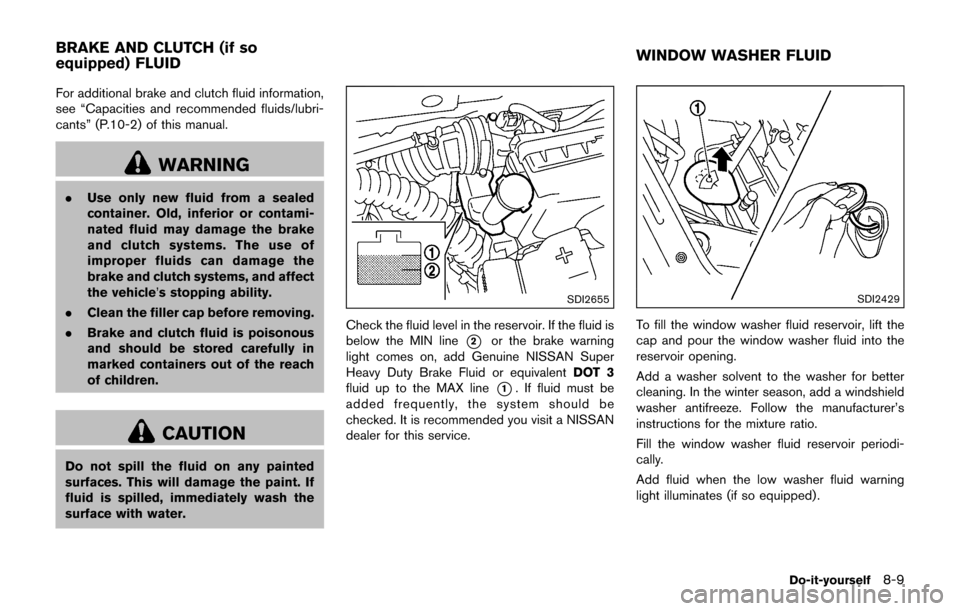
SDI2655
Check the fluid level in the reservoir. If the fluid is
below the MIN line
*2or the brake warning
light comes on, add Genuine NISSAN Super
Heavy Duty Brake Fluid or equivalent DOT 3
fluid up to the MAX line
*1. If fluid must be
added frequently, the system should be
checked. It is recommended you visit a NISSAN
dealer for this service.
SDI2429
To fill the window washer fluid reservoir, lift the
cap and pour the window washer fluid into the
reservoir opening.
Add a washer solvent to the washer for better
cleaning. In the winter season, add a windshield
washer antifreeze. Follow the manufacturer’s
instructions for the mixture ratio.
Fill the window washer fluid reservoir periodi-
cally.
Add fluid when the low washer fluid warning
light illuminates (if so equipped) .
Do-it-yourself8-9
BRAKE AND CLUTCH (if so
equipped) FLUID WINDOW WASHER FLUID
Page 371 of 416

9-4Maintenance and schedules
hard steering or strange noises.
Warning lights and chimes:Make sure that
all warning lights and chimes are operating
properly.
Windshield defroster: Check that the air
comes out of the defroster outlets properly and
in sufficient quantity when operating the heater
or air conditioner.
Windshield wiper and washer*: Check that
the wipers and washers operate properly and
that the wipers do not streak.
Under the hood and vehicle
The maintenance items listed here should be
checked periodically (for example, each time you
check the engine oil or refuel) .
Battery*: Check the fluid level in each cell.
It should be between the MAX and MIN lines.
Vehicles operated in high temperatures or under
severe condition require frequent checks of the
battery fluid level.
NOTE:
Care should be taken to avoid situations
that can lead to potential battery discharge
and potential no-start conditions such as:
1. Installation or extended use of electro-
nic accessories that consume battery
power when the engine is not running (Phone chargers, GPS, DVD players,
etc.)
2. Vehicle is not driven regularly and/or
only driven short distances.
In these cases, the battery may need to be
charged to maintain battery health.
Brake and clutch fluid level*: Make sure that
the brake and clutch fluid level is between the
MAX and MIN lines on the reservoir.
Engine coolant level*: Check the coolant level
when the engine is cold.
Engine drive belt*: Make sure that the drive
belt is not frayed, worn, cracked or oily.
Engine oil level*: Check the level after parking
the vehicle on a level surface and turning off the
engine. Wait more than 10 minutes for the oil to
drain back into the oil pan.
Exhaust system: Make sure there are no loose
supports, cracks or holes. If the sound of the
exhaust seems unusual or there is a smell of
exhaust fumes, immediately have the exhaust
system inspected. It is recommended you visit a
NISSAN dealer for this service. (See “Precau-
tions when starting and driving” (P.5-2) for
exhaust gas (carbon monoxide) .)
Fluid leaks: Check under the vehicle for fuel,
oil, water or other fluid leaks after the vehicle has
been parked for a while. Water dripping from the air conditioner after use is normal. If you should
notice any leaks or if gasoline fumes are evident,
check for the cause and have it corrected
immediately.
Radiator and hoses:
Check the front of the
radiator and clean off any dirt, insects, leaves,
etc., that may have accumulated. Make sure the
hoses have no cracks, deformation, rot or loose
connections.
Underbody: The underbody is frequently ex-
posed to corrosive substances such as those
used on icy roads or to control dust. It is very
important to remove these substances, other-
wise rust will form on the floor pan, frame, fuel
lines and around the exhaust system. At the end
of winter, the underbody should be thoroughly
flushed with plain water, being careful to clean
those areas where mud and dirt may accumu-
late. For additional information, see “Cleaning
exterior” (P.7-2).
Windshield washer fluid*: Check that there is
adequate fluid in the reservoir.
Page 373 of 416

9-6Maintenance and schedules
CHASSIS AND BODY MAINTENANCE
Brake lines and cables:
Visually inspect for proper installation. Check for
chafing, cracks, deterioration, and signs of
leaking. Replace any deteriorated or damaged
parts immediately.
Brake pads and rotors:
Check for wear, deterioration and fluid leaks.
Replace any deteriorated or damaged parts
immediately.
Exhaust system:
Visually inspect the exhaust pipes, muffler and
hangers for leaks, cracks, deterioration, and
damage. Tighten connections or replace parts
as necessary.
In-cabin microfilter:
Replace at specified intervals. When driving for
prolonged periods in dusty conditions, replace
the filter more frequently.
Propeller shaft(s):
Check for damage, looseness, and grease
leakage. (AWD)
Steering gear and linkage, axle and sus-
pension parts, drive shaft boots:
Check for damage, looseness, and leakage of oil
or grease. Under severe driving conditions,
inspect more frequently.Tire rotation:
Tires should be rotated every 5,000 miles
(8,000 km) according to the instructions under
“Explanation of general maintenance items”
(P.9-2) . When rotating tires, check for damage
and uneven wear. Replace if necessary.
Transmission fluid/oil, differential oil and
transfer case oil:
Visually inspect for signs of leakage at specified
intervals.
If using a car-top carrier, or driving on rough or
muddy roads:
.
Replace the manual transmission gear oil
every 20,000 miles (32,000 km) or 24
months.
. Replace the CVT fluid every 60,000 miles
(96,000 km) or request the dealer to inspect
the fluid deterioration data using a CON-
SULT. If the deterioration data is more than
210,000, replace the CVT fluid.
Off-road maintenance:
Check the following items frequently whenever
you drive off-road through deep sand, mud or
water:
. Brake pads and rotors
. Brake linings and drums .
Brake lines and hoses
. Differential, transmission and transfer case
oil
. Steering linkage
. Propeller shaft(s) and front drive shafts
. Engine air filter
. Clutch housing drain (AWD only)
Page 388 of 416

Fluid typeCapacity (Approximate)
Recommended Fluids/Lubricants
Metric
Measure US
Measure Imperial
Measure
Manual Transmission (MT) gear oil — — — For NISMO RS models
ÂGenuine NISSAN Manual Transmission Fluid (MTF) HQ Multi 75W-85 or equivalent
 If Genuine NISSAN Manual Transmission Fluid (MTF) HQ Multi is not available, API GL-4,
Viscosity SAE 75W-85 may be used as a temporary replacement. However, use Genuine
NISSAN Manual Transmission Fluid (MTF) HQ Multi as soon as it is available.
Except for NISMO RS models
ÂGenuine NISSAN Manual Transmission Fluid (MTF) TL/JR Type 75W-80 or equivalent
 If Genuine NISSAN Manual Transmission Fluid (MTF) TL/JR Type is not available, API GL-4+,
Viscosity SAE 75W-80 may be used as a temporary replacement. However, use Genuine
NISSAN Manual Transmission Fluid (MTF) TL/JR Type as soon as it is available.
Differential gear oil — — —ÂGenuine NISSAN Differential Oil Hypoid Super GL-5 80W-90 or equivalent conventional
(non-synthetic) oil
Transfer fluid — — —
Brake and clutch fluid Refill to the proper oil level according
to the instructions in the “8. Do-it-
yourself” section. Â
Genuine NISSAN Super Heavy Duty Brake Fluid
*6or equivalent DOT 3*6: Available in mainland U.S.A. through a NISSAN dealer.
Multi-purpose grease — — —ÂNLGI No. 2 (Lithium soap base)
Air conditioning system refrigerant — — —ÂFor additional information, see “Vehicle identification” (P.10-11) for air conditioner
specification label.
 HFC-134a (R-134a)
Air conditioning system lubricants — — —ÂNISSAN A/C System Oil Type R or exact equivalent
Window washer fluid 4.5 1-1/4 gal 1 galÂGenuine NISSAN Windshield Washer Concentrate Cleaner & Antifreeze or equivalent
Technical and consumer information10-3
Page 408 of 416

11 Index
A
ABS (Anti-lock Braking System) ............................ 5-36
Adjusting the screen .................................................. 4-11
Advanced air bag system ......................................... 1-44
Air bag systemAdvanced air bag system .................................. 1-44
Front passenger air bag and status light ...... 1-46
Front-seat mounted side-impact
supplemental air bag system ............................ 1-51
Roof-mounted curtain side-impact
supplemental air bag system ............................ 1-51
Air bag warning labels .............................................. 1-54
Air bag warning light ..................................... 1-54, 2-20
Air cleaner housing filter ........................................... 8-14
Air conditioner Air conditioner operation ................................... 4-28
Air conditioner service ....................................... 4-35
Air conditioner specification label ................. 10-13
Air conditioning system refrigerant and
lubricant recommendations .................... 4-35, 10-8
In-cabin microfilter ............................................... 4-35
Air conditioner operation .......................................... 4-31
Alarm, How to stop alarm (see vehicle
security system) .......................................................... 2-34
Alcohol, drugs and driving ......................................... 5-7
All-wheel drive (AWD) .............................................. 5-29
Antenna ......................................................................... 4-75
Anti-lock Braking System (ABS) ............................ 5-36
Anti-lock braking system (ABS) warning light .... 2-16
Appearance care Exterior appearance care ..................................... 7-2
Interior appearance care ....................................... 7-5
Application download ................................................ 4-76
Around View
ŠMonitor .............................................. 4-13 Audible reminders ...................................................... 2-23
Audio operation precautions ................................... 4-35
Audio system ............................................................... 4-35
Steering wheel audio controls ......................... 4-73
Autolight system ......................................................... 2-40
Automatic Air conditioner ...................................................... 4-32
Door locks ................................................................ 3-5
Average fuel consumption ........................................ 2-13
Avoiding collision and rollover .................................. 5-6
B
Back door (See liftgate) ........................................... 3-16
Battery ........................................................................... 8-10 Battery replacement, Intelligent Key ............... 8-20
Battery saver system .......................................... 2-41
Variable voltage control system ....................... 8-12
Before starting the engine ....................................... 5-12
Bluetooth
ŠHands-Free Phone System .... 4-80, 4-89
BluetoothŠsettings ........................................ 4-88, 4-94
BluetoothŠstreaming audio ......................... 4-60, 4-71
Booster seats .............................................................. 1-34
Brake Anti-lock Braking System (ABS) ..................... 5-36
Brake and clutch fluid ........................................... 8-9
Brake system ........................................................ 5-35
Parking brake operation ..................................... 5-25
Warning light ........................................................ 2-16
Break-in schedule ....................................................... 5-27
Brightness control Instrument panel .................................................. 2-43
Bulb check/instrument panel ................................... 2-16
Bulb replacement ....................................................... 8-23
C
Cabin air filter .............................................................. 4-35
Capacities and
recommended fluids/lubricants ............................... 10-2
Car phone or CB radio ............................................. 4-80
Cargo cover ................................................................. 2-49
Cargo floor box ........................................................... 2-48
Catalytic converter, Three way catalyst .................. 5-3
CD/USB memory care and cleaning ..................... 4-73
Chassis and body maintenance ............................. 9-11
Check tire pressure warning ..................................... 2-9
Child restraints ............................................................ 1-18
Booster seats ....................................................... 1-34
LATCH system ..................................................... 1-20
Precautions on child restraints ........................ 1-19
Child safety .................................................................. 1-16
Child safety rear door lock ........................................ 3-6
Chimes, Audible reminders ...................................... 2-23
Circuit breaker, Fusible link ..................................... 8-18
Cleaning exterior and interior ........................... 7-2, 7-5
Clutch fluid ..................................................................... 8-9
Coat hook ..................................................................... 2-48
Cockpit ............................................................................ 2-3
Cold weather driving ................................................. 5-39
Compact Disc (CD) player (See
audio system) .............................................................. 4-65
Continuously Variable Transmission (CVT) fluid ... 8-8
Control buttons and function .................................... 4-3
Controls, Steering wheel audio controls .............. 4-73
Coolant Capacities and
recommended fluids/lubricants ........................ 10-2
Changing engine coolant ..................................... 8-5
Checking engine coolant level ............................ 8-5
High temperature warning light ....................... 2-18