2017 NISSAN JUKE ECO mode
[x] Cancel search: ECO modePage 353 of 416
8-28Do-it-yourself
If you have a flat tire, see “Flat tire” (P.6-3) .
TIRE PRESSURE
Tire Pressure Monitoring System (TPMS)
This vehicle is equipped with the Tire Pressure
Monitoring System (TPMS) . It monitors tire
pressure of all tires except the spare. When
the low tire pressure warning light is lit, and the
CHECK TIRE PRES (pressure) warning mes-
sage is displayed in the vehicle information
display, one or more of your tires is significantly
under-inflated.
The TPMS will activate only when the vehicle is
driven at speeds above 16 MPH (25 km/h) .
Also, this system may not detect a sudden drop
in tire pressure (for example a flat tire while
driving) .
For more details, see “Low tire pressure warning
light” (P.2-18) , “Tire Pressure Monitoring Sys-
tem (TPMS)” (P.5-3) and “Tire Pressure Mon-
itoring System (TPMS)” (P.6-3) .
Tire inflation pressure
Check the pressure of the tires (including
the spare) often and always prior to long
distance trips. The recommended tire
pressure specifications are shown on the
Tire and Loading Information label underthe “Cold Tire Pressure” heading. The
Tire and Loading Information label is
affixed to the driver side center pillar.
Tire pressures should be checked reg-
ularly because:
.Most tires naturally lose air over time.
.Tires can lose air suddenly when
driven over potholes or other objects
or if the vehicle strikes a curb while
parking.
The tire pressures should be checked
when the tires are cold. The tires are
considered COLD after the vehicle has
been parked for 3 or more hours, or
driven less than 1 mile (1.6 km) at
moderate speeds.
Incorrect tire pressure, including
under inflation, may adversely affect
tire life and vehicle handling.
WARNING
.Improperly inflated tires can
fail suddenly and cause an
accident.
.The Gross Vehicle Weight rat-
ing (GVWR) is located on the F.
M.V.S.S./C.M.V.S.S. certifica-
tion label. The vehicle weight
capacity is indicated on the
Tire and Loading Information
label. Do not load your vehicle
beyond this capacity. Over-
loading your vehicle may re-
sult in reduced tire life, unsafe
operating conditions due to
premature tire failure, or un-
favorable handling character-
istics and could also lead to a
serious accident. Loading be-
yond the specified capacity
may also result in failure of
other vehicle components.
.Before taking a long trip, or
whenever you heavily load
your vehicle, use a tire pres-
sure gauge to ensure that the
tire pressures are at the spe-
cified level.
WHEELS AND TIRES
Page 355 of 416

8-30Do-it-yourself
SDI2503
Tire and Loading Information label
*1Seating capacity: The maximum
number of occupants that can be
seated in the vehicle.
*2Vehicle load limit: See “Vehicle
loading information” (P.10-15) .
*3Original size: The size of the tires
originally installed on the vehicle at
the factory.
*4Cold tire pressure: Inflate the tires to
this pressure when the tires are
cold. Tires are considered COLDafter the vehicle has been parked for
3 or more hours, or driven less than
1 mile (1.6 km) at moderate speeds.
The recommended cold tire inflation
is set by the manufacturer to provide
the best balance of tire wear, vehicle
handling, driveability, tire noise, etc.,
up to the vehicle’s GVWR.
*5Tire size — see “Tire labeling” (P.8-
34) .
*6Spare tire size or compact spare tire
size (if so equipped)
Page 357 of 416

8-32Do-it-yourself
Except for NISMO and NISMO RS models:
SIZECOLD TIRE INFLATION
PRESSURE
FRONT ORIGINAL TIRE P215/55R17 93V 230 kPa, 33 PSI (2WD
MT models)
250 kPa, 36 PSI (2WD
CVT models)
240 kPa, 35 PSI (AWD
models)
REAR ORIGINAL TIRE P215/55R17 93V 230 kPa, 33 PSI (2WD
MT models)
250 kPa, 36 PSI (2WD
CVT models)
240 kPa, 35 PSI (AWD
models)
SPARE TIRE T135/80D16 101M (2WD
models)
T135/90D16 102M (AWD
models) 420 kPa, 60 PSI
Page 358 of 416

For NISMO models:
SIZECOLD TIRE INFLATION
PRESSURE
FRONT ORIGINAL TIRE 225/45R18 95Y 230 kPa, 33 PSI (2WD
MT models)
240 kPa, 35 PSI (AWD
models)
REAR ORIGINAL TIRE 225/45R18 95Y 230 kPa, 33 PSI (2WD
MT models)
240 kPa, 35 PSI (AWD
models)
SPARE TIRE T135/80D16 101M (2WD
models)
T135/90D16 102M (AWD
models) 420 kPa, 60 PSI
Do-it-yourself8-33
Page 359 of 416

8-34Do-it-yourself
For NISMO RS models:
SIZECOLD TIRE INFLATION
PRESSURE
FRONT ORIGINAL TIRE 225/45R18 95Y 230 kPa, 33 PSI (2WD
MT models)
240 kPa, 35 PSI (AWD
models)
REAR ORIGINAL TIRE 225/45R18 95Y 230 kPa, 33 PSI (2WD
MT models)
240 kPa, 35 PSI (AWD
models)
SPARE TIRE T135/70D17 92M 420 kPa, 60 PSI
SDI1575
Example
TIRE LABELING
Federal law requires tire manufacturers
to place standardized information on the
sidewall of all tires. This information
identifies and describes the fundamental
characteristics of the tire and also
provides the tire identification number
(TIN) for safety standard certification.
The TIN can be used to identify the tire
in case of a recall.
Page 362 of 416

Warranty Information Booklet.
All season tires
NISSAN specifies all season tires on some
models to provide good performance all year,
including snowy and icy road conditions. All
Season tires are identified by ALL SEASON
and/or M&S (Mud and Snow) on the tire
sidewall. Snow tires have better snow traction
than All Season tires and may be more appro-
priate in some areas.
Summer tires
NISSAN specifies summer tires on some
models to provide superior performance on dry
roads. Summer tire performance is substantially
reduced in snow and ice. Summer tires do not
have the tire traction rating M&S on the tire
sidewall.
If you plan to operate your vehicle in snowy or
icy conditions, NISSAN recommends the use of
SNOW tires or ALL SEASON tires on all four
wheels.
Snow tires
If snow tires are needed, it is necessary to select
tires equivalent in size and load rating to the
original equipment tires. If you do not, it can
adversely affect the safety and handling of your
vehicle.
Generally, snow tires will have lower speed
ratings than factory equipped tires and may not
match the potential maximum vehicle speed.
Never exceed the maximum speed rating of the
tire.
If you install snow tires, they must be the same
size, brand, construction and tread pattern on all
four wheels.
For additional traction on icy roads, studded
tires may be used. However, some U.S. states
and Canadian provinces prohibit their use.
Check local, state and provincial laws before
installing studded tires. Skid and traction cap-
abilities of studded snow tires, on wet or dry
surfaces, may be poorer than that of non-
studded snow tires.
TIRE CHAINS
Use of tire chains may be prohibited according
to location. Check the local laws before instal-
ling tire chains. When installing tire chains, make
sure they are the proper size for the tires on your
vehicle and are installed according to the chainmanufacturer’s suggestions.
Use only SAE
Class S chains. Class “S” chains are used on
vehicles with restricted tire to vehicle clearance.
Vehicles that can use Class “S” chains are
designed to meet the SAE standard minimum
clearances between the tire and the closest
vehicle suspension or body component required
to accommodate the use of a winter traction
device (tire chains or cables) . The minimum
clearances are determined using the factory
equipped tire size. Other types may damage
your vehicle. Use chain tensioners when re-
commended by the tire chain manufacturer to
ensure a tight fit. Loose end links of the tire
chain must be secured or removed to prevent
the possibility of whipping action damage to the
fenders or underbody. If possible, avoid fully
loading your vehicle when using tire chains. In
addition, drive at a reduced speed. Otherwise,
your vehicle may be damaged and/or vehicle
handling and performance may be adversely
affected.
Tire chains must be installed only on the
front wheels and not on the rear wheels.
Never install tire chains on a TEMPORARY USE
ONLY spare tire.
Do not use tire chains on dry roads. Driving with
tire chains in such conditions can cause damage
to the various mechanisms of the vehicle due to
Do-it-yourself8-37
Page 364 of 416
SDI1663
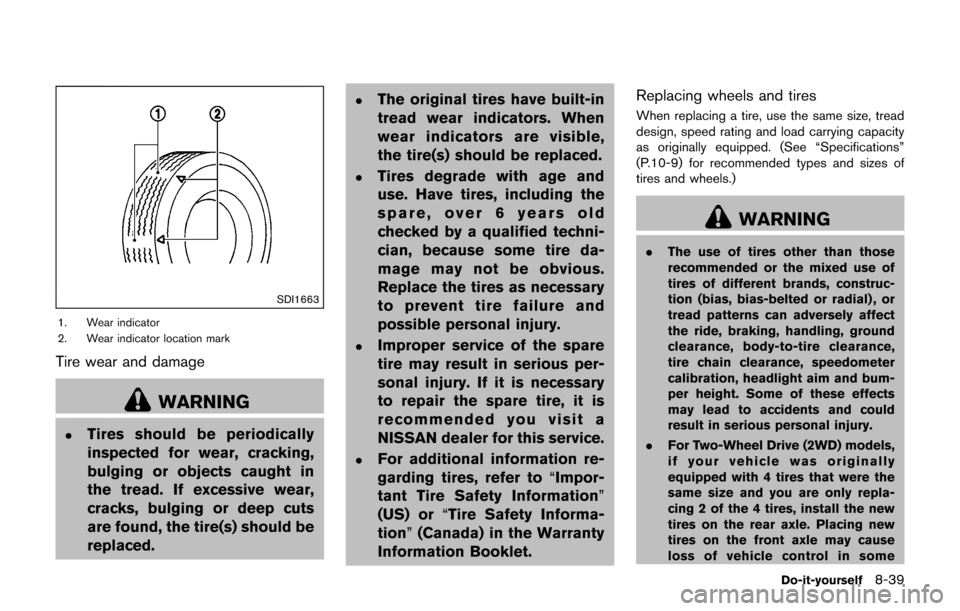
1. Wear indicator
2. Wear indicator location mark
Tire wear and damage
WARNING
.Tires should be periodically
inspected for wear, cracking,
bulging or objects caught in
the tread. If excessive wear,
cracks, bulging or deep cuts
are found, the tire(s) should be
replaced.
.The original tires have built-in
tread wear indicators. When
wear indicators are visible,
the tire(s) should be replaced.
.Tires degrade with age and
use. Have tires, including the
spare, over 6 years old
checked by a qualified techni-
cian, because some tire da-
mage may not be obvious.
Replace the tires as necessary
to prevent tire failure and
possible personal injury.
.Improper service of the spare
tire may result in serious per-
sonal injury. If it is necessary
to repair the spare tire, it is
recommended you visit a
NISSAN dealer for this service.
.For additional information re-
garding tires, refer to“Impor-
tant Tire Safety Information”
(US) or “Tire Safety Informa-
tion” (Canada) in the Warranty
Information Booklet. Replacing wheels and tires
When replacing a tire, use the same size, tread
design, speed rating and load carrying capacity
as originally equipped. (See “Specifications”
(P.10-9) for recommended types and sizes of
tires and wheels.)
WARNING
.
The use of tires other than those
recommended or the mixed use of
tires of different brands, construc-
tion (bias, bias-belted or radial) , or
tread patterns can adversely affect
the ride, braking, handling, ground
clearance, body-to-tire clearance,
tire chain clearance, speedometer
calibration, headlight aim and bum-
per height. Some of these effects
may lead to accidents and could
result in serious personal injury.
. For Two-Wheel Drive (2WD) models,
if your vehicle was originally
equipped with 4 tires that were the
same size and you are only repla-
cing 2 of the 4 tires, install the new
tires on the rear axle. Placing new
tires on the front axle may cause
loss of vehicle control in some
Do-it-yourself8-39
Page 365 of 416
8-40Do-it-yourself
driving conditions and cause an
accident and personal injury.
. If the wheels are changed for any
reason, always replace with wheels
which have the same off-set dimen-
sion. Wheels of a different off-set
could cause premature tire wear,
degrade vehicle handling character-
istics and/or interference with the
brake discs/drums. Such interfer-
ence can lead to decreased braking
efficiency and/or early brake pad/
shoe wear. See “Wheels and tires”
(P.10-9) of this manual for wheel off-
set dimensions.
. Since the spare tire is not equipped
with the TPMS, when a spare tire is
mounted or a wheel is replaced, the
TPMS will not function and the low
tire pressure warning light will flash
for approximately 1 minute. The
light will remain on after 1 minute.
Have your tires replaced and/or
TPMS system reset as soon as
possible. It is recommended you
visit a NISSAN dealer for these
services.
. Replacing tires with those not ori-
ginally specified by NISSAN could affect the proper operation of the
TPMS.
. The TPMS sensor may be damaged
if it is not handled correctly. Be
careful when handling the TPMS
sensor.
. When replacing the TPMS sensor,
the ID registration may be required.
It is recommended you visit a
NISSAN dealer for ID registration.
. Do not use a valve stem cap that is
not specified by NISSAN. The valve
stem cap may become stuck.
. Be sure that the valve stem caps are
correctly fitted. Otherwise the valve
may be clogged up with dirt and
cause a malfunction or loss of
pressure.
. Do not install a damaged or de-
formed wheel or tire even if it has
been repaired. Such wheels or tires
could have structural damage and
could fail without warning.
. The use of retread tire is not re-
commended.
. For additional information regard-
ing tires, refer to “Important Tire
Safety Information” (US) or“Tire Safety Information”
(Canada) in the
Warranty Information Booklet.
All-Wheel Drive (AWD) models
CAUTION
. Always use tires of the same size,
brand, construction (bias, bias-
belted or radial) , and tread pattern
on all four wheels. Failure to do so
may result in a circumference differ-
ence between tires on the front and
rear axles which will cause exces-
sive tire wear and may damage the
transmission, transfer case and rear
differential gears.
. Only use spare tires specified for
each AWD model.
If excessive tire wear is found, it is recom-
mended that all four tires be replaced with tires
of the same size, brand, construction and tread
pattern. The tire pressure and wheel alignment
should also be checked and corrected as
necessary. It is recommended you visit a
NISSAN dealer for this service.