2017 NISSAN ARMADA battery
[x] Cancel search: batteryPage 534 of 614
ENGINE COMPARTMENT
WARNING
Never use a fuse of a higher or lower
amperage rating than that specified on
the fuse box cover. This could damage
the electrical system or electronic con-
trol units or cause a fire.
If any electrical equipment does not operate,
check for an open fuse.
1. Be sure the ignition switch is pushed to the OFF or LOCK position and the headlight
switch is turned to OFF.
2. Open the engine hood and remove the cover on the battery.
3. Remove the fuse/fusible link holder cover
*1,*2or*3.
4. Remove the fuse with the fuse puller.
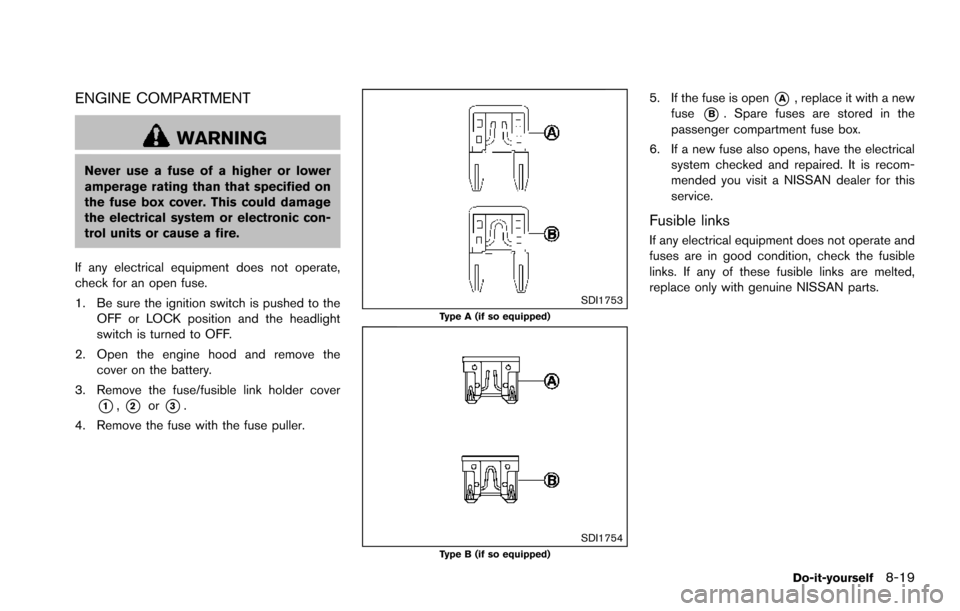
SDI1753Type A (if so equipped)
SDI1754Type B (if so equipped)
5. If the fuse is open*A, replace it with a new
fuse
*B. Spare fuses are stored in the
passenger compartment fuse box.
6. If a new fuse also opens, have the electrical system checked and repaired. It is recom-
mended you visit a NISSAN dealer for this
service.
Fusible links
If any electrical equipment does not operate and
fuses are in good condition, check the fusible
links. If any of these fusible links are melted,
replace only with genuine NISSAN parts.
Do-it-yourself8-19
Page 536 of 614
SDI2704
Extended storage fuse switch (if so
equipped)
To reduce battery drain, the extended storage
fuse switch comes from the factory switched off.
Prior to delivery of your vehicle, the switch is
pushed in (switched on) and should always
remain on.
If the extended storage fuse switch is not
pushed in (switched on), the “SHIPPING MODE
ON, PUSH STORAGE FUSE” warning may
appear on the vehicle information display (if so
equipped) . See “Vehicle information display”
(P.2-20) .
If any electrical equipment does not operate,remove the extended storage fuse switch and
check for an open fuse.
NOTE:
If the extended storage fuse switch mal-
functions or if the fuse is open, it is not
necessary to replace the switch. In this
case, remove the extended storage fuse
switch and replace it with a new fuse of the
same rating.
How to remove the extended storage fuse
switch:
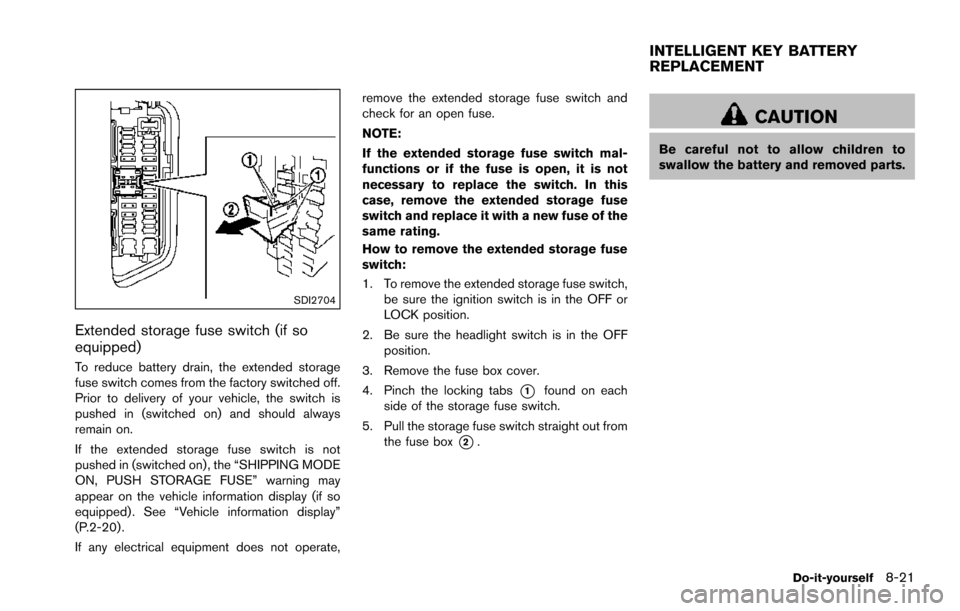
1. To remove the extended storage fuse switch,
be sure the ignition switch is in the OFF or
LOCK position.
2. Be sure the headlight switch is in the OFF position.
3. Remove the fuse box cover.
4. Pinch the locking tabs
*1found on each
side of the storage fuse switch.
5. Pull the storage fuse switch straight out from the fuse box
*2.
CAUTION
Be careful not to allow children to
swallow the battery and removed parts.
Do-it-yourself8-21
INTELLIGENT KEY BATTERY
REPLACEMENT
Page 537 of 614
8-22Do-it-yourself
SDI2451
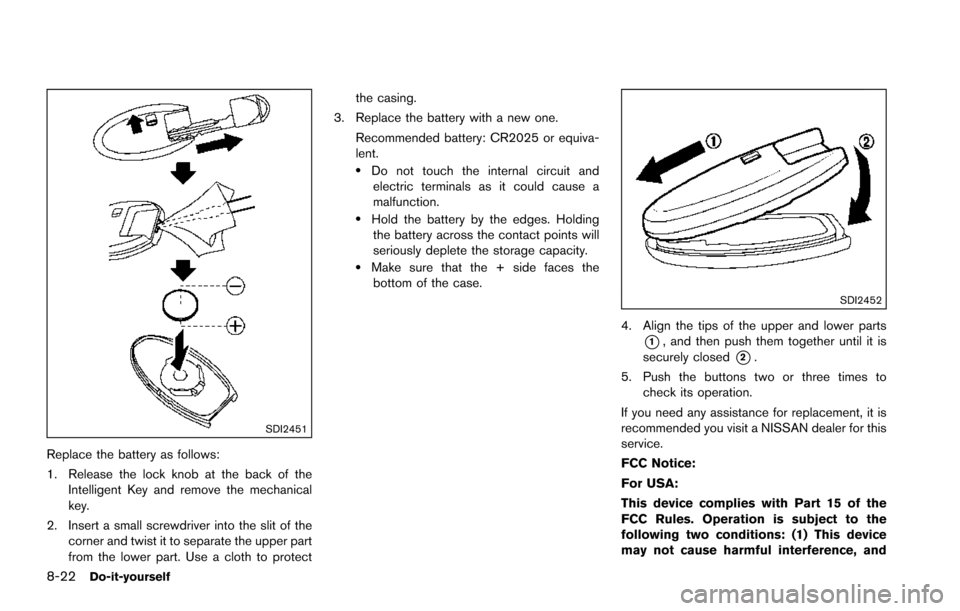
Replace the battery as follows:
1. Release the lock knob at the back of theIntelligent Key and remove the mechanical
key.
2. Insert a small screwdriver into the slit of the corner and twist it to separate the upper part
from the lower part. Use a cloth to protect the casing.
3. Replace the battery with a new one.
Recommended battery: CR2025 or equiva-
lent.
.Do not touch the internal circuit andelectric terminals as it could cause a
malfunction.
.Hold the battery by the edges. Holdingthe battery across the contact points will
seriously deplete the storage capacity.
.Make sure that the + side faces thebottom of the case.
SDI2452
4. Align the tips of the upper and lower parts
*1, and then push them together until it is
securely closed
*2.
5. Push the buttons two or three times to check its operation.
If you need any assistance for replacement, it is
recommended you visit a NISSAN dealer for this
service.
FCC Notice:
For USA:
This device complies with Part 15 of the
FCC Rules. Operation is subject to the
following two conditions: (1) This device
may not cause harmful interference, and
Page 559 of 614
9-4Maintenance and schedules
Steering wheel:Check for changes in the
steering conditions, such as excessive free play,
hard steering or strange noises.
Warning lights and chimes: Make sure that
all warning lights and chimes are operating
properly.
Windshield defroster: Check that the air
comes out of the defroster outlets properly and
in sufficient quantity when operating the heater
or air conditioner.
Windshield wiper and washer*: Check that
the wipers and washer operate properly and that
the wipers do not streak.
Under the hood and vehicle
The maintenance items listed here should be
checked periodically (for example, each time you
check the engine oil or refuel) .
Battery*: Check the fluid level in each cell. It
should be between the MAX and MIN lines.
Vehicles operated in high temperatures or under
severe condition require frequent checks of the
battery fluid level.
NOTE:
Care should be taken to avoid situations
that can lead to potential battery discharge
and potential no-start conditions such as: 1.
Installation or extended use of electro-
nic accessories that consume battery
power when the engine is not running
(Phone chargers, GPS, DVD players,
etc.)
2. Vehicle is not driven regularly and/or
only driven short distances.
In these cases, the battery may need to be
charged to maintain battery health.
Brake fluid level*: Make sure that the brake
fluid level is between the MAX and MIN lines on
the reservoir.
Engine coolant level*: Check the coolant level
when the engine is cold.
Engine drive belts*: Make sure that no belt is
frayed, worn, cracked or oily.
Engine oil level*: Check the level after parking
the vehicle on a level spot and turning off the
engine. Wait more than 15 minutes for the oil to
drain back into the oil pan.
Exhaust system: Make sure there are no loose
supports, cracks or holes. If the sound of the
exhaust seems unusual or there is a smell of
exhaust fumes, immediately have the exhaust
system inspected. It is recommended you visit a
NISSAN dealer for this service. (See “Precau-
tions when starting and driving” (P.5-4) for
exhaust gas (carbon monoxide) .) Fluid leaks:
Check under the vehicle for fuel,
oil, water or other fluid leaks after the vehicle has
been parked for a while. Water dripping from the
air conditioner after use is normal. If you should
notice any leaks or if gasoline fumes are evident,
check for the cause and have it corrected
immediately.
Power steering fluid level* and lines: Check
the level when the fluid is cold, with the engine
off. Check the lines for proper attachment, leaks,
cracks, etc.
Radiator and hoses: Check the front of the
radiator and clean off any dirt, insects, leaves,
etc., that may have accumulated. Make sure the
hoses have no cracks, deformation, rot or loose
connections.
Underbody: The underbody is frequently ex-
posed to corrosive substances such as those
used on icy roads or to control dust. It is very
important to remove these substances, other-
wise rust will form on the floor pan, frame, fuel
lines and around the exhaust system. At the end
of winter, the underbody should be thoroughly
flushed with plain water, being careful to clean
those areas where mud and dirt may accumu-
late. For additional information, see “Cleaning
exterior” (P.7-2).
Windshield washer fluid*: Check that there is
adequate fluid in the reservoir.
Page 566 of 614
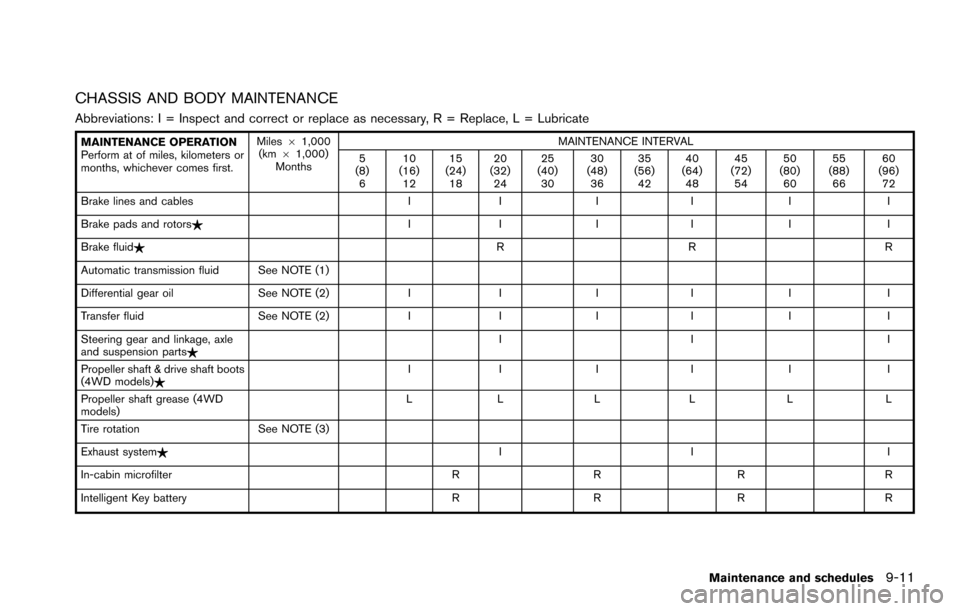
CHASSIS AND BODY MAINTENANCE
Abbreviations: I = Inspect and correct or replace as necessary, R = Replace, L = Lubricate
MAINTENANCE OPERATION
Perform at of miles, kilometers or
months, whichever comes first.Miles
61,000
(km 61,000)
Months MAINTENANCE INTERVAL
5
(8) 6 10
(16) 12 15
(24) 18 20
(32) 24 25
(40) 30 30
(48) 36 35
(56) 42 40
(64) 48 45
(72) 54 50
(80) 60 55
(88) 66 60
(96) 72
Brake lines and cables II II I I
Brake pads and rotors$ II I I I I
Brake fluid$ RR R
Automatic transmission fluid See NOTE (1)
Differential gear oil See NOTE (2)II II I I
Transfer fluid See NOTE (2)II II I I
Steering gear and linkage, axle
and suspension parts$ II I
Propeller shaft & drive shaft boots
(4WD models)$ II I I I I
Propeller shaft grease (4WD
models) LL L L L L
Tire rotation See NOTE (3)
Exhaust system$ II I
In-cabin microfilter RR R R
Intelligent Key battery RR R R
Maintenance and schedules9-11
Page 567 of 614
9-12Maintenance and schedules
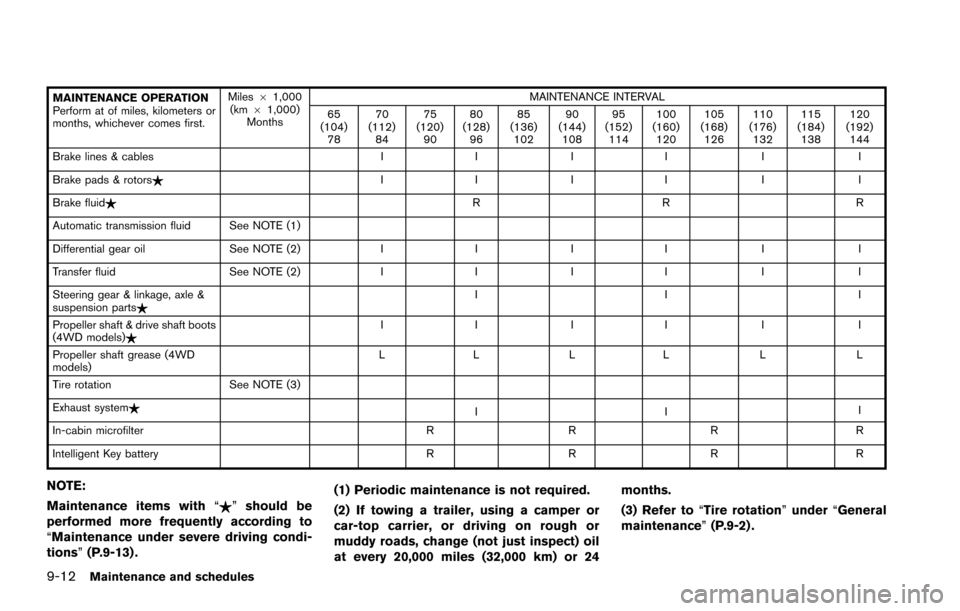
MAINTENANCE OPERATION
Perform at of miles, kilometers or
months, whichever comes first.Miles
61,000
(km 61,000)
Months MAINTENANCE INTERVAL
65
(104) 78 70
(112) 84 75
(120) 90 80
(128) 96 85
(136) 102 90
(144) 108 95
(152) 114 100
(160) 120 105
(168) 126 110
(176) 132 115
(184) 138 120
(192) 144
Brake lines & cables II II I I
Brake pads & rotors$ II II I I
Brake fluid$ RR R
Automatic transmission fluid See NOTE (1)
Differential gear oil See NOTE (2)II II I I
Transfer fluid See NOTE (2)II II I I
Steering gear & linkage, axle &
suspension parts$ II I
Propeller shaft & drive shaft boots
(4WD models)$ II II I I
Propeller shaft grease (4WD
models) LL LL L L
Tire rotation See NOTE (3)
Exhaust system$ III
In-cabin microfilter RRR R
Intelligent Key battery RRR R
NOTE:
Maintenance items with “$”should be
performed more frequently according to
“Maintenance under severe driving condi-
tions” (P.9-13) . (1) Periodic maintenance is not required.
(2) If towing a trailer, using a camper or
car-top carrier, or driving on rough or
muddy roads, change (not just inspect) oil
at every 20,000 miles (32,000 km) or 24 months.
(3) Refer to
“Tire rotation” under“General
maintenance” (P.9-2) .
Page 596 of 614
turning corners.
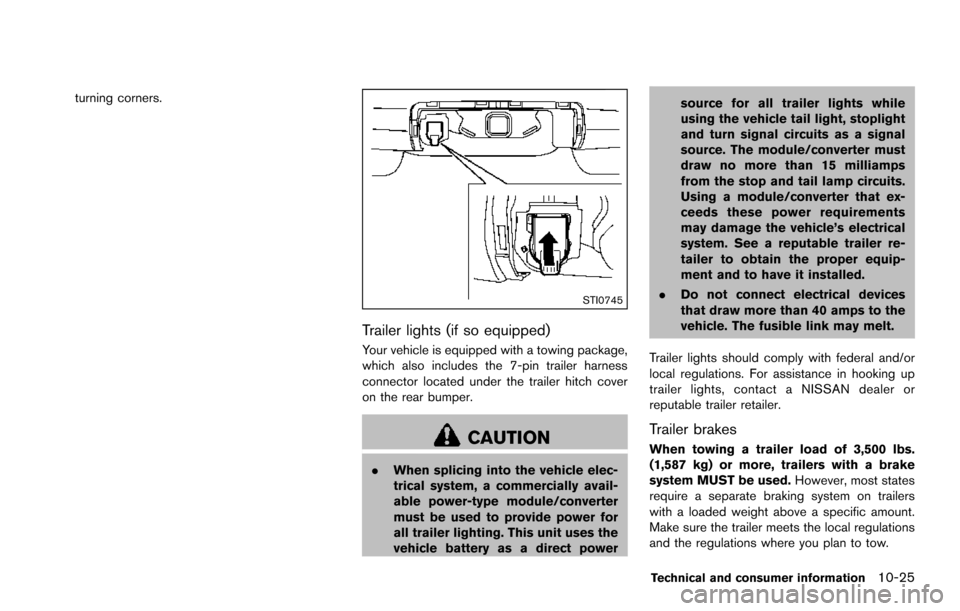
STI0745
Trailer lights (if so equipped)
Your vehicle is equipped with a towing package,
which also includes the 7-pin trailer harness
connector located under the trailer hitch cover
on the rear bumper.
CAUTION
.When splicing into the vehicle elec-
trical system, a commercially avail-
able power-type module/converter
must be used to provide power for
all trailer lighting. This unit uses the
vehicle battery as a direct power source for all trailer lights while
using the vehicle tail light, stoplight
and turn signal circuits as a signal
source. The module/converter must
draw no more than 15 milliamps
from the stop and tail lamp circuits.
Using a module/converter that ex-
ceeds these power requirements
may damage the vehicle’s electrical
system. See a reputable trailer re-
tailer to obtain the proper equip-
ment and to have it installed.
. Do not connect electrical devices
that draw more than 40 amps to the
vehicle. The fusible link may melt.
Trailer lights should comply with federal and/or
local regulations. For assistance in hooking up
trailer lights, contact a NISSAN dealer or
reputable trailer retailer.
Trailer brakes
When towing a trailer load of 3,500 lbs.
(1,587 kg) or more, trailers with a brake
system MUST be used. However, most states
require a separate braking system on trailers
with a loaded weight above a specific amount.
Make sure the trailer meets the local regulations
and the regulations where you plan to tow.
Technical and consumer information10-25
Page 603 of 614
10-32Technical and consumer information
Transport Canada’s Road Safety Infor-
mation Centre at 1-800-333-0371 or
online at www.tc.gc.ca/roadsafety (Eng-
lish speakers) or www.tc.gc.ca/securiter-
outiere (French speakers) .
To notify NISSAN of any safety concerns
please contact our Consumer Informa-
tion Centre toll free at 1-800-387-0122.
WARNING
A vehicle equipped with Four-Wheel
Drive (4WD) should never be tested
using a two wheel dynamometer (such
as the dynamometers used by some
states for emissions testing) , or similar
equipment. Make sure you inform test
facility personnel that your vehicle is
equipped with 4WD before it is placed
on a dynamometer. Using the wrong
test equipment may result in transmis-
sion damage or unexpected vehicle
movement which could result in serious
vehicle damage or personal injury.
Due to legal requirements in some states and
Canadian Provinces, your vehicle may be
required to be in what is called the “ready
condition” for an Inspection/Maintenance (I/M)
test of the emission control system.
The vehicle is set to the “ready condition” when
it is driven through certain driving patterns.
Usually, the “ready condition” can be obtained
by ordinary usage of the vehicle.
If a powertrain system component is repaired or
the battery is disconnected, the vehicle may be
reset to a “not ready condition”. Before taking the I/M test, check the vehicle’s inspection/
maintenance test readiness condition. Place the
ignition switch in the ON position without
starting the engine. If the Malfunction Indicator
Light (MIL) comes on steady for 20 seconds and
then blinks for 10 seconds, the I/M test
condition is “not ready”. If the MIL does not
blink after 20 seconds, the I/M test condition is
“ready”.
It is recommended you visit a NISSAN dealer to
set “ready condition” or to prepare the vehicle
for testing.
READINESS FOR INSPECTION/
MAINTENANCE (I/M) TEST