10-24Technical and consumer information
WARNING
Properly adjust the weight distributing
hitch so the rear of the bumper is no
higher than the measured reference
height when the trailer is attached. If
the rear bumper is higher than the
measured reference height when
loaded, the vehicle may handle unpre-
dictably which could cause a loss of
vehicle control and cause serious per-
sonal injury or property damage.
Sway control device
Sudden maneuvers, wind gusts and buffeting
caused by other vehicles can affect trailer
handling. Sway control devices may be used to
help control these affects. If you choose to use
one, contact a reputable trailer hitch supplier to
make sure the sway control device will work with
the vehicle, hitch, trailer and the trailer’s brake
system. Follow the instructions provided by the
manufacturer for installing and using the sway
control device.
Class I hitch
Class I trailer hitch equipment (receiver, ball
mount and hitch ball) can be used to tow trailers
of a maximum weight of 2,000 lb (907 kg) .
Class II hitch
Class II trailer hitch equipment (receiver, ball
mount and hitch ball) can be used to tow trailers
of a maximum weight of 3,500 lb (1,588 kg).
Class III hitch
Class III trailer hitch equipment (receiver, ball
mount and hitch ball) can be used to tow trailers
of a maximum weight of 5,000 lb (2,267 kg).
Class IV hitch
Class IV trailer hitch equipment (receiver, ball
mount and hitch ball) can be used to tow trailers
of a maximum weight of 10,000 lb (4,545 kg) . A
weight distributing hitch should be used to tow
trailers that weigh over 5,000 lb (2,267 kg) .
Your vehicle may be equipped with Class IV
trailer hitch equipment that has a 10,000 lb
(4,545 kg) maximum weight rating, but your
vehicle is only capable of towing the maximum
trailer weights shown in the “Towing Load/
Specification” chart earlier in this section.
CAUTION
.Do not use axle-mounted hitches.
. Do not modify the vehicle exhaust
system, brake system, etc.
. Do not attach any additional hitches
to your vehicle because a hitch is
already mounted to your vehicle
frame.
Tire pressures
.When towing a trailer, inflate the
vehicle tires to the recommended
cold tire pressure indicated on the
Tire and Loading Information label.
. Trailer tire condition, size, load rating
and proper inflation pressure should
be in accordance with the trailer and
tire manufacturers’ specifications.
Safety chains
Always use a suitable chain between your
vehicle and the trailer. The safety chains should
be crossed and should be attached to the hitch,
not to the vehicle bumper or axle. Be sure to
leave enough slack in the chains to permit
turning corners.
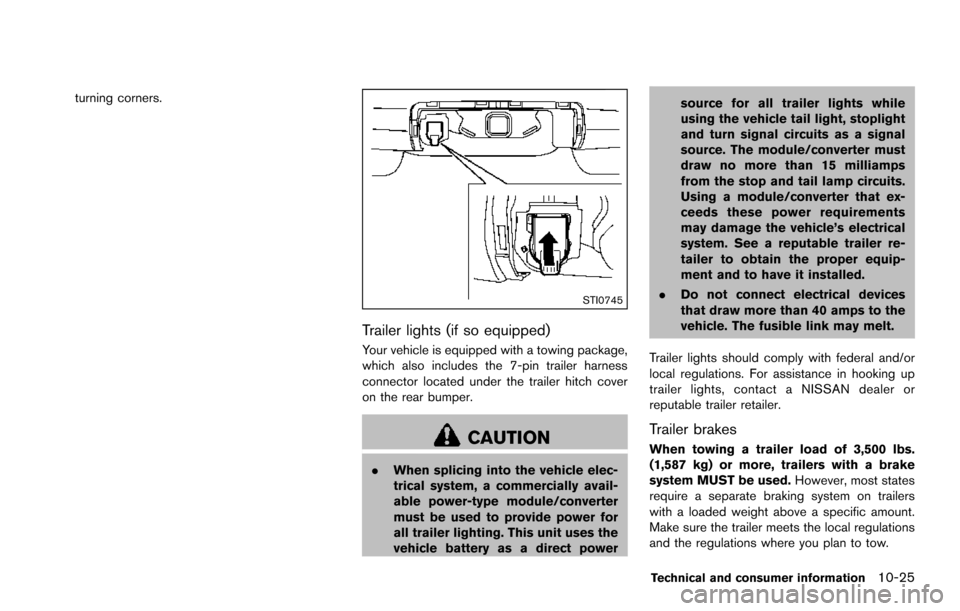
STI0745
Trailer lights (if so equipped)
Your vehicle is equipped with a towing package,
which also includes the 7-pin trailer harness
connector located under the trailer hitch cover
on the rear bumper.
CAUTION
.When splicing into the vehicle elec-
trical system, a commercially avail-
able power-type module/converter
must be used to provide power for
all trailer lighting. This unit uses the
vehicle battery as a direct power source for all trailer lights while
using the vehicle tail light, stoplight
and turn signal circuits as a signal
source. The module/converter must
draw no more than 15 milliamps
from the stop and tail lamp circuits.
Using a module/converter that ex-
ceeds these power requirements
may damage the vehicle’s electrical
system. See a reputable trailer re-
tailer to obtain the proper equip-
ment and to have it installed.
. Do not connect electrical devices
that draw more than 40 amps to the
vehicle. The fusible link may melt.
Trailer lights should comply with federal and/or
local regulations. For assistance in hooking up
trailer lights, contact a NISSAN dealer or
reputable trailer retailer.
Trailer brakes
When towing a trailer load of 3,500 lbs.
(1,587 kg) or more, trailers with a brake
system MUST be used. However, most states
require a separate braking system on trailers
with a loaded weight above a specific amount.
Make sure the trailer meets the local regulations
and the regulations where you plan to tow.
Technical and consumer information10-25
CAUTION
If you move the shift lever to the P
(Park) position before blocking the
wheels and applying the parking brake,
transmission damage could occur.
1. Apply and hold the brake pedal.
2. Have someone place blocks on the downhill side of the vehicle and trailer wheels.
3. After the wheel blocks are in place, slowly release the brake pedal until the blocks
absorb the vehicle load.
4. Apply the parking brake.
5. Shift the transmission into P (Park) .
6. Four-Wheel Drive (4WD) models:
Make sure that the 4WD shift switch is
engaged in the AUTO, 4HI or 4LO position
and the Automatic Transmission (AT) park
warning light is turned off.
7. Turn off the engine.
To drive away:
1. Apply and hold the brake pedal.
2. Start the engine.
3. Shift the transmission into gear. 4. Release the parking brake.
5. Drive slowly until the vehicle and trailer are
clear from the blocks.
6. Apply and hold the brake pedal.
7. Have someone retrieve and store the blocks.
. While going downhill, the weight of the
trailer pushing on the tow vehicle may
decrease overall stability. Therefore, to
maintain adequate control, reduce your
speed and shift to a lower gear. Avoid long
or repeated use of the brakes when
descending a hill, as this reduces their
effectiveness and could cause overheating.
Shifting to a lower gear instead provides
“engine braking” and reduces the need to
brake as frequently.
. If the engine coolant temperature rises to a
high temperature, see “If your vehicle over-
heats” (P.6-14) .
. Trailer towing requires more fuel than normal
circumstances.
. Avoid towing a trailer for your vehicle’s first
500 miles (800 km).
. Have your vehicle serviced more often than
at intervals specified in the recommended
maintenance schedule shown in the "9.
Maintenance and schedules" section. .
When making a turn, your trailer wheels will
be closer to the inside of the turn than your
vehicle wheels. To compensate for this,
make a larger than normal turning radius
during the turn.
. Crosswinds and rough roads will adversely
affect vehicle/trailer handling, possibly caus-
ing vehicle sway. When being passed by
larger vehicles, be prepared for possible
changes in crosswinds that could affect
vehicle handling.
Do the following if the trailer begins to sway:
1. Take your foot off the accelerator pedal to allow the vehicle to coast and steer as
straight ahead as the road conditions allow.
This combination will help stabilize the
vehicle.
.Do not correct trailer sway by steering orapplying the brakes.
2. When the trailer sway stops, gently apply the brakes and pull to the side of the road in
a safe area.
3. Try to rearrange the trailer load so it is balanced as described earlier in this section.
. Be careful when passing other vehicles.
Passing while towing a trailer requires
considerably more distance than normal
passing. Remember the length of the trailer
must also pass the other vehicle before you
Technical and consumer information10-27