2017 NISSAN ARMADA Sus
[x] Cancel search: SusPage 568 of 614
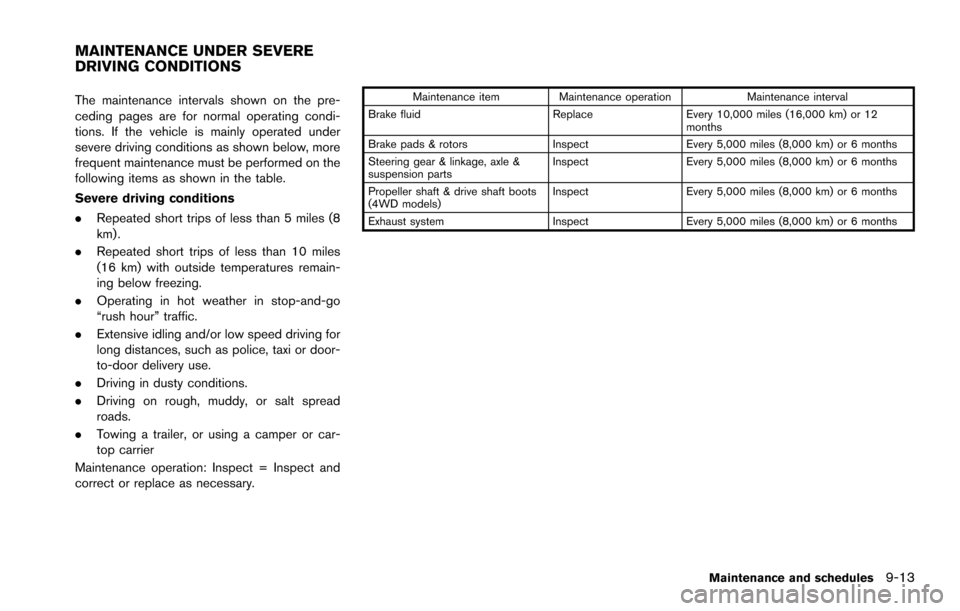
The maintenance intervals shown on the pre-
ceding pages are for normal operating condi-
tions. If the vehicle is mainly operated under
severe driving conditions as shown below, more
frequent maintenance must be performed on the
following items as shown in the table.
Severe driving conditions
.Repeated short trips of less than 5 miles (8
km) .
. Repeated short trips of less than 10 miles
(16 km) with outside temperatures remain-
ing below freezing.
. Operating in hot weather in stop-and-go
“rush hour” traffic.
. Extensive idling and/or low speed driving for
long distances, such as police, taxi or door-
to-door delivery use.
. Driving in dusty conditions.
. Driving on rough, muddy, or salt spread
roads.
. Towing a trailer, or using a camper or car-
top carrier
Maintenance operation: Inspect = Inspect and
correct or replace as necessary.Maintenance item Maintenance operation Maintenance interval
Brake fluid ReplaceEvery 10,000 miles (16,000 km) or 12
months
Brake pads & rotors InspectEvery 5,000 miles (8,000 km) or 6 months
Steering gear & linkage, axle &
suspension parts Inspect
Every 5,000 miles (8,000 km) or 6 months
Propeller shaft & drive shaft boots
(4WD models) Inspect
Every 5,000 miles (8,000 km) or 6 months
Exhaust system InspectEvery 5,000 miles (8,000 km) or 6 months
Maintenance and schedules9-13
MAINTENANCE UNDER SEVERE
DRIVING CONDITIONS
Page 573 of 614
10-2Technical and consumer information
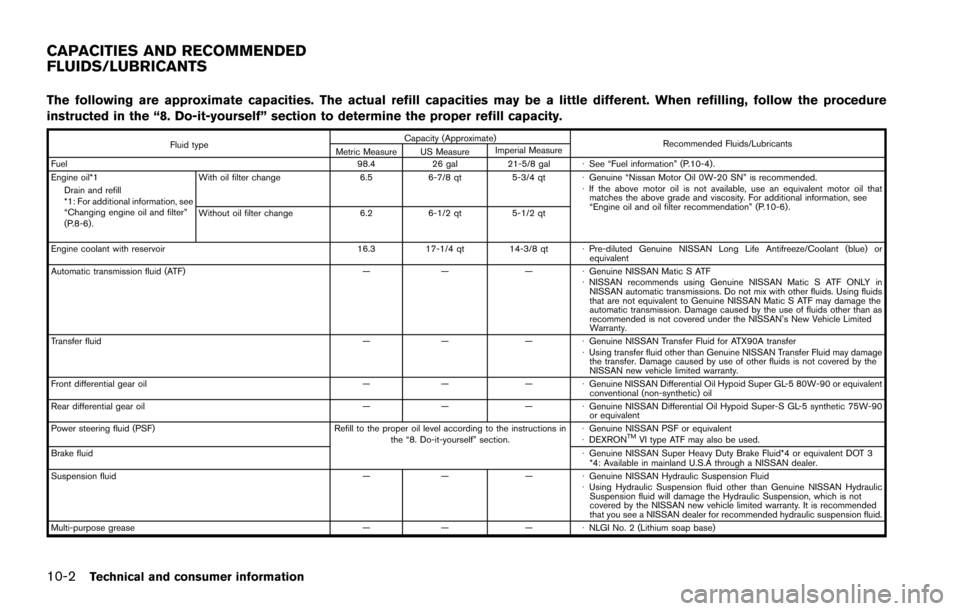
The following are approximate capacities. The actual refill capacities may be a little different. When refilling, follow the procedure
instructed in the “8. Do-it-yourself” section to determine the proper refill capacity.
Fluid typeCapacity (Approximate)
Recommended Fluids/Lubricants
Metric Measure US Measure Imperial Measure
Fuel 98.426 gal 21-5/8 galÂSee “Fuel information” (P.10-4).
Engine oil*1 With oil filter change 6.56-7/8 qt 5-3/4 qtÂGenuine “Nissan Motor Oil 0W-20 SN” is recommended.
 If the above motor oil is not available, use an equivalent motor oil that
matches the above grade and viscosity. For additional information, see
“Engine oil and oil filter recommendation” (P.10-6).
Drain and refill
*1: For additional information, see
“Changing engine oil and filter”
(P.8-6) .
Without oil filter change
6.26-1/2 qt 5-1/2 qt
Engine coolant with reservoir 16.317-1/4 qt 14-3/8 qt ÂPre-diluted Genuine NISSAN Long Life Antifreeze/Coolant (blue) or
equivalent
Automatic transmission fluid (ATF) —— —ÂGenuine NISSAN Matic S ATF
 NISSAN recommends using Genuine NISSAN Matic S ATF ONLY in
NISSAN automatic transmissions. Do not mix with other fluids. Using fluids
that are not equivalent to Genuine NISSAN Matic S ATF may damage the
automatic transmission. Damage caused by the use of fluids other than as
recommended is not covered under the NISSAN’s New Vehicle Limited
Warranty.
Transfer fluid —— —ÂGenuine NISSAN Transfer Fluid for ATX90A transfer
 Using transfer fluid other than Genuine NISSAN Transfer Fluid may damage
the transfer. Damage caused by use of other fluids is not covered by the
NISSAN new vehicle limited warranty.
Front differential gear oil —— —ÂGenuine NISSAN Differential Oil Hypoid Super GL-5 80W-90 or equivalent
conventional (non-synthetic) oil
Rear differential gear oil —— —ÂGenuine NISSAN Differential Oil Hypoid Super-S GL-5 synthetic 75W-90
or equivalent
Power steering fluid (PSF) Refill to the proper oil level according to the instructions in
the “8. Do-it-yourself” section. Â
Genuine NISSAN PSF or equivalent
 DEXRON
TMVI type ATF may also be used.
Brake fluid ÂGenuine NISSAN Super Heavy Duty Brake Fluid*4 or equivalent DOT 3
*4: Available in mainland U.S.A through a NISSAN dealer.
Suspension fluid —— —ÂGenuine NISSAN Hydraulic Suspension Fluid
 Using Hydraulic Suspension fluid other than Genuine NISSAN Hydraulic
Suspension fluid will damage the Hydraulic Suspension, which is not
covered by the NISSAN new vehicle limited warranty. It is recommended
that you see a NISSAN dealer for recommended hydraulic suspension fluid.
Multi-purpose grease —— —ÂNLGI No. 2 (Lithium soap base)
CAPACITIES AND RECOMMENDED
FLUIDS/LUBRICANTS
Page 576 of 614
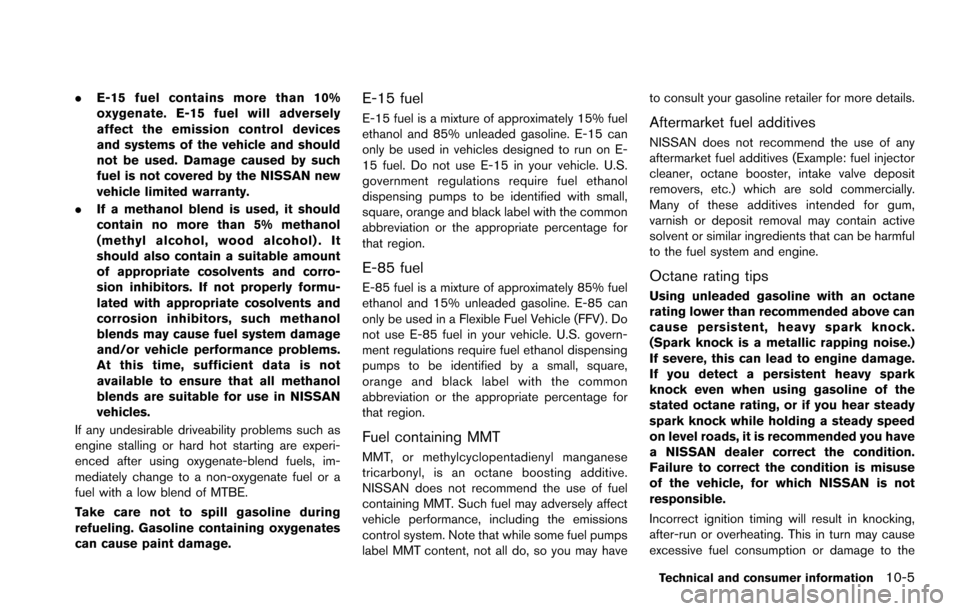
.E-15 fuel contains more than 10%
oxygenate. E-15 fuel will adversely
affect the emission control devices
and systems of the vehicle and should
not be used. Damage caused by such
fuel is not covered by the NISSAN new
vehicle limited warranty.
. If a methanol blend is used, it should
contain no more than 5% methanol
(methyl alcohol, wood alcohol) . It
should also contain a suitable amount
of appropriate cosolvents and corro-
sion inhibitors. If not properly formu-
lated with appropriate cosolvents and
corrosion inhibitors, such methanol
blends may cause fuel system damage
and/or vehicle performance problems.
At this time, sufficient data is not
available to ensure that all methanol
blends are suitable for use in NISSAN
vehicles.
If any undesirable driveability problems such as
engine stalling or hard hot starting are experi-
enced after using oxygenate-blend fuels, im-
mediately change to a non-oxygenate fuel or a
fuel with a low blend of MTBE.
Take care not to spill gasoline during
refueling. Gasoline containing oxygenates
can cause paint damage.E-15 fuel
E-15 fuel is a mixture of approximately 15% fuel
ethanol and 85% unleaded gasoline. E-15 can
only be used in vehicles designed to run on E-
15 fuel. Do not use E-15 in your vehicle. U.S.
government regulations require fuel ethanol
dispensing pumps to be identified with small,
square, orange and black label with the common
abbreviation or the appropriate percentage for
that region.
E-85 fuel
E-85 fuel is a mixture of approximately 85% fuel
ethanol and 15% unleaded gasoline. E-85 can
only be used in a Flexible Fuel Vehicle (FFV) . Do
not use E-85 fuel in your vehicle. U.S. govern-
ment regulations require fuel ethanol dispensing
pumps to be identified by a small, square,
orange and black label with the common
abbreviation or the appropriate percentage for
that region.
Fuel containing MMT
MMT, or methylcyclopentadienyl manganese
tricarbonyl, is an octane boosting additive.
NISSAN does not recommend the use of fuel
containing MMT. Such fuel may adversely affect
vehicle performance, including the emissions
control system. Note that while some fuel pumps
label MMT content, not all do, so you may have to consult your gasoline retailer for more details.
Aftermarket fuel additives
NISSAN does not recommend the use of any
aftermarket fuel additives (Example: fuel injector
cleaner, octane booster, intake valve deposit
removers, etc.) which are sold commercially.
Many of these additives intended for gum,
varnish or deposit removal may contain active
solvent or similar ingredients that can be harmful
to the fuel system and engine.
Octane rating tips
Using unleaded gasoline with an octane
rating lower than recommended above can
cause persistent, heavy spark knock.
(Spark knock is a metallic rapping noise.)
If severe, this can lead to engine damage.
If you detect a persistent heavy spark
knock even when using gasoline of the
stated octane rating, or if you hear steady
spark knock while holding a steady speed
on level roads, it is recommended you have
a NISSAN dealer correct the condition.
Failure to correct the condition is misuse
of the vehicle, for which NISSAN is not
responsible.
Incorrect ignition timing will result in knocking,
after-run or overheating. This in turn may cause
excessive fuel consumption or damage to the
Technical and consumer information10-5
Page 597 of 614
10-26Technical and consumer information
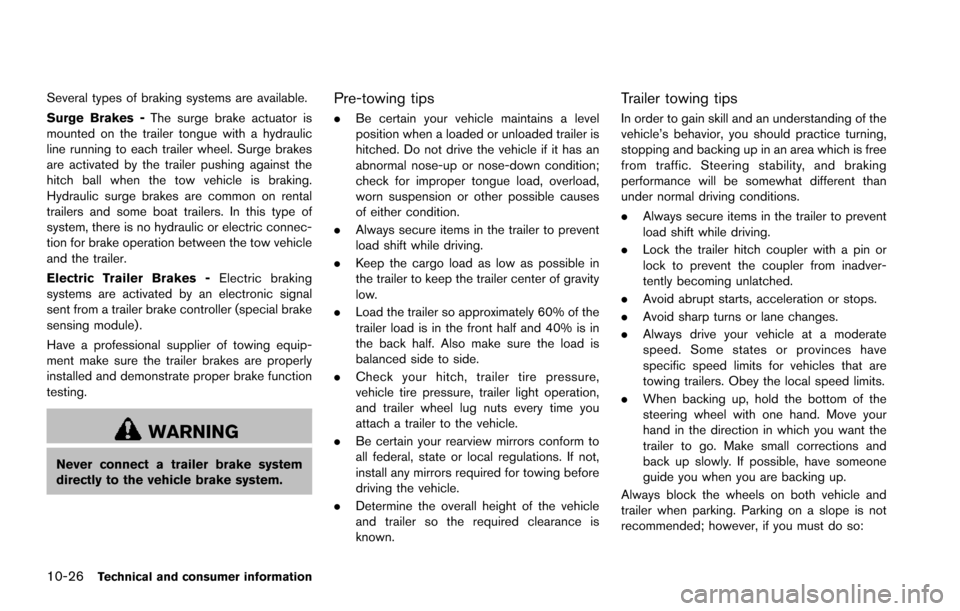
Several types of braking systems are available.
Surge Brakes -The surge brake actuator is
mounted on the trailer tongue with a hydraulic
line running to each trailer wheel. Surge brakes
are activated by the trailer pushing against the
hitch ball when the tow vehicle is braking.
Hydraulic surge brakes are common on rental
trailers and some boat trailers. In this type of
system, there is no hydraulic or electric connec-
tion for brake operation between the tow vehicle
and the trailer.
Electric Trailer Brakes - Electric braking
systems are activated by an electronic signal
sent from a trailer brake controller (special brake
sensing module) .
Have a professional supplier of towing equip-
ment make sure the trailer brakes are properly
installed and demonstrate proper brake function
testing.
WARNING
Never connect a trailer brake system
directly to the vehicle brake system.
Pre-towing tips
. Be certain your vehicle maintains a level
position when a loaded or unloaded trailer is
hitched. Do not drive the vehicle if it has an
abnormal nose-up or nose-down condition;
check for improper tongue load, overload,
worn suspension or other possible causes
of either condition.
. Always secure items in the trailer to prevent
load shift while driving.
. Keep the cargo load as low as possible in
the trailer to keep the trailer center of gravity
low.
. Load the trailer so approximately 60% of the
trailer load is in the front half and 40% is in
the back half. Also make sure the load is
balanced side to side.
. Check your hitch, trailer tire pressure,
vehicle tire pressure, trailer light operation,
and trailer wheel lug nuts every time you
attach a trailer to the vehicle.
. Be certain your rearview mirrors conform to
all federal, state or local regulations. If not,
install any mirrors required for towing before
driving the vehicle.
. Determine the overall height of the vehicle
and trailer so the required clearance is
known.
Trailer towing tips
In order to gain skill and an understanding of the
vehicle’s behavior, you should practice turning,
stopping and backing up in an area which is free
from traffic. Steering stability, and braking
performance will be somewhat different than
under normal driving conditions.
.Always secure items in the trailer to prevent
load shift while driving.
. Lock the trailer hitch coupler with a pin or
lock to prevent the coupler from inadver-
tently becoming unlatched.
. Avoid abrupt starts, acceleration or stops.
. Avoid sharp turns or lane changes.
. Always drive your vehicle at a moderate
speed. Some states or provinces have
specific speed limits for vehicles that are
towing trailers. Obey the local speed limits.
. When backing up, hold the bottom of the
steering wheel with one hand. Move your
hand in the direction in which you want the
trailer to go. Make small corrections and
back up slowly. If possible, have someone
guide you when you are backing up.
Always block the wheels on both vehicle and
trailer when parking. Parking on a slope is not
recommended; however, if you must do so:
Page 601 of 614
10-30Technical and consumer information
WARNING
The traction grade assigned to this tire
is based on straight-ahead braking
traction tests, and does not include
acceleration, cornering, hydroplaning,
or peak traction characteristics.
TEMPERATURE A, B AND C
The temperature grades A (the highest) , B, and
C, representing the tire’s resistance to the
generation of heat and its ability to dissipate
heat when tested under controlled conditions on
a specified indoor laboratory test wheel. Sus-
tained high temperature can cause the material
of the tire to degenerate and reduce tire life, and
excessive temperature can lead to sudden tire
failure. The grade C corresponds to a level of
performance which all passenger car tires must
meet under the Federal Motor Vehicle Safety
Standard No. 109. Grades B and A represent
higher levels of performance on the laboratory
test wheel than the minimum required by law.
WARNING
The temperature grade for this tire is
established for a tire that is properly
inflated and not overloaded. Excessive
speed, under-inflation, or excessive
loading, either separately or in combi-
nation, can cause heat build-up and
possible tire failure.Your NISSAN is covered by the following
emission warranties.
For USA:
.
Emission Defects Warranty
. Emissions Performance Warranty
Details of these warranties may be found with
other vehicle warranties in your Warranty In-
formation Booklet that comes with your
NISSAN. If you did not receive a Warranty
Information Booklet, or it has become lost, you
may obtain a replacement by writing to:
. NISSAN Division
Nissan North America, Inc.
Consumer Affairs Department
P.O. Box 685003
Franklin, TN 37068-5003
EMISSION CONTROL SYSTEM
WARRANTY