2017 MITSUBISHI SHOGUN spare wheel
[x] Cancel search: spare wheelPage 302 of 394

WARNINGlBe sure to apply chocks or blocks to the
correct tyre when jacking up the vehicle.If the vehicle moves while jacked up, the
jack could slip out of position, leading to
an accident.NOTEl The chocks shown in the illustration do not
come with your vehicle. It is recommended
that you keep one in the vehicle for use if needed.
l If chocks are not available, use stones or any
other objects that are large enough to hold the wheel in position.
6. Get the spare wheel, jack, jack handle
and wheel nut wrench ready.
Refer to “Tool, jack and jack handle” on page 8-07.
Spare wheel information
E00803600266
Check the air pressure of the spare tyre fre-quently and make sure it is ready for emer-
gency use at any time.
Maintaining the spare wheel at the highest specified air pressure will ensure that it can
always be used under any conditions (city/ high-speed driving, varying load weight,etc.).
The spare wheel is stored on the outside of
the backdoor. (Refer to “To remove the spare wheel” on page 8-10).
1- Spare wheel
CAUTIONl The tyre pressure should be periodically
checked and maintained at the specified
pressure while the tyre is stowed.
Driving with an insufficient tyre pressure can lead to an accident. If you have nochoice but to drive with an insufficient tyre
pressure, keep your speed down and inflate the tyre to the correct pressure as soon as
possible. (Refer to “Tyre inflation pressures”
on page 10-11.)To remove the spare wheel
E00803500177
CAUTIONl Grasp the spare wheel firmly when remov-
ing or attaching it.
l When removing the spare wheel, put on
gloves. Removing the spare wheel with your
bare hands may cause injury to the fingers.
1. Open the backdoor.
2. Open the lids (A) inside of the backdoor.
How to change a tyre
8-10OVWX17E1For emergencies8
Page 303 of 394

3.Remove the bolts (B) by turning them
anticlockwise with the wheel nut
wrench.
4. Close the backdoor.
5. Open the spare wheel garnish (C).
CAUTIONl Do not open the backdoor with the spare
wheel garnish open. The spare wheel garnish
could swing out to the right of the vehicle, resulting in an accident.
6. Loosen the spare wheel bolts with the
wheel nut wrench (D), then remove the spare wheel.
NOTEl Put the spare wheel under the vehicle body
near the flat tyre. This makes it safer if the jack slips out of position.To change a tyre
E00803202543
1. Loosen the wheel nuts a quarter turn
with the wheel nut wrench. Do not re- move the wheel nuts yet.
How to change a tyre
8-11OVWX17E1For emergencies8
Page 305 of 394

WARNINGlDo not bump the raised vehicle or leave it
sitting on the jack for a long time. Bothare very dangerous.
l Do not use a jack except the one that
came with your vehicle.
l The jack should not be used for any pur-
pose other than to change a tyre.
l No one should be in your vehicle when us-
ing the jack.
l Do not start or run the engine while your
vehicle is on the jack.
l Do not turn the raised wheel. The tyres
still on the ground could turn and make your vehicle fall off the jack.
7. Remove the wheel nuts with the wheel
nut wrench, then take the wheel off.
CAUTIONl Handle the wheel carefully when changing
the tyre, to avoid scratching the wheel sur- face.
8. Clean out any mud, etc. on the hub sur-
face (F), hub bolts (G) or in the installa- tion holes (H) in the wheel, and then
mount the spare wheel.
WARNINGl Mount the spare wheel with the valve
stem (I) facing outboard. If you cannot see
the valve stem, you have installed the wheel backwards.
Operating the vehicle with the spare
wheel installed backwards can cause vehi-
cle damage and result in an accident.
9. Finger-tighten the wheel nuts. (Turn
them clockwise.)
Tighten the wheel nuts (flange nuts) un-
til their flange section comes in contact
with the wheel and is no longer loose.CAUTIONl Never apply oil to either the wheel bolts or
the nuts, or they will tighten too much.
10. Put the notch (J) provided on the jack
handle end on the valve (K) of the jack.
How to change a tyre
8-13OVWX17E1For emergencies8
Page 307 of 394

14.Check your tyre inflation pressure at the
next gasstation. The correct pressures
are shown on the driver’s door label. See the illustration.
15. On vehicles with tyre pressure monitor-
ing system (TPMS), after filling your tyres to the correct pressure, reset the tyre pressure monitoring system(TPMS).
Refer to “Tyre pressure monitoring sys-
tem (TPMS): Reset of low tyre pressure
warning threshold” on page 6-51.
CAUTIONl After changing the tyre and driving the vehi-
cle about 1,000 km (620 miles), retighten the
wheel nuts to make sure that they have not come loose.
l If the steering wheel vibrates when driving
after changing the tyre, we recommend you to have the tyres checked for balance.CAUTIONl Do not mix one type of tyre with another or
use a different size from the one listed. This
would cause early wear and poor handling.To store the flat tyre or spare
tyre
E00803400192
1. Attach the wheel to the spare wheel
hanger (A) while aligning the holes in
the wheel with the bolts on the spare
wheel hanger.
Using the wheel nut wrench, tighten the spare wheel bolts firmly.
Tightening torque
37 to 54 Nm
(Achieved by applying a force of 140 to
200 N at the end of the wheel nut wrench supplied with the vehicle.)
2. Reverse the opening procedure when
closing the spare wheel garnish.
Tightening torque for spare wheel gar- nish mounting bolt
11 to 25 Nm
(Achieved by applying a force of 40 to
92 N at the end of the wheel nut wrench supplied with the vehicle.)CAUTIONl The spare wheel should always be secured
during vehicle operation. If a flat tyre is changed, put the flat tyre in the spare wheel
mounting position, and use the wheel nut
wrench to secure it firmly.NOTEl Have your damaged tyre repaired as soon as
possible.
How to change a tyre
8-15OVWX17E1For emergencies8
Page 317 of 394

Damaged paint
E00901201237
Small cracks and scratches in the paint coat
should be touched up as soon as possible
with MITSUBISHI MOTORS GENUINE
touch-up paint to prevent corrosion. Check body areas facing the road or the tyres
carefully for damage to the paint coat caused
by flying stones, etc. The paint code number
for your vehicle can be found on the vehicle information code plate. (Refer to “Vehicle in-
formation code plate” on page 11-02.)
Cleaning plastic parts
E00901300619
Use a sponge or chamois leather.
If a car wax adheres on a grey or black rough surface of the bumper, moulding or lamps, the surface becomes white. In such a case,
wipe it off using lukewarm water and soft cloth or chamois leather.
CAUTIONl Do not use a scrubbing brush or other hard
tools as they may damage the plastic part surface.
l Do not use wax containing compound (pol-
ishing powder) which may damage the plas-
tic part surface.CAUTIONl Do not bring the plastic parts into contact
with petrol, light oil, brake fluids, engine
oils, greases, paint thinners, and sulphuric acid (battery electrolyte) which may crack,stain or discolour the plastic parts.
If they touch the plastic parts, wipe them off
with soft cloth, chamois or the like and an aqueous solution of neutral detergent thenimmediately rinse the affected parts with
water.Chrome parts
E00901400115
In order to prevent spots and corrosion of
chrome parts, wash with water, dry thorough-
ly, and apply a special protective coating.
This should be done more frequently in win- ter.
Aluminium wheels
E00901501663
1. Remove dirt using a sponge while sprin-
kling water on the wheels.
2. Use neutral detergent on any dirt that
cannot be removed easily with water.
Rinse off the neutral detergent after
washing the wheels.
3. Dry the wheels thoroughly using a cha-
mois leather or a soft cloth.
CAUTIONl Do not use a brush or other hard implement
on the wheels.
Doing so could scratch the wheels.
l Do not use any cleaner that contains an abra-
sive substance or is acidic or alkaline. Doing
so could cause the coating on the wheels to peel or become discoloured or stained.
l Do not directly apply hot water using a
steam cleaner or by any other means.
l Contact with seawater and road deicer can
cause corrosion. Rinse off such substances as soon as possible.Window glass
E00901600032
The window glass can normally be cleaned
using only a sponge and water.
Glass cleaner can be used to remove oil, grease, dead insects, etc. After washing the
glass, wipe dry with a clean, dry, soft cloth. Never use the same cloth to wipe the window glass as would be used to wipe the paint-
work; wax from the painted surfaces could
adhere to the glass and reduce its transparen-
cy and visibility.
Cleaning the exterior of your vehicle
9-05OVWX17E1Vehicle care9
Page 331 of 394
Replacing tyres and wheels
E01007201530
CAUTIONlAvoid using different size tyres from the one
listed and the combined use of different
types of tyres, as this can affect driving safe- ty.
Refer to “Tyres and wheels” on page
11-11.
l Even if a wheel has the same rim size and
offset as the specified type of wheel, its
shape may prevent it from being fitted cor- rectly. We recommend you to consult a spe-
cialist before using wheels that you have.
l If your vehicle is equipped with a tyre pres-
sure monitoring system, only MITSUBISHI
MOTORS genuine wheels should be used.
Use of another type of wheel risks air leaks and sensor damage, as it will not be possible
to install the tyre pressure sensor properly.
Refer to “Tyre pressure monitoring system
(TPMS)” on page 6-48.
Wheel balance
On vehicles equipped with 17x7 1/2J size
aluminium wheels (round rim type), if you
need to balance a wheel, put the balance weight (A) on the specified position which is
spoke side from the notch (B) on the inner surface of the wheel.
There is a possibility that the balance weight
is interfered the related brake part if it is put
any place other than the specified position.
For details, we recommend you to consult a MITSUBISHI MOTORS Authorized Service
Point.Tyre rotation
E01001901203
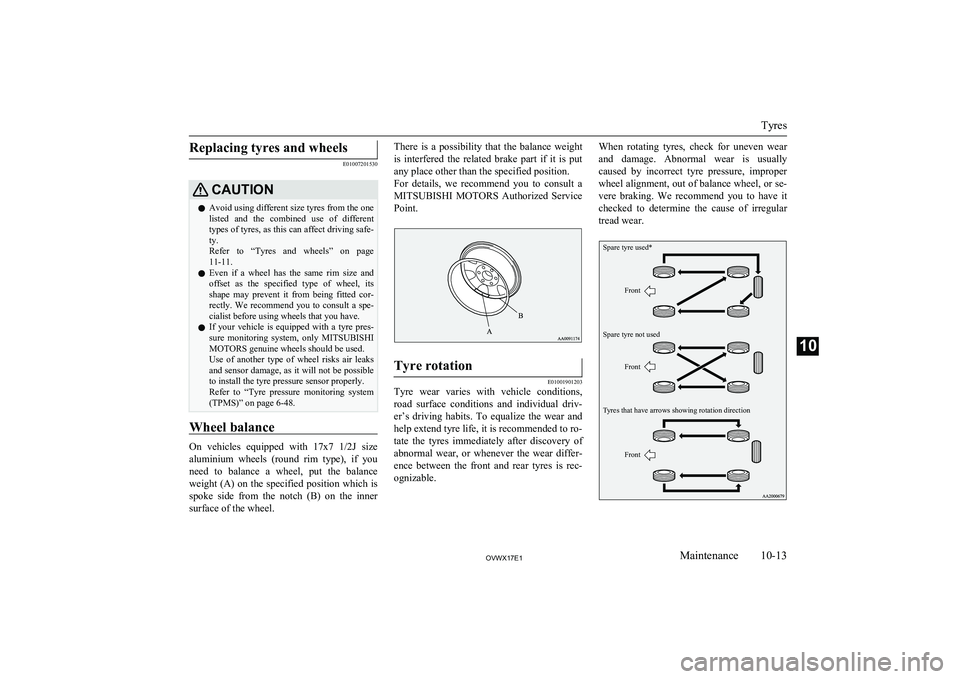
Tyre wear varies with vehicle conditions,
road surface conditions and individual driv- er’s driving habits. To equalize the wear andhelp extend tyre life, it is recommended to ro-
tate the tyres immediately after discovery of
abnormal wear, or whenever the wear differ- ence between the front and rear tyres is rec-
ognizable.
When rotating tyres, check for uneven wear
and damage. Abnormal wear is usually caused by incorrect tyre pressure, improper wheel alignment, out of balance wheel, or se-
vere braking. We recommend you to have it checked to determine the cause of irregular
tread wear.Spare tyre used*Spare tyre not usedTyres that have arrows showing rotation directionFrontFrontFront
Tyres
10-13OVWX17E1Maintenance10
Page 332 of 394

*- If the spare tyre wheel differs from thestandard tyre wheel, do not perform tyre rota-
tion using a spare wheel.CAUTIONl If the tyres have arrows (A) indicating the
correct direction of rotation, swap the front and rear wheels on the left hand side of the
vehicle and the front and rear wheels on the
right hand side of the vehicle separately. Keep each tyre on its original side of the ve-hicle. When fitting the tyres, make sure the
arrows point in the direction in which the wheels will turn when the vehicle moves
forward. Any tyre whose arrow points in the
wrong direction will not perform to its full potential.Front
CAUTIONl Avoid the combined use of different types of
tyres.
Using different types of tyres can affect ve-
hicle performance and safety.Snow tyres
E01002001894
The use of snow tyres is recommended for
driving on snow and ice. To preserve driving stability, mount snow tyres of the same size and tread pattern on all 4 wheels.
Snow tyres worn more than 50% are no lon-
ger suitable for use as snow tyres.
Snow tyres which do not meet specifications must not be used.
CAUTIONl Observe permissible maximum speed for
your snow tyres and the legal speed limit.
l If your vehicle is equipped with a tyre pres-
sure monitoring system, only MITSUBISHI
MOTORS genuine wheels should be used.
Use of another type of wheel risks air leaks and sensor damage, as it will not be possible
to install the tyre pressure sensor properly.
Refer to “Tyre pressure monitoring system
(TPMS)” on page 6-48.NOTEl The laws and regulations concerning snow
tyres (driving speed, required use, type, etc.)
vary. Find out and follow the laws and regu- lations in the area you intend to drive.
l If flange nuts are used on your vehicle,
change to tapered nuts when steel wheels are used.Tyre chains
E01002101794
On 4WD vehicles in which the driving power
is distributed preferentially to the rear wheels, ensure that the tyre chains are fitted
on the rear in accordance with the manufac- turer’s instructions.
Use only tyre chains which are designed for use with the tyres mounted on the vehicle: use of the incorrect size or type of chain
could result in damage to the vehicle body.
Before fitting tyre chains, we recommend you to consult a MITSUBISHI MOTORS
Authorized Service Point. The max. chain
height is as follows.
Tyre sizeWheel size
Max. chain
height[mm]265/65R17 112H
265/65R17 112S
17 x 7 1/2 J22Tyres
10-14OVWX17E1Maintenance10
Page 347 of 394

Rear fog lamp
E01004100371
1. Open the spare wheel garnish (A). (Re-
fer to “To remove the spare wheel” on
page 8-10).
2. Remove the socket and bulb assembly
(B) by turning it anticlockwise, and then remove the bulb by pulling it out.
3. To install the bulb, perform the removal
steps in reverse.High-mounted stop lamp (bulb
type)*
E01004500535
1. Insert a straight blade (or minus) screw-
driver with a cloth over at the edge of
the cover and pry gently to remove the cover.
2. Remove the socket and bulb assembly
together by turning it anticlockwise, and then remove the bulb by pulling it out.
3. To install the bulb, perform the removal
steps in reverse.
Licence plate lamps
E01004602136
1. Remove the mounting screws and re-
move the lamp unit.
Replacement of lamp bulbs
10-29OVWX17E1Maintenance10