2017 MITSUBISHI OUTLANDER SPORT light
[x] Cancel search: lightPage 100 of 399
Power window control
Features and controls 5-37
5
N00510800370
N00548700097
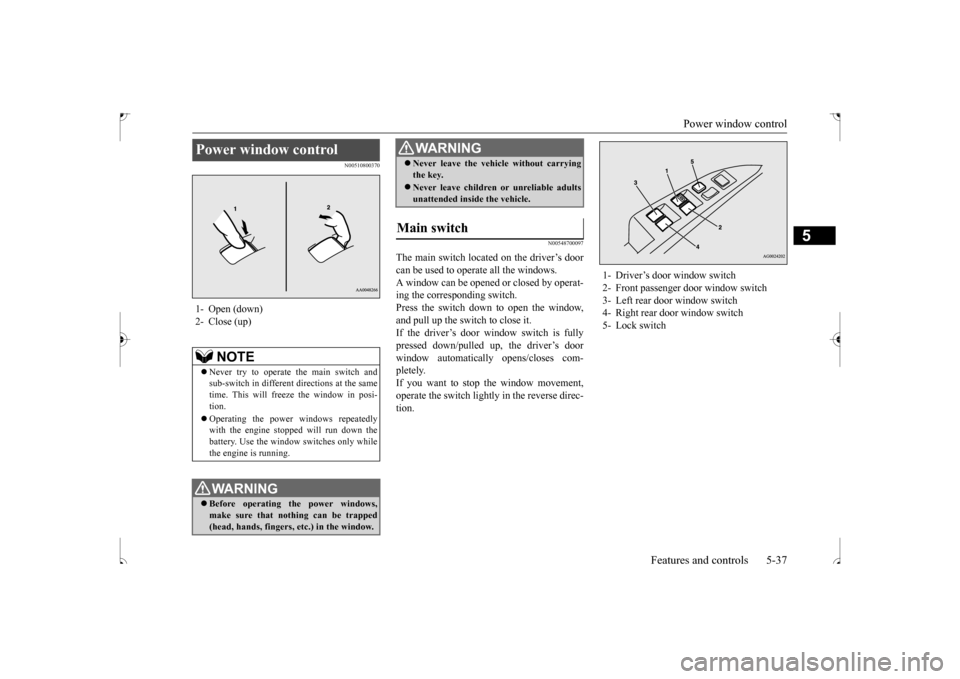
The main switch located on the driver’s door can be used to operate all the windows.A window can be opened or closed by operat- ing the corresponding switch. Press the switch down to open the window,and pull up the switch to close it. If the driver’s door window switch is fully pressed down/pulled up, the driver’s doorwindow automatically opens/closes com- pletely. If you want to stop the window movement,operate the switch lightly in the reverse direc- tion.
Power window control 1- Open (down)2- Close (up)
NOTE
Never try to operate the main switch and sub-switch in different directions at the sametime. This will freeze the window in posi- tion. Operating the power windows repeatedly with the engine stopped will run down the battery. Use the window switches only whilethe engine is running.WA R N I N G Before operating the power windows, make sure that nothing can be trapped(head, hands, fingers, etc.) in the window.
Never leave the vehicle without carrying the key. Never leave children or unreliable adults unattended inside the vehicle.
Main switch
WA R N I N G
1- Driver’s door window switch 2- Front passenger door window switch3- Left rear door window switch 4- Right rear door window switch 5- Lock switch
BK0239500US.bo
ok 37 ページ 2016年5月13日 金曜日 午前8時53分
Page 103 of 399
Parking brake 5-40 Features and controls
5
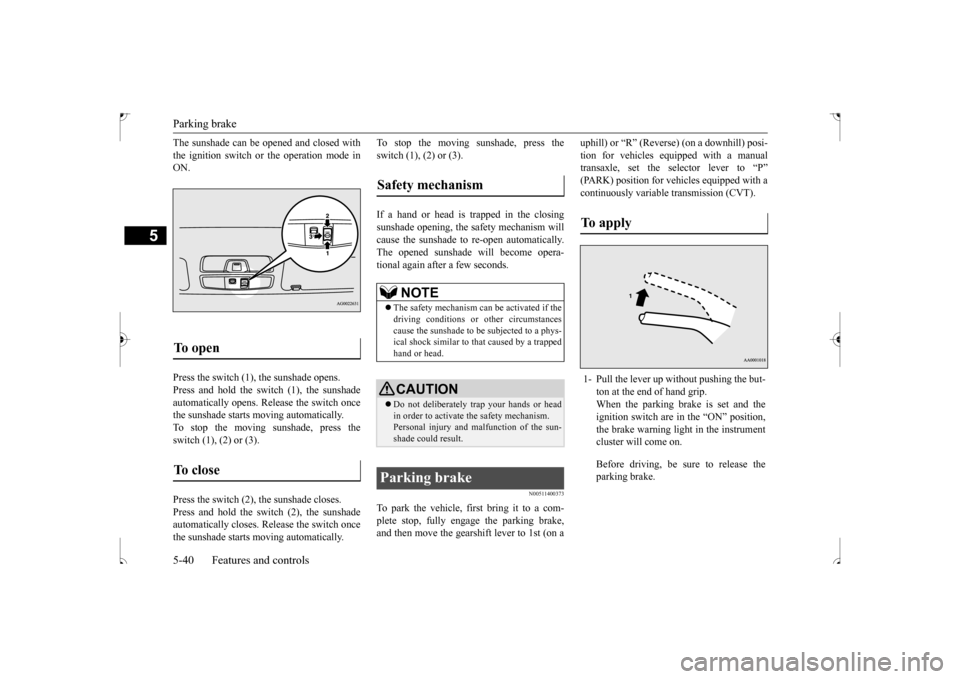
The sunshade can be opened and closed with the ignition switch or the operation mode in ON. Press the switch (1), the sunshade opens. Press and hold the switch (1), the sunshade automatically opens. Release the switch once the sunshade starts moving automatically.To stop the moving sunshade, press the switch (1), (2) or (3). Press the switch (2), the sunshade closes. Press and hold the switch (2), the sunshade automatically closes. Release the switch oncethe sunshade starts moving automatically.
To stop the moving sunshade, press the switch (1), (2) or (3). If a hand or head is trapped in the closing sunshade opening, the safety mechanism will cause the sunshade to re-open automatically. The opened sunshade will become opera-tional again after a few seconds.
N00511400373
To park the vehicle, first bring it to a com-plete stop, fully engage the parking brake, and then move the gearshift lever to 1st (on a
uphill) or “R” (Reverse) (on a downhill) posi- tion for vehicles equipped with a manual transaxle, set the selector lever to “P” (PARK) position for vehicles equipped with acontinuously variable transmission (CVT).
To open
To close
Safety mechanism
NOTE
The safety mechanism can be activated if the driving conditions or other circumstances cause the sunshade to be subjected to a phys-ical shock similar to that caused by a trapped hand or head.CAUTION Do not deliberately trap your hands or head in order to activate the safety mechanism. Personal injury and malfunction of the sun- shade could result.
Parking brake
To apply 1- Pull the lever up without pushing the but-
ton at the end of hand grip. When the parking brake is set and the ignition switch are in the “ON” position,the brake warning light in the instrument cluster will come on. Before driving, be sure to release the parking brake.
BK0239500US.bo
ok 40 ページ 2016年5月13日 金曜日 午前8時53分
Page 104 of 399
Steering wheel height and reach adjustment
Features and controls 5-41
5
When parking on a hill, set the parking brake, and turn the front wheels toward the curb on adownhill, or away from the curb on an uphill.
N00511500228
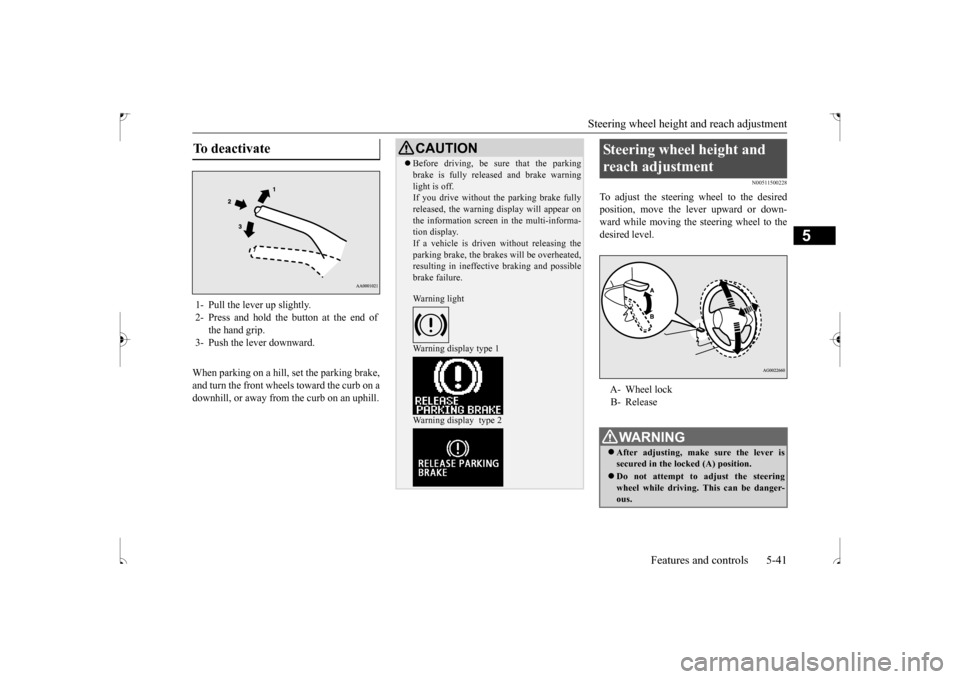
To adjust the steering wheel to the desiredposition, move the lever upward or down-ward while moving the steering wheel to the desired level.
To deactivate 1- Pull the lever up slightly. 2- Press and hold the button at the end of
the hand grip.
3- Push the lever downward.
CAUTION Before driving, be sure that the parking brake is fully released and brake warning light is off. If you drive without the parking brake fully released, the warning display will appear onthe information screen in the multi-informa- tion display. If a vehicle is driven without releasing theparking brake, the brakes will be overheated, resulting in ineffective braking and possible brake failure. Warning light Warning display type 1 Warning display type 2
Steering wheel height and reach adjustment A- Wheel lock B- ReleaseWA R N I N G After adjusting, make sure the lever is secured in the locked (A) position. Do not attempt to adjust the steering wheel while driving. This can be danger-ous.
BK0239500US.bo
ok 41 ページ 2016年5月13日 金曜日 午前8時53分
Page 106 of 399
Inside rearview mirror
Features and controls 5-43
5
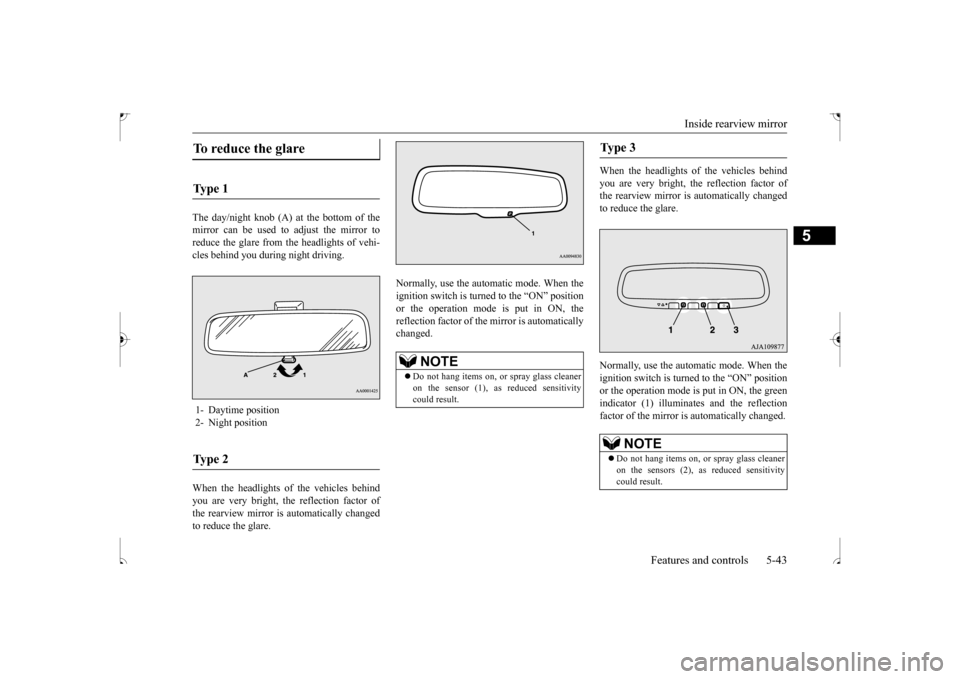
The day/night knob (A) at the bottom of the mirror can be used to adjust the mirror toreduce the glare from the headlights of vehi- cles behind you during night driving. When the headlights of the vehicles behind you are very bright, the reflection factor ofthe rearview mirror is automatically changed to reduce the glare.
Normally, use the automatic mode. When the ignition switch is turned to the “ON” position or the operation mode is put in ON, thereflection factor of the mirror is automatically changed.
When the headlights of the vehicles behind you are very bright, the reflection factor of the rearview mirror is automatically changedto reduce the glare. Normally, use the automatic mode. When the ignition switch is turned to the “ON” position or the operation mode is put in ON, the greenindicator (1) illuminates and the reflectionfactor of the mirror is automatically changed.
To reduce the glare Ty p e 1 1- Daytime position2- Night positionTy p e 2
NOTE
Do not hang items on, or spray glass cleaner on the sensor (1), as reduced sensitivity could result.
Ty p e 3
NOTE
Do not hang items on, or spray glass cleaner on the sensors (2), as reduced sensitivity could result.
BK0239500US.bo
ok 43 ページ 2016年5月13日 金曜日 午前8時53分
Page 109 of 399
Ignition switch 5-46 Features and controls
5
On vehicles equipped with the F.A.S.T.-key, the mirrors automatically retract or extendwhen the doors are locked or unlocked using the remote control transmitter buttons or the F. A . S . T- k e y.Refer to “Keyless entry system” on page 5-25or “To operate using the F.A.S.T.-key” on page 5-14.
N00549300191
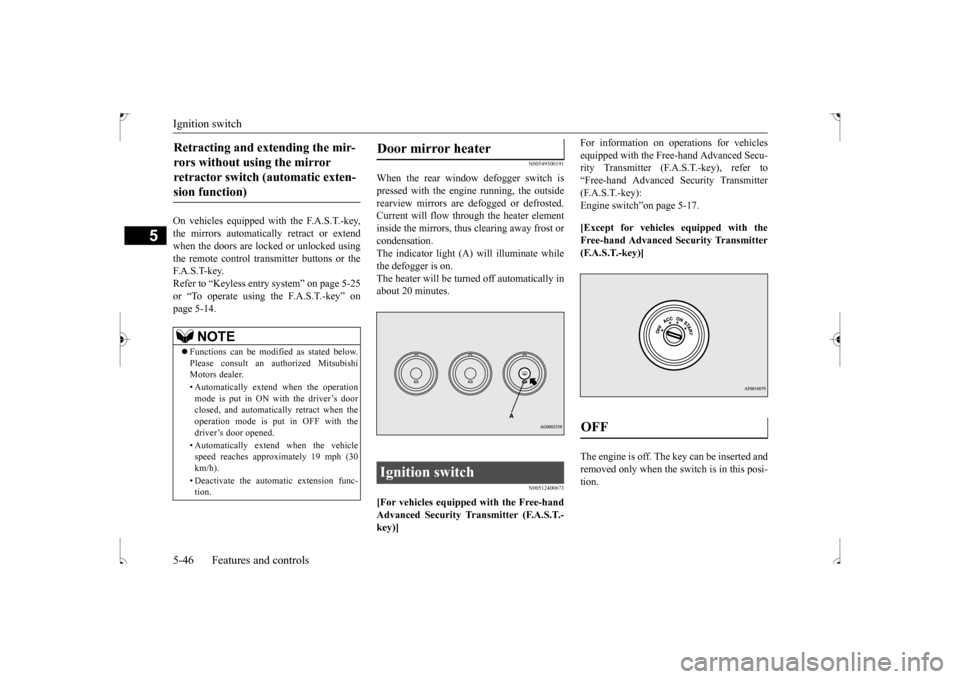
When the rear window defogger switch is pressed with the engine running, the outsiderearview mirrors are defogged or defrosted. Current will flow through the heater element inside the mirrors, thus clearing away frost orcondensation. The indicator light (A) will illuminate while the defogger is on.The heater will be turned off automatically inabout 20 minutes.
N00512400673
[For vehicles equipped with the Free-handAdvanced Security Transmitter (F.A.S.T.- key)]
For information on operations for vehicles equipped with the Free-hand Advanced Secu- rity Transmitter (F.A.S.T.-key), refer to “Free-hand Advanced Security Transmitter(F.A.S.T.-key): Engine switch”on page 5-17. [Except for vehicles equipped with the Free-hand Advanced Security Transmitter(F.A.S.T.-key)] The engine is off. The key can be inserted and removed only when the switch is in this posi-tion.
Retracting and extending the mir- rors without using the mirror retractor switch (automatic exten- sion function)
NOTE
Functions can be modified as stated below. Please consult an authorized MitsubishiMotors dealer. • Automatically extend when the operation mode is put in ON with the driver’s door closed, and automatically retract when the operation mode is put in OFF with thedriver’s door opened. • Automatically extend when the vehicle speed reaches approximately 19 mph (30 km/h). • Deactivate the automatic extension func- tion.
Door mirror heater Ignition switch
OFF
BK0239500US.bo
ok 46 ページ 2016年5月13日 金曜日 午前8時53分
Page 112 of 399
Manual transaxle (if so equipped)
Features and controls 5-49
5
7. Turn the ignition switch to the “ON” posi- tion and make certain that all warning lights are functioning properly before starting the engine.8. Turn the ignition switch to the “START” position without pressing the accelerator pedal. Release the key when the enginestarts.
After several attempts, you may experience that the engine still does not start. 1. Make sure that all electric devices, such as lights, air conditioning blower and rear window defogger, are turned off. 2. While depressing the brake pedal {contin-uously variable transmission (CVT)} or the clutch pedal (manual transaxle), press the accelerator pedal halfway and hold itthere, then crank the engine. Release the accelerator pedal, immediately after the engine starts.
3. If the engine still will not start, the engine could be flooded with too much gasoline. While depressing the brake pedal (CVT) or the clutch pedal (manual transaxle),push the accelerator pedal all the way down and hold it there, then crank the engine for 5 to 6 seconds. Return the igni-tion switch to the “OFF” position and release the accelerator pedal. Wait a few seconds, and then crank the engine againfor 5 to 6 seconds while depressing thebrake pedal (CVT) or the clutch pedal (manual transaxle), but do not push the accelerator pedal. Release the ignition keyif the engine starts. If the engine fails to start, repeat these procedures. If the engine still will not start, contact yourlocal Mitsubishi Motors dealer or a repair facility of your choice for assistance.
When the ambient temperature is -22 °F (-30 °C) or lower, it may not be possible to start from a standstill even with the selector leverin the “D” (DRIVE) or “R” (REVERSE) position.
This occurs because the transaxle has not warmed up sufficiently; it does not indicate a problem. If this occurs, place the selector lever in the “P” (PARK) position and let theengine idle for at least 10 minutes. The transaxle will warm up, and you will be able to start normally.Do not leave the vehicle during warm-up operation.
N00512701194
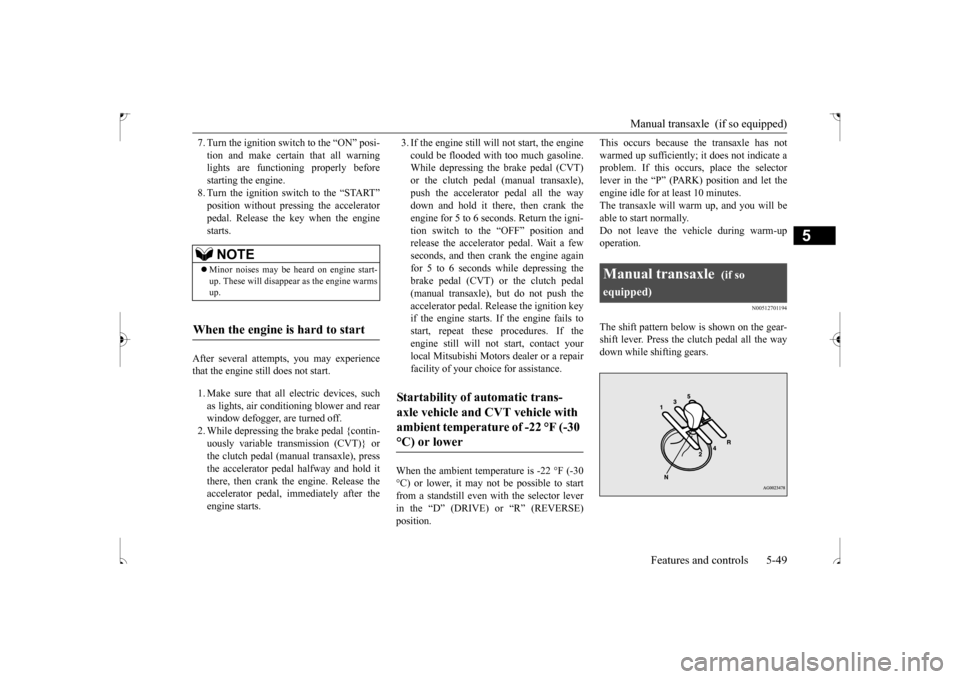
The shift pattern below is shown on the gear-shift lever. Press the clutch pedal all the way down while shifting gears.
NOTE
Minor noises may be heard on engine start- up. These will disappear as the engine warmsup.
When the engine is hard to start
Startability of automatic trans- axle vehicle and CVT vehicle with ambient temperature of -22 °F (-30 °C) or lower
Manual transaxle
(if so
equipped)
BK0239500US.bo
ok 49 ページ 2016年5月13日 金曜日 午前8時53分
Page 120 of 399
Continuously variable transmission (CVT) (if so equipped)
Features and controls 5-57
5
N00560800027
To gain extra acceleration in “D” (DRIVE) position (when passing another vehicle) push the accelerator to the floor. The CVT will automatically downshift.
For short waiting periods, such as at traffic lights, the vehicle can be left in selector leverposition and held stationary with the service brake. For longer waiting periods with the enginerunning, place the selector lever in the “N” (NEUTRAL) position and apply the parking brake, while holding the vehicle stationarywith the service brake. Prior to moving off after having stopped the vehicle, make sure that the selector lever is in“D” (DRIVE) position or Sports mode posi- tion.
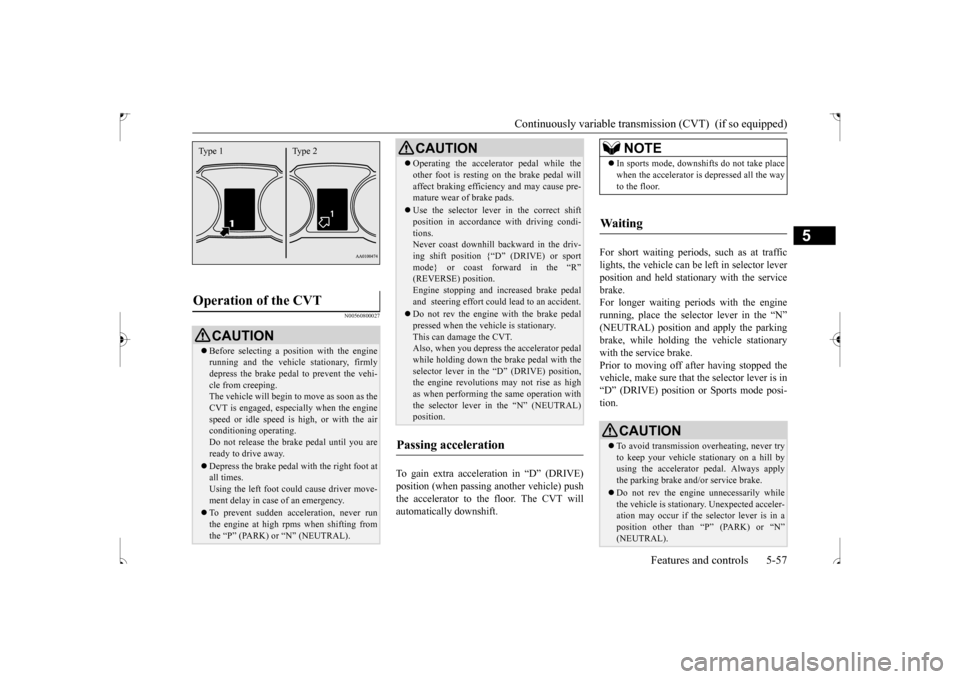
Operation of the CVT
CAUTION Before selecting a position with the engine running and the vehicle stationary, firmly depress the brake pedal to prevent the vehi- cle from creeping.The vehicle will begin to move as soon as the CVT is engaged, especially when the engine speed or idle speed is high, or with the airconditioning operating. Do not release the brake pedal until you are ready to drive away. Depress the brake pedal
with the right foot at
all times.Using the left foot could cause driver move- ment delay in case of an emergency. To prevent sudden acceleration, never run the engine at high rpms when shifting from the “P” (PARK) or “N” (NEUTRAL).Type 1 Type 2
Operating the accelerator pedal while the other foot is resting on the brake pedal will affect braking efficiency and may cause pre- mature wear of brake pads. Use the selector lever in the correct shift position in accordance with driving condi- tions.Never coast downhill backward in the driv- ing shift position {“D” (DRIVE) or sport mode} or coast forward in the “R”(REVERSE) position. Engine stopping and increased brake pedal and steering effort could lead to an accident. Do not rev the engine with the brake pedal pressed when the vehicle is stationary.This can damage the CVT. Also, when you depress the accelerator pedal while holding down the brake pedal with theselector lever in the “D” (DRIVE) position, the engine revolutions may not rise as high as when performing the same operation withthe selector lever in the “N” (NEUTRAL) position.
Passing acceleration
CAUTION
NOTE
In sports mode, downshifts do not take place when the accelerator is depressed all the way to the floor.
Waiting
CAUTION To avoid transmission overheating, never try to keep your vehicle stationary on a hill by using the accelerator pedal. Always apply the parking brake and/or service brake. Do not rev the engine unnecessarily while the vehicle is stationary. Unexpected acceler-ation may occur if the selector lever is in a position other than “P” (PARK) or “N” (NEUTRAL).
BK0239500US.bo
ok 57 ページ 2016年5月13日 金曜日 午前8時53分
Page 124 of 399
4-wheel drive operation
Features and controls 5-61
5
When turning a sharp corner in “4WD LOCK” position at low speed, a slight differ- ence in steering may be experienced similarto feeling as if the brakes were applied. This
is called tight corner braking and results from each of the four tires being at a different dis- tance from the corner. The phenomenon is typical of 4-wheel drive vehicles. If thisoccurs, either straighten out the steering wheel or change to another mode. Set the drive mode-selector to “4WD AUTO” or “4WD LOCK” in accordance with the road conditions, and then gradually depress the accelerator pedal for a smooth start.
WA R N I N G Do not over-rely on the 4-wheel drive vehi- cles. Even 4-wheel drive vehicles have lim- its to the system and ability to maintain control and traction. Reckless driving may lead to accidents. Always drive carefully,taking account of the road conditions. Improperly operating this vehicle on or off-pavement can cause an accident or rollover in which you and your passengers could be seriously injured or killed.• Follow all instructio
ns and guidelines in
the owner’s manual.• Keep your speed low and do not drivefaster than conditions.NOTE
Driving on rough roads can be hard on a vehicle. Before you leave the pavement, be sure all scheduled maintenance and servicehas been done, and that you have inspected your vehicle. Pay special attention to the condition of the tires, and check the tire pres-sures. Mitsubishi Motors is not responsible to the operator for any damage or injury caused or liability incurred by improper and negligentoperation of a vehicle. All techniques of vehicle operation depend on the skill and experience of the operator and other partici-pating parties. Any deviation from the rec- ommended operating instructions above is at their own risk.
Note that the stopping distance required of the 4-wheel drive vehicle differs very little from that of the front-wheel drive vehicle. When driving on a snow-covered road or a slippery, muddy surface, make sure that youkeep a sufficient distance between your vehi- cle and the one ahead of you. The driving posture should be more upright; adjust the seat to a good position for easy steering and pedal operation. Be sure to wearthe seat belt. After driving on rough roads, check each part of the vehicle and wash it thoroughly with water. Refer to the “Inspection and maintenance following rough road opera-tion” section and “Vehicle care and Mainte- nance” sections.CAUTION Setting the drive mode-selector to “4WD LOCK” position to drive on dry paved roadwill increase fuel consumption, with possible noise generation.
Turning sharp corners
NOTE
On snowy or icy roads
NOTE
The use of snow tires is recommended. Maintain a safe distance between vehicles, avoid sudden braking, and use engine brak- ing (downshifting).CAUTION Avoid sudden braking, sudden acceleration and sharp turning. Skidding occurs and con- trol of the vehicle could be lost.
BK0239500US.bo
ok 61 ページ 2016年5月13日 金曜日 午前8時53分