2017 MITSUBISHI OUTLANDER SPORT ECU
[x] Cancel search: ECUPage 34 of 399

Seat belts
Seat and restraint systems 4-13
4
1. Occupants should always sit back in their seats with their backs against the upright seatback. To reduce the risk of serious injury or death during deployment of theairbag, adjust the driver’s seat as far back as possible while maintaining a position that still enables you to fully apply thepedals, easily control the steering wheel, and safely operate the vehicle. The front passenger seat should also be moved asfar back as possible. Refer to “Supple-mental Restraint System (SRS) - airbag” on page 4-26. Also refer to “To adjust the seat forward or backward” on page 4-3.
2. Before using the rear center seat belt, make sure that the detachable anchor issecurely latched and the seat belt is not twisted. For details, refer to page 4-14. 3. Grasp the latch plate and slide it up thewebbing so that it easily pulls across your body.
4. Pull the seat belt out slowly while holding the latch plate. Push the latch plate into the buckle until you hear a “click”. Pull up on the belt to be sure the latch plate islocked securely in the buckle. 5. The lap part of the belt must always be worn low and snug across the hips. Pull up on the shoulder portion of the belt to take up any slack in the lap belt.
WA R N I N G To reduce the risk of serious injury or death in the event of an accident or sud- den stop, all seatbacks should be kept in the upright position while the vehicle is in motion.Seat belt performance during an accident can be adversely affected if the seatbacks are reclined. The more a seatback isreclined, the more likely seat belt perfor- mance will be adversely affected. If the seat belt is not properly positioned againstthe body during an accident, there is increased risk you will slide under the belt and receive serious injury or death.
NOTE
If the seat belt locks up and cannot be pulled out, pull it once with force and let it retractall the way. Then, pull the belt out slowly once again.
BK0239500US.bo
ok 13 ページ 2016年5月13日 金曜日 午前8時53分
Page 37 of 399
Seat belts 4-16 Seat and restraint systems
4
N00418400342
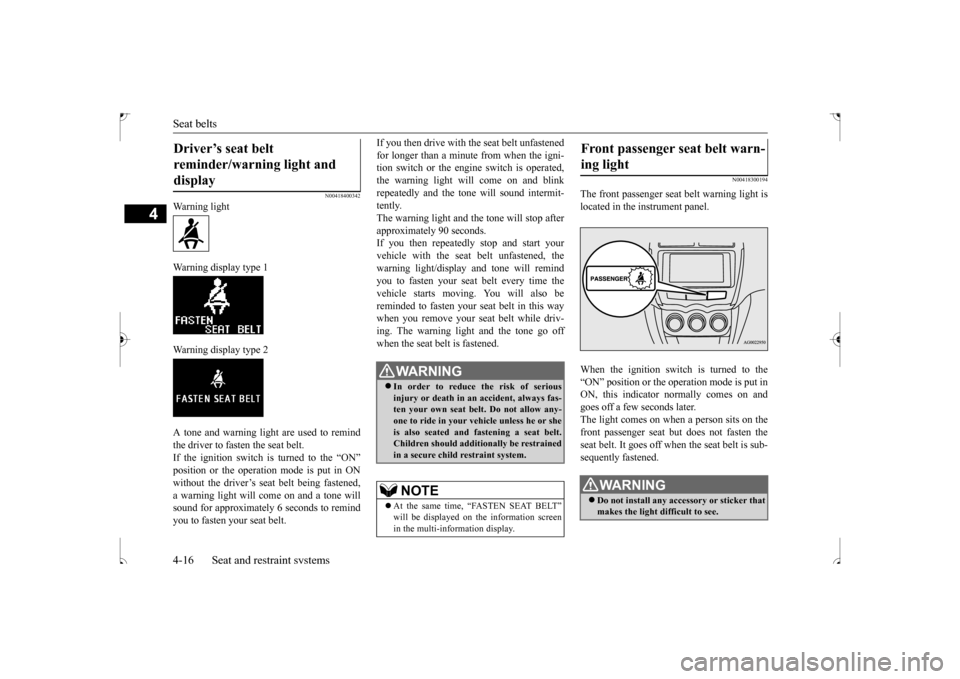
Warning light Warning display type 1 Warning display type 2 A tone and warning light are used to remind the driver to fasten the seat belt.If the ignition switch is turned to the “ON” position or the operation mode is put in ON without the driver’s seat belt being fastened,a warning light will come on and a tone will sound for approximately 6 seconds to remind you to fasten your seat belt.
If you then drive with the seat belt unfastened for longer than a minute from when the igni- tion switch or the engine switch is operated, the warning light will come on and blinkrepeatedly and the tone will sound intermit- tently. The warning light and the tone will stop afterapproximately 90 seconds. If you then repeatedly stop and start your vehicle with the seat belt unfastened, thewarning light/display and tone will remindyou to fasten your seat belt every time the vehicle starts moving. You will also be reminded to fasten your seat belt in this waywhen you remove your seat belt while driv- ing. The warning light and the tone go off when the seat belt is fastened.
N00418300194
The front passenger seat belt warning light islocated in the instrument panel. When the ignition switch is turned to the “ON” position or the operation mode is put inON, this indicator normally comes on andgoes off a few seconds later. The light comes on when a person sits on the front passenger seat but does not fasten theseat belt. It goes off when the seat belt is sub- sequently fastened.
Driver’s seat belt reminder/warning light and display
WA R N I N G In order to reduce the risk of serious injury or death in an accident, always fas- ten your own seat belt. Do not allow any-one to ride in your vehicle unless he or she is also seated and fastening a seat belt. Children should additionally be restrained in a secure child restraint system.NOTE
At the same time, “FASTEN SEAT BELT” will be displayed on the information screen in the multi-information display.
Front passenger seat belt warn- ing light
WA R N I N G Do not install any accessory or sticker that makes the light difficult to see.
BK0239500US.bo
ok 16 ページ 2016年5月13日 金曜日 午前8時53分
Page 38 of 399
Seat belt use during pregnancy
Seat and restraint systems 4-17
4
N00406300344
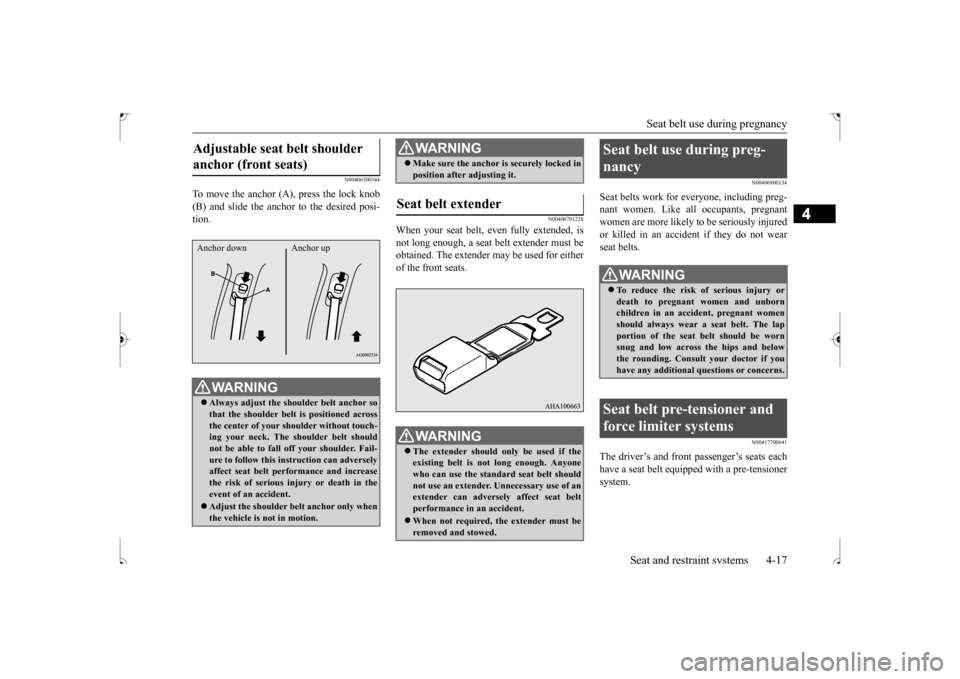
To move the anchor (A), press the lock knob (B) and slide the anchor to the desired posi- tion.
N00406701228
When your seat belt, even fully extended, is not long enough, a seat belt extender must be obtained. The extender may be used for either of the front seats.
N00406800134
Seat belts work for ev
eryone, including preg-
nant women. Like all occupants, pregnantwomen are more likely to be seriously injured or killed in an accident if they do not wear seat belts.
N00417700641
The driver’s and front passenger’s seats eachhave a seat belt equipped with a pre-tensioner system.
Adjustable seat belt shoulder anchor (front seats)
WA R N I N G Always adjust the shoulder belt anchor so that the shoulder belt is positioned acrossthe center of your shoulder without touch- ing your neck. The shoulder belt should not be able to fall off your shoulder. Fail-ure to follow this instruction can adversely affect seat belt performance and increase the risk of serious injury or death in theevent of an accident. Adjust the shoulder belt anchor only when the vehicle is not in motion.
Anchor down Anchor up
Make sure the anchor is securely locked in position after adjusting it.
Seat belt extender
WA R N I N G The extender should only be used if the existing belt is not long enough. Anyone who can use the standard seat belt shouldnot use an extender. Unnecessary use of an extender can adversely affect seat belt performance in an accident. When not required, the extender must be removed and stowed.WA R N I N G
Seat belt use during preg- nancy
WA R N I N G To reduce the risk of serious injury or death to pregnant women and unbornchildren in an accident, pregnant women should always wear a seat belt. The lap portion of the seat belt should be wornsnug and low across the hips and below the rounding. Consult your doctor if you have any additional questions or concerns.
Seat belt pre-tensioner and force limiter systems
BK0239500US.bo
ok 17 ページ 2016年5月13日 金曜日 午前8時53分
Page 42 of 399
Child restraint systems
Seat and restraint systems 4-21
4
N00418800128
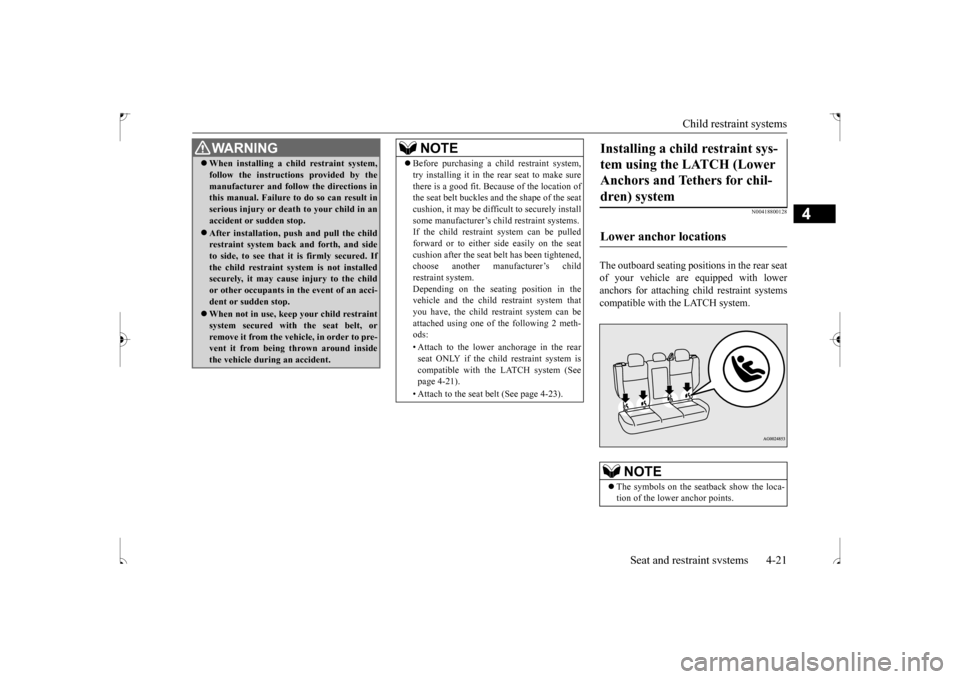
The outboard seating positions in the rear seat of your vehicle are equipped with loweranchors for attaching child restraint systemscompatible with the LATCH system.
When installing a child restraint system, follow the instructions provided by the manufacturer and follow the directions in this manual. Failure to do so can result in serious injury or death to your child in anaccident or sudden stop. After installation, push and pull the child restraint system back
and forth, and side
to side, to see that it is firmly secured. If the child restraint system is not installedsecurely, it may cause injury to the child or other occupants in the event of an acci- dent or sudden stop. When not in use, keep your child restraint system secured with the seat belt, orremove it from the vehicle, in order to pre- vent it from being thrown around inside the vehicle during an accident.WA R N I N G
NOTE
Before purchasing a child restraint system, try installing it in the
rear seat to make sure
there is a good fit. Because of the location of the seat belt buckles and the shape of the seat cushion, it may be difficult to securely installsome manufacturer’s child restraint systems. If the child restraint system can be pulled forward or to either side easily on the seatcushion after the seat belt has been tightened, choose another manufacturer’s child restraint system.Depending on the seating position in the vehicle and the child restraint system that you have, the child restraint system can beattached using one of the following 2 meth- ods: • Attach to the lower anchorage in the rear seat ONLY if the child restraint system is compatible with the LATCH system (Seepage 4-21). • Attach to the seat belt (See page 4-23).
Installing a child restraint sys- tem using the LATCH (Lower Anchors and Tethers for chil- dren) system Lower anchor locations
NOTE
The symbols on the seatback show the loca- tion of the lower anchor points.
BK0239500US.bo
ok 21 ページ 2016年5月13日 金曜日 午前8時53分
Page 43 of 399
Child restraint systems 4-22 Seat and restraint systems
4
N00418901214
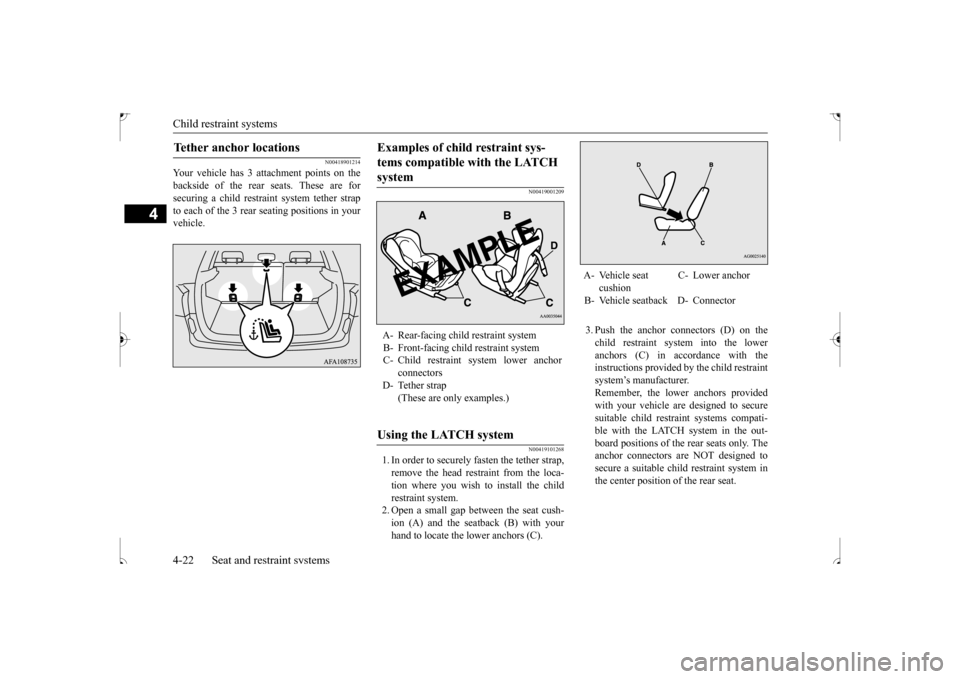
Your vehicle has 3 attachment points on the backside of the rear seats. These are forsecuring a child restraint system tether strap to each of the 3 rear seating positions in your vehicle.
N00419001209 N00419101268
1. In order to securely fasten the tether strap, remove the head restraint from the loca- tion where you wish to install the childrestraint system. 2. Open a small gap between the seat cush- ion (A) and the seatback (B) with yourhand to locate the lower anchors (C).
3. Push the anchor connectors (D) on the child restraint system into the loweranchors (C) in accordance with the instructions provided by the child restraint system’s manufacturer.Remember, the lower anchors providedwith your vehicle are designed to secure suitable child restraint systems compati- ble with the LATCH system in the out-board positions of the rear seats only. The anchor connectors are NOT designed to secure a suitable child restraint system inthe center position of the rear seat.
Tether anchor locations
Examples of child restraint sys- tems compatible with the LATCH system A- Rear-facing child restraint system B- Front-facing child restraint systemC- Child restraint system lower anchor
connectors
D- Tether strap
(These are only examples.)
Using the LATCH system
A- Vehicle seat
cushion
C- Lower anchor
B- Vehicle seatback D- Connector
BK0239500US.bo
ok 22 ページ 2016年5月13日 金曜日 午前8時53分
Page 44 of 399
Child restraint systems
Seat and restraint systems 4-23
4
4. Remove the cargo area cover from the vehicle. (Refer to “Cargo area cover” onpage 5-177.)
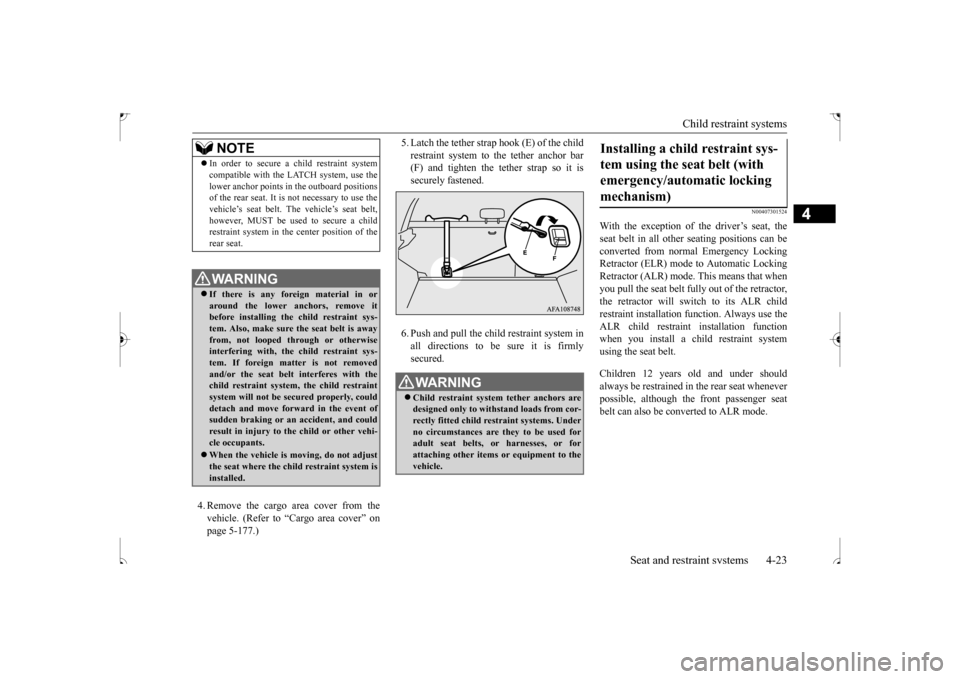
5. Latch the tether strap hook (E) of the child restraint system to the tether anchor bar (F) and tighten the tether strap so it is securely fastened. 6. Push and pull the ch
ild restraint system in
all directions to be sure it is firmlysecured.
N00407301524
With the exception of the driver’s seat, theseat belt in all other seating positions can beconverted from normal Emergency Locking Retractor (ELR) mode to Automatic Locking Retractor (ALR) mode. This means that whenyou pull the seat belt fully out of the retractor,the retractor will switch to its ALR child restraint installation function. Always use the ALR child restraint installation functionwhen you install a child restraint system using the seat belt. Children 12 years old and under should always be restrained in the rear seat wheneverpossible, although the front passenger seat belt can also be converted to ALR mode.
NOTE
In order to secure a child restraint system compatible with the LATCH system, use the lower anchor points in the outboard positions of the rear seat. It is not necessary to use the vehicle’s seat belt. The vehicle’s seat belt,however, MUST be used to secure a child restraint system in the center position of the rear seat.WA R N I N G If there is any foreign material in or around the lower anchors, remove it before installing the child restraint sys-tem. Also, make sure the seat belt is away from, not looped through or otherwise interfering with, the child restraint sys-tem. If foreign matter is not removed and/or the seat belt interferes with the child restraint system, the child restraintsystem will not be secured properly, could detach and move forward in the event of sudden braking or an accident, and couldresult in injury to the child or other vehi- cle occupants. When the vehicle is moving, do not adjust the seat where the child restraint system isinstalled.
WA R N I N G Child restraint system tether anchors are designed only to withstand loads from cor-rectly fitted child restraint systems. Under no circumstances are they to be used for adult seat belts, or harnesses, or forattaching other items or equipment to the vehicle.
Installing a child restraint sys- tem using the seat belt (with emergency/automatic locking mechanism)
BK0239500US.bo
ok 23 ページ 2016年5月13日 金曜日 午前8時53分
Page 45 of 399
Child restraint systems 4-24 Seat and restraint systems
4
1. Place the child restraint system on the seat where you wish to install it. To help assure proper fitting of the childrestraint system, always remove the head restraint.
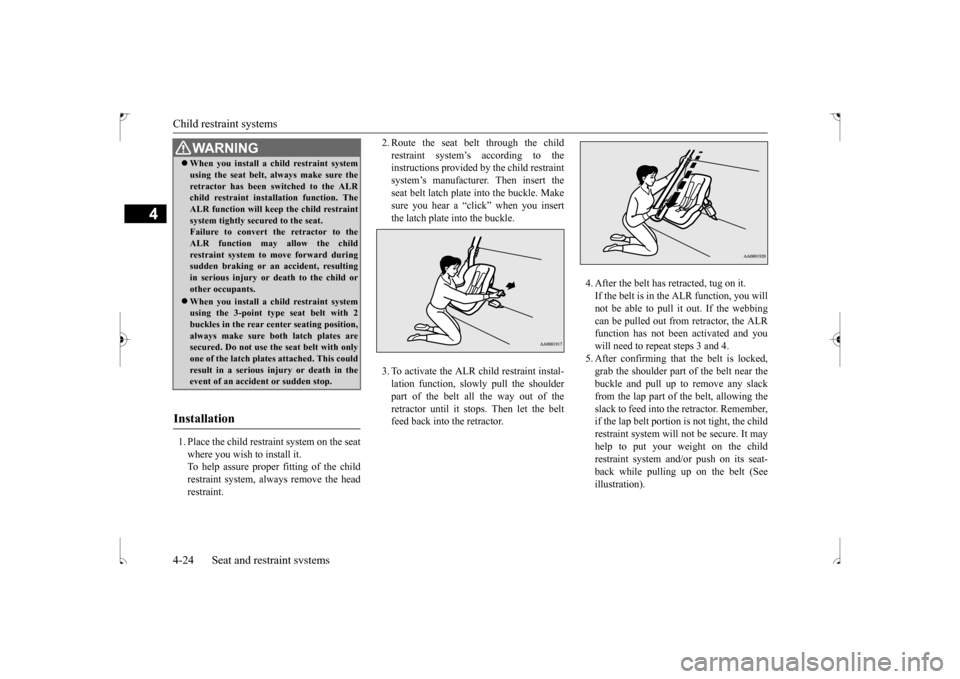
2. Route the seat belt through the child restraint system’s according to the instructions provided by the child restraint system’s manufacturer. Then insert theseat belt latch plate into the buckle. Make sure you hear a “click” when you insert the latch plate into the buckle. 3. To activate the ALR child restraint instal- lation function, slow
ly pull the shoulder
part of the belt all the way out of theretractor until it stops. Then let the belt feed back into the retractor.
4. After the belt has retracted, tug on it. If the belt is in the ALR function, you will not be able to pull it out. If the webbingcan be pulled out from retractor, the ALR function has not been activated and you will need to repeat steps 3 and 4.5. After confirming that the belt is locked,grab the shoulder part of the belt near the buckle and pull up to remove any slack from the lap part of the belt, allowing theslack to feed into the retractor. Remember, if the lap belt portion is not tight, the child restraint system will not be secure. It mayhelp to put your weight on the child restraint system and/or push on its seat- back while pulling up on the belt (Seeillustration).
WA R N I N G When you install a child restraint system using the seat belt, always make sure the retractor has been switched to the ALR child restraint installation function. The ALR function will keep the child restraintsystem tightly secured to the seat. Failure to convert the retractor to the ALR function may allow the childrestraint system to move forward during sudden braking or an accident, resulting in serious injury or death to the child orother occupants. When you install a child restraint system using the 3-point type seat belt with 2 buckles in the rear center seating position, always make sure both latch plates aresecured. Do not use the seat belt with only one of the latch plates attached. This could result in a serious injury or death in theevent of an accident or sudden stop.
Installation BK0239500US.bo
ok 24 ページ 2016年5月13日 金曜日 午前8時53分
Page 46 of 399
Child restraint systems
Seat and restraint systems 4-25
4
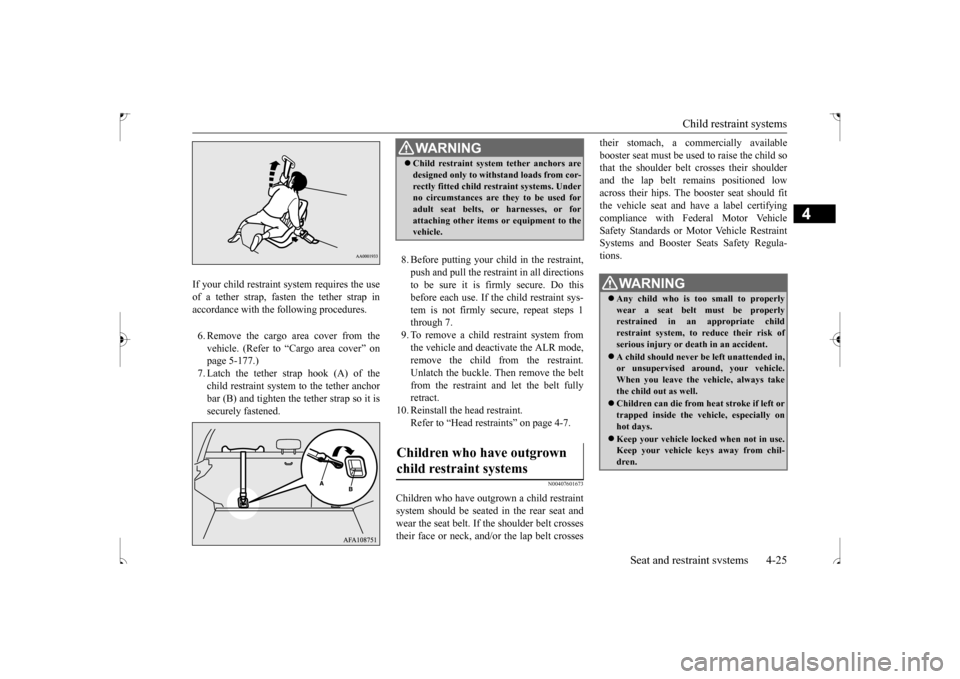
6. Remove the cargo area cover from the vehicle. (Refer to “Cargo area cover” on page 5-177.) 7. Latch the tether strap hook (A) of thechild restraint system to the tether anchorbar (B) and tighten the tether strap so it is securely fastened.
8. Before putting your child in the restraint, push and pull the restraint in all directions to be sure it is firmly secure. Do this before each use. If the child restraint sys-tem is not firmly secure, repeat steps 1 through 7. 9. To remove a child restraint system fromthe vehicle and deactivate the ALR mode, remove the child from the restraint. Unlatch the buckle. Then remove the beltfrom the restraint and let the belt fully retract.
10. Reinstall the head restraint.
Refer to “Head restraints” on page 4-7.
N00407601673
Children who have outgrown a child restraint system should be seated in the rear seat and wear the seat belt. If the shoulder belt crossestheir face or neck, and/or the lap belt crosses
their stomach, a commercially available booster seat must be used to raise the child so that the shoulder belt crosses their shoulder and the lap belt remains positioned lowacross their hips. The booster seat should fit the vehicle seat and have a label certifying compliance with Federal Motor VehicleSafety Standards or Motor Vehicle Restraint Systems and Booster Seats Safety Regula- tions.
If your child restraint system requires the use of a tether strap, fasten the tether strap in accordance with the following procedures.
WA R N I N G Child restraint system tether anchors are designed only to withstand loads from cor- rectly fitted child restraint systems. Under no circumstances are they to be used for adult seat belts, or harnesses, or forattaching other items or equipment to the vehicle.
Children who have outgrown child restraint systems
WA R N I N G Any child who is too small to properly wear a seat belt must be properlyrestrained in an appropriate child restraint system, to reduce their risk of serious injury or death in an accident. A child should never be left unattended in, or unsupervised around, your vehicle.When you leave the vehicle, always take the child out as well. Children can die from he
at stroke if left or
trapped inside the vehicle, especially on hot days. Keep your vehicle locked when not in use. Keep your vehicle keys away from chil- dren.
BK0239500US.bo
ok 25 ページ 2016年5月13日 金曜日 午前8時53分