2017 MITSUBISHI OUTLANDER PHEV ESP
[x] Cancel search: ESPPage 221 of 548

Economical drivingE00600102422
For economical driving, there are some tech- nical requirements that have to be met. Theprerequisite for low fuel consumption is a
properly adjusted engine. In order to achieve longer life of the vehicle and the most eco- nomical operation, we recommend you tohave the vehicle checked at regular intervals in accordance with the service standards.
Fuel economy and generation of exhaust gas
and noise are highly influenced by personal
driving habits as well as the particular operat- ing conditions. The following points shouldbe observed in order to minimize wear of
brakes, tyres and engine as well as to reduce
environmental pollution.
Starting and acceleration
Avoid driving when the accelerator pedal ispressed way down, such as for unnecessarily sudden starts, acceleration and deceleration.
Smoothly depress the accelerator pedal.
Observe the speed limit and keep the speed
as constant as possible while driving.
Idling
Parking for a long period with the ready indi-
cator illuminated will shorten the cruising
range.
Speed
The higher the vehicle speed, the more drive
battery is consumed. Avoid driving at full speed. Even a slight release of the accelerator
pedal will save a significant amount of drive battery.
Tyre inflation pressure
Check the tyre inflation pressures at regular intervals. Low tyre inflation pressure increa-ses road resistance and fuel consumption. In addition, low tyre pressures adversely affect
tyre wear and driving stability.
Cargo loads
Do not drive with unnecessary articles in the
luggage compartment. Especially during city
driving where frequent starting and stopping is necessary, the increased weight of the ve-
hicle will greatly affect fuel consumption. Al- so avoid driving with unnecessary luggage or carriers, etc., on the roof; the increased air re- sistance will increase fuel consumption.
Air conditioning
Too much cooling/heating can affect the cruising range, so maintain an appropriatetemperature to extend the cruising range.
Driving, alcohol and drugs
E00600200070
Driving after drinking alcohol is one of the
most frequent causes of accidents.
Your driving ability can be seriously im- paired even with blood alcohol levels far be-
low the legal minimum. If you have been drinking, don’t drive. Ride with a designated non-drinking driver, call a cab or a friend, or
use public transportation. Drinking coffee or
taking a cold shower will not make you so- ber.
Similarly, prescription and nonprescription
drugs affect your alertness, perception and re- action time. Consult with your doctor or
pharmacist before driving while under the in- fluence of any of these medications.WARNINGl NEVER DRINK AND DRIVE.
Your perceptions are less accurate, your
reflexes are slower and your judgment is impaired.Safe driving techniques
E00600301775
Driving safety and protection against injury
cannot be fully ensured. However, we recom- mend that you pay extra attention to the fol-
lowing:
Economical driving
7-02OGGE17E1Starting and driving7
Page 240 of 548

To increase generative force
Each time you pull the - (DOWN) paddle to-
wards you, the regenerative brake force rises one level.
To return to the normal regen-
erative brake force level of B2
Pull the + (UP) paddle for approx. 2 seconds
or longer. The select lever position indicator displays “D”.
S-AWC (Super All Wheel
Control) E00622601185
S-AWC is an integrated vehicle dynamics
control system that helps enhance driving
performance, cornering performance, and ve-
hicle stability over a wide range of driving conditions through integrated management of the twin motor 4WD, the AYC (Active Yaw
Control), the ABS and the ASC.
CAUTIONl Do not over-rely on the S-AWC. Even the S-
AWC cannot prevent the natural laws of
physics from acting on the vehicle. This sys- tem, like any other system, has limits and
cannot help you to maintain traction and
control of the vehicle in all circumstances. Reckless driving may lead to accidents. It is the driver’s responsibility to drive carefully.
This means taking into account the traffic,
road and environmental conditions.
Twin Motor 4WD
This system improves vehicle stability per-
formance and fuel economy performanceduring acceleration and deceleration by mo-
tors provided at front and rear wheels, re- spectively, controlling the distribution of a
drive force between the front and rear wheels optimal for the operation of the driver.
Active yaw control system
(AYC)
E00622801044
The AYC is a system, with a left-right differ- ential limiting function and yaw control func-
tion, that controls the left-right driving/brak-
ing force by managing the brake.
S-AWC (Super All Wheel Control)
7-21OGGE17E1Starting and driving7
Page 241 of 548
CAUTIONlControl of the braking force does not en-
hance the stopping performance of the vehi-
cle, therefore, pay careful attention to the safety of your surroundings when driving.
Left-right differential limiting
function
The left-right differential limiting function is
a function that enhances driving performance and vehicle stability by preventing idle spin-
ning of a wheel when driving on a slippery road or when the road surfaces of left andright wheels are different.
Yaw control function
The yaw control function is a function thatenhances vehicle cornering performance and vehicle stability with management of vehicle
turning power (yaw moment) by controlling the brake force when the vehicle does not
turn in response to steering input, such as
when the steering wheel is turned quickly or when driving on a slippery road.
4WD lock switch
E00637000063
If the 4WD lock switch is pressed when the
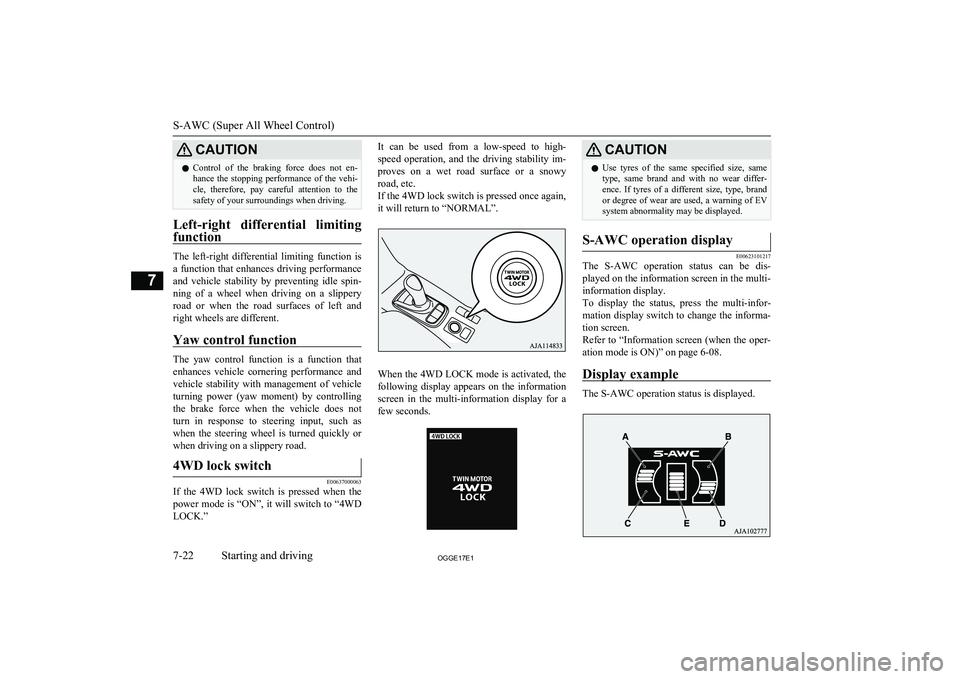
power mode is “ON”, it will switch to “4WD LOCK.”
It can be used from a low-speed to high-
speed operation, and the driving stability im- proves on a wet road surface or a snowyroad, etc.
If the 4WD lock switch is pressed once again, it will return to “NORMAL”.
When the 4WD LOCK mode is activated, the
following display appears on the information
screen in the multi-information display for a few seconds.
CAUTIONl Use tyres of the same specified size, same
type, same brand and with no wear differ- ence. If tyres of a different size, type, brandor degree of wear are used, a warning of EVsystem abnormality may be displayed.S-AWC operation display
E00623101217
The S-AWC operation status can be dis-
played on the information screen in the multi-
information display.
To display the status, press the multi-infor-
mation display switch to change the informa- tion screen.
Refer to “Information screen (when the oper- ation mode is ON)” on page 6-08.
Display example
The S-AWC operation status is displayed.
S-AWC (Super All Wheel Control)
7-22OGGE17E1Starting and driving7
Page 243 of 548

NOTElDriving on rough roads can be hard on a ve-
hicle. Before you leave paved roads, be sure all scheduled maintenance and service has
been done, and that you have inspected your vehicle. Pay special attention to the condi- tion of the tyres, and check the tyre pres-
sures.
l MITSUBISHI
MOTORS is not responsible
for any damage or injury caused or liability
incurred by improper and negligent opera- tion of a vehicle by the operator. All techni-
ques of vehicle operation depend on the skill and experience of the operator and other par- ticipating parties. Any deviation from the
recommended operating instructions above is at their own risk.
l Note that the stopping distance required of a
4-wheel drive vehicle differs very little from
that of a 2-wheel drive vehicle. When driv- ing on a snow-covered road or a slippery,muddy surface, make sure that you keep a
sufficient distance between your vehicle and
the one ahead of you.
l The driving posture should be more upright;
adjust the seat to a good position for easy steering and pedal operation. Be sure to wear
the seat belt.
l After driving on rough roads, check each
part of the vehicle and wash it thoroughlywith water. Refer to the “Inspection andmaintenance following rough road opera-
tion” section and “Maintenance” section.NOTEl When moving out of mud, sand or fresh
snow, pressing the accelerator pedal may not
allow the Plug-in Hybrid EV system output to increase. In such situations, switching to
“4WD LOCK” with the 4WD lock switch and temporarily turning off the Active Sta- bility Control (ASC) with the “ASC OFF”
switch will make it easier to move out your vehicle.
Refer to “Operation under adverse driving
conditions: If your vehicle becomes stuck in sand, mud or snow” on page 9-26.
Climbing/descending sharp
grades
Your vehicle may not provide sufficient hill
climbing ability and regenerative brake on steep slope. Avoid driving on steep slopes
even though the vehicle is a 4-wheel drive vehicle.
Inspection and maintenance
following rough roadoperation E00606701407
After operating the vehicle in rough road
conditions, be sure to perform the following inspection and maintenance procedures:
l Check that the vehicle has not been dam-
aged by rocks, gravel, etc.
l Carefully wash the vehicle with water.
Drive the vehicle slowly while lightly
depressing the brake pedal in order to dry out the brakes. If the brakes still do
not function properly, we recommend you to have the brakes checked as soon
as possible.
l Remove the insects, dried grass, etc.
clogging the radiator core.
l Check the inside of the vehicle. If water
entry is found, dry the carpet etc.
l Inspect the headlamps. If the headlamp
bulb is flooded with water, we recom-
mend you to have it drained.Cautions on handling of 4-
wheel drive vehicles E00606801844
Tyres and wheels
Since the driving torque can be applied to the
4 wheels, the driving performance of the ve- hicle when operating in 4-wheel drive is
greatly affected by the condition of the tyres.
Pay close attention to the tyres.
Inspection and maintenance following rough road operation
7-24OGGE17E1Starting and driving7
Page 246 of 548

NOTE•When the protecting device of the Plug-in
Hybrid EV System is working.
l When the battery charge mode switch or the
battery save mode switch is turned on while
driving in the EV priority mode, the mode changes to the selected mode.
If the EV switch is pressed, the mode is re- turned to the EV priority mode.
However, the mode may not return to the
EV priority mode depending on the remain- ing power in the drive battery.
l In any of the situations listed below, the EV
priority mode continues even if the engine is automatically started.
• When the accelerator pedal is fully de-
pressed.
• When the vehicle speed is over 120 km/h
(74 mph).
• When the cruise control or Adaptive
Cruise Control System (ACC) is operat-
ing.
• When the demister switch is pressed.
NOTEl If the ambient temperature is low, the engine
may start for heating when the air condition- er is operated.
If you want to stop the engine running for heating, select the EV priority mode before
operating the air conditioner.
l In the EV priority mode, the accelerator ped-
al response may be negative even if the ac-
celerator pedal is depressed or released.
l The motor output in the EV priority mode
may decrease due to the deteriorated drive
battery or the ambient temperature falls. In such a case, start the engine by cancelling
the EV priority mode to secure the motor output.Battery save mode switch
E00636800064
The remaining quantity of the drive battery
can be kept if you drive in the EV driving mode at a residential area or use electric
power at the destination.
Moreover, the electric power consumption of
the drive battery can also be held down by
pressing the battery save mode switch while high-speed driving.
If the battery save mode switch is pressed
while the ready indicator is on, the engine will start to keep the remaining quantity of
the drive battery, the vehicle operates in the series hybrid mode or the parallel hybrid mode.
It can be cancelled, if it is pressed once again.
If the battery save mode is activated, the fol-
lowing image is displayed on the information
screen in the multi-information display.
Battery save mode switch
7-27OGGE17E1Starting and driving7
Page 250 of 548
BrakingE00607002967
All the parts of the brake system are critical
to safety. We recommend you to have the ve- hicle checked at regular intervals according
to the service booklet.CAUTIONl Avoid driving habits that cause heavy brak-
ing and never “ride” the brakes by resting
your foot on the brake pedal while driving.
It causes brake overheating and fade.
Brake system
The service brake is divided into two brake
circuits. And your vehicle is equipped with
power brakes. If one brake circuit fails, the other is available to stop the vehicle. If you
should lose the power assist for some reason, the brakes will still work. In these situations,
even if the brake pedal moves down to the very end of its possible stroke or resists being
depressed, keep depressing the brake pedal
down harder and further than usual; stop
driving as soon as possible and have the brake system repaired.
WARNINGl Do not turn off the Plug-in Hybrid EV
System while your vehicle is in motion. If
you turn off the Plug-in Hybrid EV Sys- tem while driving, the power assistancefor the braking system will stop working
and your brakes will not work effectively.
l If the power assist is lost or if either brake
hydraulic system stops working properly,
have your vehicle checked immediately.
Warning display
The brake warning lamp illuminates to indi-
cate a fault in the braking system. A warning
is also displayed on the multi information display. Refer to "Brake warning lamp" and "Brake warning display" 6-50, 6-52.
When brakes are wet
Check the brake system while driving at a
low speed immediately after starting, espe- cially when the brakes are wet, to confirm
they work normally.
A film of water can be formed on the brake discs and prevent normal braking after driv-
ing in heavy rain or through large puddles, or after the vehicle is washed. If this occurs, dry
the brakes out by driving slowly while lightly
depressing the brake pedal.
When driving downhillWARNINGl Do not leave any objects near the brake
pedal or let a floor mat slide under it; do- ing so could prevent the full pedal stroke
that would be necessary in an emergency. Make sure that the pedal can be operated freely at all times. Make sure that thefloor mat is securely held in place.CAUTIONl Put the selector lever to “B” position accord-
ing to the grade of a slope or the speed in along downward slope, and use the regenera-
tive brake together.
If you depress the brake pedal and slowing down is repeated frequently, the foot brake
may be overheated and effectiveness may worsen.
Braking
7-31OGGE17E1Starting and driving7
Page 259 of 548

NOTElIf you turn the steering wheel while the vehi-
cle is stationary with the headlamps on, the headlamps may become dim. This behaviour
is not abnormal. The headlamps will return to their original brightness after a shortwhile.
Electric power steering system
warning display
If there is a malfunction in the system, the warning display will appear on the informa-
tion screen in the multi information display.
CAUTIONl If the warning display appears while the
Plug-in Hybrid EV System is operating,
have the vehicle inspected by a
MITSUBISHI MOTORS Authorized Serv-
ice Point as soon as possible.
It may become harder to turn the steering wheel.Active stability control
(ASC) E00616701468
The Active Stability Control (ASC) takes
overall control of the anti-lock brake system, traction control function and stability control
function to help maintain the vehicle’s con-
trol and traction. Please read this section in conjunction with the page on the anti-lock
brake system, traction control function and stability control function.
Anti-lock brake system (ABS) ® p. 7-37
Traction control function ® p. 7-41
Stability control function ® p. 7-41CAUTIONl Do not over-rely on the ASC. Even the ASC
cannot prevent the natural laws of physics
from acting on the vehicle.
This system, like any other system, has lim-
its and cannot help you to maintain traction and control of the vehicle in all circumstan- ces. Reckless driving may lead to accidents. It is the driver’s responsibility to drive care-
fully. This means taking into account the traffic, road and environmental conditions.
l Be sure to use the same specified type and
size of tyre on all 4 wheels. Otherwise, the ASC may not work properly.CAUTIONl Do not install any aftermarket limited-slip
differential (LSD) on your vehicle. The ASC
may stop functioning properly.NOTEl An operation noise may be emitted from the
Plug-in Hybrid EV System compartment in
the following situations. The sound is asso- ciated with checking the operations of the ASC. At this time, you may feel a shock
from the brake pedal if you depress it. These
do not indicate a malfunction.
• When the operation mode is put in ON.
• When the vehicle is driven for a while af-
ter the Plug-in Hybrid EV System is
turned on.
l When the ASC is activated, you may feel a
vibration in the vehicle body or hear a whin-
ing sound from the Plug-in Hybrid EV Sys- tem compartment.
This indicates that the system is operating normally. It does not indicate a malfunction.
l When the anti-lock brake system warning
lamp is illuminated, the ASC is not active.
Active stability control (ASC)
7-40OGGE17E1Starting and driving7
Page 270 of 548

Decelerate to driver’s desired speed and push
down SET-switch - (B) and release.
The Speed Limiter indication is displayed
again and the set speed is updated.
To increase the vehicle speed
temporarily
E00634301020
A driver can temporarily accelerate for emer-
gency use.
The Speed Limiter is temporarily deactiva-
ted, and the vehicle speed can be increased.
The Speed Limiter will resume when the ve-
hicle speed goes down to enough less than
the set speed.
Put on an accelerator pedal to the pedal
stroke end. (over a detent that makes pedal reaction force bigger before pedal stroke end)
CAUTIONl There is a possibility for the Speed Limiter
to allow abrupt acceleration corresponding
to accelerator pedal position. So be careful
of the abrupt acceleration.
If vehicle speed exceeds set speed about
+3 km/h (2 mph), alert messages are ap- peared in the combination meter.
CAUTIONl Be careful about over speed.NOTElA driver can change the set speed during this
emergency use.To deactivate
E00634401050
Use whichever following ways to deactivate.
l Press CANCEL switch
l Press the Speed Limiter ON/OFF switch
l If CRUISE CONTROL ON/OFF switch
or ACC ON/OFF switch is pressed, the Speed Limiter will be cancelled.
NOTEl If the Speed Limiter is cancelled by other
states, it may be a system malfunction.
Stop using the Speed Limiter and turn off
the Speed Limiter. Have your vehicle in-
spected by a MITSUBISHI MOTORS Serv-
ice Point.
Speed Limiter*
7-51OGGE17E1Starting and driving7