2017 MITSUBISHI LANCER fuel cap
[x] Cancel search: fuel capPage 22 of 385
Filling the fuel tank
General information 3-3
3
MMT is a manganese-containing metallic additive that is blended into some gasolines to increase the octane number. Mitsubishi Motors Corporation recommendsusing gasolines without MMT. Use of gasolines blended with MMT may adversely affect performance, and cause themalfunction indicator on your instrumentpanel to come on. If this happens, contact an authorized Mitsubishi Motors dealer or a repair facility of your choice for assistance. Your vehicle may have been designed to sat- isfy California’s low-emission regulationsbased on clean-burning low-sulfur gasoline. Gasoline sold in parts of the country other than California is allowed to have a highersulfur content. Using such gasoline could adversely affect the vehicle’s catalytic con- verter and cause the engine malfunction indi-cator (“SERVICE ENGINE SOON” or “CHECK ENGINE”) to come on. Illumina- tion of this indicator while you are usinghigh-sulfur gasoline does not necessarily mean the vehicle’s emission-control system is malfunctioning. Your authorized Mitsubishi
Motors dealer may suggest you try using a different, lower-sulfur brand of unleaded gas- oline to determine whether the problem is fuel-related.
N00301100900
MMT (methylcyclopentadienyl manganese tricarbonyl) Sulfur in gasoline
NOTE
Poor-quality gasoline can cause problems such as poor starting,
stalling during idling,
abnormal engine noise, and poor accelera- tion. If you experience any of these prob- lems, try using a different brand of gasoline.If the engine malfunction indicator (“SER- VICE ENGINE SOON” or “CHECK ENGINE”) flashes, have the vehicleinspected as soon as possible by the nearest authorized Mitsubishi Motors dealer or a repair facility of your choice. Repeatedly driving short distances at low speeds can cause deposits to form in the fuelsystem and engine, resulting in poor starting and poor acceleration. If these problems occur, you are advised to add a detergentadditive to the gasoline when you refuel the vehicle. The additive will remove the depos- its, thereby returning the engine to a normalcondition. Be sure to use a Mitsubishi Motors Genuine cleaning additive. Using an unsuitable additive could make the engine malfunction. For details, please contact the nearest authorized Mitsubishi Motors dealer.
Filling the fuel tank
WA R N I N G Gasoline is highly flammable and explo- sive. You could be burned, seriously injured or killed when handling it. When refueling your vehicle, always turn theengine off and keep away from flames, sparks, and smoking materials. Always handle fuel in well-ventilated outdoorareas. Before removing the fuel cap, be sure to get rid of your body’s static electricity by touching a metal part of the car or fuel pump. Any static electricity on your bodycould create a spark that ignites fuel vapor. Perform the whole refueling process (opening the fuel tank filler door, remov- ing the fuel cap, etc.) by yourself. Do notlet any other person come near the fuel tank filler. If you allowed a person to help you and that person was carrying staticelectricity, fuel vapor could be ignited. Do not move away from the fuel tank filler until refueling is finished. If you moved away and did something else (for example, sitting on a seat) part-way through the refueling process, you could pick up a fresh charge of static electricity. Be careful not to inhale fuel vapor. Fuel contains toxic substances.
BK0237700US.bo
ok 3 ページ 2016年4月15日 金曜日 午前11時28分
Page 23 of 385
Filling the fuel tank 3-4 General information
3
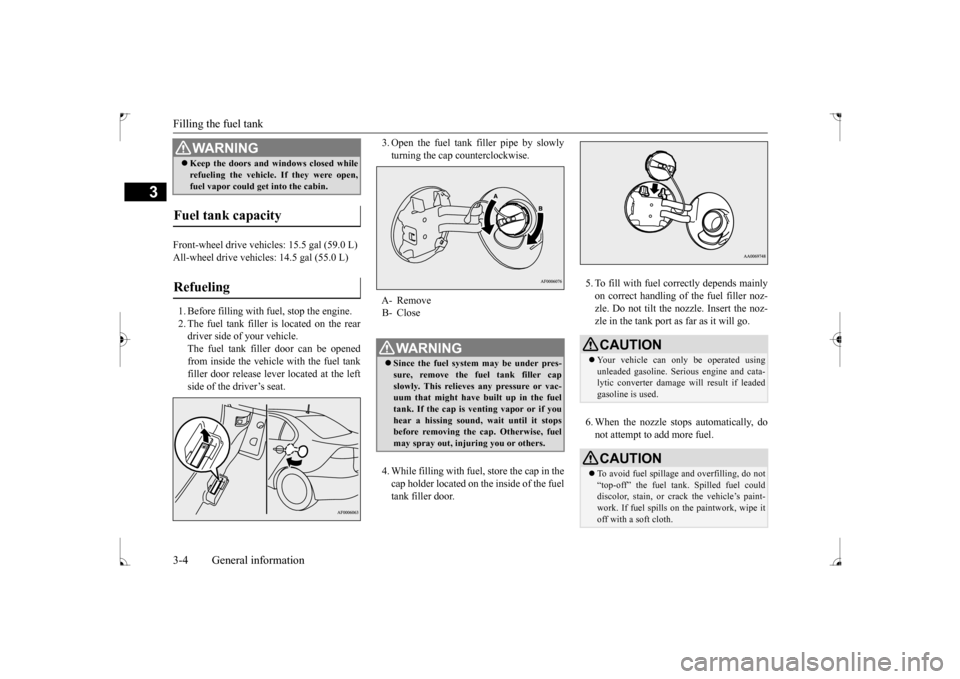
Front-wheel drive vehicles: 15.5 gal (59.0 L) All-wheel drive vehicles: 14.5 gal (55.0 L) 1. Before filling with fuel, stop the engine. 2. The fuel tank filler is located on the rear driver side of your vehicle. The fuel tank filler door can be openedfrom inside the vehicle with the fuel tank filler door release le
ver located at the left
side of the driver’s seat.
3. Open the fuel tank filler pipe by slowly turning the cap counterclockwise. 4. While filling with fuel, store the cap in the cap holder located on the inside of the fuel tank filler door.
5. To fill with fuel correctly depends mainly on correct handling of the fuel filler noz- zle. Do not tilt the nozzle. Insert the noz-zle in the tank port as far as it will go. 6. When the nozzle stops automatically, do not attempt to add more fuel.
Keep the doors and windows closed while refueling the vehicle. If they were open, fuel vapor could get into the cabin.
Fuel tank capacity Refueling
WA R N I N G
A- Remove B- Close
WA R N I N G Since the fuel system may be under pres- sure, remove the fuel tank filler cap slowly. This relieves any pressure or vac-uum that might have built up in the fuel tank. If the cap is venting vapor or if you hear a hissing sound, wait until it stopsbefore removing the cap. Otherwise, fuel may spray out, injuring you or others.
CAUTION Your vehicle can only be operated using unleaded gasoline. Serious engine and cata-lytic converter damage will result if leaded gasoline is used.CAUTION To avoid fuel spillage
and overfilling, do not
“top-off” the fuel tank. Spilled fuel could discolor, stain, or crack the vehicle’s paint-work. If fuel spills on the paintwork, wipe it off with a soft cloth.
BK0237700US.bo
ok 4 ページ 2016年4月15日 金曜日 午前11時28分
Page 24 of 385
Modifications to and racing of your vehicle
General information 3-5
3
7. To close, turn the fuel tank filler cap slowly clockwise until you hear clicking sounds, then gently push the fuel tank filler door closed.
N00301600048
This vehicle should not be modified withnon-Mitsubishi Motors genuine parts. Mit-subishi Motors designs and manufactures high quality vehicles
with an emphasis on
safety and durability. Modifications usingnon-Mitsubishi Motors genuine parts may affect the performance, safety and/or durabil- ity of your vehicle, and may violate applica-ble state and/or federal regulations. DAMAGE OR PERFORMANCE PROB- LEMS RESULTING FROM MODIFICA- TIONS TO OR RACING OF YOUR VEHICLE ARE NOT COVEREDUNDER WARRANTY. Examples of modifications to your vehicle that can cause damage or performance prob- lems include the following: Failure to use Mitsubishi Motors genuine parts Failure to use required fuel and fluids Failure to use proper size tires and wheels Modification of the fuel, intake, exhaust, emission, suspension, engine, drive train or electrical wiring systems
Modification of any onboard com- puter/control module, including repro- gramming, or replacing/adding chips to any onboard computer/control module
Review the Warranty and Maintenance Man- ual for further details regarding warranty cov- erage.
N00301701235
The installation of accessories, optional parts, etc., should only be carried out within the limits prescribed by law in the driving area and in accordance with theguidelines and warnings contained within the documents accompanying this vehicle.
WA R N I N G Make sure the fuel cap is securely closed. If the fuel cap is loose, fuel could leak, resulting in a fire.CAUTION If you need to replace the fuel tank filler cap, use only the cap specified for your model vehicle. NOTE
If the fuel tank filler cap
is not tight while
driving, the engine malfunction indicator (“SERVICE ENGINE SOON” or “Checkengine light”) may come on when the onboard diagnostic (OBD) system performs a self check. Always tighten the fuel tank filler cap until you hear clicking sounds.The indicator will go off after driving several times. If the indicator does not go off, con- tact your authorized Mitsubishi Motorsdealer or a repair f
acility of your choice as
soon as possible.
Modifications to and racing of your vehicle
Installation of accessories
CAUTION Before any electrical or electronic accesso- ries are installed, consult an authorized Mitsubishi Motors dealer. Your vehicle is equipped with a diagnosis connector (data link connector) for checkingand servicing the electronic control system. Mitsubishi Motors does not recommend con- necting a device other than the Scan Tool forinspections and service to this connector because an unexpected problem could result. In addition, malfunctions caused by connect-ing a device other than the Scan Tool may not be covered under warranty.
BK0237700US.bo
ok 5 ページ 2016年4月15日 金曜日 午前11時28分
Page 68 of 385

Break-in recommendations
Features and controls 5-3
5
N00508701395
Advanced automobile manufacturing tech- niques permit you to operate your new vehi-cle without requiring a long break-in period of low-speed driving. However, you can add to the future perfor-mance and economy of your vehicle by observing the following precautions during the first 300 miles (500 km).Drive your vehicle at moderate speeds duringthe break-in period. Avoid revving the engine. Avoid rough driving such as fast starts, sudden acceleration, prolonged high-speed driving and sudden braking. These would have a detrimental effect on the engine and also cause increased fuel andoil consumption, which could result in malfunction of the engine components. Be particularly careful to avoid full accelera-tion while in low gear. Do not overload the vehicle. Observe the seating capacity (See “Cargo load precau-tions” on page 6-10). Do not use this vehicle for trailer towing.
N00508801657
Two keys are provided. The keys fit all locks. Keep one in a safe place as a spare key. Two keys are provided. The keys fit all locks. Keep one in a safe place as a spare key.
Two Free-hand Advanced Security Transmit- ter (F.A.S.T.-key) and two emergency keysare provided.Keep one F.A.S.T.-key and one emergency key in a safe place together as a set of spare keys.
Break-in recommendations
Keys Type 1 1- Key for the electronic immobilizer2- Key number plateType 2
1- Key for the electronic immobilizer and
keyless entry system
2- Key number plateType 3
BK0237700US.bo
ok 3 ページ 2016年4月15日 金曜日 午前11時28分
Page 151 of 385

Tire pressure monitoring system 5-86 Features and controls
5
Accordingly, when the low tire pressure tell- tale illuminates, you should stop and check your tires as soon as possible, and inflate them to the proper pressure. Driving on a sig-nificantly under-inflated tire causes the tire to overheat and can lead to tire failure. Under-inflation also reduces fuel efficiencyand tire tread life, and may affect the vehi- cle’s handling and stopping ability. Please note that the TPMS is not a substitute forproper tire maintenance, and it is the driver’sresponsibility to maintain correct tire pres- sure, even if under-inflation has not reached the level to trigger illumination of the TPMSlow tire pressure telltale. Your vehicle has also been equipped with a TPMS malfunction indicator to indicate whenthe system is not operating properly. The TPMS malfunction indicator is combined with the low tire pressure telltale.When the system detects a malfunction, the telltale will flash for approximately one min- ute and then remain continuously illuminated.This sequence will continue upon subsequent vehicle start-ups as long as the malfunction exists.When the malfunction indicator is illumi- nated, the system may not be able to detect or signal low tire pressure as intended.TPMS malfunctions may occur for a variety of reasons, including the installation of replacement or alternate tires or wheels on the
vehicle that prevent the TPMS from function- ing properly. Always check the TPMS mal- function telltale after replacing one or more tires or wheels on your vehicle to ensure thatthe replacement or alternate tires and wheels allow the TPMS to continue to function prop- erly.
N00532800439
1. If the tire pressure monitoring systemwarning light illuminates, avoid hardbraking, sharp steering maneuvers and high speeds. You should stop and adjust the tires to the proper inflation pressure assoon as possible. Adjust the spare tire at the same time. Refer to “Tires” on page 9-14.
2. If the tire pressure monitoring system warning light remains illuminated afteryou have been driving for about 20 min- utes after you adjust the tire inflation pres- sure, one or more of the tires may have apuncture. Inspect the tire and if it has a puncture, have it repaired by an autho- rized Mitsubishi Motors dealer as soon aspossible.
If the warning light/display illu- minates while driving
NOTE
In addition, the warning display is displayed on the information screen in the multi-infor-mation display. When inspecting or adjusting the tire pres- sure, do not apply excessive force to the valve stem to avoid breakage.
After inspecting or adjusting the tire pres- sure, always reinstall the valve cap on the valve stem. Without the valve cap, dirt or moisture could get into the valve, resulting in damage to thetire inflation pressure sensor. Do not use metal valve caps, which may cause a metal reaction, resulting in corrosion and damage of the tire inflation pressure sen- sors. Once adjustments have been made, the warn- ing light will go off after a few minutes ofdriving.WA R N I N G If the warning light/display illuminates while you are driving, avoid hard braking, sharp steering maneuvers and highspeeds. Driving with an under-inflated tire adversely affects vehicle performance and can result in an accident.NOTE
BK0237700US.bo
ok 86 ページ 2016年4月15日 金曜日 午前11時28分
Page 189 of 385

Warning lights 5-124 Features and controls
5
N00520300147 N00520400467
When the ignition switch is turned to the “ON” position, this indicator normally comeson and goes out a few seconds later. A warn- ing is also displayed in the multi-information display.The warning light also illuminates after start-ing the engine under the following condi- tions: When the parking brake is still applied. When the brake fluid level is low. When the brake force distribution func- tion is not operating correctly.
Before driving, be sure that the parking brake is fully released and brake warning light isoff.
N00520501830
This indicator is a part of the onboard diag- nostic (OBD) system which monitors the emissions, engine contro
l system or continu-
ously variable transmission (CVT) control system. If a problem is detected in one of these systems, this indicator illuminates orflashes. When the ignition switch is turned tothe “ON” position, this indicator normally comes on and goes off after the engine has started. This indicator will come on if the fuel tank filler cap is not properly tightened. If this indicator comes on and stays on after refuel- ing, stop the engine and check that the cap isproperly tightened. (Turn the cap clockwise until you hear clicking sounds.) If this indicator does not go off after severalseconds or lights up while driving, have the system checked as soon as possible at an authorized Mitsubishi Motors dealer or arepair facility of your choice.
Warning lights Brake warning light
CAUTION If the brake warning light and the anti-lock braking system warning light are illuminated at the same time, the braking force distribu-tion function will not operate, so the vehicle may be destabilized during sudden braking under the following conditions.
• When the brake warning light does not go out even when the parking brake is released.• When the brake warning light stays onwhile driving.• If the above occurs, avoid sudden brakingand high-speed driving. Park the vehicle in a safe place, and contact an authorized Mit- subishi Motors dealer or a repair facility ofyour choice as soon as possible.
The vehicle should be brought to a halt in the following manner when brake performance is deteriorated.• Confirm that the vehicle slows down whenyou press down on the brake pedal harder than usual. In some cases, the brake pedalmay go all the way to the floor.• Should the brakes fail, use engine brakingto reduce your speed and slowly apply the parking brake. Depress the brake pedal to illuminate thestop lights to alert the vehicles behind you.
Do not suddenly apply the parking brake while driving. This may cause the rear wheels to lock and cause an accident.CAUTION
Engine malfunction indicator (“SERVICE ENGINE SOON” or “Check engine light”)
BK0237700US.book
124 ページ 2016年4月15日 金曜日 午前11時28分
Page 241 of 385

Loading information 6-6 Driving safety
6
Your front bumper can be damaged if you scrape it over curbs or parking stop blocks.Be careful when traveling up or down steep slopes where your bumper can scrape the road. When leaving the vehicle unattended, always carry the key and lock all doors.Always try to park your vehicle in a well lit area.
N00629900349
It is very important to know how much weight your vehicle can carry. This weight iscalled the vehicle capacity weight and includes the weight of all occupants, cargo and non-factory-installed options. The tireand loading information placard located on the driver’s door sill of your vehicle will show how much weight it may properly carry. It is important to familiarize yourself with the following terms before loading your vehicle: Vehicle maximum load on the tire: load on an individual tire that is determined by distributing to each axle its share of the maximum loaded vehicle weight anddividing by two. Vehicle normal load on the tire: load on an individual tire that is determined by dis-tributing to each axle its share of the curb weight, accessory weight, and normal occupant weight and dividing by two.
Maximum loaded vehicle weight: the sum of - (a) Curb weight; (b) Accessory weight;(c) Vehicle capacity weight; and (d) Production options weight. Curb weight: the weight of a motor vehi- cle with standard equipment including the maximum capacity of fuel, oil, and cool- ant. Accessory weight: the combined weight (in excess of those standard items which may be replaced) of automatic transmis- sion, power steering, power brakes, powerwindows, power seats, radio, and heater, to the extent that these items are available as factory- installed equipment (whetherinstalled or not). Vehicle capacity weight: the rated cargo and luggage load plus 150 lbs (68 kg)
*
times the vehicle’s designated seating capacity. Production options weight: the combined weight of those installed regular produc- tion options weighing over 5 lbs (2.3 kg) in excess of those standard items whichthey replace, not previously considered in curb weight or accessory weight, includ- ing heavy duty brakes, ride levelers, roofrack, heavy duty battery, and special trim.
WA R N I N G Leaving the engine running risks injury or death from accidentally moving the gear- shift lever (manual transaxle or the selec- tor lever (CVT) or from the accumulation of toxic exhaust fumes in the passengercompartment.
Where you park
WA R N I N G Do not park your vehicle in areas where combustible materials such as dry grass or leaves can come in contact with a hotexhaust, since a fire could occur.
When leaving the vehicle
Loading information
WA R N I N G Never overload your vehicle. Overloading can damage your vehicle, adversely affectvehicle performance, including handling and braking, cause tire failure, and result in an accident.
BK0237700US.bo
ok 6 ページ 2016年4月15日 金曜日 午前11時28分
Page 326 of 385

Engine coolant
Vehicle care and maintenance 9-7
9
Mitsubishi Motors Genuine 0W-20 Synthetic Engine Oil is recommended for optimum fueleconomy and cold weather starting. If Mitsubishi Motors Genuine 0W-20 Syn- thetic Engine Oil is not available, 5W-20grade oils displaying the ILSAC certification can be used. However, Mitsubishi Motors Genuine 0W-20 Synthetic Engine Oil shouldbe used at the next oil change to maintainoptimum fuel economy and cold weather starting.
N00955100042
The oil filter should be replaced at the time ormileage specified in the “WARRANTY AND MAINTENANCE MANUAL”.Only use high quality replacement filters on this vehicle. The manufacturer’s specifica- tions for Genuine Mitsubishi oil filters
require that the filter can withstand a pressure of 256 psi (1.8 MPa). A Genuine Mitsubishi oil filter is the best replacement filter. Follow the installation
instructions printed on
the filter.
N00937801611
The coolant reserve tank (A) lets you quickly see when you need to add coolant. When the engine is cold, the level in the reserve tankshould be between the “FULL” and “LOW” marks. The radiator usually stays full so there is no reason to remove
the radiator cap (B)
except when you check the coolant freeze point or replace the antifreeze coolant.
Mitsubishi Motors Genuine Coolant provides excellent protection against corrosion andrust formation on all metals, including alumi- num, and prevents blockages in some parts of engine.If you need to add co
olant often, or if the
level in the reserve tank does not drop when the engine cools, the cooling system shouldbe pressure-tested for leaks. Take your vehi- cle to an authorized Mitsubishi Motors dealer or a repair facility of your choice for testing.
To replace the oil filter
Engine coolant To check the coolant level * - Front of the vehicle
FULL LOW
To add coolant Use “Mitsubishi Motors Genuine Super Long Life Coolant Premium” or an equivalent
*.
* : similar high quality ethylene glycol
based non-silicate, non-amine, non- nitrate and non-borate coolant with long life hybrid organic acid technologyCAUTION Do not use alcohol or methanol antifreeze or any engine coolants that contain them. Using the wrong antifreeze can corrode aluminum parts.
BK0237700US.bo
ok 7 ページ 2016年4月15日 金曜日 午前11時28分