2017 MITSUBISHI L200 towing
[x] Cancel search: towingPage 103 of 426

Warning lampsE00502400147Brake warning lamp
E00502503875
This lamp illuminates whenthe ignition switch is turnedto the “ON” position or the
operation mode is put in ON, and goes off after a few sec-onds.
Always make sure that the lamp goes off be- fore driving.
With the ignition switch or the operation mode in ON, the brake warning lamp illumi-
nates under the following conditions:
l When the parking brake lever has been
engaged.
l When the brake fluid level in the reser-
voir falls to a low level.
l When the brake force distribution func-
tion is not operating correctly.
With the ignition switch or the operation
mode in ON, a buzzer sounds under the fol- lowing condition:
l The vehicle speed exceeds 8 km/h
(5 mph) with the parking brake applied.
CAUTIONl In the situations listed below, brake perform-
ance may be compromised or the vehicle may become unstable if brakes are applied
suddenly; consequently, avoid driving at
high speeds or applying the brakes suddenly. Furthermore, the vehicle should be brought
to a stop in a safe location and to have it
checked.
• The brake warning lamp does not illumi-
nate when the parking brake is applied ordoes not turn off when the parking brake is released.
• The ABS warning lamp and brake warn-
ing lamp illuminate at the same time
For details, refer to “ABS warning lamp”
on page 6-57.
• The brake warning lamp remains illumi-
nated during driving.
l The vehicle should be brought to a halt in
the following manner when brake perform- ance has deteriorated.
• Depress the brake pedal harder than usual.
Even if the brake pedal moves down to
the very end of its possible stroke, keep it
pressed down hard.
• Should the brakes fail, use engine braking
to reduce your speed and pull the parking
brake lever.
Depress the brake pedal to operate the
stop lamp to alert the vehicles behind you.Check engine warning lamp
E00502603137
This lamp is a part of an on-
board diagnostic system
which monitors the emis-
sions, engine control system or A/T control system.
If a problem is detected in
one of these systems, this lamp illuminates or flashes.
Although your vehicle will usually be driva-
ble and not need towing, we recommend you
to have the system checked as soon as possi-
ble.
This lamp will also illuminate when the igni-
tion switch is turned “ON” or the operation mode is put in ON, and goes off after the en-gine has started. If it does not go off after the
engine has started, we recommend you to have the vehicle checked.
CAUTIONl Prolonged driving with this lamp on may
cause further damage to the emission control
system. It could also affect fuel economy and drivability.
l If the lamp does not illuminate when the ig-
nition switch is turned to the “ON” position
or the operation mode is put in ON, we rec- ommend you to have the system checked.
Warning lamps
5-15OKTE17E1Instruments and controls5
Page 117 of 426

Economical driving............................................................................. 6-02
Driving, alcohol and drugs.................................................................. 6-02
Safe driving techniques....................................................................... 6-03
Running-in recommendations............................................................. 6-04 Parking brake...................................................................................... 6-05
Parking................................................................................................ 6-06
Steering wheel height and reach adjustment....................................... 6-07
Inside rear-view mirror....................................................................... 6-08 Outside rear-view mirrors................................................................... 6-09
Ignition switch*...................................................................................6-13 Engine switch*.................................................................................... 6-14
Steering wheel lock............................................................................. 6-16
Starting and stopping the engine......................................................... 6-17
Diesel particulate filter (DPF)............................................................. 6-21 Turbocharger operation*..................................................................... 6-22Auto Stop & Go (AS&G) system*..................................................... 6-23
Manual transmission*......................................................................... 6-27 Automatic transmission Sports Mode 5A/T........................................6-28Easy select 4WD*............................................................................... 6-35
Super select 4WD II*.......................................................................... 6-40
Rear differential lock*........................................................................ 6-45 4-wheel drive operation*.................................................................... 6-49
Inspection and maintenance following rough road operation............. 6-52
Cautions on handling of 4-wheel drive vehicles................................. 6-52
Braking................................................................................................ 6-53
Hill start assist..................................................................................... 6-55
Brake assist system............................................................................. 6-56
Emergency stop signal system*.......................................................... 6-56
Anti-lock brake system (ABS)............................................................ 6-57Power steering system.........................................................................6-59
Active Stability & Traction Control (ASTC)*....................................6-59
Trailer Stability Assist (TSA)............................................................. 6-63 Cruise control*.................................................................................... 6-63
Speed Limiter...................................................................................... 6-69
Lane Departure Warning (LDW)*...................................................... 6-76
Rear-view camera*............................................................................. 6-79
Cargo loads......................................................................................... 6-83Trailer towing......................................................................................6-83Starting and driving
OKTE17E16
Page 120 of 426

Running-in recommendationsE00600404070
During the running-in period for the first 1,000 km (620 miles), it is advisable to drive your new vehicle using the following precautions as a guideline to aid long life as well as future economy and performance.
l Do not race the engine at high speeds.
l Avoid rapid starting, accelerating, braking and prolonged high-speed running.
l Keep to the running-in speed limit shown below.
Please note that the legal speed limits displayed must be adhered to.
l Do not exceed loading limits.
l Refrain from towing a trailer.Vehicles with M/T
Shift point
Speed limit2WDVehicles with Easy select 4WDVehicles with Super select 4WD II2H, 4H4L2H, 4H, 4HLc4LLc1st
gear20 km/h (12 mph)20 km/h (12 mph)5 km/h (3 mph)20 km/h (12 mph)5 km/h (3 mph)2nd
gear40 km/h (25 mph)40 km/h (25 mph)15 km/h (9 mph)40 km/h (25 mph)15 km/h (9 mph)3rd
gear65 km/h (40 mph)65 km/h (40 mph)25 km/h (16 mph)65 km/h (40 mph)25 km/h (16 mph)4th
gear95 km/h (59 mph)95 km/h (59 mph)35 km/h (22 mph)95 km/h (59 mph)35 km/h (22 mph)5th
gear110 km/h (68 mph)110 km/h (68 mph)
45 km/h (28 mph)
115 km/h (71 mph)
45 km/h (28 mph)6th
gear55 km/h (34 mph)55 km/h (34 mph)
Running-in recommendations
6-04OKTE17E1Starting and driving6
Page 169 of 426

Towing
If towing is necessary, we recommend you tohave it done by your MITSUBISHI
MOTORS Authorized Service Point or a
commercial tow truck service.
In the following cases, transport the vehicle
using a tow truck.
l The engine runs but the vehicle does not
move or abnormal noise is produced.
l Inspection of the vehicle’s underside re-
veals that oil or some other fluid is leak- ing.
Only when you cannot receive a towing serv-
ice from a MITSUBISHI MOTORS Author-
ized Service Point or commercial tow truck service, tow your vehicle carefully in accord-
ance with the instructions given in “Towing”
on page 8-24.CAUTIONl Transport the vehicle with the driving
wheels on a carriage (Type C or D) as illus- trated.
Never try to tow with the front or rear
wheels on the ground (Type A or B) as illus-
trated.
This could result in damage to the drivetrain,
or unstable towing.
Jacking up a 4-wheel drive ve-
hicle
WARNINGl Do not crank the engine while jacking up
the vehicle.
The tyre on the ground may turn and the
vehicle may roll off the jack.Braking
E00607003065
All the parts of the brake system are critical
to safety. We recommend you to have the ve- hicle checked at regular intervals according
to the service booklet.
Braking
6-53OKTE17E1Starting and driving6
Page 179 of 426

CAUTIONlIf the vehicle is towed with the ignition
switch in the “ON” position or the operation
mode in ON and only the front wheels or on- ly the rear wheels raised off the ground, the
ASTC may operate, resulting in an accident. When towing the vehicle with the front
wheels raised, keep the ignition switch in the “LOCK” or “ACC” position or the operation
mode in ACC or OFF. When towing the ve- hicle with the rear wheels raised, keep the
ignition switch in the “ACC” position or the operation mode in ACC.
Refer to “Towing” on page 8-24.Trailer Stability Assist
(TSA) E00639500033
The trailer stability assist system helps safely running while towing a trailer by controllingthe braking force of each wheel and enginepower in order to stabilize the motion when
detecting the continuous sway of the vehicle
caused by a trailer.
When the trailer stability assist system oper- ates the brakes, the brake lamp turns on.
About the towing of the trailer, refer to page 6-83.CAUTIONl Do not over-rely on TSA system.
Due to the slippery road surface, heavy side
wind, inappropriate weight and positioning
of luggage, and/or driving at high speed, TSA system may fail to secure the stability.
Always drive appropriately in accordance with the condition of traffic, road surface
condition, weather, and the weight and posi- tioning of luggage.
l The trailer stability assist system does not
operate in case as follows:
• When sudden braking and braking while
driving downhill cause an abrupt motion
of the vehicle which makes the vehicle
and the trailer form a dogleg shape.CAUTION• When a sideslip occurs by sudden steer-
ing.NOTEl When TSA system operates, the vehicle
body may vibrate and the operating sounds
from the engine compartment may be heard.
These motions indicate normal operation of
the system, not abnormal operation.
l TSA system operates when the vehicle speed
is about 55 km/h (34 mph) or higher.
l When TSA system operates, the ASC opera-
tion indication lamp blinks on and off.
l When ASC does not work, TSA system does
not operate.Cruise control*
E00609102395
Cruise control is an automatic speed controlsystem that keeps a set speed. It can be acti-vated at approximately 40 km/h (25 mph) or
more.
CAUTIONl When you do not wish to drive at a set
speed, turn off the cruise control for safety.
Trailer Stability Assist (TSA)
6-63OKTE17E1Starting and driving6
Page 199 of 426

However, the vehicle may hit the truck be-cause the body of the truck strays onto the
course in reality.
l When approaching to solid objects
The reference lines for distance and vehicle
width are intended to indicate the distance toa flat object such as a level, flat road surface.
This may make the distance to a projecting
object shown on the screen differ from the actual distance to the projecting object. Do
not use them as a guide for distances to solid
objects.
Example: On the screen the point B appears the nearest, then the point C and A in order of
distance. The points A and B actually are the same distances from the vehicle, and thepoint C is farther off than the points A and B.Cargo loads
E00609901123
Cargo loads precautionsCAUTIONl When loading luggage, be careful to the fol-
lowing.
• Stow cargo and luggage in the cargo area
whenever possible.
• Distribute cargo or luggage evenly not to
be unbalanced in weight.
• Do not place cargo or luggage on the in-
strument panel.
Also, do not stack up cargo or luggage on the front passenger’s seat or the rear seat.
Having the driver’s vision blocked, and
your cargo being thrown inside the cabin if you suddenly have to brake can cause a
serious accident or injury.Trailer towing
E00610001863
In order to tow a trailer with your vehicle,
when having a trailer towing device mounted that meets all relevant regulations in your
area, consult a MITSUBISHI MOTORS Au-
thorized Service Point.
Cargo loads
6-83OKTE17E1Starting and driving6Check surroundings for safety. Check surroundings for safety.
Page 200 of 426

Check that your towing bar coupling ball
does not obscure your vehicle’s licence plate when the trailer or caravan is disconnected. Ifit obscures the licence plate, please remove
the towing bar coupling ball. And if the tow-
ing bar coupling ball is lockable by using a
key or any kind of tools, please remove the coupling ball and use a towing bar coupling
ball which can be removed or repositioned
without the use of a key or any kind of tools instead.
The regulations concerning the towing of a
trailer may differ from country to country.
You are advised to obey the regulations in
each area.CAUTIONl Danger of Accident!
A towing bar should be fitted according to
MITSUBISHI MOTORS guidelines.NOTEl If you are going to tow a trailer, pay careful
attention to the following points.Maximum towable weight with
brake and maximum trailer- nose weight
Never exceed the maximum towable weight
with brake and the maximum trailer-nose weight as listed in the specifications. (Referto “Vehicle weight” on page 11-11.)
If you tow a trailer at an altitude of more than
1,000 m above sea-level, reduce your weight
by 10 % of the gross combination weight for
every increase of 1,000 m above sea-level, as the engine output is lowered owing to de-
crease in atmospheric pressure.
Towing bar mounting specifi-cations
See the following table for fixing points (A) for the towing bar.
Single cabClub cabDouble
cab130 mm30 mm30 mm255 mm55 mm55 mm360 mm60 mm60 mm4810 mm925 mm925 mm519.5 mm19.5 mm19.5 mm647.5 mm47.5 mm47.5 mm788 mm88 mm88 mm*1: Vehicles without heavy duty suspension
*2 : Vehicles with heavy duty suspension
*3 : Vehicles equipped with 17 inch tyres
*4 : 2WD vehicles equipped with 245/70R16
tyres, 4WD vehicles equipped with 17 inch tyres
Trailer towing
6-84OKTE17E1Starting and driving6
Page 201 of 426
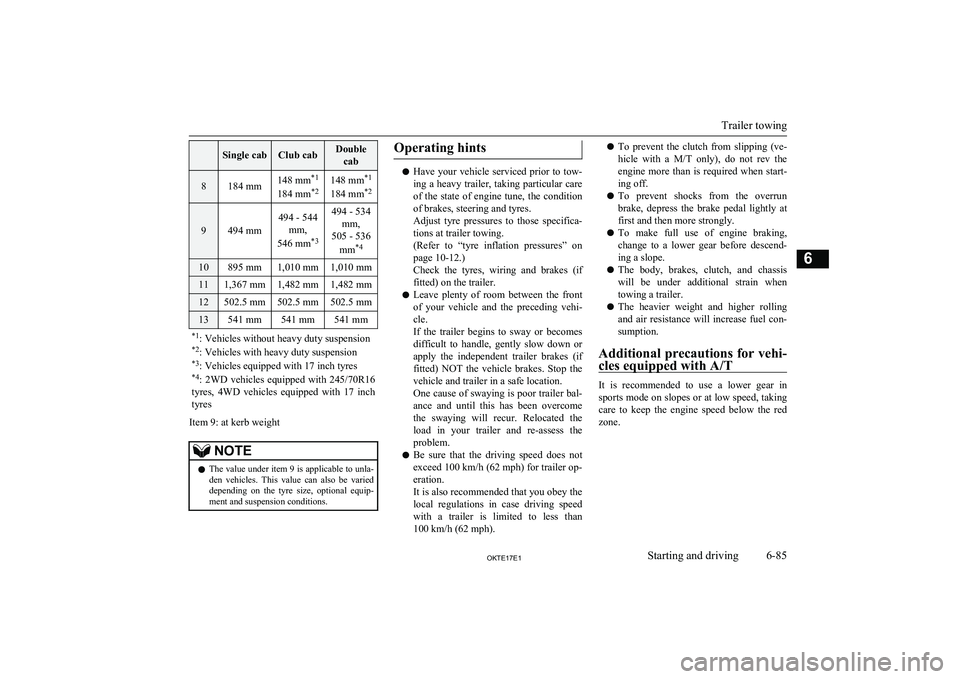
Single cabClub cabDoublecab8184 mm148 mm *1
184 mm *2148 mm *1
184 mm *2
9494 mm
494 - 544
mm,
546 mm *3494 - 534
mm,
505 - 536
mm *410895 mm1,010 mm1,010 mm111,367 mm1,482 mm1,482 mm12502.5 mm502.5 mm502.5 mm13541 mm541 mm541 mm*1
: Vehicles without heavy duty suspension
*2 : Vehicles with heavy duty suspension
*3 : Vehicles equipped with 17 inch tyres
*4 : 2WD vehicles equipped with 245/70R16
tyres, 4WD vehicles equipped with 17 inch
tyres
Item 9: at kerb weight
NOTEl The value under item 9 is applicable to unla-
den vehicles. This value can also be varied depending on the tyre size, optional equip-
ment and suspension conditions.Operating hints
l Have your vehicle serviced prior to tow-
ing a heavy trailer, taking particular care
of the state of engine tune, the condition of brakes, steering and tyres.
Adjust tyre pressures to those specifica- tions at trailer towing.
(Refer to “tyre inflation pressures” on
page 10-12.)
Check the tyres, wiring and brakes (if fitted) on the trailer.
l Leave plenty of room between the front
of your vehicle and the preceding vehi- cle.
If the trailer begins to sway or becomes difficult to handle, gently slow down or
apply the independent trailer brakes (if fitted) NOT the vehicle brakes. Stop the
vehicle and trailer in a safe location.
One cause of swaying is poor trailer bal-
ance and until this has been overcome the swaying will recur. Relocated the load in your trailer and re-assess the
problem.
l Be sure that the driving speed does not
exceed 100 km/h (62 mph) for trailer op-
eration.
It is also recommended that you obey the
local regulations in case driving speed with a trailer is limited to less than
100 km/h (62 mph).
l To prevent the clutch from slipping (ve-
hicle with a M/T only), do not rev the
engine more than is required when start-
ing off.
l To prevent shocks from the overrun
brake, depress the brake pedal lightly at
first and then more strongly.
l To make full use of engine braking,
change to a lower gear before descend-
ing a slope.
l The body, brakes, clutch, and chassis
will be under additional strain when
towing a trailer.
l The heavier weight and higher rolling
and air resistance will increase fuel con- sumption.
Additional precautions for vehi-
cles equipped with A/T
It is recommended to use a lower gear in
sports mode on slopes or at low speed, taking care to keep the engine speed below the red
zone.
Trailer towing
6-85OKTE17E1Starting and driving6