2017 MITSUBISHI L200 service
[x] Cancel search: servicePage 96 of 426

1.Displays the time until the next periodic
inspection.
NOTEl The distance is shown in units of 100 km
(100 miles). The time is shown in units of months.
2. This informs you that a periodic inspec-
tion is due. Please consult a MITSUBISHI MOTORS Authorized
Service Point.
3. After your vehicle is inspected at a
MITSUBISHI MOTORS Authorized
Service Point, it displays the time until the next periodic inspection.
To reset
The “---” display can be reset while the igni- tion switch or the operation mode is in OFF. 1. When you lightly press the multi infor-
mation display switch a few times, the
information display switches to the serv- ice reminder display.
2. Press and hold the multi information dis-
play switch for about 2 seconds or more to make the spanner mark start flashing.
(If there is no operation for about 10 sec-
onds with flashing, the display will re-
vert to its original indication.)
3. Lightly press the multi information dis-
play switch while the icon is flashing to
change the display from “---” to
“cLEAr”. After this, the time until the next periodic inspection will be dis-played.CAUTIONl The customer is responsible for making sure
that periodic inspection and maintenance are
performed.
Inspections and maintenance must be per- formed to prevent accidents and malfunc- tions.NOTEl “---” display cannot be reset when the igni-
tion switch or the operation mode is in ON.
Multi-information display
5-08OKTE17E1Instruments and controls5Distance
Month
Page 98 of 426

lWhen the engine switch or the operation
mode is in the following conditions, the
average fuel consumption display is au-
tomatically reset.
[Except for vehicles equipped with key-
less operation system]
The ignition switch is in the “ACC” or “LOCK” position for about 4 hours or
longer.
[For vehicles equipped with keyless op- eration system]
The operation mode is in ACC or OFF
for about 4 hours or longer.NOTEl The average fuel consumption display can
be reset separately for the auto reset mode and for the manual reset mode.
l The memory of the auto reset mode or man-
ual reset mode for the average fuel con- sumption display is erased if the battery isdisconnected.
l The initial (default) setting is “Auto reset
mode”.Changing the fuel consumption
display unit
E00523001808
The display unit for fuel consumption can be
switched. The distance and amount units are also switched to match the selected fuel con- sumption unit.
1. When you lightly press the multi infor-
mation display switch a few times, theinformation display switches to the aver-age fuel consumption display.
Refer to “Information display” on page
5-03.
2. Press and hold the multi information dis-
play switch for about 5 seconds or more until buzzer sound is heard twice.
3. Press and hold the multi information dis-
play switch to switch in sequence from “km/L” → “L/100 km” → “mpg” →“km/L”.NOTEl The display units for the driving range, the
average fuel consumption are switched, but the units for the indicating needle (speedom- eter), the odometer, the tripmeter and the
service reminder will remain unchanged.NOTEl The memory of the unit setting is erased if
the battery is disconnected, and it returns au- tomatically to factory setting.
The distance units is also switched in the fol-
lowing combinations to match the selected
fuel consumption unit.
Fuel consumptionDistance (driving range)km/LkmL/100 kmkmmpgmile(s)Changing the temperature unit
E00523101753
The display unit for outside temperature canbe switched. 1. When you lightly press the multi infor-
mation display switch a few times, the information display switches to the out-
side temperature display.
Refer to “Information display” on page
5-03.
2. Each time you press the multi informa-
tion display switch for 2 seconds or more on outside temperature display,you can switch from °C to °F or from °F
to °C unit of outside temperature dis-
play.
Multi-information display
5-10OKTE17E1Instruments and controls5
Page 106 of 426
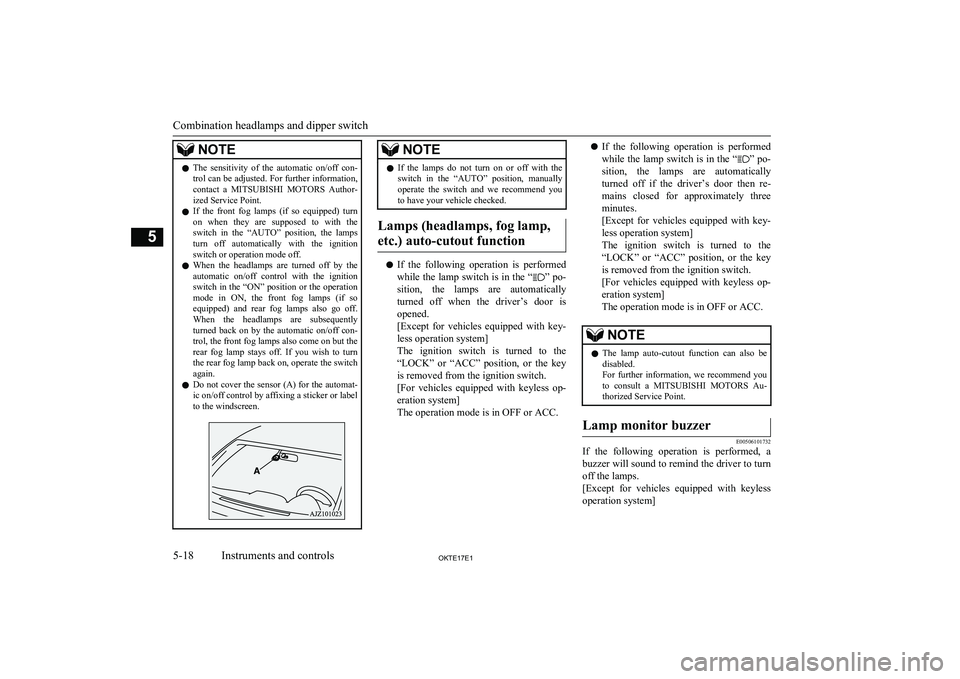
NOTElThe sensitivity of the automatic on/off con-
trol can be adjusted. For further information,contact a MITSUBISHI MOTORS Author-
ized Service Point.
l If the front fog lamps (if so equipped) turn
on when they are supposed to with theswitch in the “AUTO” position, the lamps
turn off automatically with the ignition
switch or operation mode off.
l When the headlamps are turned off by the
automatic on/off control with the ignition
switch in the “ON” position or the operation
mode in ON, the front fog lamps (if so
equipped) and rear fog lamps also go off.
When the headlamps are subsequently turned back on by the automatic on/off con-
trol, the front fog lamps also come on but the rear fog lamp stays off. If you wish to turn
the rear fog lamp back on, operate the switch again.
l Do not cover the sensor (A) for the automat-
ic on/off control by affixing a sticker or label
to the windscreen.NOTEl If the lamps do not turn on or off with the
switch in the “AUTO” position, manually
operate the switch and we recommend you
to have your vehicle checked.
Lamps (headlamps, fog lamp,
etc.) auto-cutout function
l If the following operation is performed
while the lamp switch is in the “” po-
sition, the lamps are automatically
turned off when the driver’s door is
opened.
[Except for vehicles equipped with key-
less operation system]
The ignition switch is turned to the
“LOCK” or “ACC” position, or the key is removed from the ignition switch.
[For vehicles equipped with keyless op- eration system]
The operation mode is in OFF or ACC.
l If the following operation is performed
while the lamp switch is in the “” po-
sition, the lamps are automatically
turned off if the driver’s door then re- mains closed for approximately three
minutes.
[Except for vehicles equipped with key-
less operation system]
The ignition switch is turned to the “LOCK” or “ACC” position, or the key
is removed from the ignition switch.
[For vehicles equipped with keyless op- eration system]
The operation mode is in OFF or ACC.NOTEl The lamp auto-cutout function can also be
disabled.
For further information, we recommend you
to consult a MITSUBISHI MOTORS Au-
thorized Service Point.Lamp monitor buzzer
E00506101732
If the following operation is performed, a
buzzer will sound to remind the driver to turn
off the lamps.
[Except for vehicles equipped with keyless
operation system]
Combination headlamps and dipper switch
5-18OKTE17E1Instruments and controls5
Page 109 of 426

2- Lane-change signalsWhen moving the lever to (2) slightly tochange a lane, the turn-signal lamps and
indication lamp in the instrument cluster will only flash while the lever is operat- ed.
Also, when you move the lever to (2) slightly then release it, the turn-signal lamps and indication lamp in the instru-
ment cluster will flash 3 times.NOTEl If the lamp flashes unusually quickly, the
bulb in a turn-signal lamp may have burned out. We recommend you to have the vehicle
inspected.
l It is possible to activate the following func-
tions.
• Flashing of the turn-signal lamps when
the lever is operated with the ignition
switch or the operation mode is in ACC.
• The turn-signal lamps 3-flash function for
lane changes can be deactivated.
• The time required to operate the lever for
the 3-flash function can be adjusted.
• Changing of the tone of a sounding buz-
zer as the turn-signal lamps flash.
For further information, we recommend you
to consult a MITSUBISHI MOTORS Au-
thorized Service Point.Hazard warning flasher
switch E00506602183
Use the hazard warning flasher switch when
the vehicle has to be parked on the road for
any emergency.
The hazard warning flashers can always be operated, regardless of the ignition switch po-
sition or the operation mode.
Push the switch to turn on the hazard warning flashers, all turn-signal lamps flash continu-
ously.
To turn them off, push the switch again.NOTEl On vehicles equipped with the emergency
stop signal system, while the hazard warning lamps are blinking due to having manually
pushed the switch, the emergency stop sig-
nal system does not operate.
Refer to “Emergency stop signal system*” on page 6-56.
Hazard warning flasher switch
5-21OKTE17E1Instruments and controls5
Page 111 of 426

NOTElTo turn the rear fog lamp on again, turn the
knob twice in the “ON” direction after turn-ing on the headlamps. (Vehicle with frontfog lamps)Wiper and washer switch
E00507102824
The windscreen wipers and washer can be
operated with the ignition switch or the oper- ation mode in ON or ACC.
If the blades are frozen to the windscreen, do
not operate the wipers until the ice has mel- ted and the blades are freed, otherwise thewiper motor may be damaged.
CAUTIONl If the washer is used in cold weather, the
washer fluid sprayed against the glass may freeze, which may hinder visibility. Warm
the glass with the defroster or rear window demister before using the washer.Windscreen wipers
E00516900127
Except for vehicles equipped
with rain sensor
E00527001268
MIST-Misting function
The wipers will operate once.OFF-OffINT-Intermittent (Speed sensitive)LO-SlowHI-FastTo adjust intermittent intervals
With the lever in the “INT” (speed sensitive intermittent operation) position, the intermit-
tent intervals can be adjusted by turning the knob (A).
1- Fast
2- Slow
NOTEl The speed-sensitive-operation function of
the windscreen wipers can be deactivated.
For further information, we recommend you to consult a MITSUBISHI MOTORS Au-
thorized Service Point.
Misting function
Move the lever in the direction of the arrow
and release, to operate the wipers once.
Wiper and washer switch
5-23OKTE17E1Instruments and controls5
Page 113 of 426

NOTElDo not cover the sensor by affixing a sticker
or label to the windscreen. Also, do not put
any water-repellent coating on the wind- screen. The rain sensor would not be able to
detect the extent of rain, and the wipers might stop working normally.
l In the following cases, the rain sensor may
be malfunctioning.
For further information, we recommend you
to consult a MITSUBISHI MOTORS Au-
thorized Service Point.
• When the wipers operate at a constant in-
terval despite changes in the extent of rain.
• When the wipers do not operate even
though it is raining.
l The wipers may automatically operate when
things such as insects or foreign objects are affixed to the windscreen on top of the rainsensor or when the windscreen is frozen.
Objects affixed to the windscreen will stop
the wipers when the wipers cannot remove them. To operate the wipers again, move the
lever in the “LO” or “HI” position.
Also, the wipers may operate automatically
due to strong direct sunlight or electromag- netic wave. To stop the wipers, place thelever in the “OFF” position.
l Contact a
MITSUBISHI MOTORS Author-
ized Service Point when replacing the wind- screen or reinforcing the glass around the
sensor.To adjust the sensitivity of the rain sensor
With the lever in the “AUTO” (rain sensor)
position, it is possible to adjust the sensitivity of the rain sensor by turning the knob (B).
“+”- Higher sensitivity to rain
“−”- Lower sensitivity to rain
NOTEl It is possible to activate the following func-
tions.
• Automatic operation (rain droplet sensi-
tive) can be changed to intermittent opera-
tion (vehicle-speed sensitive).
• Automatic operation (rain droplet sensi-
tive) can be changed to intermittent opera-
tion (except vehicle-speed sensitive).
For further information, we recommend you to consult a MITSUBISHI MOTORS Au-
thorized Service Point.Misting function
Move the lever in the direction of the arrow
and release, to operate the wipers once.
Use this function when you are driving in
mist or drizzle.
The wipers will operate once if the lever is raised to the “MIST” position and released
when the ignition switch or the operation
mode is in the “ON” or “ACC” position. The wipers will continue to operate while the lev-
er is held in the “MIST” position.Wiper and washer switch
5-25OKTE17E1Instruments and controls5
Page 118 of 426
Economical drivingE00600102318
For economical driving, there are some tech- nical requirements that have to be met. Theprerequisite for low fuel consumption is a
properly adjusted engine. In order to achieve longer life of the vehicle and the most eco- nomical operation, we recommend you tohave the vehicle checked at regular intervals in accordance with the service standards.
Fuel economy and generation of exhaust gas
and noise are highly influenced by personal
driving habits as well as the particular operat- ing conditions. The following points shouldbe observed in order to minimize wear of
brakes, tyres and engine as well as to reduce
environmental pollution.
Starting the engine
Avoid sudden acceleration and sudden starts,
as they will increase fuel consumption.
Shifting
Shift only at an appropriate speed and engine speed. Always use the highest shift position
possible.
The transfer shift lever or the drive mode-se-
lector should be set to “2H” when driving 4WD vehicles on normal roads and express
ways to obtain best possible fuel economy.
City traffic
Frequent starting and stopping increases the
average fuel consumption. Use roads with smooth traffic flow whenever possible. When driving on congested roads, avoid use of a
low shift position at high engine speeds.
Idling
The vehicle consumes fuel even during idling. Avoid extended idling whenever pos-
sible.
Speed
At higher vehicle speed, more fuel is con-
sumed. Avoid driving at full speed. Even a slight release of the accelerator pedal willsave a significant amount of fuel.
Tyre inflation pressure
Check the tyre inflation pressures at regularintervals. Low tyre inflation pressure increa-ses road resistance and fuel consumption. In
addition, low tyre pressures adversely affect tyre wear and driving stability.
Cargo loads
Do not drive with unnecessary articles in the
luggage compartment. Especially during city
driving where frequent starting and stopping is necessary, the increased weight of the ve-
hicle will greatly affect fuel consumption. Al- so avoid driving with unnecessary luggage or carriers, etc., on the roof; the increased air re- sistance will increase fuel consumption.
Cold engine starting
Starting of a cold engine consumes more fuel. Unnecessary fuel consumption is alsocaused by keeping a hot engine running. Af-
ter the engine is started, commence driving as soon as possible.
Cooler or air conditioning
The use of the air conditioner will increase the fuel consumption.
Driving, alcohol and drugs
E00600200070
Driving after drinking alcohol is one of the
most frequent causes of accidents.
Economical driving
6-02OKTE17E1Starting and driving6
Page 128 of 426

The mirrors automatically retract or extendwhen the doors are locked or unlocked using the key switches or the keyless operation
function of the keyless operation system.
Refer to “Keyless entry system” on page 3-03.
Refer to “Keyless operation system: To oper- ate using the keyless operation function” on
page 3-10.NOTEl Functions can be modified as stated below.
Please consult a MITSUBISHI MOTORS
Authorized Service Point.
• Automatically extend when the driver’s
door is closed, and then the following op- eration is performed.
[Except vehicles equipped with keyless operation system]
Turn the ignition switch to the “ON” or
“ACC” position.
[Vehicles equipped with keyless operation
system]
Put the operation mode in ON or ACC.
• Automatically retract when the ignition
switch is turned to the “LOCK” position
or the operation mode is put in OFF, and the driver’s door is then opened.
• Automatically extend when the vehicle
speed reaches 30 km/h (19 mph). (vehi-
cles equipped with the keyless entry key
or the keyless operation key)NOTE• Deactivate the automatic extension func-
tion.
The outside rear-view mirrors can be folded
or extended by the following operations,
even if changing to any of the above.
After pressing the “LOCK” switch to lock the doors, if the “LOCK” switch is pressed
again twice in a row within about 30 sec-
onds, the outside rear-view mirrors will re- tract.
After pressing the “UNLOCK” switch to un-
lock the doors, if the “UNLOCK” switch is
pressed again twice in a row within about 30 seconds, the outside rear-view mirrors will
extend again.Heated mirror*
E00601201641
To demist or defrost the outside rear-view
mirrors, press the rear window demister
switch.
The indication lamp (A) will illuminate while
the demister is on.
The heater will be turned off automatically in
about 20 minutes depending on the outside temperature.
Outside rear-view mirrors
6-12OKTE17E1Starting and driving6 Type 1 Type 2