2017 MITSUBISHI L200 wheel
[x] Cancel search: wheelPage 27 of 426

CAUTIONlYour vehicle is equipped with a diagnosis
connector for checking and servicing theelectronic control system.
Do not connect a device other than a diagno-
sis tool for inspections and service to this
connector.
Otherwise, the battery could be discharged,
the electronic devices of the vehicle could malfunction, or other unexpected problems could result.
In addition, malfunctions caused by connect-
ing a device other than a diagnosis tool may not be covered under warranty.
l The installation of accessories, optional
parts, etc., should only be carried out
within the limits prescribed by law in your country, and in accordance with the
guidelines and warnings contained with-
in the documents accompanying this ve- hicle.
l Improper installation of electrical parts
could cause fire, please refer to the Mod-
ification/ alteration to the electrical or fuel systems section within this owner’smanual.
l When installing the radio, for the re-
quired information (frequency, transmis-
sion output, installing procedure), con-
sult a MITSUBISHI MOTORS Author-
ized Service Point.
If the frequency, transmission output and
installing condition are not appropriate, it can adversely affect the electronic de-vices and could lead to unsafe vehicle
operation.
l Using a cellular phone or radio set inside
the vehicle without an external antenna
may cause electrical system interference,
which could lead to unsafe vehicle oper- ation.
l Tyres and wheels which do not meet
specifications must not be used.
Refer to the “Specifications” section for information regarding wheel and tyre
sizes.
Important points!
Due to a large number of accessories and re-
placement parts of different manufactures available in the market, it is not possible, not
only for MITSUBISHI MOTORS , but also a
MITSUBISHI MOTORS Authorized Service
Point, to check whether the attachment or in-
stallation of such parts affects the overall safety of your MITSUBISHI-vehicle.
Even when such parts are officially Author-
ized, for example by a “general operators permit” (an appraisal for the part) or throughthe execution of the part in an officially ap-
proved manner of construction, or when a single operation permit following the attach-
ment or installation of such parts, it cannot be deduced from that alone, that the drivingsafety of your vehicles has not been affected.
Consider also that there basically exists no li-
ability on the part of the appraiser or the offi- cial. Maximum safety can only be ensured
with parts recommended, sold and fitted or
installed by a MITSUBISHI MOTORS Au-
thorized Service Point ( MITSUBISHI
MOTORS GENUINE replacement parts and
MITSUBISHI MOTORS accessories). The
same also pertains to modifications of
MITSUBISHI vehicles with respect to the
production specifications. For safety reasons, do not attempt any modifications other than
those that follow the recommendations of a MITSUBISHI MOTORS Authorized Service
Point.
Installation of accessories
2-05OKTE17E1General information2
Page 42 of 426

LampBuzzerItemCauseNote (Solution)There is a fault in the keyless operation sys-tem.If the warning lamp illuminates,please contact a MITSUBISHI
MOTORS Authorized Service
Point.Immediately stop the vehicle in a safe place and contact a
MITSUBISHI MOTORS Authorized
Service Point.Inner buzzer sounds
(intermittent sounds)There is a fault in the electrical system.Inner buzzer sounds (continuous sounds).Blinks.Outer buzzer sounds approximately 3 sec-onds. Inner buzzer sounds approximately
1 minute.Keyless operation key reminder.When the operation mode is in OFF withthe keyless operation key left in the key
slot, if you try to open the driver’s door.Remove the keyless operation key from the key slot.
Refer to “Starting and stopping the
engine” on page 6-17.Illuminates.Inner buzzer sounds.Steering wheel lock.There is a fault in the steering wheel lock
system.Refer to “Steering wheel lock” on
page 6-16.Blinks.Outer buzzer sounds approximately 3 sec-onds.Operation mode OFF reminder system.When the operation mode is in any mode
other than OFF with all the doors are closed, if you try to lock by using the driv- er’s or front passenger’s door lock/unlock
switch.Refer to “Operation mode OFF re- minder system” on page 6-16.
Keyless operation system*
3-14OKTE17E1Locking and unlocking3
Page 43 of 426

LampBuzzerItemCauseNote (Solution)Illuminates.No sounds.Immobilizer system.There is a fault in the electronic immobiliz-
er (Anti-theft starting system).Put the operation mode in OFF and then start the engine again. If the warning is not cancelled, contact a
MITSUBISHI MOTORS Author-
ized Service Point.Blinks.Inner buzzer sounds.Steering wheel lock.Steering wheel does not unlock.Unlock the steering wheel lock fol- lowing the procedure of reference
page.
Refer to “Steering wheel lock” on
page 6-16.Illuminates.No sounds.Steering wheel lock is abnormal.Refer to “Steering wheel lock” on
page 6-16.
Doors
E00300403605CAUTIONlMake sure the doors are closed: driving with
doors not completely closed is dangerous.
l Never leave children in the vehicle unatten-
ded.
l Be careful not to lock the doors while the
key is inside the vehicle.NOTEl To prevent the key from being locked inside
the vehicle, neither the lock knob on the
driver’s door nor the key can be used to lock the driver’s door when it is open.To lock or unlock with the key
Doors
3-15OKTE17E1Locking and unlocking3
Page 54 of 426

Seat adjustmentE00400301887
Adjust the driver’s seat so that you are com- fortable and that you can reach the pedals,
steering wheel, switches etc. while retaining a clear field of vision.WARNINGl Do not attempt to adjust the seat while
driving. This can cause loss of vehicle con- trol and result in an accident. After ad-
justments are made, ensure the seating is locked in position by attempting to move
the seat forward and rearward without
using the adjusting mechanism.
l It is extremely dangerous to ride in the
cargo area (inside or outside) of a vehicle. Also, the cargo area and rear seats should
never be used as a play area by children. In a collision, people or children ridingunrestrained in these areas are more like- ly to be seriously injured or killed.
l Do not allow people or children to ride in
any area of your vehicle that is not equip- ped with seats and seat belts, and make
sure that everyone travelling in your vehi- cle is in a seat and wearing a seat belt, or
in the case of a child is strapped in a child restraint.WARNINGl To minimize the risk of personal injury in
the event of a collision or sudden braking,the seatbacks should always be in the al- most upright position while the vehicle is
in motion. The protection provided by the seat belts may be reduced significantly when the seatback is reclined. There is
greater risk that the passenger will slide
under the seat belt, resulting in serious in- jury, when the seatback is reclined.
l Do not place objects under the seats. This
could prevent the seat from locking se-
curely, and it could lead to an accident. It may also cause damage to the seat or oth-
er parts.CAUTIONl Make sure the seat is adjusted by an adult or
with adult supervision for correct and safe operation.
l Do not place a cushion or the like between
your back and the seatback while driving.The effectiveness of the head restraints will
be reduced in the event of an accident.
l The reclining mechanism of the front man-
ual seat’s seatback is spring loaded, causing
it to fold the seatback forward when the lock lever is operated. When using the lever, sit close to the seatback or hold it with yourhand to control its return motion.
l When sliding the seats, be careful not to
catch your hand or foot.CAUTIONl If your vehicle is equipped with the rear
seat, when sliding or reclining the seat rear- ward, pay careful attention to the rear seat
passengers. (Club cab and Double cab)Front seats
E00400401468
Manual type*
1- To adjust forward or backwardLift the handle and adjust the seat to the
desired position, and release the handle.
2- To recline the seatback Pull the lever up and then lean backwardto the desired position, and release the lever.
Seat adjustment
4-02OKTE17E1Seat and seat belts4
Page 78 of 426
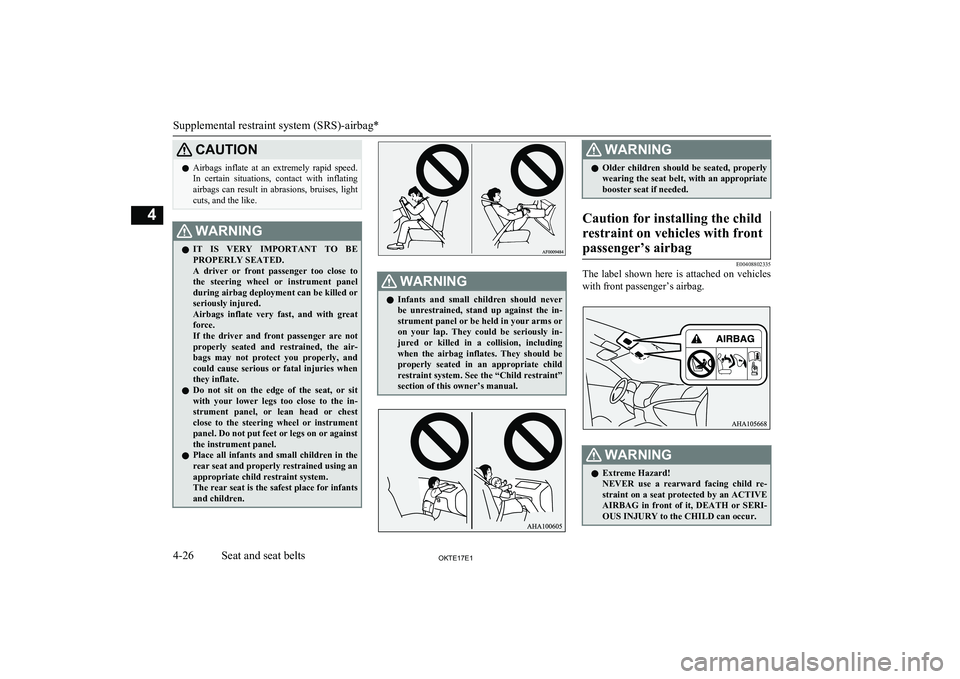
CAUTIONlAirbags inflate at an extremely rapid speed.
In certain situations, contact with inflatingairbags can result in abrasions, bruises, light
cuts, and the like.WARNINGl IT IS VERY IMPORTANT TO BE
PROPERLY SEATED.
A driver or front passenger too close to the steering wheel or instrument panel
during airbag deployment can be killed or seriously injured.
Airbags inflate very fast, and with great force.
If the driver and front passenger are not
properly seated and restrained, the air-
bags may not protect you properly, and could cause serious or fatal injuries whenthey inflate.
l Do not sit on the edge of the seat, or sit
with your lower legs too close to the in-
strument panel, or lean head or chest close to the steering wheel or instrument
panel. Do not put feet or legs on or against
the instrument panel.
l Place all infants and small children in the
rear seat and properly restrained using an
appropriate child restraint system.
The rear seat is the safest place for infants
and children.WARNINGl Infants and small children should never
be unrestrained, stand up against the in-strument panel or be held in your arms or on your lap. They could be seriously in-jured or killed in a collision, including when the airbag inflates. They should be
properly seated in an appropriate child restraint system. See the “Child restraint”
section of this owner’s manual.WARNINGl Older children should be seated, properly
wearing the seat belt, with an appropriatebooster seat if needed.Caution for installing the child
restraint on vehicles with frontpassenger’s airbag
E00408802335
The label shown here is attached on vehicles with front passenger’s airbag.
WARNINGl Extreme Hazard!
NEVER use a rearward facing child re- straint on a seat protected by an ACTIVEAIRBAG in front of it, DEATH or SERI- OUS INJURY to the CHILD can occur.
Supplemental restraint system (SRS)-airbag*
4-26OKTE17E1Seat and seat belts4
Page 80 of 426

WARNING•Always remove the key from the front
passenger’s airbag ON-OFF switch af-
ter operating that switch. Failure to do so could lead to improper position ofthe front passenger’s airbag ON-OFF
switch.
• Do not turn OFF the front passenger’s
airbag ON-OFF switch except when a child restraint system is fitted to the
front passenger seat.
• If the OFF indicator does not come on
when the front passenger’s airbag ON-
OFF switch is turned OFF, do not fit a child restraint system to the front pas-
senger seat. We recommend you to
have the system inspected by a MITSUBISHI MOTORS Authorized
Service Point.
• If the OFF indicator remains on when
the front passenger’s airbag ON-OFF switch is turned ON, do not allow any- one to sit on the front passenger seat.
We recommend you to have the system inspected by a MITSUBISHI
MOTORS Authorized Service Point.
To turn an airbag off, follow these steps:
1. Insert the key into the front passenger’s
airbag ON-OFF switch, and turn it to the “OFF” position.
2. Remove the key from the front passen-
ger’s airbag ON-OFF switch.
3. Turn the ignition switch to the “ON” po-
sition or put the operation mode in ON. The front passenger’s airbag OFF indi-
cation lamp will stay on.
The front passenger’s airbag is now deactiva- ted and will not deploy until switched on
again.
Driver’s and front passenger’s
airbag system
E00407402015
The driver’s airbag is located under the pad- ded cover in the middle of the steering wheel. The front passenger’s airbag is contained in
the instrument panel above the glove box.
The driver’s airbag inflates at two different rates according to the severity of the impact
(if so equipped).
The driver’s airbag and the front passenger’s
airbag are designed to inflate at the same time even if the passenger seat is not occu-pied.
Supplemental restraint system (SRS)-airbag*
4-28OKTE17E1Seat and seat belts4 AHA109190
Type 1
Type 2
Page 81 of 426

Driver’s knee airbag system*
E00412401263
The driver’s knee airbag is located under the
steering wheel. The driver’s knee airbag is
designed to deploy at the same time as the driver’s front airbag.
Deployment of front airbags
and driver’s knee airbag
E00407502814
The front airbags and driver’s knee airbag ARE DESIGNED
TO DEPLOY when…
The front airbags and driver’s knee airbag are
designed to deploy when the vehicle suffers a moderate to severe frontal impact. The typi-
cal condition is shown in the illustration.
1- Head-on collision with a solid wall at
speed of approximately 25 km/h
(16 mph) or higher
2- Moderate-to-severe frontal impact with-
in the shaded area between the arrows
The front airbags and driver’s knee airbag
will deploy if the severity of impact is above
the designed threshold level, comparable to an approximately 25 km/h (16 mph) collision
when impacting straight into a solid wall that
does not move or deform. If the severity of the impact is below the above threshold level,
the front airbags and driver’s knee airbag may not deploy. However, this threshold
speed will be considerably higher if the vehi- cle strikes an object that absorbs the impact
by either deforming or moving (for example,
another stationary vehicle, pole or a guard
rail).
Because frontal collisions can easily move you out of position, it is important to always
properly wear your seat belts. Your seat belts will help keep you a safe distance from thesteering wheel and instrument panel during
the initial stages of airbag deployment. The
initial stage of airbag inflation is the most
forceful, and can possibly cause serious or fa- tal injuries. Moreover, the seat belts in your
vehicle are your primary means of protection in a collision. The SRS airbags are designed
to provide additional protection. Therefore, for your safety and the safety of all occu-
pants, be sure to always properly wear your seat belts.
Supplemental restraint system (SRS)-airbag*
4-29OKTE17E1Seat and seat belts4
Page 83 of 426

Because the front airbags and driver’s knee
airbag may deploy in certain types of unex- pected impacts as shown in the illustration that can easily move you out of position, it is important to always properly wear your seat belts. Your seat belts will help keep you a
safe distance from the steering wheel and in- strument panel during the initial stages of air-
bag deployment. The initial stage of airbag inflation is the most forceful and can possibly
cause serious or fatal injuries if you contact it
at this stage.WARNINGl Do not attach anything to the steering
wheel’s padded cover, such as badges or accessories. It might strike and injure an
occupant if the airbag inflates.
l Do not set anything on, or attach anything
to, the instrument panel above the glove box. It might strike and injure an occu- pant if the airbag inflates.WARNINGl Do not attach accessories to, or put them
in front of, the windscreen. These objects
could restrict the airbag inflation, or strike and injure an occupant if the air-
bags inflate.
l Do not attach additional keys or accesso-
ries (hard, pointed or heavy objects) tothe ignition key. Such objects could pre-
vent the driver’s knee airbag from inflat-
ing normally or could be propelled to
cause serious injury if the airbag inflates.
l Do not attach accessories to the lower
portion of the driver’s side instrumentpanel. Such objects could prevent the
driver’s knee airbag from inflating nor-
mally or could be propelled to cause seri- ous injury if the airbag inflates.WARNINGl Do not put packages, pets or other objects
between the airbags and the driver orfront passenger. It could affect airbagperformance, or could cause injury when the airbag inflates.
l Right after the airbag inflation, several
airbag system components will be hot. Do
not touch these components. There is a danger of being burnt.
l The airbag system is designed to work on-
ly once. Once the airbags have deployed, they will not work again. They must
promptly be replaced and we recommend you to have the entire airbag system in-
spected by a MITSUBISHI MOTORS
Authorized Service Point.Side airbag system*
E00407601892
The side airbags (A) are contained in the
driver and front passenger seatbacks.
Supplemental restraint system (SRS)-airbag*
4-31OKTE17E1Seat and seat belts4