2017 MERCEDES-BENZ SPRINTER ESP
[x] Cancel search: ESPPage 33 of 286

tion with other information (if necessary, after
consultation with an authorized expert), could
be traced to a person.
Examples include:
Raccident reports
Rdamage to the vehicle
Rwitness statements
Further additional functions that have been con-
tractually agreed upon with the customer allow
certain vehicle data to be conveyed by the vehi-
cle as well. The additional functions include, for
example, vehicle location in case of an emer-
gency.
COMAND/mbrace (Canada: TELEAID)
If the vehicle is equipped with COMAND or
mbrace, additional data about the vehicle’s
operation, the use of the vehicle in certain sit-
uations, and the location of the vehicle may be
compiled through COMAND or the mbrace sys-
tem.
For additional information please refer to the
COMAND User Manual and/or the mbrace
Terms and Conditions.
Event Data Recorders
This vehicle is equipped with an event data
recorder (EDR). The main purpose of an EDR is
to record, in certain crash or near crash-like sit-
uations, such as an air bag deployment or hitting a road obstacle, data that will assist in under-
standing how a vehicle’s systems performed.
The EDR is designed to record data related to
vehicle dynamics and safety systems for a short
period of time, typically 30 seconds or less.
The EDR in this vehicle is designed to record
such data as:
RHow various systems in your vehicle were
operating;
RWhether or not the driver and passenger
safety belts were buckled/fastened;
RHow far (if at all) the driver was depressing the
accelerator and/or brake pedal; and,
RHow fast the vehicle was traveling.
These data can help provide a better under-
standing of the circumstances in which crashes and injuries occur. NOTE: EDR data are recorded
by your vehicle only if a non-trivial crash situa- tion occurs; no data are recorded by the EDR
under normal driving conditions and no personal
data (e.g., name, gender, age, and crash loca-
tion) are recorded. However, other parties, such
as l
aw enforcement could combine the EDR data
with the type of personally identifying data rou-
tinely acquired during a crash investigation.
Access to the vehicle and/or the EDR is needed
to read data that is recorded by an EDR, and
special equipment is required. In addition to the
vehicle manufacturer, other parties that have
the special equipment, such as law enforce-
ment, can read the information by accessing the
vehicle or the EDR.
EDR data may be used in civil and criminal mat-
ters as a tool in accident reconstruction, acci-
dent claims, and vehicle safety. Since the Crash
Data Retrieval CDR tool that is used to extract
data from the EDR is commercially available,
Mercedes-Benz USA, LLC ("MBUSA") expressly
disclaims any and all liability arising from the
extraction of this information by unauthorized
Mercedes-Benz personnel.
MBUSA will not share EDR data with others
without the consent of the vehicle owners or, if
the vehicle is leased, without the consent of the
lessee. Exceptions to this representation
include responses to subpoenas by law enforce- ment; by federal, state or local government; in
connection with or arising out of litigation invol v-
i
ng MBUSA or its subsidiaries and affiliates; or,
as required by law.
Warning: The EDR is a component of the
Restraint System Module. Tampering with, alter-
ing, modifying or removing the EDR component
may result in a malfunction of the Restraint Sys-
tem Module and other systems.
State laws or regulations regarding EDRs that
conflict with federal regulation are pre-empted.
This means that in the event of such conflict, the
federal regulation governs. As of February 2013, 13 states have enacted laws relating to EDRs.
Introduction31
Z
Page 36 of 286

Indicator and warning lamps
Instrumentcluste ron vehicles without steering whee lbuttons
Instrumen tcluste rin vehicles wit hsteering-wheel buttons
FunctionPag e
:Speedometer with warn-
ing and indicator lamps
dESP®warning lamp19 0
AS Rwarning lamp19 0
%Coolan tlevel to olow19 5
?Coolan ttemperature to o
high19 5
6Restrain tsystems malfunc -
tion40
ÄIndicato rlamp ,distanc e
warning14 0
·Warning lamp ,distanc e
warning14 0
ÃWarning and indicator lamps,
Lan eKeepin gAssist14 4
FunctionPag e
bBrake fluid level to olow19 2
EBDmalfunctioning19 1
Trailer brak eforce booste r
malfunction19 2
4Engin eoil level warning19 5
;Chec kEngin eindicator lamp19 6
%Preglow118
Preglow system malfunction197
;Indicator and warning
lamps
GLeft-han dtur nsignal82
!AB Smalfunction19 1
hTirepressur eloss or th etire
pressur emonitor is malfunc -
tioning (US Aonly)
19 7
Tirepressur eloss (Canada
only)25 1
34Instrument cluster
At a glance
Page 37 of 286

FunctionPage
¦Fluid level too low in wind-
shield washer/headlamp
cleaning system
198
åDEF supply low or contami-
nated/diluted159
Exhaust gas aftertreatment
malfunction193
ÄIndicator lamp, distance
warning140
·Warning lamp, distance
warning140
ÃWarning and indicator lamps,
Lane Keeping Assist144
1Door or hood open198
Electrically operated step
malfunction199
#Brake pads/linings worn194
+LOW RANGE active145
KHigh-beam headlamps on
(vehicle with steering wheel
buttons)
82
JRight-hand turn signal82
:ASR malfunction54
BAS malfunction191
hESP®malfunction190
ÈDirt accumulation in air filter197
6Reserve fuel159
Fuel filler cap open196
FunctionPage
:Water in the fuel198
mFuel filter dirty198
#Battery charging malfunction194
bBulb defective198
=Tachometer with warning
and indicator lamps
cParking brake applied133
LLow-beam headlamps on80
KWorking speed governor
(ADR) on151
ÐPower steering assistance
malfunction199
KHigh-beam headlamps on
(vehicle without steering
wheel buttons)
82
åDEF supply low or contami-
nated/diluted159
Exhaust gas aftertreatment
malfunction193
|Reserve fuel196
Fuel filler cap open196
hESP®malfunction190
7Fasten seat belts198
iCorresponding messages may also be
shown in the display (Ypage 173).
Instrument cluster35
At a glance
Page 48 of 286
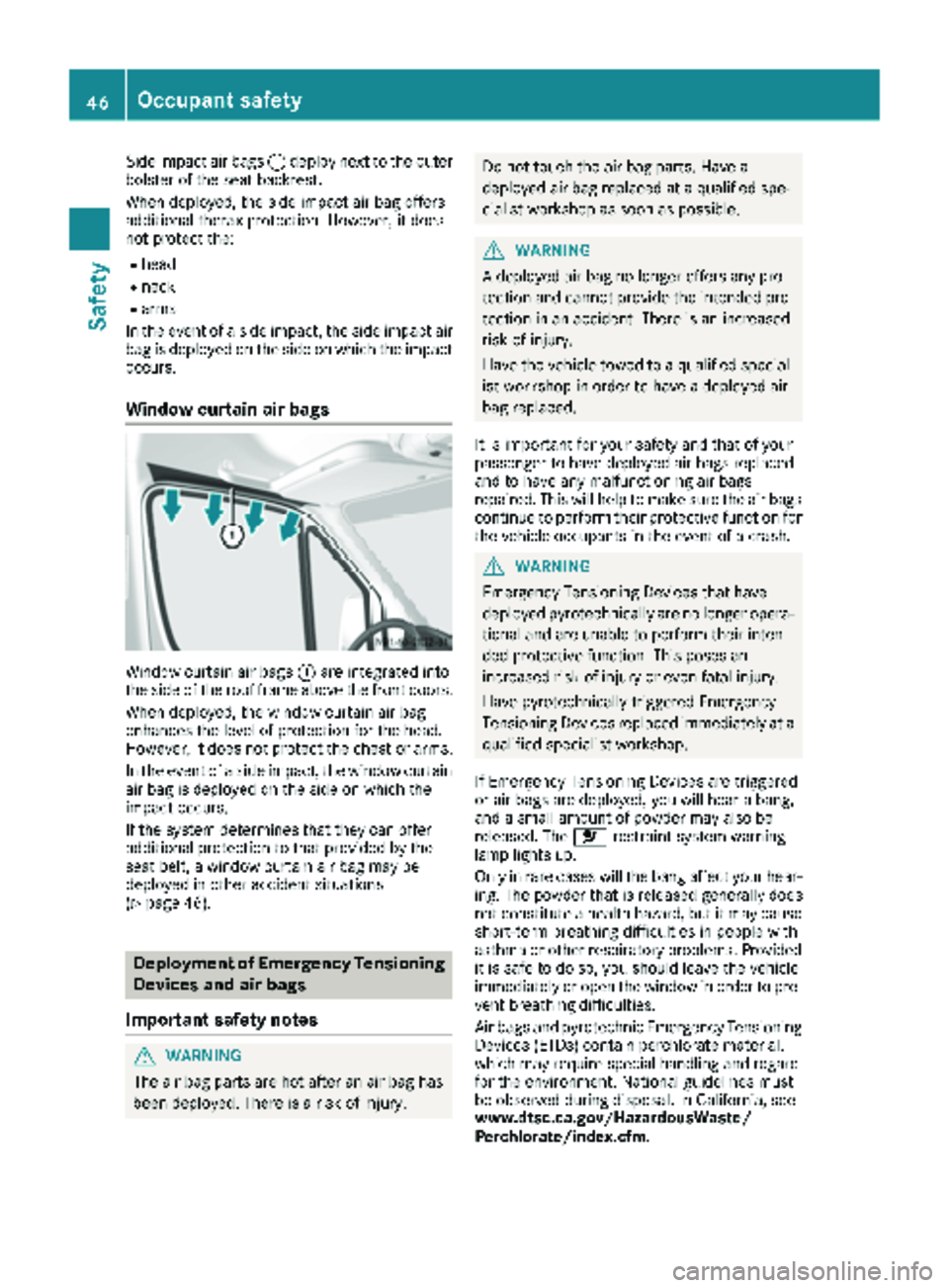
Side impact air bags:deploy next to the outer
bolster of the seat backrest.
When deployed, the side impact air bag offers
additional thorax protection. However, it does
not protect the:
Rhead
Rneck
Rarms
In the event of a side impact, the side impact air
bag is deployed on the side on which the impact
occurs.
Window curtain air bags
Window curtain air bags :are integrated into
the side of the roof frame above the front doors.
When deployed, the window curtain air bag
enhances the level of protection for the head.
However, it does not protect the chest or arms.
In the event of a side impact, the window curtain
air bag is deployed on the side on which the
impact occurs.
If the system determines that they can offer
additional protection to that provided by the
seat belt, a window curtain air bag may be
deployed in other accident situations
(
Ypage 46).
Deployment of Emergency Tensioning
Devices and air bags
Important safety notes
GWARNING
The air bag parts are hot after an air bag has
been deployed. There is a risk of injury.
Do not touch the air bag parts. Have a
deployed air bag replaced at a qualified spe-
cialist workshop as soon as possible.
GWARNING
A deployed air bag no longer offers any pro-
tection and cannot provide the intended pro-
tection in an accident. There is an increased
risk of injury.
Have the vehicle towed to a qualified special-
ist workshop in order to have a deployed air
bag replaced.
It is important for your safety and that of your
passenger to have deployed air bags replaced
and to have any malfunctioning air bags
repaired. This will help to make sure the air bags
continue to perform their protective function for
the vehicle occupants in the event of a crash.
GWARNING
Emergency Tensioning Devices that have
deployed pyrotechnically are no longer opera-
tional and are unable to perform their inten-
ded protective function. This poses an
increased risk of injury or even fatal injury.
Have pyrotechnically triggered Emergency
Tensioning Devices replaced immediately at a
qualified specialist workshop.
If Emergency Tensioning Devices are triggered
or air bags are deployed, you will hear a bang,
and a small amount of powder may also be
released. The 6restraint system warning
lamp lights up.
Only in rare cases will the bang affect your hear-
ing. The powder that is released generally does
not constitute a health hazard, but it may cause
short-term breathing difficulties in people with
asthma or other respiratory problems. Provided
it is safe to do so, you should leave the vehicle
immediately or open the window in order to pre-
vent breathing difficulties.
Air bags and pyrotechnic Emergency Tensioning
Devices (ETDs) contain perchlorate material,
which may require special handling and regard
for the environment. National guidelines must
be observed during disposal. In California, see
www.dtsc.ca.gov/HazardousWaste/
Perchlorate/index.cfm .
46Occupant safety
Safety
Page 49 of 286

Method of operation
During the first stage of a collision, the restraint
system control unit evaluates important physi-
cal data relating to vehicle deceleration or accel-
eration, such as:
Rduration
Rdirection
Rintensity
Based on the evaluation of this data, the
restraint system control unit triggers the Emer-
gency Tensioning Devices during a frontal or
rear collision.
An Emergency Tensioning Device can only be
triggered, if:
Rthe ignition is switched on
Rthe components of the restraint system are
operational. You can find further information
under: "Restraint system warning lamp"
(
Ypage 40)
Rthe seat belt buckle tongue has engaged in
the belt buckle of the respective front seat
The Emergency Tensioning Device of the front-
passenger seat is triggered independently of the
lock status of the seat belt.
If the restraint system control unit detects a
more severe accident, further components of
the restraint system are activated independ-
ently of each other in certain frontal collision
situations:
RFront air bags
RWindow curtain air bag on the side on which
the impact occurs
The activation threshold of the Emergency Ten-
sioning Devices and the air bag are determined
by evaluating the rate of vehicle deceleration or
acceleration which occurs at various points in
the vehicle. This process is pre-emptive in
nature. Deployment should take place in good
time at the start of the collision.
The rate of vehicle deceleration or acceleration
and the direction of the force are essentially
determined by:
Rthe distribution of forces during the collision
Rthe collision angle
Rthe deformation characteristics of the vehicle
Rthe characteristics of the object with which
the vehicle has collided
Factors which can only be seen and measured
after a collision has occurred do not play a deci-
sive role in the deployment of an air bag . Nor dothey provide a
n indication of air bag deploy-
ment.
The vehicle can be deformed considerably, with-
out an air bag being deployed. This is the case if
only parts which are relatively easily deformed
are affected and the rate of deceleration is not
high. Conversely, air bags may be deployed even though the vehicle suffers only minor deforma-
tion. This is the case if, for example, very rigid
vehicle parts such as longitudinal body mem-
bers are hit, and sufficient deceleration occurs
as a result.
If the restraint system control unit detects a side
impact, the relevant restraint system compo-
nents are deployed independently of each other.
If the system determines a need for additional
protection for the vehicle occupants, the Emer-
gency Tensioning Devices are triggered.
RSide impact air bag on the side of impact,
independently of the Emergency Tensioning
Device and the use of the seat belt
RWindow curtain air bag on the side of impact,independently of the use of the seat belt and
independently of whether the front-
passenger seat is occupied
iNot all air bags are deployed in an accident.
The different air bag systems work independ-
ently of each other.
How the air bag system works is determined
by the severity of the accident detected,
especially the vehicle deceleration or accel-
eration and the apparent type of accident:
Rfrontal collision
Rside impact
Children in the vehicle
Important safety notes
Accident statistics show that children secured
in the rear seats are safer than children secured
in the front-passenger seat. For this reason, we
strongly advise that you install a child restraint
system on a rear seat. Children are generally
better protected there.
If a child younger than twelve years old and
under 5 ft (1.50 m) in height is traveling in the
vehicle:
Ralways secure the child in a child restraint
system suitable for this vehicle. The child
Children in the vehicle47
Safety
Z
Page 51 of 286

Removingth echild restrain tsystem and deac -
tivating th especial seat belt retractor:
XMak esur eyou observ eth echild restrain t
system manufacturer' sinstallation instruc-
tions.
XPress th erelease butto nof th eseat belt
buckle and guide th eseat belt tongue bac k
towards th ebelt sash guide .
The special seat belt retracto ris deactivated.
Child restraint system
The use of seat belt sand infant and child
restrain tsystems is require dby law in:
Rall 50 state s
RtheU.S. territories
Rth eDistric tof Columbia
Rall Canadian province s
Further information about th ecorrec tchild
restrain tsystem is available from any authorize d
Sprinte rdealer.
GWARNIN G
If th echild restrain tsystem is installed incor-
rectl yon asuitable seat ,it canno tprotect as
intended. The child canno tthen be restrained
in th eevent of an accident, heav ybraking or
sudde nchanges of direction .There is an
increased ris kof injury, possibl yeve nfatal.
Mak esur ethat you observ eth echild restrain t
system manufacturer' sinstallation instruc-
tion sand th enote son use. Pleas eensure,
that th ebase of th echild restrain tsystem is
always resting completely on th eseat cush-
ion .Never plac eobjects ,e.g. cushions, under
or behind th echild restrain tsystem. Only use
child restrain tsystems wit hth eoriginal cover
designed for them. Only replace damaged
cover swit hgenuine covers.
GWARNIN G
If th echild restrain tsystem is installed incor-
rectl yor is no tsecured ,it can come loos ein
th eevent of an accident, heav ybraking or a
sudde nchang ein direction .The child
restrain tsystem could be throw nabout ,strik -
ing vehicl eoccupants. There is an increased
ris kof injury, possibl yeve nfatal.
Always instal lchild restrain tsystems prop-
erly, eve nif they are no tbein gused .Mak e
sur ethat you observ eth echild restrain tsys-
te m manufacturer' sinstallation instructions.
You will fin dfurther information on stowin g
objects ,luggag eand loads securel yunder
"Loading guidelines" (
Ypage 208).
GWARNING
Child restrain tsystems or their securin gsys-
tems whic hhav ebeen damaged or subjecte d
to aload in an acciden tcan no longer protect
as intended. The child canno tthen be
restrained in th eevent of an accident, heav y
braking or sudde nchanges of direction .There
is an increased ris kof injury, possibl yeve n
fatal.
Replac echild restrain tsystems whic hhav e
been damaged or subjecte dto aload in an
acciden tas soo nas possible. Hav eth esecur-
ing systems on th echild restrain tsystem
checke dat aqualified specialist workshop,
before you instal l achild restrain tsystem
again .
Securing systems for child restrain tsystems
include:
Rth eseat belt system
Rth eLATCH-type (ISOFIX) securin grings
RTop Tether anchorage
iIf it is absolutely necessar yto instal l achild
restrain tsystem on th efront-passenger seat ,
be sur eto observ eth enote son "Child
restrain tsystems on th efront-passenger
seat " (
Ypage 51) .
All child restrain tsystems mus tmee tth efol -
lowin gstandards :
RU.S. Federal Motor Vehicl eSafet yStandards
21 3and 22 5
RCanadian Motor Vehicl eSafet yStandards
21 3and 210. 2
A statemen tby th echild restrain tmanufacturer
of complianc ewit hthe
se standards can be
foun don th einstruction label on th echild
restrain tsystem. You will also fin dth estate -
men tin th einstruction manual provide dwit hth e
child restrain tsystem.
Children in the vehicle49
Safety
Z
Page 53 of 286

Top Tether anchorage points
Example: rear bench seat with three seats
Top Tether anchorages;are on the bench seat
legs on the rear side of the respective rear bench
seat.
XSlide head restraint :up.
XInstall the LATCH-type (ISOFIX) child restraint
system with Top Tether. Make sure you
observe the child restraint system manufac-
turer's installation instructions.
XRoute the Top Tether belt ?under head
restraint :between the two head restraint
bars.
XHook Top Tether hook =into Top Tether
anchorage ;.
Make sure that:
RTop Tether hook =is hooked into Top
Tether anchorage ;, as shown
RTop Tether belt?is not twisted
XTighten Top Tether belt ?. Make sure you
observe the child restraint system manufac-
turer's installation instructions.
XIf necessary, push the head restraint back
down slightly (Ypage 76). Make sure that
you do not interfere with the correct routing of
Top Tether belt ?.
Child restraint system on the front-
passenger seat
General notes
Accident statistics show that children secured
in the rear seats are safer than children secured
in the front seats. For this reason, Mercedes-
Benz strongly advises that you install a child
restraint system on a rear seat.
Rearward-facing child restraint system
The front-passenger front air bag cannot be
deactivated. Always install a rearward-facing
child restraint system on a suitable rear seat.
Always comply with the manufacturer's instal-
lation and operating instructions for the child
restraint system.
Forward-facing child restraint system
Always move the front-passenger seat as far
back as possible if the child must be secured on
the front-passenger seat in a forward-facing
child restraint system. The base of the child
restraint system must always rest on the seat
cushion of the front-passenger seat. As much as
possible of the backrest of the child restraint
system must be resting on the backrest of the
front-passenger seat. The child restraint system
may not be subjected to a load by the head
restraint. Adjust the head restraint position
accordingly. Always make sure the shoulder belt is correctly secured, running from the belt outlet
to the belt guide of the child restraint system.
The shoulder belt strap must be routed forward
and down from the vehicle belt outlet. Adjust the belt outlet and front-passenger seat as required.
Always comply with the manufacturer's instal-
lation and operating instructions for the child
restraint system.
Children in the vehicle51
Safety
Z
Page 55 of 286

As a result, they could:
Ractivate vehicle equipment and become
trapped, for example
Ractivate or deactivate systems, thereby
endangering other road users
Unsecured animals could also be flung around
the vehicle in the event of an accident or sud-
den steering or braking, thereby injuring vehi- cle occupants. There is a risk of an accident
and injury.
Never leave animals unattended in the vehi-
cle. Always secure animals properly during
the journey, e.g. use a suitable animal trans-
port box.
Driving safety systems
Overview
In this section, you will find information about
the following driving safety systems:
RABS ( Anti-lock Braking System)
RASR (Acceleration SkidControl)
RBAS ( Brake Assist System)
REBD ( Electronic Brake Force Distribution)
RESP®(E lectronic StabilityProgram)
Important safety notes
If you fail to adapt your driving style or if you are
inattentive, the driving safety systems can nei-
ther reduce the risk of accident nor override the
laws of physics. Driving safety systems are
merely aids designed to assist driving. You are
responsible for the distance to the vehicle in
front, for vehicle speed, braking in good time
and for staying in your lane. Always adapt your
driving style to the prevailing road and weather
conditions and maintain a sufficient, safe dis-
tance from other road users. Drive carefully.
Please note that the driving safety systems
described only work optimally when:
Rthere is adequate contact between the tires
and the road surface
Ryou use winter tires (M+S tires), with snow
chains if necessary, when the road conditions
are wintry Pay particular attention to the information
regarding tires, tire tread and winter operation
under "Wheels and tires" (
Ypage 243).
ABS (Anti-lock Braking System)
Important safety notes
Observe the important safety guidelines for the
driving safety system (Ypage 53).
GWARNING
If ABS is faulty, the wheels could lock when
braking. The steerability and braking charac-
teristics may be severely impaired. Addition-
ally, further driving safety systems are deac-
tivated. There is an increased danger of skid-
ding and accidents.
Drive on carefully. Have ABS checked imme-
diately at a qualified specialist workshop.
If ABS is malfunctioning, other systems will also
fail, including driving safety systems. Observe
the information relating to the !warning
lamp (
Ypage 191).
ABS regulates brake pressure in such a way that
the wheels do not lock when you brake. This
allows you to continue steering the vehicle when
braking.
ABS works from a speed of about 5 mph
(8 km/h), regardless of road-surface conditions. ABS works on slippery surfaces, even when you
only brake gently.
The yellow !warning lamp in the instrument
cluster lights up when the ignition is switched
on. The lamp goes out when the engine starts
running.
Braking
If ABS intervenes when braking, you will feel a
pulsating in the brake pedal.
The pulsating brake pedal can be an indication
of hazardous road conditions and functions as a
reminder to take extra care while driving.
XIf ABS intervenes: continue to depress the
brake pedal with force until the braking sit-
uation is over.
XTo make a full brake application: depress
the brake pedal with full force.
Driving safety systems53
Safety
Z