2017 MERCEDES-BENZ SLC-Class wheel size
[x] Cancel search: wheel sizePage 265 of 294

Important safety notes
GWARNING
Eac htire, includin gthe spar e(if provided),
should be checke datleast once amonth
when cold and inflated to th epressur erec-
ommended by th evehicl emanufacturer on
th eT irea nd Loading Information placard on
th ed river' sdoor B-pillar or th etirep ressur e
label on th einside of th efuel filler flap .Ifyour
vehicl ehas tires of adifferen tsizet hant he
siz eindicated on th eTirea nd Loading Infor -
mation placard or th etirep ressur elabel, you
should determine th eproper tire pressur efor
those tires .
As an added safet yfeature, your vehicl ehas
been equipped wit hatirep ressur emonitoring
system (TPMS) that illuminate salow tire pres-
sur etelltale when on eormoreofy our tires
are significantly underinflated. Accordingly,
when th elow tire pressur etelltale illuminates,
you should stop and chec kyour tires as soo n
as possible ,and inflat ethemtot heproper
pressure. Drivin gonasignificantly underin-
flated tire causes th etiretoo verheat and can
lead to tire failure. Underinflation also
reduce sfuel efficiency and tire tread life ,and
may affec tthe vehicle's handlin gand stop-
pin gability.
Pleas enotet hatthe TPM Sisn otas ubstitut e
for proper tire maintenance ,and it is th edriv-
er' sre
sponsibilit ytom aintai ncorrect tire
pressure, eve nifunderinflation has no t
reached th elevel to trigge rillumination of th e
TPM Slow tire pressur etelltale.
Your vehicl ehas also been equipped wit ha
TPM Smalfunction indicator to indicat eifthe
system is no toperating properly. The TPM S
malfunction indicator is combined wit hthe
low tire pressur etelltale. When th esystem
detects amalfunction ,the warning lamp will
flas hfor approximately aminute and then
remain continuously illuminated. This
sequenc ewill be repeated every time th evehi-
cle is started as lon gasthemalfunction
exists.
When th emalfunction indicator is illuminated,
th es ystem may no tbeable to detec torsignal
low tire pressur easintended. TPM Smalfunc -
tion smay occur for avariet yofr easons,
includin gthe installation of incompatible
replacemen toralternate tires or wheels on
th ev ehicl ethatp reven tthe TPM Sfromf unc-
tioning properly. Always chec kthe TPM Smal-
function telltale after replacing on eormore
tires or wheels on your vehicl etoensuret hat
th er eplacemen toralternate tires and wheels
allow th eTPM Stoc ontinue to function prop-
erly.
It is th edriver' sresponsibilit ytos et th etire
pressur etothatrecommended for cold tires
whic hiss uitable for th eoperating situation
(
Ypage 258). Not etha tthe correc ttirep ressur e
for th ecurren toperating situation must first be
taught-in to th etirep ressur emonitor. If there is
as ubstantial loss of pressure, th ewarning
threshold for th ewarning message is aligned to
th er eferenc evalue staught-in .Restart th etire
pressur emonitor after adjusting th epressur eof
th ec oldt ires (
Ypage 264). The curren tpres-
sures are saved as ne wreferenc evalues. As a
result ,awarning message will appear if th etire
pressur edrops sign ifica
ntly.
The tire pressur emonitor does no twarn you of
an incorrectl yset tire pressure. Observ ethe
note sont herecommended tire pressur e
(
Ypage 258).
The tire pressur emonitor is no table to warn you
of as udde nloss of pressure, e.g. if th etirei s
penetrated by aforeign object. In th eevent of a
sudde nloss of pressure, brin gthe vehicl etoa
halt by braking carefully. Avoid abrup tsteering
movements.
The tire pressur emonitor has ayellow warning
lamp in th einstrumen tcluste rfor indicating
pressur eloss or amalfunction .Whether th e
warning lamp flashes or lights up indicates
whether atirep ressur eistoolow or th etire
pressur emonitor is malfunctioning :
Rif thewarning lamp is lit continuously, th etire
pressur eononeor mor etires is significantly
to ol ow. The tire pressur emonitor is no tmal-
functioning .
Rif thewarning lamp flashes for aroun da
minute and then remain slit constantly, th e
tire pressur emonitor is malfunctioning .
Tire pressure263
Wheels and tires
Z
Page 267 of 294

Additionaltire pressure values for different
load scan also be found on the tire pressure
table on the insid eofthe fuel fille rflap
(
Ypage 258).
XMake sure thatt he tire pressure is correct on
al lf ou rw heels.
XMake sure thatt he SmartKeyisinp osition2
in the ignition lock.
XPress the =or; button on the steering
whee ltoselect the Serv.menu.
XPress the 9or: button to select
Tir ePressure.
XPress the abutton.
The multifunctio ndisplay shows the current
tire pressure for the individual tire sorthe
Tir epressure wil lbedisplayed
after drivin gafew minutesmessage.
XPress the :button.
The UseCurrentPressuresasNewRef‐erenceValuesmessage appear sinthe mul-
tifunctio ndisplay.
If youw ishtoc onfirm the restart:
XPress the abutton.
The TirePress.MonitorRestartedmes-
sage appear sinthe multifunctio ndisplay.
After driving for afew minutes, the system
checks whethe rthe current tire pressures are
withint he specified range.T he new tire pres-
sures ar ethen accepte dasreference values
and monitored.
If youw ishtoc ancelthe restart:
XPress the %button.
The tire pressure values stored at the last
restart will continue to be monitored.
Radio type approval fort he tire pres-
sure monitor
CountryRadio type approval number
USAFCC ID: MRXMW2433A
FCC ID: MRXGG4
FCC ID: MRXMC34MA4
CanadaIC:2 546A-MW2433A
IC:2 546A-GG4
IC:2 546A-MC34MA4
Loadin gthe vehicle
Instructio nlabel sfor tiresa nd loads
GWARNING
Overloaded tire scan overheat, causing a
blowout. Overloaded tire scan also impai rthe
steering and driving characteristics and lead
to brake failure. There is ariskofa ccident.
Observ ethe load rating of the tires. The load
rating must be at leas thalfoft he GAW Rof
your vehicle. Never overload the tire sby
exceeding the maximu mload.
Twoi nstructio nlabel sony ourvehicl eshowt he
maximu mpossibl eload.
(1) The Tire and Loading Informatio nplacard is
on the B-pillar on the driver's side .The Tire
and Loading Informatio nplacard shows the
maximu mpermissibl enumbe rofoccu-
pants and the maximu mpermissibl evehicle
load .Italsoc ontains details of the tire sizes
and corresponding pressures for tires
mounted at the factory.
(2) The vehicl eide ntificatio nplate is on the
B-pillar on the driver's side .The vehicle
identificatio nplate informs yo uofthe gross
vehicl eweigh trating .Iti smadeupoft he
vehicl eweigh t, allvehicl eoccupants, the
fuel and the cargo. Yo ucan also find infor-
matio nabout the maximu mgross axle
weight rating on the front and rea raxle.
The maximu mgross axl eweigh trating is
the maximu mweigh tthatc an be carrie dby
one axl e(
fro
nt or rea raxle) .Never exceed
the maximu mloadort he maximu mgross
axl ew eigh trating for the front or rea raxle.
:B-pillar, driver's side
Loadin gthe vehicle265
Wheel sand tires
Z
Page 268 of 294
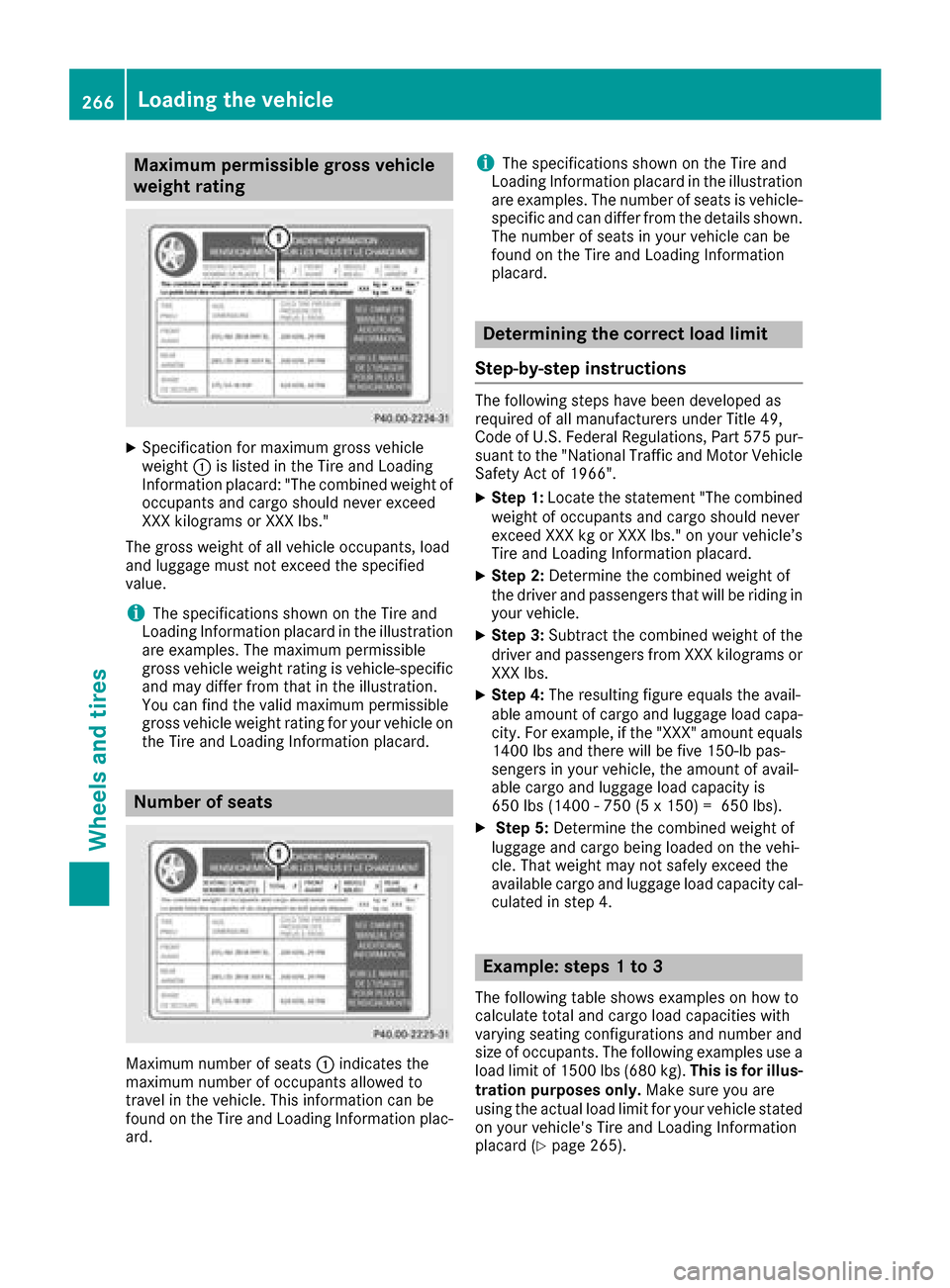
Maximum permissible gross vehicle
weight rating
XSpecification for maximumgross vehicle
weight :is listed in the Tire and Loading
Informatio nplacard: "The combined weight of
occupants and cargo should never exceed
XXX kilograms or XXX lbs."
The gross weight of all vehicleo ccupants, load
and luggage must not exceed the specified
value.
iThe specifications shownont he Tire and
Loading Informatio nplacard in the illustration
are examples. The maximu mpermissible
gross vehiclew eight rating is vehicle-specific
and may diffe rfrom that in the illustration.
You can find the vali dmaximu mpermissible
gross vehiclew eight rating for you rvehicl eon
the Tire and Loading Informatio nplacard.
Number of seats
Maximu mnumber of seats :indicates the
maximu mnumber of occupants allowe dto
travel in the vehicle. This information can be
found on the Tire and Loading Informatio nplac-
ard.
iThe specifications shownont he Tire and
Loading Informatio nplacard in the illustration
are examples. The number of seats is vehicle-
specific and can diffe rfrom the details shown.
The number of seats in you rvehicl ecan be
found on the Tire and Loading Information
placard.
Determinin gthe correct load limit
Step-by-ste pinstructions
The following steps have been developed as
required of all manufacturers under Title 49,
Cod eofU .S. FederalR egulations, Part 575 pur-
suant to the "National Traffi cand Motor Vehicle
Safety Act of 1966".
XStep 1: Locate the statement "The combined
weight of occupants and cargo should never
exceed XXX kg or XXX lbs." on you rvehicle’s
Tire and Loading Informatio nplacard.
XStep 2: Determine the combined weight of
the drivera nd passengers that wil lberiding in
you rvehicle.
XStep 3: Subtract the combined weight of the
drive rand passengers from XXX kilograms or
XXX lbs.
XStep 4: The resulting figure equals the avail-
abl eamount of cargo and luggage loa dcapa-
city. For example, if the "XXX "amount equals
1400 lbs and there wil lbefive 150-lb pas-
sengers in you rvehicle, the amount of avail-
abl ecargo and luggage loa dcapacity is
650 lbs (1400 -750 (5 x150) = 650 lbs).
XStep 5: Determine the combined weight of
luggage and cargo being loaded on the vehi-
cle. That weight may not safel yexceed the
available cargo and luggage loa dcapacity cal-
culated in step 4.
Example :steps 1to3
The following table showse xamples on how to
calculate total and cargo loa dcapacities with
varying seating configurations and number and
size of occupants. The following examples use a
loa dlimi tof1 500 lbs (680 kg). This is for illus-
tration purposes only. Make sure you are
using the actua lloadl imitfor you rvehicl estated
on you rvehicle's Tire and Loading Information
placard (
Ypag e265).
266Loading the vehicle
Wheels and tires
Page 271 of 294

Tire labeling
Overview
:Unifor mTireQ ualit yGradin gStandard
(Ypage 272)
;DOT, Tire Identification Number
(Ypage 271)
=Maximum tire load (Ypage 271)
?Maximum tire pressure (Ypage 261)
AManufacturer
BTire material (Ypage 272)
CTire size designation, load-bearing capacity
and spee drating (Ypage 269)
DLoa dindex (Ypage 271)
ETire name
The markings describe dabove ar eont he tire in
additio ntothe tire nam e(sales designation) and
the manufacturer's name.
iTire data is vehicle-specific and mayd eviate
fromt he data in the example.
Tire size designation ,loa d-bearing
capacity and speed rating
GWARNING
Exceeding the stated tire load-bearing capa-
city and the approved maximum spee dcould
lead to tire damage or the tire bursting. There is ar iskofa ccident.
Therefore ,onlyu setire types and sizes
approved for your vehicl emodel .Observe the
tire load rating and spee drating required for
your vehicle.
:Tire width
;Nomina laspec tratio in %
=Tire code
?Rimd iame ter
ALoadbeari ng index
BSpeed rating
General: depending on the manufacturer's
standards ,the size imprinted in the tire wall may
not contain any letters or mayc ontain one letter
thatp recedes the size description.
If there is no letter preceding the size descrip-
tio n(as shown above): these ar epassenger
vehicl etiresa ccording to Europea nmanufac-
turing standards.
If "P "precedes the size description: these are
passenge rvehicl etiresa ccording to U.S. man-
ufacturin gstandards.
If "LT" precedes the size description: these are
light truck tire saccording to U.S. manufacturing
standards.
If "T "precedes the size description: compact
emergency wheels with high tire pressure that
ar eo nlyd esig nedf or temporary us einanemer-
gency.
Tire width: tire width:shows the nominal tire
width in millimeters.
Height-width ratio: aspect ratio;is the size
ratio between the tire height and tire width and
is shown in percent. The aspect ratio is calcula-
ted by dividing the tire width by the tire height.
Tire code: tire code=specifie sthe tire type.
"R "r epresents radial tires; "D" represents diag-
ona ltire s; "
B" represents diagona
lradial tires.
Optionally ,tire sw itham aximum spee dofover
149 mph (24 0km/h )mayhave "ZR" in the size
Alla bout wheels an dtires269
Wheel sand tires
Z
Page 272 of 294

description, dependingonthe manufacturer
(e.g. 245/40 ZR 18).
Rim diameter: rim diameter?is the diameter
of the bead seat, not the diameter of the rim
flange. The rim diameter is specified in
inches (in).
Load-bearing index: load-bearing indexAis a
numerical code that specifies the maximum
load-bearing capacityofat ire.
Do not overload the tires by exceeding the
specified load limit. The maximum permissible
load can be found on the vehicle's Tire and
Loading Information placard on the B-pillar on
the driver'ss ide (
Ypage 265).
Example:
Load-bearin gindex 91 indicates amaximum
load of 1,356lb( 615 kg) that the tires can bear.
For further information on the maximum tire
load in kilograms and lbs, see (
Ypage 271).
For further information on the load bearing
index ,see "Load index "(
Ypage 271).
Speed rating: speed ratingBspecifies the
approved maximum speed of the tire.
iTire data is vehicle-specific and may deviate
from the data in the example.
Regardless of the speed rating, always observe
the speed limits. Driv ecarefully and adapt your
driving style to the traffic conditions.
Summer
tires
IndexSpeed rating
Qup to 100 mph (160 km/h)
Rup to 106 mph (170 km/h)
Sup to 112 mph (180 km/h)
Tup to 118 mph (190 km/h)
Hup to 130 mph (210 km/h)
Vup to 149 mph (240 km/h)
Wup to 168 mph (270 km/h)
Yup to 186 mph (300 km/h)
ZR...Yup to 186 mph (300 km/h)
ZR...(..Y)over 186 mph (300 km/ h)
ZRover 149 mph (240 km/h)
ROptionally, tires withamaximum speed of
over 149 mph (240k m/h) may have "ZR" in
the sized escription, depending on the man-
ufacturer (e.g .245/4 0ZR18).
The service specification is made up of load-
bearingi ndexAand speed rating B.
RIf the sizedescription of your tir eincludes
"ZR" and there are no service specifications,
ask the tir emanufacturer in order to findo ut
the maximum speed.
If as ervice specification is available, the max-
imum speed is limited accordingtot he speed
rating in the service specification .Example:
245/4 0ZR18 97 Y. In this example, "97 Y" is
the service specification .The letter "Y" rep-
resent sthe speed rating. The maximum
speed of the tir eislimited to 186 mph
(300k m/h).
RThe sized escription for all tires with maxi-
mum speeds of over 186 mph (300k m/h)
must include "ZR", andthe service specifica-
tion must be given in parentheses. Example:
275/4 0ZR18( 99 Y). Spee drating "(Y)" indi-
cates that the maximum speed of the tir eis
over 186 mph (300k m/h).A sk the tir eman-
ufacturer about the maximum speed.
All-
weather
tires and
winter
tires
IndexSpeed rating
QM +S1up to 100 mph (160k m/h)
TM +S1up to 118 mph (190k m/h)
HM +S1up to 130 mph (210k m/h)
VM +S1up to 149 mph (240k m/h)
iNot all tires with the M+S marking provide
the driving characteristics of winter tires. In
additio ntothe M+S marking, winter tires also
have the isnowflakes ymbol on the tire
wall. Tires with this marking fulfill the require-
ments of the Rubber Manufacturers Associa-
tion (RMA) and the Rubber Association of
Canada (RAC) regarding the tir etraction on
snow. They have been especially developed
for driving on snow.
1Or M+S ifor winter tires.
270All about wheels and tires
Wheels and tires
Page 273 of 294

An electronic speed limiterprevents your vehi-
cle from exceeding aspeed of 130 mph
(21 0km/h).
The speed rating of tire smounted at the factory
maybeh ighe rthant he maximu mspeed thatt he
electronic speed limite rpermits.
Make sure thaty ourtire sh avet he required
speed rating ,e.g.w henb uyin gnew tires. The
required speed rating for your vehicl ecan be
found in the "tires "sectio n(
Ypage 278).
Further informatio nabout reading tire data can
be obtained from any qualified specialist work-
shop.
Load index
In additio ntothe load-bearing index, load
index :maya lsobei mprinte donthe sidewall
of the tire .You will find thisa fterthe letter that
identifie sthe speed rating (
Ypage 269).
RIf no specification is given: no text (a sinthe
exampl eabove), represents astandard load
(SL) tire
RXL or Extra Load: represents areinforced tire
RLight Load: represents alight load tire
RC, D, E: represents aloa dr ange thatd epends
on the maximu mloadt hatt he tire can carry at
ac ertain pressure
iTire data is vehicle-specific and mayd eviate
from the data in the example.
Maximum load rating
Maximu mtire load :is the maximu mpermis-
sibl ew eigh tfor which the tire is approved.
Do not overload the tire sbyexceeding the
specified load limit. The maximu mpermissible
load can be found on the vehicle's Tire and
Loading Informatio nplacard on the B-pillar on
the driver's side (
Ypage 265).
iThe actual values for tire sarevehicle-spe-
cifi cand mayd eviate from the values in the
illustration.
DOT, Tire Identificatio nNumbe r(TIN)
US tire regulations stipulate thate very tire man-
ufacturer or retreader must imprint aTIN in or on
the sidewall of each tire produced.
The TIN is auniqu eide ntificatio nnumber. The
TIN enables the tire manufacturer sorretreaders
to inform purchaser sofrecallsand othe rsafety-
relevant matters .Itmakes it possibl efor the
purchaser to easily identify the affecte dtires.
The TIN is made up of manufacturer identifica-
tio nc ode ;,t ire size =,tire typ ecode ?and
manufacturing date A.
DO T(De partment of Transportation): tire
symbol :marks thatt he tire complies with the
Alla bout wheels and tires271
Wheel sand tires
Z
Page 274 of 294

requirements of the U.S. Department of Trans-
portation.
Manufacturer identificationcode: manufac-
turer identification code ;provides details on
the tire manufacturer. New tires have acode
with two symbols. Retreaded tires have acode
with four symbols.
For further informatio nabout retreaded tires,
see (
Ypag e278).
Tire size: identifier=describes the tire size.
Tire type code: tire type code?can be used by
the manufacturer as acode to describ especific
characteristics of the tire.
Date of manufacture: date of manufactureA
provides informatio nabout the age of atire. The
first and second positions represent the wee kof
manufacture, starting with "01" for the first cal-
endar week. Positions three and four represent
the yea rofmanufacture. For example, atire that
is marked "3214" was manufactured in wee k32
in 2014.
iTire data is vehicle-specific and may deviate
from the data in the example.
Tire characteristics
This informatio ndescribes the type of tire cord
and the number of layers in sidewall :and
under tire tread ;.
iTire data is vehicle-specific and may deviate
from the data in the example.
Definition of terms for tires and loading
Tire ply compositio nand material used
Describes the number of plies or the number of
layers of rubber-coated fabri cinthe tire tread
and sidewall. These are made of steel, nylon,
polyester and other materials.
Bar
Metric unit for tire pressure. 14.5038 pounds
per square inch (psi)a nd 100 kilopascals(kPa)
are the equivalent of 1bar.
DOT (Department of Transportation)
DOT-marked tires fulfill the requirements of the
USD epartment of Transportation.
Normal occupant weight
The number of occupants for which the vehicle
is designed multiplied by 68 kilograms (150 lbs).
Uniform Tire Quality Grading Standards
Auniform standard to grad ethe quality of tires
with regards to tread quality ,tire traction and
temperature characteristics. The quality grad-
ing assessment is made by the manufacturer
following specifications from the U.S. govern-
ment. The ratings are moldedi nto the sidewallof
the tire.
Recommended tire pressures
The recommended tire pressure applie stothe
tires mounted at the factory.
The Tire and Loading Information placard con-
tains the recommended tire pressures for cold
tires on afullyloaded vehicl eand for the maxi-
mum permissiblev ehiclespeed.
The tire pressure table contains the recommen-
ded pressures for cold tires for various operat-
ing conditions, i.e. differing loa dand speedc on-
ditions.
Increased vehicle weight due to optional
equipment
The combined weight of all standard and
optionale quipment available for the vehicle,
regardless of whethe ritisactually installed on
the vehicl eornot.
Rim
This is the part of the whee lonwhich the tire is
mounted.
GAWR (Gross Axl eWeight Rating)
The GAWR is the maximu mgross axle weight
rating. The actua lloadonana xle must never
exceed the gross axle weight rating. The gross
axle weight rating can be found on the vehicle
identification plate on the B-pillar on the dri
ver's
side.
272Alla bout wheels and tires
Wheels and tires
Page 276 of 294

Weight of optional extras
The combined weight of those optionalextras
that weigh more than the replaced standard
parts and more than 2.3 kg (5 lbs) .These
optiona lextras, such as high-performance
brakes ,levelc ontrol, aroof rack or ahigh-per-
formance battery ,are not included in the curb
weight and the weight of the accessories.
TIN (Tire Identification Number)
This is aunique identifier which can be use dby
at ire manufacturer to identify tires, for example
for aproduct recall, and thus identify the pur-
chasers. The TIN is made up of the manufactur-
er's identity code, tire size, tire type code and
the manufacturing date.
Load bearin gindex
The loa dbearing index (also loa dindex) is acode
that contains the maximu mloadb earing capa-
city of atire.
Traction
Tractio nisthe result of friction between the tires
and the road surface.
Treadwear indicators
Narrow bars (tread wea rbars )that are distrib-
uted over the tire tread. If the tire tread is level
with the bars ,the wea rlimi tofá in (1.6 mm)
has been reached.
Occupant distribution
The distribution of occupants in avehicl eatt heir
designated seating positions.
Total load limit
Nomina lloada nd luggag eloadp lus6 8k g
(150 lbs) multiplied by the number of seats in
the vehicle.
Changing awheel
Flat tire
The "Breakdown assistance" section
(Ypage241) contains information and notes on
how to dealw ithaflat tire. Informatio nondriv-
ing with MOExtended tires in the event of aflat
tire can be found under "MOExtended tires (tires
with run-fla tcharacteristics" (
Ypag e242).
Rotating the wheels
GWARNING
Interchanging the front and rear wheels may
severely impair the driving characteristics if
the wheels or tires have different dimensions. The whee lbrakes or suspension components
may als obedamaged. There is arisk of acci-
dent.
Rotate front and rear wheels only if the wheels and tires are of the same dimensions.
!On vehicles equipped with atire pressure
monitor, electronic components are located
in the wheel.
Tire-mounting tools should not be use dnear
the valve .This coul ddamage the electronic
components.
Only have tires changed at aqualified spe-
cialist workshop.
Always pay attention to the instructions and
safety notes when changing awheel
(
Ypag e275).
The wea rpatterns on the front and rear tires
differ, depending on the operating conditions.
Rotate the wheels before aclearw earp attern
has formed on the tires. Front tires typically
wea rmore on the shoulders and the rear tires in
the center.
On vehicles that have the same size front and
rear wheels, you can rotate the wheels accord-
ing to the interval sinthe tire manufacturer's
warranty book in you rvehicl edocuments. If no
warranty book is available,t he tires should be
rotated every 3,000 to 6,000 mile s(5,000 to
10,000 km) .Depending on tire wear, this may
be required earlier. Do not change the direction
of whee lrotation.
Clean the contact surfaces of the whee land the
brake disc thoroughly every time awhee lisr ota-
ted. Check the tire pressure and, if necessary,
restart the tire pressure loss warning system or
the tire pressure monitor.
Directio nofrotation
Tires with aspecified direction of rotation have
additiona lbenefits, e.g. if there is arisk of hydro-
planing. These advantages can only be gained if
the tires are installed corresponding to the
direction of rotation.
274Changing awheel
Wheels and tires