2017 MERCEDES-BENZ SLC-Class belt
[x] Cancel search: beltPage 42 of 294

GWARNING
The seat belts may not perform their intended protective function if:
Rthey are damaged, modified, extremely
dirty,b leached or dyed
Rthe seat beltb uckle is damaged or
extremely dirty
Rthe Emergency Tensioning Devices, belt
anchorages or inertia reelsh ave been modi-
fied.
Seat belts may be damaged in an accident,
although the damage may not be visible, e.g.
due to splinters of glass. Modified or damaged
seat belts may tear or fail ,e.g. in an accident.
Modified Emergency Tensioning Devices
coul daccidentally trigger or fail to deploy
when necessary. This posesani ncreased risk
of injury or even fatal injury.
Never modify the seat belts, Emergency Ten-
sioning Devices, belta nchorages and inertia
reels. Make sure that the seat belts are
undamaged, not worn out and clean. Follow-
ing an accident, have the seat belts checked
immediatel yataqualified specialist work-
shop.
Only use seat belts that have been approved for
you rvehicl ebyM ercedes-Benz.
Proper use of the seat belts
Observe the safety notes on the seat belt
(Ypage39).
All vehicleo ccupants must be wearing the seat
beltc orrectly before beginning the journey .Also
make sure that all vehicleo ccupants are always
wearing the seat beltc orrectly while the vehicle
is in motion.
When fastening the seat belt, alway smake sure
that:
Rthe seat beltt ongue is only inserted to the belt
buckle belonging to that seat.
Rthe seat beltist ight across yourbody.
Avoid wearing bulky clothing, e.g. awinter
coat.
Rthe seat beltisn ot twisted.
Only then can the forces which occur be dis-
tributed over the area of the belt.
Rthe shoulde rsection of the beltisa lways
routed across the center of you rshoulder.
The shoulde rsection of the beltm ust not
come into contact with you rneck or be routed
under you rarm.
Rthe lap beltp asses tightly and as low downa s
possible across you rlap.
The lap beltm ust alwaysberouted across
you rhip joints and not across you rabdomen.
This applie sparticularl ytopregnant women.
If necessary, pus hthe lap beltd owntoyour
hip joint and pul littight using the shoulder
section of the belt.
Rthe seat beltisn ot routed across sharp ,poin-
ted or fragile objects.
If you have such items located on or in your
clothing, e.g. pens, keys or eyeglasses, store
these in asuitable place.
Ronly one personisu singaseat beltata time.
Infants and children must never travel sitting
on the lap of avehicl eoccupant. In the event
of an accident, they coul dbecrushed
between the vehicleo ccupant and seat belt.
Robjects are never secure dwithaseat belti f
the seat beltisa lsob eing used by one of the
vehicle's occu
pants.
Also ensure that there are never objects
between apersona nd the seat, e.g. cushions.
Seat belts are only intended to secure and
restrai nvehicl eoccupants. Always observe the
notes in the "Stowage options/compartments"
section for securing objects, luggage or loads
(
Ypag e217).
Fastening seat belts
Observe the safety notes on the seat belt
(Ypag e39) and the notes on correct use of seat
belts (Ypag e40).
40Occupant safety
Safety
Page 43 of 294

Basicillust ration
XAdjus tthe sea t(Ypage 82).
The sea tbackrest mus tbeinana lmost ver-
tical position.
XPull the sea tbelts moothly outofb eltl oop =
and engage bel ttongue ;into belt
buckle :.
The sea tbeltont he driver’ sseata nd the
front-passenger sea tmay be tightened auto-
matically ,see "Belt adjustment"
(
Ypage 41).
XIf necessary ,pullu pward sonthe shoulder
section of the sea tbelttot ighten the belt
across your body.
In orde rtoattach the chil drestraint system
securelyint he vehicle, the sea tbeltont he front-
passenger sea tisequipped with aspecia lseat
bel tretractor. Furthe rinformation on the "Spe-
cia lsea tb eltr etractor" (
Ypage 52).
Releasing seat belts
!Make sur ethat the sea tbeltisf ully rolled up.
Otherwise ,the sea tbeltorb eltt onguew illb e
trapped in the doo rorinthe seatmechanism.
Thisc ouldd amaget he door, the doo rtrim
panel and the sea tbelt. Damaged sea tbelts
can no longer fulfil lthei rprotective function
and mus tbereplaced. Visit aquali fied spe-
cialist workshop.
XPres sthe release button in the bel tbuckle,
hol dthe bel ttonguef irmlyand guide the belt
back.
Sea tbelta djustment
Mercedes-Ben zSLC 43 AMG: the seatbelt
adjustment function is not available.
The seat-bel tadjustment is an integral part of
the PRE-SAFE
®convenience function. Thisf unc-
tion adjusts the driver's and front-passenger
sea tbelttot he upper bod yofthe occupants.
The bel tstrap is tightened slightlyw hen:
Rthe belttongueise ngaged in the buckle and
Rthe ignition is switched on
The seat-bel tadjustment will apply acertain
retraction force if any slack is detected between
the vehicle occupant and the sea tbelt. Do not
hol dontot he seatbeltt ightly while it is adjust-
ing.
You can switch the seat-bel tadjustment on and
off in the on-board computer (
Ypage 174).
Beltw arning for the drive rand front
passenger
The 7 seatbeltw arning lamp in the instru-
ment cluster is areminder that al lvehicle occu-
pants mus twearthei rseatb elts. It may light up
continuously or flash. In addition, there may be
aw arning tone.
Regardless of whether the driver's sea tbelth as
already bee nfastened, the 7seatbeltw arn-
ing lamp lights up for six seconds each time the engine is started. If, afte rsix seconds ,the driver
or front-passenger sea tbelth as not bee nfas-
tened and the doors are closed, the 7seat
bel twarning lamp lights up .Assoon as the driv-
er's and front-passenger sea tbelts are fastened
or afront doo risopened again, the 7seat
bel tw arning lamp goeso ut.
If the driver's sea tbeltisn ot fastened afte rthe
engine is started, an additional warning tone will
sound. The warning tone switches off after six
seconds or once the driver's sea tbeltisf as-
tened.
If the vehicle' sspeed exceeds 15 mph
(25 km/h )once and the driver's and front-
passenger sea tbelts are not fastened, awarning
tone sounds. Awarning tone also sounds with
increasing intensity for 60 seconds or until the
driver or front passenger hav efastened their
sea tbelts.
If the driver or front passenger unfasten their
sea tbelts during the journey,t he seatbeltw arn-
ing is activated again.
Occupan tsafety41
Safety
Z
Page 44 of 294

Air bags
Introd uction
The installation poin tofanair bag can be rec -
ognized by th eAIRBA Gs ymbol.
An air bag complements th ecorrectly fastened
seat belt .Itisnos ubstitutefor th eseat belt .The
air bag provides additional protection in appli-
cable acciden tsituations.
Not all air bags are deployed in an accident. The
differen tair bag systems function independ-
entl yfromo neanother (
Ypage 48).
However, no system available today can com-
pletely eliminate injurie sand fatalities.
It is also no tpossibl etorule out ariskofi njury
caused by an air bag due to th ehigh spee dat
whic hthe air bag mus tbedeployed.
Import ant safety notes
GWARNIN G
If you do no tsit in th ecorrect seat position ,
th ea ir bag canno tprotect as intended and
could eve ncaus eadditional injury when
deployed. This poses an increased ris kof
injury or eve nfatal injury.
To avoi dhazardous situations, always mak e
sur ethata ll of th evehicle's occupants:
Rhav efastene dtheir seat belt scorrectly ,
includin gpregnant women
Rare sitting correctl yand maintai nthe great-
est possibl edistanc etotheair bags
Rfollow th efollowin ginstruction s
Always mak esuret hatthe re are no objects
between th eair bag and th evehicle's occu-
pants .
RAdjus tthe seat sproperly before beginning
your journey. Always mak esuret hatthe seat
is in an almost upright position .The center of
th eh ead restrain tmusts upport th ehead at
about eye level.
RMov ethe driver's and front-passenger seat s
as far bac kaspossible. The driver's seat posi-
tion mus tallow th evehicl etobed riven safely.
ROnly hold th esteering whee lontheoutside .
This allows th eair bag to be fully deployed.
RAlways lean against th ebackrest while driv-
ing .Don otlean forward sorlean against th edoor or side window. You may otherwise be in
th
ed eploymen tarea of th eair bags .
RAlways keep your fee tinthefootwell in fron t
o
f th eseat .Don otput your fee tonthedash -
board, for example. Your fee tmay otherwise
be in th edeployment area of th eair bag.
RForthisr eason ,always secure person sless
than 5ft(1.50m)t allins uitabl erestraint sys-
tems .Uptot hisheight ,the seat belt cannot
be worn correctly.
If ac hild is traveling in your vehicle ,also
observe the followin gnotes:
RAlway ssecurec hildren under twelve year sof
ag ea nd less than5 ft (1.50m)tallins uitable
child restraint systems.
ROnlys ecureac hild in arearward-facing child
restraint systemont he front-passengerseat
when the front-passenge rfront ai rbag is
deactivated .Ifthe PASSENGER AIR BAG OFF
indicator lamp is permanentl ylit,t he front-
passenge rfront ai rbag is deactivated
(
Ypage 38).
RAlway sobser ve the instructions and safety
note sont he "Occupant Classification System
(OCS) "(
Ypage 44) and on "Children in the
vehicle" (Ypage 51 )ina ddit iontot he child
restraint systemm anufacturer's installation
and operating instructions.
Objects in the vehicle interior may prevent
an air bag fromf unctioningcorrectly. Before
startin gyourjourney and to avoi drisks resul ting
fromt h
e spee dofthe airbag as it deploys, make
sure that:
Rthere ar enopeople, animals or objects
between the vehicl eoccupants and an air
bag.
Rthere ar enoobjects between the seat, door
and B-pillar.
Rno accessories, such as cup holders, are
attache dtothe vehicl ewithint he deployment
area of an ai rbag,e .g.tod oors or side win-
dows.
Rno heavy, sharp-edged or fragile objects ar ein
the pockets of your clothing. Store such
objects in asuitabl eplace.
GWARNING
If yo umodify the ai rbag cove rora ffix objects
such as sticker stoit, the ai rbag can no longer
functio ncorrectly. There is an increasedr isk
of injury.
42Occupant safety
Safety
Page 46 of 294
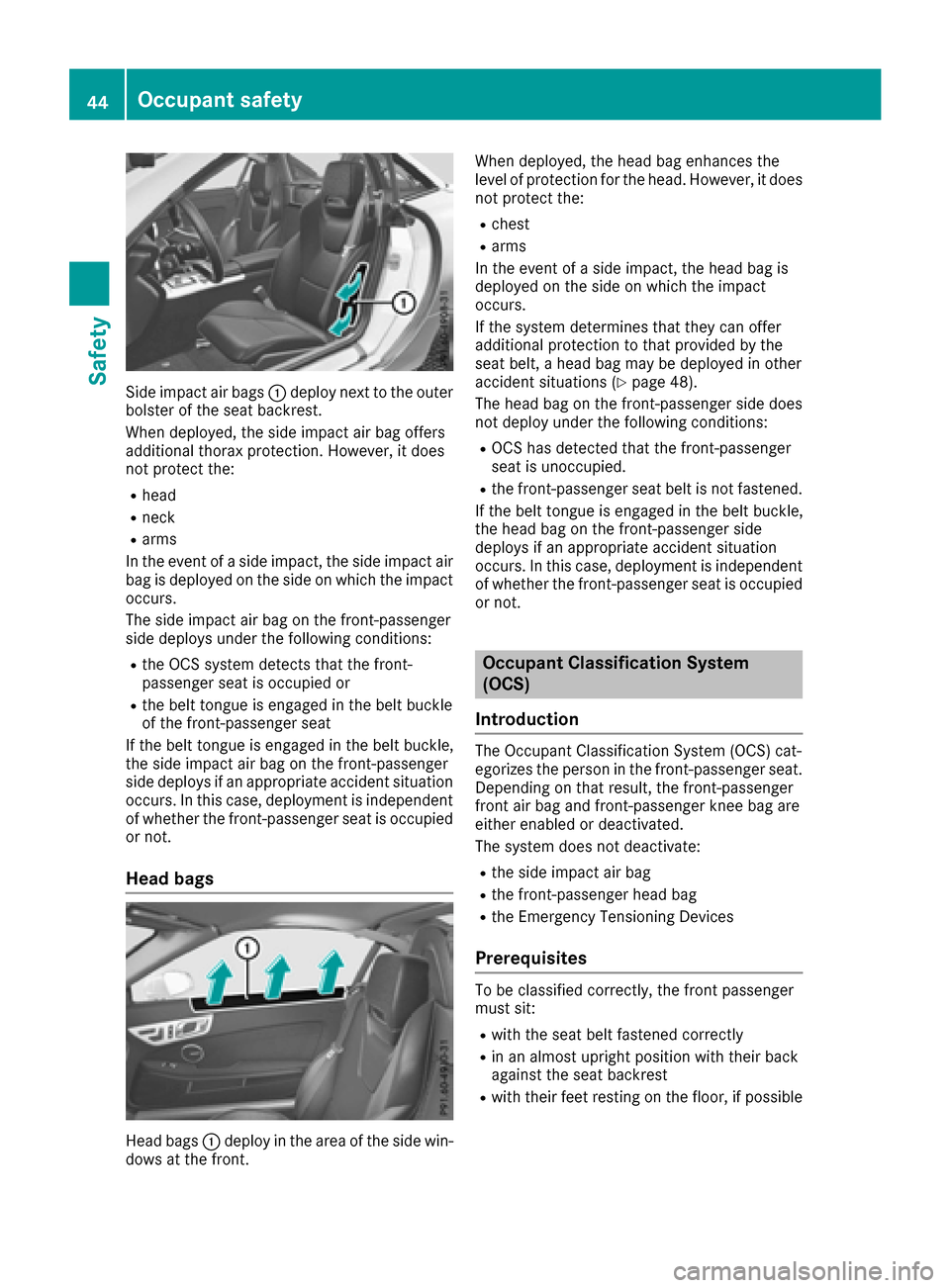
Sideimpact ai rbags: deplo ynext to the outer
bolster of the sea tbackrest.
Whe ndeployed, the sid eimpact ai rbag offers
additiona lthora xprotection. However, it does
not protect the:
Rhead
Rneck
Rarms
In the event of asidei mpact, the sid eimpact air
ba gisd eploye donthe sid eonw hich the impact
occurs.
The sid eimpact ai rbag on the front-passenger
sid ed eploys under the following conditions:
Rthe OCSs ystem detects that the front-
passenger sea tiso ccupied or
Rthe bel ttongu eise ngaged in the bel tbuckle
of the front-passenger seat
If the bel ttongu eise ngaged in the bel tbuckle,
the sid eimpact ai rbag on the front-passenger
sid ed eploys if an appropriate accident situation
occurs. In this case, deployment is independent
of whethe rthe front-passenger sea tiso ccupied
or not.
Head bags
Hea dbags: deplo yinthe are aofthe sid ewin-
dow satt he front. Whe
ndeployed, the hea dbagenhances the
level of protectio nfor the head. However, it does
not protect the:
Rchest
Rarms
In the event of asidei mpact, the hea dbagis
deploye donthe sid eonw hich the impact
occurs.
If the system determine sthat they can offer
additiona lprotectio ntothat provided by the
sea tbelt, aheadb agmay be deploye dinother
accident situations (
Ypage 48).
The hea dbagon the front-passenger sid edoes
not deplo yunder the following conditions:
ROCSh asdetected that the front-passenger
sea tisu noccupied.
Rthe front-passenger sea tbelti sn ot fastened.
If the bel ttongu eise ngaged in the bel tbuckle,
the hea dbagon the front-passenger side
deploys if an appropriate accident situation
occurs. In this case, deployment is independent
of whethe rthe front-passenger sea tiso ccupied
or not.
Occupant Classification System
(OCS)
Introduction
The Occupant Classification System (OCS) cat-
egorize sthe person in the front-passenger seat.
Depending on that result, the front-passenger
front ai rbag and front-passenger knee ba gare
either enabled or deactivated.
The system doe snot deactivate:
Rthe sid eimpact ai rbag
Rthe front-passenger hea dbag
Rthe Emergency Tensioning Devices
Prerequisites
To be classifie dcorrectly ,the front passenger
mus tsit:
Rwith the sea tbeltf astened correctly
Rin an almost upright position with thei rback
against the sea tbackrest
Rwith thei rfee tresting on the floor, if possible
44Occupan tsafety
Safety
Page 48 of 294

GWARNING
If you secure achild in arearward-facing child
restraint system on the front-passenge rseat
and the PASSENGER AIR BAG ON indicator
lamp is lit up, the front-passenge rfront air bag
may deploy in an accident. The child coul dbe
struck by the air bag .This posesani ncreased
risk of injury or even fatal injury.
Make sure that the front-passenge rfront air
bag has been disabled. The PASSENGER AIR
BAG OFF indicator lamp must be lit.
If the PASSENGER AIR BAG OFF indicator lamp
remains off and/or the PASSENGER AIR BAG
ON indicator lamp lights up, do not install arear-
ward-facing child restraint system on the front-
passenger seat. You can find more information
on OCS under "Problems with the Occupant
Classification System" (
Ypag e48).
GWARNING
If you secure achild in aforward-facing child
restraint system on the front-passenge rseat
and you position the front-passenge rseat too
close to the dashboard, in the event of an
accident, the child could:
Rcome into contact with the vehicle's inte-
rior if the PASSENGER AIR BAG OFF indi-
cator lamp is lit, for example
Rbe struck by the air bag if the PASSENGER
AIR BAG ON is lit up
This poses an increased risk of injury or even fatal injury.
Move the front-passenge rseat as far back as
possible.A lways make sure that the shoulder
belts trap is correctly routed from the vehicle
beltl oop to the shoulde rbeltg uide on the
child restraint system. The shoulde rbelts trap
must be routed forwards and downwards
from the beltl oop.Always observe the child
restraint system manufacturer's installation
instructions.
If OCS determines that:
Rthe front-passenge rseat is unoccupied ,the
PASSENGER AIR BAG OFF indicator lamp
lights up after the system self-test and remains lit. This indicates that the front-
passenger front air bag is deactivated.
Rthe front-passenge
rseat is occupied by a
child of up to twelve months old, in astandard
child restraint system, the PASSENGER AIR
BAG OFF indicator lamp lights up after the
system self-test and remains lit. This indi-
cates that the front-passenge rfront air bag is
deactivated.
But even in the case of atwelve-month-old
child ,inas tandard child restraint system, the
PASSENGER AIR BAG ON can light up perma-
nently after the system self-test. This indi-
cates that the front-passenge rfront air bag is
activated. The result of the classification is
dependent on, among other factors, the child
restraint system and the child's stature. Make
sure that the conditions for acorrect classi-
ficatio nare met. If the PASSENGER AIR BAG
OFF indicator lamp is still lit, do not install a
child restraint system on the front-passenger
seat.
Rthe front-passenge rseat is occupied by aper-
son of smaller stature (e.g. ateenage ror
smal ladult), either the PASSENGER AIR BAG
ON or PASSENGER AIR BAG OFF indicator
lamp lights up and remains lit after the system
self-test depending on the result of the clas-
sification.
-If the PASSENGER AIR BAG ON indicator
lamp lights up, move the front-passenger
seat as far back as possible.
-If the PASSENGER AIR BAG OFF indicator
lamp is lit, apersonofs maller stature
should not use the front-passenge rseat.
Rthe front-passenge rseat is occupied by an
adult or apersonofa dult stature, the
PASSENGER AIR BAG ON indicator lamp
lights up after the system self-test and
remains lit. This indicates that the front-
passenger front air bag is activated.
If children are traveling in the vehicle, be sure to
observe the notes on "Children in the vehicle"
(
Ypag e51).
When OCS is malfunctioning, the red 6
restraint system warning lamp in the instrument
cluster and the PASSENGER AIR BAG OFF indi-
cator lamp light up simultaneously .The front-
passenger front air bag is deactivated in this
case and does not deploy during an accident.
Have the system checked by qualified techni-
cians as soon as possible.C onsult an authorized
Mercedes-Benz Center. The front-passenger
46Occupant safety
Safety
Page 49 of 294

seat should only be repaired at an authorized
Mercedes-Benz Center.
If the front-passenger seat, the seat cover or theseat cushion is damaged,h ave the necessary
repair work carried out at an authorized
Mercedes-Benz Center.
For safety reasons, Mercedes-Benz recom-
mends that you only use seat accessories that
have been approved by Mercedes-Benz.
If the driver's air bag deploys, this does not
mean that the front-passenger front air bag will
also deploy.T he Occupant Classification Sys-
tem (OCS) categorizes the occupant in the front-
passenger seat. Depending on that result, the
front-passenger front air bag is either enabled or
deactivated.
System self-test
GDANGER
If both the PASSENGER AIR BAG OFF and
PASSENGER AIR BAG ON indicator lamps do
not light up during the system self-test, the
system is malfunctioning. The front-
passenger front air bag might be triggered
unintentionally or might not be triggered at all
in the event of an accident with high deceler-
ation. This poses an increased risk of injury or
even fatal injury.
In this case the front-passenger seat may not
be used. Do not install achild restraint system
on the front-passenger seat. Have the Occu-
pant Classification System (OCS) checked
and repaired immediately at aqualified spe-
cialist workshop.
GWARNING
If the PASSENGER AIR BAG OFF indicator
lamp remains lit after the system self-test, the
front-passenger front air bag is disabled. It will
not be deployed in the event of an accident. In
this case, the front-passenger front air bag
cannot perform its intended protective func-
tion, e.g. when aperson is seated in the front-
passenger seat.
That person could, for example, come into
contact with the vehicle's interior, especially
if the person is sitting too close to the dash-
board. This poses an increased risk of injury or
even fatal injury.
When the front-passenger seat is occupied,
always ensure that:
Rthe classification of the person in the front- passenger seat is correct and the front-
passenger front air bag is enabled or disa-
bled in accordance with the person in the
front-passenger seat
Rthe person is seated properly with acor-
rectly fastened seatbelt
Rthe front-passenger seat has been moved
as far back as possible
If the PASSENGER AIR BAG OFF indicator
lamp remains lit when it should not, the front-
passenger seat may not be used. Do not
install achild restraint system on the front-
passenger seat. Have the Occupant Classifi-
cation System (OCS) checked and repaired
immediately at aqualified specialist work-
shop.
GWARNING
Objects between the seat surface and the
child restraint system could affect OCS oper- ation. This could result in the front-passenger
air bag not functioningasi ntended during an
accident. This poses an increased risk of
injury or even fatal injury.
Do not place any objects between the seat
surface and the child restraint system. The
entire base of the child restraint system must
always rest on the seat cushion of the front-
passenger seat. The backrest of the forward-
facing child restraint system must, as far as
possible,ber esting on the backrest of the
front-passenger seat. Always comply with the
child restraint system manufacturer's instal-
lation instructions.
After the system self-test, the PASSENGER AIR
BAG OFF or PASSENGER AIR BAG ON indicator
lamp displays the status of the front-passenger
front air bag (
Ypage 45).
For more information about the OCS, see "Prob-
lems with the Occupant Classification System"
(
Ypage 48).
Occupant safety47
Safety
Z
Page 50 of 294

Problems with the Occupant Classification System (OCS)
Be sure to observe the notes on "System self-test"(Ypage 47).
ProblemPossible causes/consequences andMSolutions
The PASSENGER AIR
BAG OFF indicator lamp
lights up and remains lit,
even though the front-
passenger seat is occu-
pied by an adult oraper-
son of astature corre-
sponding to that of an
adult.The classification of the person on the front-passenger seat is incor-
rect.
XMake sure the conditionsf orac orrect classification of the person
on the front-passenger seat are met (Ypage 44).
XIf the PASSENGER AIR BAG OFF indicator lamp remains lit, the front-
passenger seat may not be used.
XHave OCS checked as soon as possible at an authorized Mercedes- Benz Center.
The PASSENGER AIR
BAG OFF indicator lamp
does not light up and/or
does not stay on.
The front-passenger seat
is:
Runoccupied
Roccupied with the
weight of achild up to
twelve months old in a
child restraint system
OCS is malfunctioning.
XMake sure there is nothin gbetween the seat cushion and the child
seat.
XMake sure that the entire base of the child restraint system rests on
the seat cushion of the front-passenger seat. The backrest of the
forward-facing child restraint system must lie as flat as possible
against the backrest of the front-passenger seat. If necessary,
adjust the position of the front-passenger seat.
XWhen installing the child restraint system, make sure that the seat belt is tight. Do not pull the seat belt tight using the front-passenger
seat adjustment .This could result in the seat belt and the child
restraint system being pulled too tightly.
XCheck for correct installation of the child restraint system.
Make sure that the head restraint does not apply aload to the child
restraint system. If necessary, adjust the head restraint accord-
ingly.
XMake sure that no object sare applying additional weight onto the
seat.
XIf the PASSENGER AIR BAG OFF indicator lamp remains off and/or
the PASSENGER AIR BAG ON indicator lamp lights up, do not install ac hild restraint system on the front-passenger seat.
XHave OCS checked as soon as possible at an authorized Mercedes-
Benz Center.
Deployment of Emergency Tensioning
Devices and air bags
Important safety notes
GWARNING
The air bag parts are hot after an air bag has
been deployed. There is arisk of injury.
Do not touch the air bag parts. Have a
deploye dair bag replaced at aqualified spe-
cialist workshop as soon as possible.
GWARNING
Ad eployeda ir bag no longer offers any pro-
tection and cannot provide the intended pro-
tection in an accident. There is an increased
risk of injury.
Have the vehicle towed to aqualified special-
ist workshop in order to have adeployeda ir
bag replaced.
For your own safety and that of your front
passenger, it is important that you have
48Occupant safety
Safety
Page 51 of 294

deployed air bags replaced and faulty air bags
repaired. This will help to make sure the air bags
continue to performtheir protective function for
the vehicle occupants in the event of acrash.
GWARNING
Emergenc yTensioning Devices that have
deployed pyrotechnically are no longer opera-
tional and are unable to performt heir inten-
ded protective function .This poses an
increased risk of injury or even fatal injury.
Have pyrotechnically triggered Emergency
Tensioning Devices replaced immediately at a
qualified specialist workshop.
An electric moto risused by PRE-SAFE
®to trig-
ger the tightenin gofthe seat belt in hazardous
situations. This procedure is reversible.
If Emergenc yTensioning Devices are triggered
or air bags are deployed, you will hear abang,
and asmall amount of powder may also be
released. The 6restraint system warning
lamp lights up.
Only in rare cases will the bang affect your hear-
ing. The powder that is released generally does
not constitute ahealth hazard, but it may cause
short-term breathin gdifficulties in people with
asthma or other respiratory problems. Provided
it is safe to do so, you should leave the vehicle
immediately or open the window in order to pre-
vent breathin gdifficulties.
Air bags and pyrotechnic Emergenc yTensioning
Devices (ETDs) contain perchlorate material,
which may require special handling and regard
for the environment. National guidelines must
be observed during disposal. In California, see
www.dtsc.ca.gov/HazardousWaste/
Perchlorate/index.cfm .
Method of operation
Duringthe first stage of acollision, the restraint
system control unit evaluates important physi-
cal data relatin gtovehicle deceleration or accel-
eration ,such as:
Rduration
Rdirection
Rintensity
Based on the evaluation of this data, the
restraint system control unit triggers the Emer-
genc yTensioning Devices during afrontal or
rear collision. An Emergenc
yTensioning Devic ecan only be
triggered, if:
Rthe ignition is switched on
Rthe component softhe restraint system are
operational. You can find further information
under: "Restraint system warning lamp"
(
Ypage 37)
Rthe belt tongue has engaged in the belt buckle
of the respective seat
If the restraint system control unit detects a
more severe accident, further component sof
the restraint system are activated independ-
ently of each other in certain frontal collision
situations:
RFronta ir bags as well as driver'sa nd front-
passenger knee bags
The front-passenger fronta ir bag is activated or
deactivated dependin gonthe person on the
front-passenger seat. The front-passenger front
air bag can only deploy in an accidentift he
PASSENGER AIR BAGONi ndicator lamp is lit.
Observe the information on the PASSENGER AIR
BAGi ndicator lamps (
Ypage 38).
Your vehicle has two-stage fronta ir bags. During
the first deployment stage, the fronta ir bag is
filled with propellant gas to reduce the risk of
injuries. The fronta ir bag is fully deployed with
the maximum amount of propellant gas if asec-
ond deployment threshold is reached within a
few milliseconds.
The activation threshold of the Emergenc yTen-
sionin gDevices and the air bag are determined
by evaluating the rate of vehicle deceleration or
acceleration which occurs at various point sin
the vehicle. This processisp re-emptive in
nature. Deploymen tshould take place in good
time at the start of the collision.
The rat
e of vehicle deceleration or acceleration
and the direction of the forcea re essentially
determined by:
Rthe distribution of forces during the collision
Rthe collision angle
Rthe deformation characteristic softhe vehicle
Rthe characteristic softhe objec twith which
the vehicle has collided
Factors which can only be seen and measured
after acollision has occurred do not play adeci-
sive role in the deployment of an air bag. Nor do
they provide an indication of air bag deploy-
ment.
The vehicle can be deformed considerably, with-
out an air bag being deployed. This is the case if
Occupant safety49
Safety
Z