2017 MERCEDES-BENZ S-Class MAYBACH trunk
[x] Cancel search: trunkPage 343 of 382
The fuses in your vehicle serve to close down
faulty circuits. If a fuse blows, all the compo-
nents on the circuit and their functions stop
operating.
If a newly inserted fuse also blows, have the
cause traced and rectified at a qualified special-
ist workshop, e.g. an authorized Mercedes-Benz
Center.
!Only use fuses that have been approved for
Mercedes-Benz vehicles and which have the
correct fuse rating for the system concerned.
Otherwise, components or systems could be
damaged.
!Make sure that no moisture can enter the
fuse box when the cover is open.
!When closing the cover, make sure that it is
lying correctly on the fuse box. Moisture seep-
ing in or dirt could otherwise impair the oper-
ation of the fuses.
Before changing a fuse
Observe the important safety notes
(Ypage 340)
XSwitch off the engine.
XSwitch off all electrical consumers.
XMake sure that the ignition is switched off
(Ypage 145).
or
XWhen using the SmartKey, turn the SmartKey
to position 0in the ignition lock and remove it
(
Ypage 145).
XSecure the vehicle against rolling away
(Ypage 162).
All indicator lamps in the instrument cluster
must be off.
The fuses are located in various fuse boxes:
RFuse box on the driver's side of the dashboard
RFuse box in the front-passenger footwell
RFuse box in the engine compartment on the
left-hand side of the vehicle, when viewed in
the direction of travel
RFuse box in the trunk
Dashboard fuse box
The fuse box is under a cover on the side of the dashboard. You can obtain further information
from an authorized Mercedes-Benz Center.
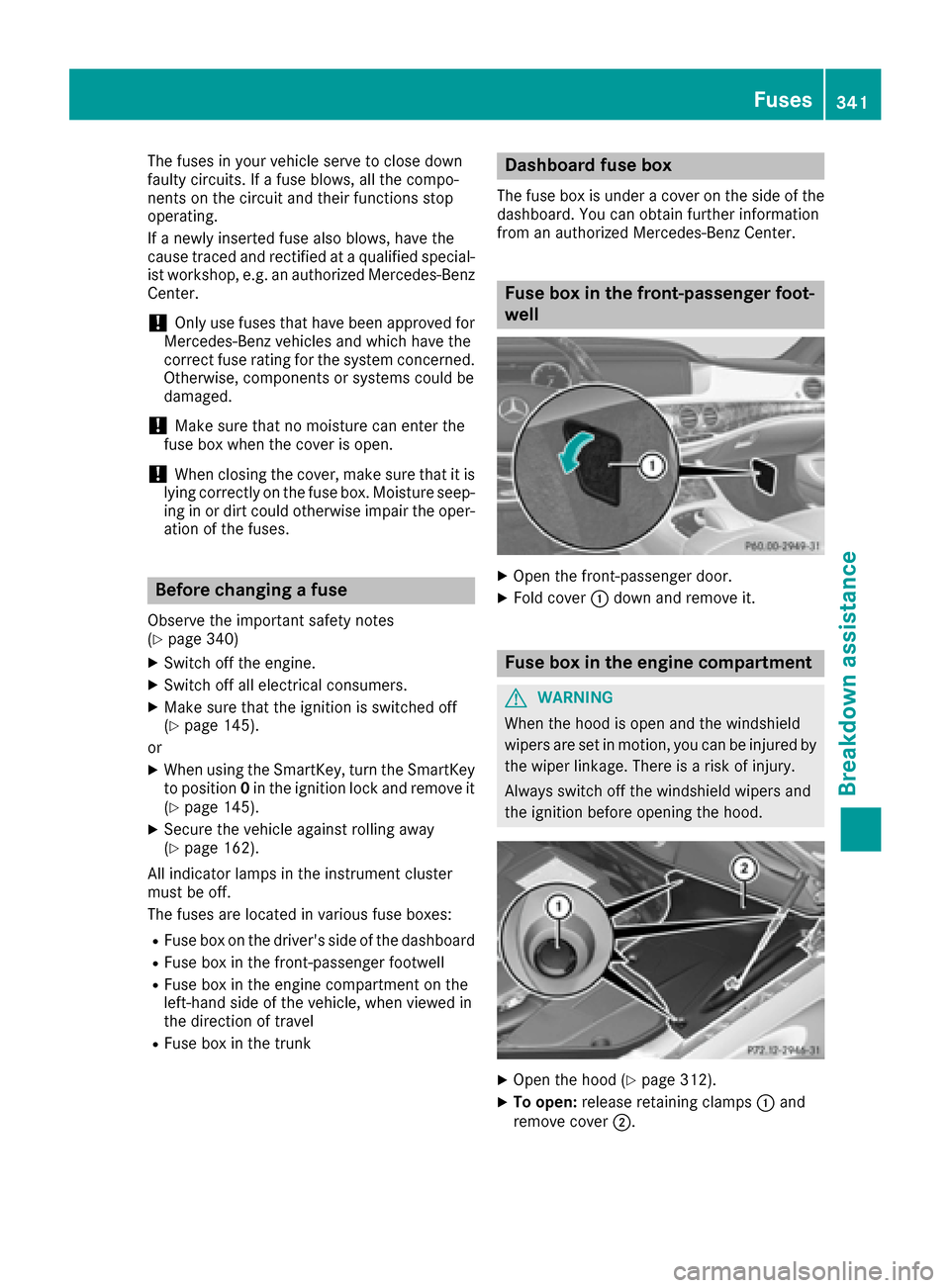
Fuse box in the front-passenger foot-
well
XOpen the front-passenger door.
XFold cover :down and remove it.
Fuse box in the engine compartment
GWARNING
When the hood is open and the windshield
wipers are set in motion, you can be injured by
the wiper linkage. There is a risk of injury.
Always switch off the windshield wipers and
the ignition before opening the hood.
XOpen the hood (Ypage 312).
XTo open: release retaining clamps :and
remove cover ;.
Fuses341
Breakdown assistance
Z
Page 344 of 382
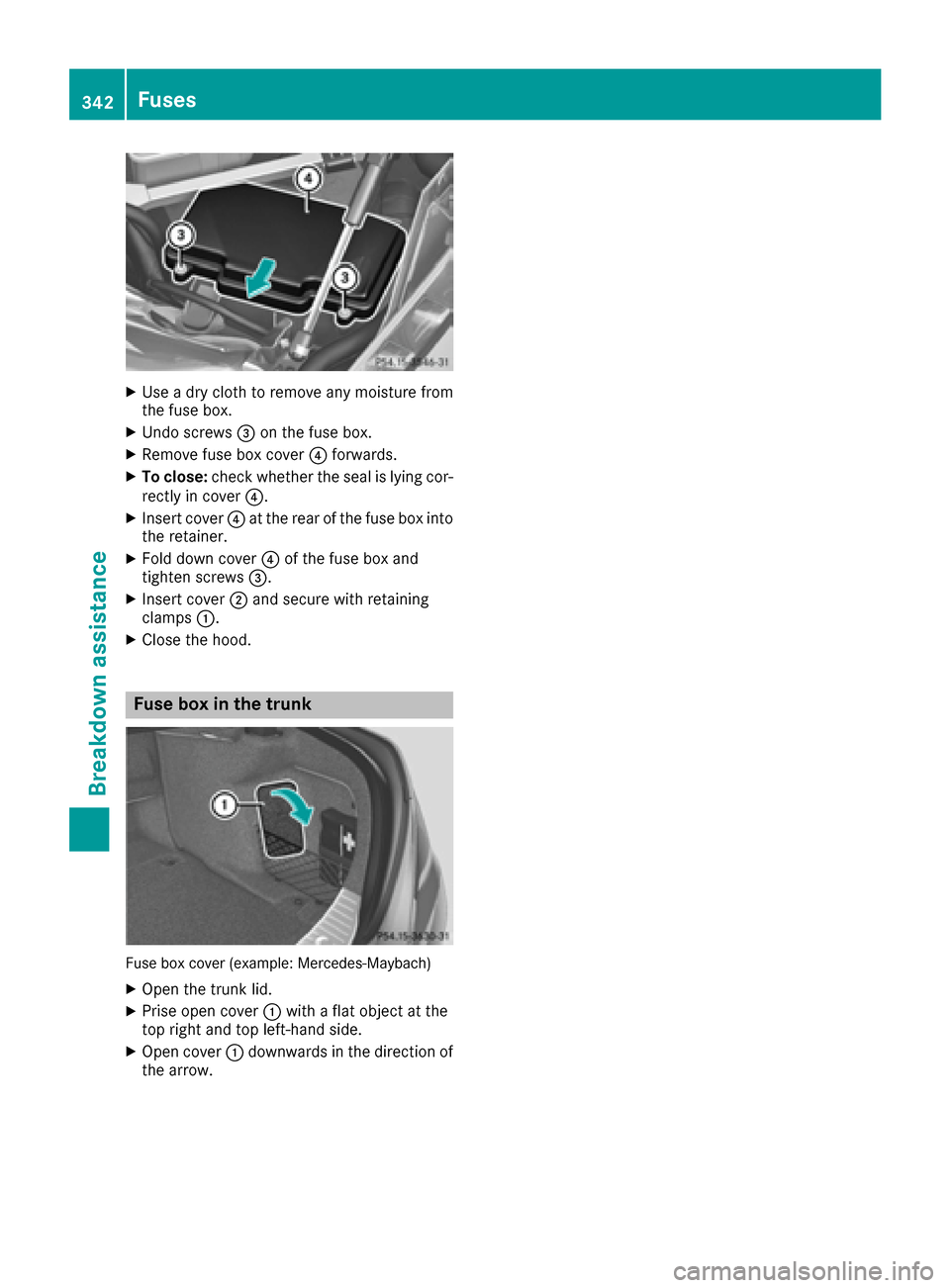
XUse a dry cloth to remove any moisture from
the fuse box.
XUndo screws=on the fuse box.
XRemove fuse box cover ?forwards.
XTo close: check whether the seal is lying cor-
rectly in cover ?.
XInsert cover?at the rear of the fuse box into
the retainer.
XFold down cover ?of the fuse box and
tighten screws =.
XInsert cover;and secure with retaining
clamps :.
XClose the hood.
Fuse box in the trunk
Fuse box cover (example: Mercedes‑Maybach)
XOpen the trunk lid.
XPrise open cover :with a flat object at the
top right and top left-hand side.
XOpen cover :downwards in the direction of
the arrow.
342Fuses
Breakdown assistance
Page 366 of 382

XPlace chocks or other suitable items under
the front and rear of the wheel that is diago-
nally opposite the wheel you wish to change.
Raising the vehicle
GWARNING
If you do not position the jack correctly at the
appropriate jacking point of the vehicle, the
jack could tip over with the vehicle raised.
There is a risk of injury.
Only position the jack at the appropriate jack-
ing point of the vehicle. The base of the jack
must be positioned vertically, directly under
the jacking point of the vehicle.
!The jack is designed exclusively for jacking
up the vehicle at the jacking points. Other-
wise, your vehicle could be damaged.
Observe the following when raising the vehi-
cle:
RTo raise the vehicle, only use the vehicle-spe-
cific jack that has been tested and approved
by Mercedes-Benz. If used incorrectly, the
jack could tip over with the vehicle raised.
RThe jack is designed only to raise and hold the
vehicle for a short time while a wheel is being
changed. It must not be used for performing
maintenance work under the vehicle.
RAvoid changing the wheel on uphill and down-
hill slopes.
RBefore raising the vehicle, secure it from roll-
ing away by applying the parking brake and
inserting wheel chocks. Do not disengage the
parking brake while the vehicle is raised.
RThe jack must be placed on a firm, flat and
non-slip surface. On a loose surface, a large,
flat, load-bearing underlay must be used. On a slippery surface, a non-slip underlay must be
used, e.g. rubber mats.
RDo not use wooden blocks or similar objects
as a jack underlay. Otherwise, the jack will not
be able to achieve its load-bearing capacity
due to the restricted height.
RMake sure that the distance between the
underside of the tires and the ground does not
exceed 1.2 in (3 cm).
RDo not place your hands or feet under the
raised vehicle.
RDo not lie under the vehicle.
RDo not start the engine when the vehicle is
raised.
RDo not open or close a door or the trunk lid
when the vehicle is raised.
RMake sure that no persons are present in the
vehicle when the vehicle is raised.
Vehicles with AMG wheels and hub caps: the
hub cap covers the wheel bolts. Before you can
unscrew the wheel bolts, you must remove the
hub cap. Two different variant
s can be installed.
Vehicles with AMG wheels and plastic hub
caps:
XTo remove: turn the center cover of hub
cap :counter-clockwise and remove.
XTo install: before installing, ensure that hub
cap :is in the open position. To do this, turn
the center cover counter-clockwise.
XPosition hub cap :and turn the center cover
clockwise until hub cap :engages physically
and audibly.
XMake sure that hub cap :is installed
securely.
364Changing a wheel
Wheels and tires
Page 369 of 382

XClean the wheel and wheel hub contact sur-
faces.
XSlide the wheel to bemounted onto the align-
ment boltand push iton.
XTighten the wheel bolts unt ilthey are finger-
tight.
XUnscrew the alignment bolt.
XTighten the last wheel boltuntil it is finger-
tight.
Lowering the vehicle
GWAR NING
The wheels could work loose ifthe wheel nuts
and bolts are not tightened to the specifie d
tightening torque. There isa risk of acc ident.
Have the tightening torque immediately
checked at a qualified specialist workshop
after a wheel ischanged.
XPlace the ratchet wrench onto the hexagon
nut of the jack so that the letters ABare vis i-
ble.
XTurn the ratchet wrench unt ilthe veh icle is
once again standing firmly on the ground.
XPlace the jack to one side.
XTighten the wheel bolts evenly in a crosswise pattern inthe sequence indicated (: toA).
The tightening torque must be 110lb-ft
(1 50 Nm) .
XTurn the jack back to its initial position.
XStow the jack and the rest of the vehicle tools
in the trunk again.
XMercedes-AMG vehicles and vehicles
with AMG equipment: insert the cover into
the outer sill.
XCheck the tire pressure of the newly mounted
wheel and adjust it if necessary.
Observe the recommended tire pressure
(
Ypage 346).
iVehicles with a tire pressure control
system: all mounted wheels must be equip-
ped with functioning sensors for the tire pres-
sure monitor.
Wheel-tire combination
You can ask for information regarding permitted wheel-tire combinations at an authorized
Mercedes-Benz Center.
!For safety reasons, Mercedes-Benz recom-
mends that you only use tires and wheels
whic h have been approved byMercedes-Benz
specific allyfor your vehicle.
These tires have been specially adapted for
use with the control systems, such as ABS or
ESP
®, and are marked as follows:
RMO = Mercedes-Benz Original
RMOE = Mercedes-Benz Original Extended
(t ires featuring run-flat characteristics)
RMO1 = Mercedes-Benz Original (only cer-
tain AMG tires)
Mercedes-Benz Original Extended tires may
only be used on wheels that have been spe-
cifically approved byMercedes-Benz.
Only use tires, wheels or accessories tested
and appr oved byMercedes-Benz. Certain
characteristics, e.g. handling, vehicle noise
emissions or fuel consumption, may other-
wise be adverselyaffected. Inaddition, when
driving with a load, tire dimension variations
could cause the tires to come into contact
with the bodywork and axle components. This
could result in damage to the tires or the vehi- cle.
Wheel-tire combination367
Wheels and tires
Z
Page 372 of 382

The maximum transmission output (PEAK) at the
base of the antenna must not exceed the fol-
lowing values:
Frequency bandMaximum
transmission output
Short wave
3 - 54 MHz100 W
4 m waveband
74 - 78 MHz30 W
2 m waveband
144 - 174 MHz50 W
Trunked radio system/
Tetra
380 - 460 MHz10 W
70 cm waveband
400 - 460 MHz35 W
Mobile communications
(2G/3G/4G)10 W
The following can be used in the vehicle without
restrictions:
RRF transmitters with a maximum transmis-
sion output of up to 100 mW
RRF transmitters with transmitter frequencies
in the 380 - 410 MHz frequency band and a
maximum transmission output of up to 2 W
(trunked radio system/Tetra)
RMobile phones (2G/3G/4G)
There are no restrictions when positioning the
antenna on the outside of the vehicle for the
following wavebands:
RTrunked radio system/Tetra
R70 cm waveband
R2G/3G/4G
Identification plates
Vehicle identification plate with vehi-
cle identification number (VIN)
Location of vehicle identification plate (exam-
ple, left-hand-drive vehicle)
XOpen the front left-hand door.
You will see vehicle identification plate :.
Example: vehicle identification plate (USA only)
:
VIN
;Vehicle model
Example: vehicle identification plate (Canada only)
:
VIN
;Paint code
370Identification plates
Technical data
Page 378 of 382

Refrigerant instruction label
Example: refrigerant instruction label
:
Warning symbol
;Refrigerant filling capacity
=Applicable SAE standards
?PAG oil part number
AType of refrigerant
Warning symbols :indicate:
RPossible dangers
RHaving service work carried out at a qualified
specialist workshop
Filling capacities
Vehicles without rear-com-
partment air-conditioning
systemCapacity
Refrigerant23.3 ± 0.4 oz
(660 ± 10 g)
PAG oil3.9 oz
(110 g)
Vehicles with rear-com-
partment air-conditioning
systemCapacity
Refrigerant27.1 ± 0.4 oz
(770 ± 10 g)
PAG oil4.2 oz
(120 g)
Vehicle data
General notes
Please note that for the specified vehicle data:
Rthe heights specified may vary as a result of:
-tires
-load
-condition of the suspension
-optional equipment
Roptional equipment reduces the maximum
payload.
Dimensions and weights
Trunk lid opening dimensions (example:
Mercedes‑Maybach)
Missing values were not available at time of
going to print.
Model:Opening height
S 550
S 550 4MATIC71.0 in
(1803 mm)
Mercedes ‑AMG
vehicles71.2 in
(1808 mm)
All other models71.1 in
(1806 mm)
376Vehicle data
Technical data
Page 379 of 382

S-Class with a short wheelbase
All models
Vehicle length201.4 in (5116 mm)
Vehicle width
including exterior
mirrors83.9 in (2130 mm)
Vehicle height59.0 in (1499 mm)
Wheelbase119.5 in (3035 mm)
Turning radius39.0 ft (11.90m)
Maximum roof load220 lb (100 kg)
Maximum trunk
load220 lb (100 kg)
S-Class with a long wheelbase
Mercedes‑AMG
vehicles
Vehicle length208.1 in (5287 mm)
Vehicle width
including exterior
mirrors83.9 in (2130 mm)
Vehicle height59.0 in (1499 mm)
Wheelbase124.6 in (3165 mm)
Turning circle,
Mercedes-AMG S 63
4MATIC41.0 ft (12.50m)
Turning circle,
Mercedes‑AMG S 6540.4 ft (12.30 m)
Maximum roof load220 lb (100 kg)
Maximum trunk
load220 lb (100 kg)
All other models
Vehicle length206.5 in (5246 mm)
Vehicle width
including exterior
mirrors83.9 in (2130 mm)
Wheelbase124.6 in (3165 mm)
All other models
Turning radius40.4 ft (12.30m)
Maximum roof load220 lb (100 kg)
Maximum trunk
load220 lb (100 kg)
ModelVehicle height
S 550
S 550 4MATIC58.8 in (1494 mm)
S 60058.9 in (1497 mm)
Mercedes‑Maybach
All models
Vehicle length214.7 in (5453 mm)
Vehicle height59.0 in (1498 mm)
Vehicle width
including exterior
mirrors83.9 in (2130 mm)
Wheelbase132.5 in (3365 mm)
Turning radius42.3 ft (12.90m)
Maximum trunk
load220 lb (100 kg)
Vehicle data377
Technical data
Z