2017 MERCEDES-BENZ S-CLASS CABRIOLET light
[x] Cancel search: lightPage 38 of 521

Re
stra int sy stem functionality When
thei gnition is switched on, asystems elf-
te st is per form ed, during whic hthe 6
re stra int sy stem warning lam plight sup. It goes
out no later than afew second safter thev ehicle
is star ted. The components of ther estraint sys‐
te ma rethen functional. Malfunctioning
restra int sy stem Am
alfunction has occur redint herestra int sys‐
te mi f:
R The 6 restra int sy stem warning lamp
does no tlight up when thei gnition is
switched on.
R The 6 restra int sy stem warning lamp
light supc ontinuousl yorrepeatedly during a
journe y. &
WARNING Risk of inju ryor fata linjury
due toam alfunctio nintherestra int sys‐
tem
If th er estraint sy stem is malfunctioning,
re stra int sy stem components ma ybetrig‐
ge redu nintentionall yormight no tbetrig‐
ge redata ll inthee vent of an accident. This
ma yaffect thes eat belt tensioner or airbag,
fo re xamp le. #
Have ther estraint sy stem checkeda nd
re paired immediatel yataqualified spe‐
cialis tworks hop. Fu
nction of ther estraint sy stem in an acci‐
dent Ho
wt he restra int sy stem worksisd etermined by
th es eve rity of thei mp act de tected and thet ype
of acciden tanticipated:
R Frontal impact
R Rear impact
R Sideimp act
R Rollover The activation
thre sholds fort he components of
th er estraint sy stem ar edetermined based on
th ee valuatio nofthe sensor values measured at
va rious points in thev ehicle. This process is pre-
em ptiveinn ature. The triggering/deployment of
th ec omponents of ther estraint sy stem should
ta ke place in good time at thes tart of thec olli‐
sion.
Fa ctor swhich can only be see nand measu red
af te rac ollision has occur redc ann otpla yad eci‐
siv erole in airbag deployment, nor do they pro‐
vide an indication of airbag deployment.
The vehicle ma ybedeformed significantl ywith‐
out an airbag being deplo yed. This is thec ase if
onl yparts whic hare re lativel yeasil ydeformed
ar ea ffected and ther ateofv ehicle deceleration
is no thigh. Con versely ,ana irbag ma ybe
deplo yede vent hough thev ehicle suf fers only
minor deformation. If very rigid vehicle parts
suc hasl ongitudinal member sarehit, fore xam‐
ple, thev ehicle deceleration ma ybehigh enough
fo rt his tohappen. Occupant saf
ety35
Page 49 of 521
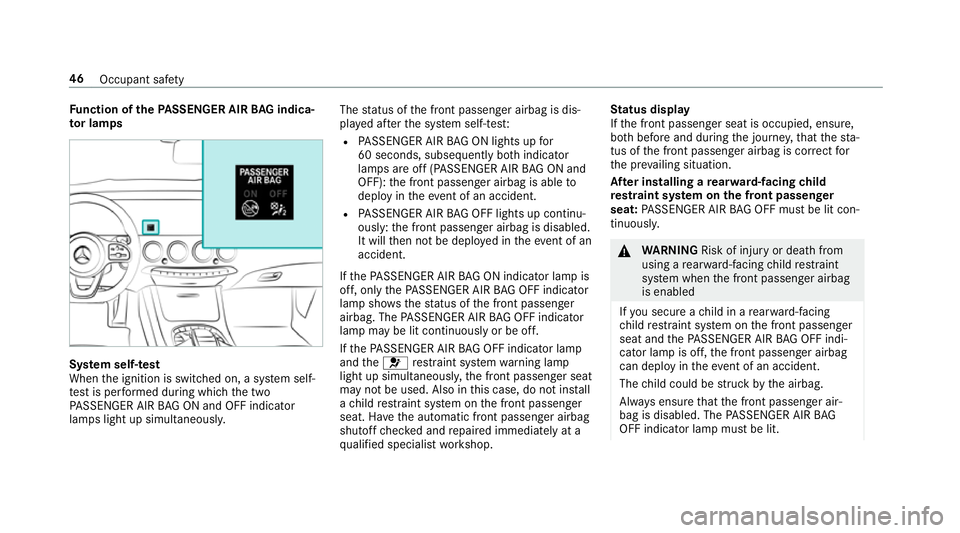
Fu
nction of theP ASSE NGER AIR BAGi ndica‐
to rlamps Sy
stem self- test
When thei gnition is switched on, asystems elf-
te st is per form ed during whic hthe two
PA SSENGER AIR BAGONa nd OFFindicator
lamps light up simultaneousl y.The
status of thef ront passenger airbag is dis‐
pla yeda fter thes ystem self-tes t:
R PASSENGER AIR BAGONl ightsupf or
60 seconds, subsequently bo thindicator
lamps ar eoff(PASSENGER AI RBAG ON and
OFF): thef ront passenger airbag is able to
deplo yintheeve nt of an accident.
R PASSENGER AIR BAGO FFlight supc ontinu‐
ously: thef ront passenger airbag is disabled.
It will then no tbed eployedint heeve nt of an
accident.
If th eP ASSENGER AIR BAGONi ndicator lam pis
off, on lytheP ASSENGER AIR BAGO FFindicator
lam pshows th estatus of thef ront passenger
airbag. The PASSENGER AIR BAGO FFindicator
lam pm aybe lit continuousl yorbeoff.
If th eP ASSENGER AIR BAGO FFindicator lamp
and the6 restra int sy stem warning lamp
light up simultaneousl y,thef ront passenger seat
ma ynotbe used. Also in this case, do no tins tall
ac hild restra int sy stem on thef ront passenger
seat. Ha vethea utomatic front passenger airbag
shutof fchec keda nd repaired immediately at a
qu alified specialis tworks hop. St
atus display
If th ef ront passenger seat is occupied, ensure,
bo th befor eand during thej ourne y,that thes ta‐
tus of thef ront passenger airbag is cor rect for
th ep reva ilin gs ituation.
Af teri nstalling arear ward-facing child
re stra int sy stem on thef ront passenger
seat: PASSENGER AIR BAGO FFmus tbel it con‐
tinuousl y. &
WARNING Risk of inju ryor deat hfrom
using arear ward-facing child restra int
sy stem when thef ront passenger airbag
is enabled
If yo us ecur eac hild in arear ward-facing
ch ild restra int sy stem on thef ront passenger
seat and theP ASSENGER AIR BAGO FFindi‐
cator lam pisoff,t he front passenger airbag
can deplo yintheeve nt of an accident.
The child could be stru ck bythea irbag.
Alw ayse nsur ethat thef ront passenger air‐
bag is disabled. The PASSENGER AIR BAG
OFF indicator lam pmustbel it. 46
Occupant saf ety
Page 51 of 521
should no
tuse thef ront passenger seat.
Ins tead, they should use arear seat.
R Ifth ef ront passenger seat is occupied wit ha
person of smaller statur e(e.g. ateenager or
small adult), theP ASSENGER AIR BAGO FF
indicator lam peither light supcontinuously
or remains out, depending on ther esult of
th ec lassification:
- PASSENGER AIRB AGOFF is off: mo vethe
front passenger sea tasfar ba ckas possi‐
ble or aperson of smaller statur eshould
use arear seat.
- Ifth eP ASSENGER AIRB AGOFF indicator
lam pisl it continuously: aperson of
smaller statur eshoul dnotuse thef ront
passenger seat. &
WARNING Risk of inju ryor deat hwhen
th eP ASSENGER AIR BAGO FFindicator
lam pisl it
If th eP ASSENGER AIR BAGO FFindicator
lam premain slit af tert he sy stem self-test,
th ef ront passenger airbag is disabled. It will
no tbed eployedint heevent of an accident. In
this case, thef ront passenger airbag can‐
no tp erform its intended pr otectiv efunction,
e.g. when aperson is seated in thef ront
passenger seat.
That person could, fore xamp le, com einto
con tact wi th thevehicle interior ,especially if
th ep erson is sitting tooc lose tothec ockpit.
If th ef ront passenger seat is occupied,
alw ayse nsur ethat:
R The classification of thep erson in the
front passenger sea tiscorrect and the
front passenger airbag is enabled or disa‐
ble dina ccordance wit hthe person in the
front passenger seat.
R The person is sea tedp roper lywit hac or‐
re ctly fastened seat belt.
R The front passenger seat has been mo ved
as farb ackasp ossible. Fu
rther related subjects:
R Child restra int sy stem on thef ront passenger
seat (→ page57). R
Suitable positionin gofthechild restra int sys‐
te m( →pag e59). Ro
ll bar &
DANG ER Risk of injur yordeathcaused
by am alfunctio noftheroll bars
If th ef unction of ther oll bar sisdefective,
th ey ma ynotextend in an accident fore xam‐
ple.
Consequent ly,t he roll bar scanno tprotect
ve hicle occupants as they ared esigned to
do. #
Have ther oll bar schec kedi mmediately
at aq ualified specialis tworks hop. &
WARNING Risk of inju rywhen ther oll
bar saretriggered
If th er oll bar saretriggered, ther eisar isk of
inju ry.
Alw aysm akes uret hat ther eisn othing in the
sweep behind ther ear head restra ints. 48
Occupant saf ety
Page 53 of 521

#
Ifth es eat belt pre-tensioning is no treduced,
mo vethes eat backres tbacks lightl y.
The locking mechanism releases. Fu
nction of PRE-SAFE ®
PLUS (anticipatory
occupant pr otection plus) PRE-
SAFE®
PLUS can de tect cer tain impacts,
particular lyan imminent rear impact ,and take
pre-em ptivem easures toprotect thev ehicle
occupants. These measures canno tnecessarily
pr eve nt an imminent impact.
PRE-SAFE ®
PLUS can implement thef ollowing
measures independentl yofeacho ther:
R Tightening thes eat belts on thed rive r's seat
and front passenger seat.
R Activating ther ear hazar dwarning light sata
higher flashin gfrequ enc y.
R Increasing brak epressure when thev ehicle
is stationar y.This brak eapplication is cancel‐
led automaticall ywhen thev ehicle pulls
aw ay. If an accident did no
toccur ,the pre-em ptive
measures that we retake na re re versed.
Sy stem limitations
The sy stem will no tinitiat eanyaction in thef ol‐
lowing situations:
R when reve rsing
The sy stem will no tinitiat eanybraking applica‐
tion in thef ollowing situations:
R whils tdriving
or
R when entering or exitin gap arkin gspace
while using ActiveP arking Assist Children in
thev ehicle Note
sont he saf etransportation of children &
WARNING Risk of accident and inju ry
due tochildren lef tunat tende dint he
ve hicle
If yo ul eave children unat tende dint hevehi‐
cle, they ma ybea bletos etthev ehicle in
motion, fore xamp leby:
R Releasing thep arking brake.
R Shifting thet ransmission out of park
position j.
R Startin gthe engine.
In addition, they ma yoperat evehicle equip‐
ment. #
Neverlea ve children and animals unat‐
te nde dint hevehicle. #
When leaving thev ehicle, alw ayst ake
th ek eywit hyou and loc kthe vehicle.
This also applies tomobil ephones if the
"Digital Car Keyint he smartphone" 50
Occupant saf ety
Page 54 of 521
function is activated via
theM ercedes
me connect weba pp. &
WARNING Thisp oses an increased risk
of deat hduetoheat strokeorexposure
to cold in thev ehicle
If persons –particularly children –expe ri‐
enc eprolonged exposur etoextremely high
or lo wtemperatures, this poses arisk of
inju ryor eve nfatal injur y. #
Neverlea ve anyone –p articularly chil‐
dren –unat tende dint hevehicle. &
WARNING Risk of bu rnsw hen thec hild
seat is exposed todirect sunlight
If th ec hild restra int sy stem is exposed to
direct sunlight or heat, parts could heat up.
Children could suf ferb urns on these parts,
particularly on me tallic parts of thec hild
re stra int sy stem. #
Alw aysm akes uret hat thec hild
re stra int sy stem is no texpose dto
direct sunlight. #
Protect it wit hablanket,for example. #
Ifth ec hild restra int sy stem has been
ex posed todirect sunlight ,allowitto
cool befor esecu ring achild int oit. #
Neverlea ve children unat tende dint he
ve hicle. To
impr oveprotection forc hildren younger than
12 yearso ld or unde r1.50 minh eight,
Mercedes-Benz recommends youo bse rvet he
fo llowing information:
R Onlysecur echildren using achild restra int
sy stem whic hisappropriat etothe height,
ag ea nd weight of thec hild and suitable for
Mercedes-Benzv ehicles. Be suretoobserve
th ei nstruction sfor cor rect us eoft hechild
re stra int sy stem.
R Alw aysi ns tallac hild restra int sy stem on a
re ar seat if possible.
R Onlyuse thef ollowing securing sy stems for
ch ild restra int sy stems: -
thes eat belt sy stem
- theI SOFIX mounting brac kets
R The manufactu rer's ins tallation instructions
fo rt he child restra int sy stem.
R The warning labels in thev ehicle interior and
on thec hild restra int sy stem. &
WARNING Risk of inju ryor deat hcaused
by incor rect ins tallation of thec hild
re stra int sy stem
If th ec hild restra int sy stem is incor rectly
ins talled on asuitable seatin gposition, it
canno tperform its intended pr otectiv efunc‐
tion.
The child canno tberestrained in thee vent of
an accident, heavy braking or asudden
ch ang eofd irection. #
Alw aysc ompl ywitht he manufacturer's
ins tallation instructions fort he child
re stra int sy stem and its cor rect use. #
Makesur ethat thee ntir ebase of the
ch ild restra int sy stem alw aysr ests on
th es itting sur face of thes eat. Occupant saf
ety51
Page 60 of 521
Suitability of
thes eat sfor child restra int sys‐
te ms Note
sona ttaching suitable child restra int
sy stems
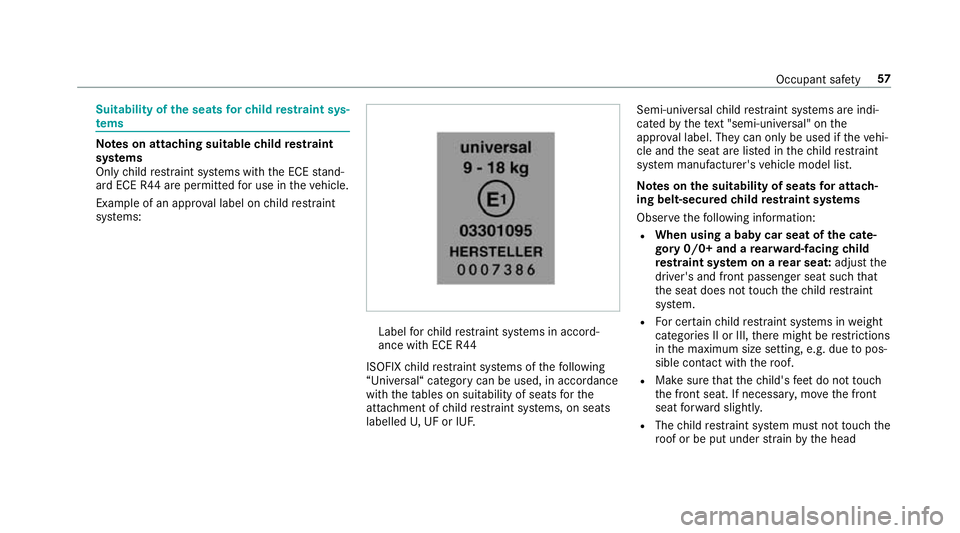
Only child restra int sy stems wit hthe ECE stand‐
ar dE CE R4 4arepermit tedf or use in thev ehicle.
Example of an appr oval label on child restra int
sy stems: Label
forc hild restra int sy stems in accord‐
ance wit hECE R44
ISOFIX child restra int sy stems of thef ollowing
“Universal“ categor ycan be used, in accordance
wit hthe tables on suitability of seats fort he
attachment of child restra int sy stems, on seats
labelled U,UF or IUF. Semi-universal
child restra int sy stems ar eindi‐
cated bythet ext" se mi-uni versal" on the
appr oval label. The ycan on ly beused if thev ehi‐
cle and thes eat ar eliste dint hechild restra int
sy stem manufacturer's vehicle model list.
Note sont he suitability of seats fora ttach‐
in gb elt-secured child restra int sy stems
Obser vethef ollowing information:
R When using ababyc ar seat of thec ate‐
gor y0/0+ and arear ward-facing child
re stra int sy stem on arear seat: adjustthe
driver's and front passenger seat suc hthat
th es eat does no ttouc hthe child restra int
sy stem.
R Forc ertain child restra int sy stems in weight
categories II or III ,ther em ight be restrictions
in them aximum size setting, e.g. due topos‐
sible con tact wi th theroof.
R Mak esuret hat thec hild's feet do no ttouch
th ef ront seat. If necessar y,mo vethef ront
seat forw ards lightl y.
R The child restra int sy stem mus tnot to ucht he
ro of or be put under stra in by theh ead Occupant saf
ety57
Page 62 of 521
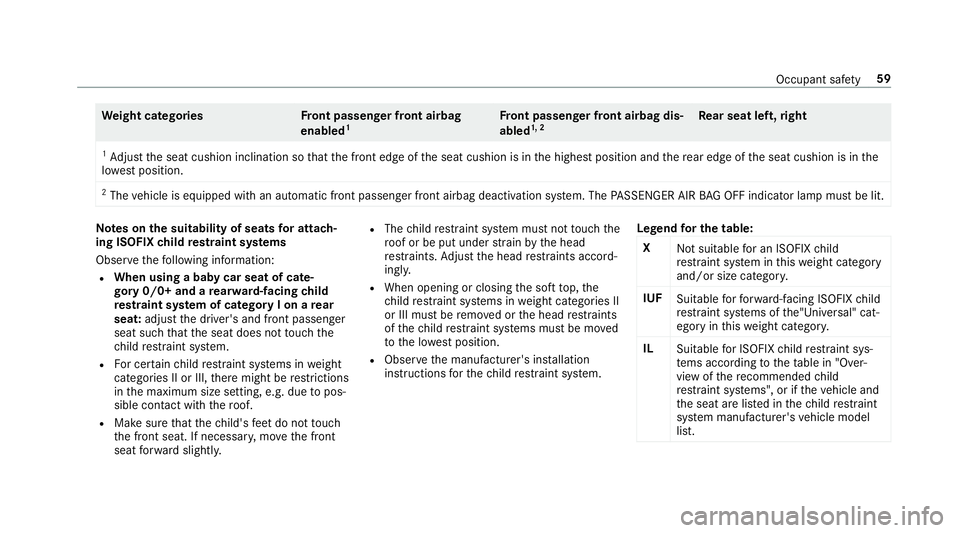
We
ight categories Front passenger front airbag
enabled 1 Fr
ont passenger front airbag dis‐
abled 1, 2 Re
ar seat left, right
1 Ad jus tthe seat cushion inclination so that thef ront edg eofthe seat cushion is in theh ighes tposition and ther ear edg eofthe seat cushion is in the
lo west position.
2 The vehicle is equipped wit hanautomatic front passenger front airbag deactivation sy stem. The PASSENGER AIR BAGO FFindicator lam pmustbel it. Note
sont he suitability of seats fora ttach‐
in gI SOFI Xchild restra int sy stems
Obser vethef ollowing information:
R When using ababyc ar seat of cate‐
gor y0/0+ and arear ward-facing child
re stra int sy stem of categor yIonarear
seat: adjustthe driver's and front passenger
seat suc hthat thes eat does no ttouc hthe
ch ild restra int sy stem.
R Forc ertai nc hild restra int sy stems in weight
categories II or III ,ther em ight be restrictions
in them aximum size setting, e.g. due topos‐
sible con tactwitht he roof.
R Mak esuret hat thec hild's feet do no ttouch
th ef ront seat. If necessar y,mo vethef ront
seat forw ards lightl y. R
The child restra int sy stem mus tnot to ucht he
ro of or be put under stra in by theh ead
re stra ints. Adjus tthe head restra int sa ccord‐
ingly.
R When opening or closing thes oftt op, the
ch ild restra int sy stems in weight categories II
or III mus tberemovedort he head restra ints
of thec hild restra int sy stems mus tbemoved
to thel ow estp osition.
R Obser vethem anufacturer's ins tallation
instructions fort he child restra int sy stem. Legend
fort he table:
X Notsuita blef or an ISOFIXc hild
re stra int sy stem in this we ight category
and/or size categor y.
IUF Suitable forf or wa rd-facin gISOFI Xchild
re stra int sy stems of the"Universal" cat‐
egor yint hisweight categor y.
IL Suitable forI SOFIX child restra int sys‐
te ms according tothet able in "Over‐
vie woft herecommended child
re stra int sy stems", or if thev ehicle and
th es eat ar eliste dint hechild restra int
sy stem manufacturer's vehicle model
list. Occupant saf
ety59
Page 68 of 521

If
yo udon otopen thev ehicle within appr ox‐
imatel y40seconds af teru nlocking:
R The vehicle is loc keda gain
R Anti- theftp rotection is reactivated
Do no tkeep thek eytoget her wit helectronic
devices or me talo bjects. This can af fect the
ke y's functionalit y.
% If batter ychec klamp 2does no tlight up
af te rp ressing the% or& button, the
batter yisdischar ged. Ac
tivating/deactivatin gthe acoustic lo cking
ve rification signal Multimedia sy
stem:
, Vehicle .
î Vehicle set-
tings .
Acoustic lock #
Activate Oor deacti vate ª thef unction. Ac
tivating/deactivatin gthe pani calarm Re
quirements:
% The panic alar mfunction is onl yavailable in
cer tain countries.
R The ignition is switched off. #
Toactivate: press button 1fora pprox‐
ima tely one second.
Av isual and audibl ealarmist riggered. #
Todeactivate: brieflyp ress but ton1again.
or #
Press thes tart/s topb utton on thec ockpit
(the keyisi nside thev ehicle). Changing
theu nlocking settings Po
ssible unlocking functions of thek ey:
R Central unlocking
R Unlocking thed rive r's door and fuel filler flap #
Toswitc hbetwe en settings: pressthe
% and& button ssimultaneousl yfor
appr oximatel ysix seconds until theb attery
ch eckl am pflashes twice.
If th eu nlocking function fort he driver's door
and fuel filler flap has been selec ted:
R Pressing the% button asecon dtime cen‐
trally unloc ksthev ehicle.
R Vehicles with KEYLESS-GO: ifyo ut ouch
th ei nner sur face of thed oor handle on the
driver's door ,onlyt he driver's door and fuel
fi ller flap ar eunlocked. Re
ducing the energy consu mptionoft hekey All
vehicles: ifyo udon otuse thev ehicle or a
ke yf or an extende dperio doft ime,youc an
re duce thee nergy consum ption of ther espec‐
tiv ek ey.T odos o, deactivat ethe keyf unctions. Opening and closing
65