2017 MERCEDES-BENZ G-Class seats
[x] Cancel search: seatsPage 208 of 286
XTo lock:insert the mechanical key into the
lock (Ypage 64) and turn it 90° clockwise to
position 2.
XTo unlock: insert the mechanical key into the
lock (Ypage 64 )and turn it 90° counter-
clockwise to position 1.
The glove bo xcan onlybel ocked and unlocked
using the mechanical key.
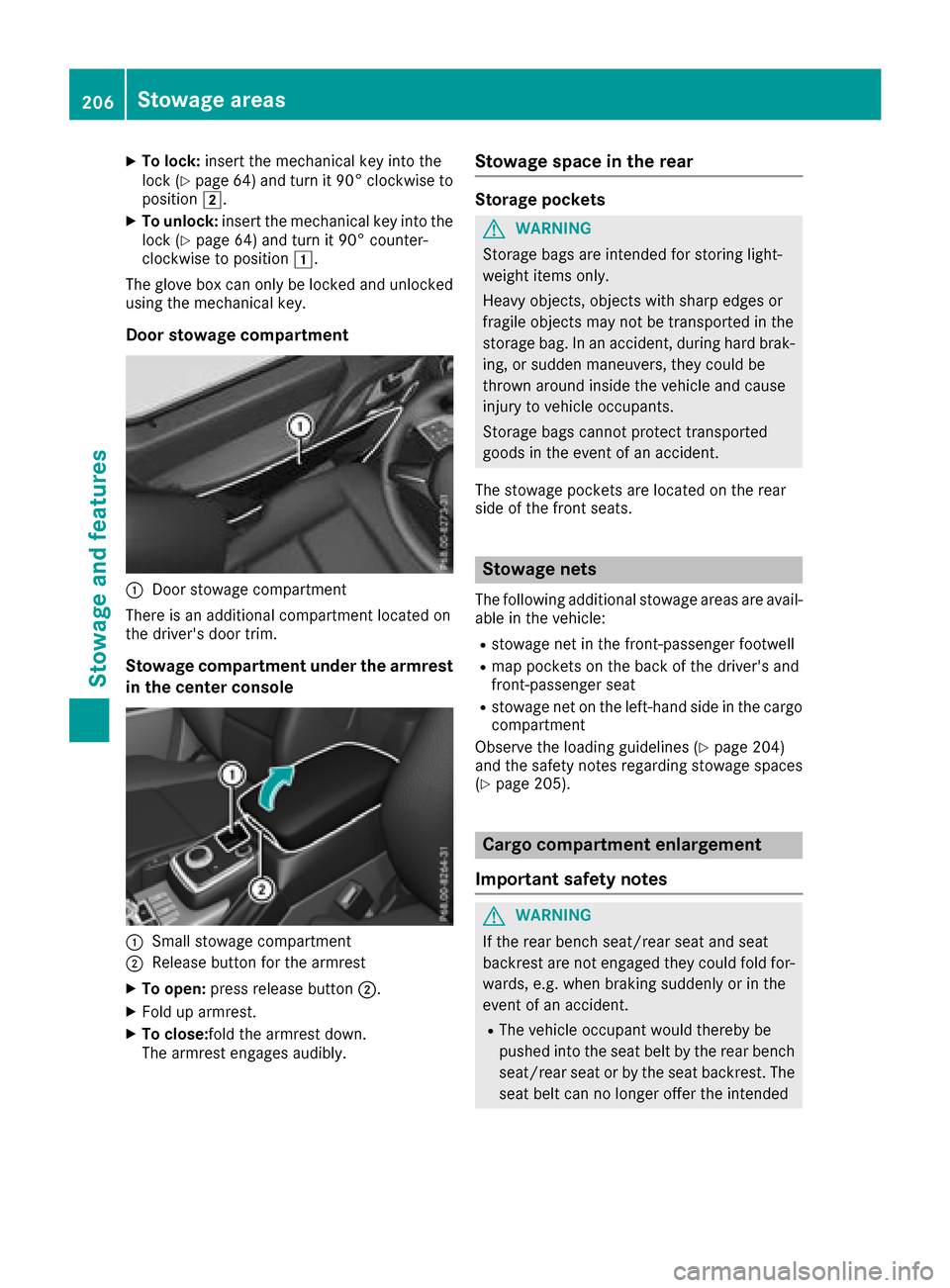
Door stowage compartment
:Door stowag ecompartment
There is an additional compartment locate don
the driver's door trim.
Stowage compartmen tundert he armrest
in the centerc onsole
:Small stowagecompartment
;Releas ebutton for the armrest
XTo open: press release button ;.
XFolduparmrest.
XTo close:foldt he armrestdown.
The armreste ngages audibly.
Stowage spaceint he rear
Storage pockets
GWARNING
Storage bags are intende dfor storing light-
weight items only.
Heavy objects, objects with sharp edges or
fragile objects mayn ot be transported in the
storag ebag.Inana ccident, during hard brak-
ing ,ors uddenmaneuvers,t hey could be
thrown around insid ethe vehicl eand cause
injury to vehicl eoccupants.
Storage bags canno tprotect transported
goods in the event of an accident.
The stowag epockets are locate donthe rear
side of the front seats.
Stowage nets
The following additional stowag eareas are avail-
able in the vehicle:
Rstowag enet in the front-passenger footwell
Rmapp ockets on the back of the driver'sa nd
front-passenger seat
Rstowag enet on the left-hand side in the cargo
compartment
Observe the loading guideline s(
Ypage 204)
and the safety notes regarding stowag espaces
(
Ypage 205).
Carg ocom partmen tenlargement
Important safety notes
GWARNING
If the rearb ench seat/rea rseata nd seat
backres tare not engaged they could foldf or-
wards ,e.g.w henb raking suddenl yorinthe
event of an accident.
RThe vehicl eoccupant woul dthereb ybe
pushedi nto the sea tbeltbyt he rearb ench
seat/rea rseatorb ythe sea tbackrest. The
sea tbeltc an no longer offert he intended
206Stowage areas
Stowageand featur es
Page 209 of 286
level of protection and could even cause
injuries.
RObjectsorloads in the trunk/cargo com-
partmentc annot be restraine dbythe seat
backrest.
There is an increased risk of injury.
Before everyt rip, make sure that the seat
backrestsa nd the rear benc hseat/rear seat
are engaged.
GWARNING
Combustion engines emit poisonous exhaust
gases such as carbo nmonoxide .Ifthe rear
door is open when the engin eisrunning, par-
ticularly if the vehicle is moving, exhaust
fumes could enter the passenger compart-
ment. There is arisk of poisoning.
Turn off the engin ebeforeo pening the rear
door. Never drive with the rear door open.
!Ensure that you remove all containers from
the cup holder in the rear beforef oldingthe
seat backrest and the seat cushio nofthe rear
benc hseat forwards.
Observe the loading guideline s(
Ypage 204).
The rear benc hseat is split symmetrically.
The left-han dand right-han drear benc hseats
can be folded forward to increase the capacity
of the rear compartment. You can:
Rfold the seat backrestsf orward
Rfold the rear benchseat back fully
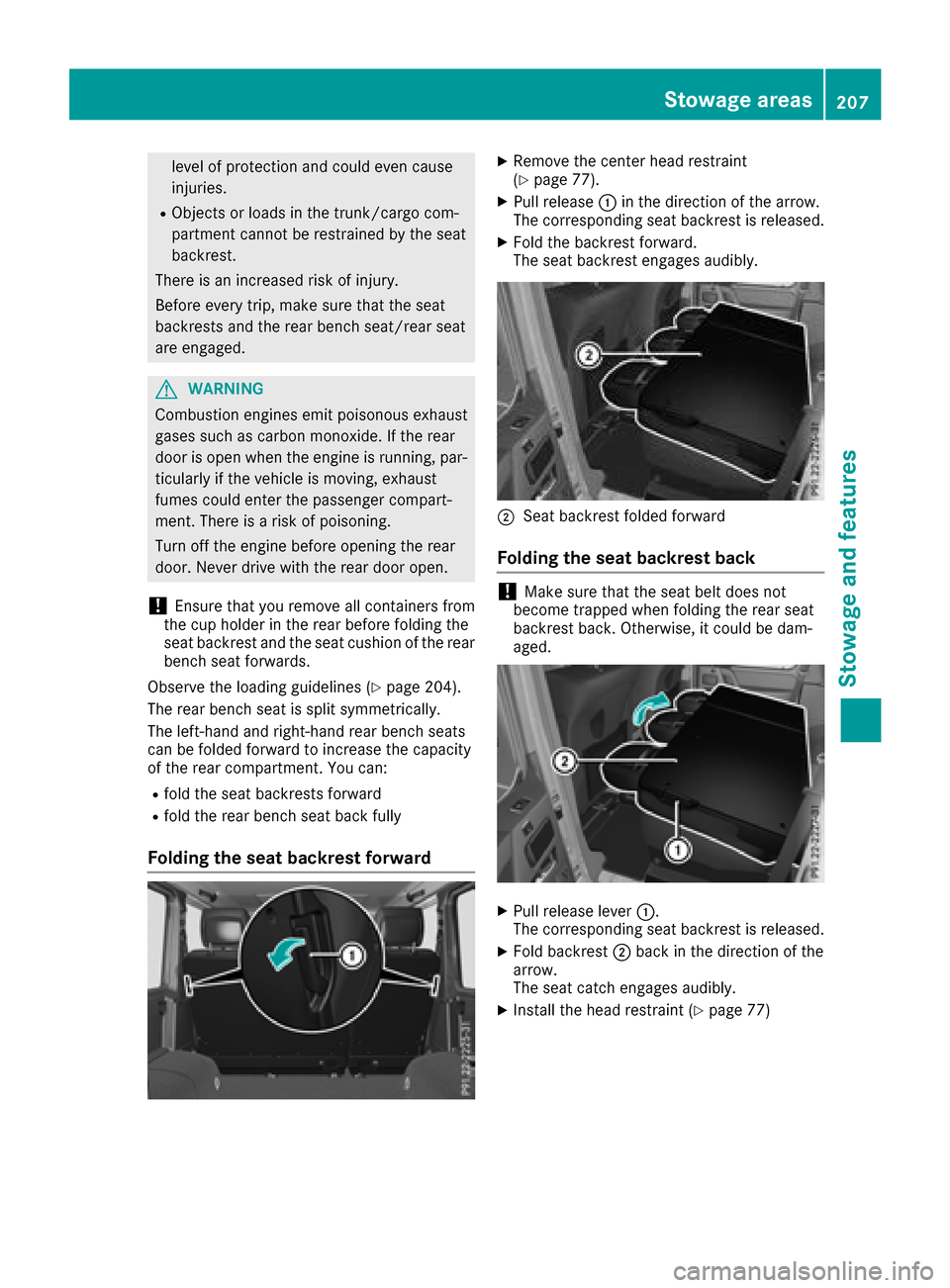
Folding th eseat backrest forward
XRemove the center head restraint
(Ypage 77).
XPull release :in the direction of the arrow.
The correspondin gseat backrest is released.
XFold the backrest forward.
The seat backrest engages audibly.
;Seat backrest folded forward
Folding th eseat backrest back
!Make sure that the seat belt does not
becom etrapped when foldingt he rear seat
backrest back .Otherwise, it could be dam-
aged.
XPull release lever :.
The correspondin gseat backrest is released.
XFold backrest ;back in the direction of the
arrow.
The seat catch engages audibly.
XInstall the head restraint (Ypage 77)
Stowage areas207
Stowage and features
Z
Page 243 of 286
XClose thedriver' sdoor.
XPlacet hewarning triang leas uitable dist ance
away (Ypage 238). Observ elegal require-
ments.
Battery (vehicle)
Important safety notes
Spe cial tools and expertk nowledg eare required
when working on th ebattery, e.g .removal and
installation. You should therefor ehave all work
involving th ebattery carried out at aqualified
specialist workshop.
GWARNING
Workc arried out incorrect lyon th ebattery
can lead, for example ,toashort circuit and
thus damag ethe veh icle electronics .This can
lead to function restrictionsa pplyingto
safety-relevan tsystems ,e.g th elighting sys-
tem, th eABS (anti-lockb raking system) or the
ESP
®(Electron ic Stabilit yProgram). The oper-
atin gsafety of your veh iclemay berestricted.
You could lose control of th evehicle ,for
example:
Rwhen braking
Rin thee vent of abrupt steering maneuvers
and/or when th evehicle 's speedisn ot
adapted to th eroad conditions
Thereisar iskofana cciden t.
In thee vent of ashort circuit or asimilar inci-
dent, contact aqualified specialist workshop
immediately. Do no tdrivea ny further. You
should have all work involving th ebattery car-
ried out at aqualified specialist workshop.
For further informatio nabout AB Sand ESP
®,
see (Ypage 57) and (Ypage 59).
GWAR NING
Electrostat icbuild-up can lead to th ecreation
of sparks ,whichc ouldignite th ehighly explo-
siveg ases of abattery. Thereisar iskofa n
explos ion.
Before handlin gthe battery, touch th evehicle
body to remove any existing electrostatic
build- up. The highly flammable gas mixtur
eforms when
chargin gthe battery as wellas when jump-start-
ing.
Always mak esure that neither you no rthe bat-
tery is electrostatic allycharge d.Ab uild-up of
electrostatic charge can becaused, for exam-
ple:
Rby wearin gclothing made from synthetic
fibe rs
Rdue to friction between clothing and seats
Rif you push or pull th ebattery across th ecar-
pet or other synthetic materials
Rif you rub th ebattery withac loth
GWARNING
During th echargin gprocess, abattery produ-
ces hydrogen gas. If ashort circuit occur sor
sparks are created, th ehydrogen gas can
ignite .Thereisar iskofane xplosion.
RMakes ure that th epositiv etermi nal of a
connected battery does no tcom eintoc on-
tac twithv ehicle parts.
RNever placem etal objectsortoolson abat-
tery.
RIt is important that you observ ethe descri-
bed order of th ebattery terminal swhen
connecting and disconnecting abattery.
RWhen jump-starting, mak esure that the
battery poles withidentical polarity are
connected.
RIt is particularly important to observ ethe
describe dorder when connecting and dis-
connecting th ejumper cables.
RNever connect or disconnect th ebattery
terminal swhile th eengineisr unning.
GWARNING
Battery acid iscaustic .Thereisar iskofi njury.
Avoid contact withskin, eyes or clothing .Do
no tinhale any battery gases.Don otlean over
th eb attery. Keep ch ildren away from batter-
ies. Wash away battery acid immediately with
plenty of clean wate rand seek medical atten-
tion.
Battery (vehicle)241
Breakdown assistance
Z
Page 244 of 286
HEnvironmentalnote
Batteries contain dangerous
substances. It is agains tthe
law to dispose of them with
th eh ousehold rubbish. They
must be collected separately and recycled to protect the
environment.
Dispose of batteries in an
environmentally friendly
manner .Take discharged
batteries to aqualifieds pe-
cialis tworkshop or aspecial
collection pointf or used bat-
teries.
!Hav ethe battery checked regularly at a
qualifieds pecialist workshop.
Observe th eservicei ntervals in th eMainte-
nance Bookle torcontac taqualifieds pecialist
workshop for morei nformation.
!Always have work on batteries carried out at
aq ualifieds pecialist workshop.S hould it, in
exceptional circumstances, be absolutely
necessaryt odisconnect th e12-vol tbattery
yourself, observe th efollowing:
RSecure th evehicle to prevent it fro mrolling
away.
RSwitch off th eignition.
RDisconnec tthe negativ eterminal first and
then th epositive terminal.
The transmission is locked in position j
after disconnecting th ebattery.
After th ework has been done, install th ebat-
ter ya nd replacet hecover of th epositive ter-
minal clam pfirmly.
Comply with safet yprecautions and tak epro-
tectiv emeasures when handling batteries.
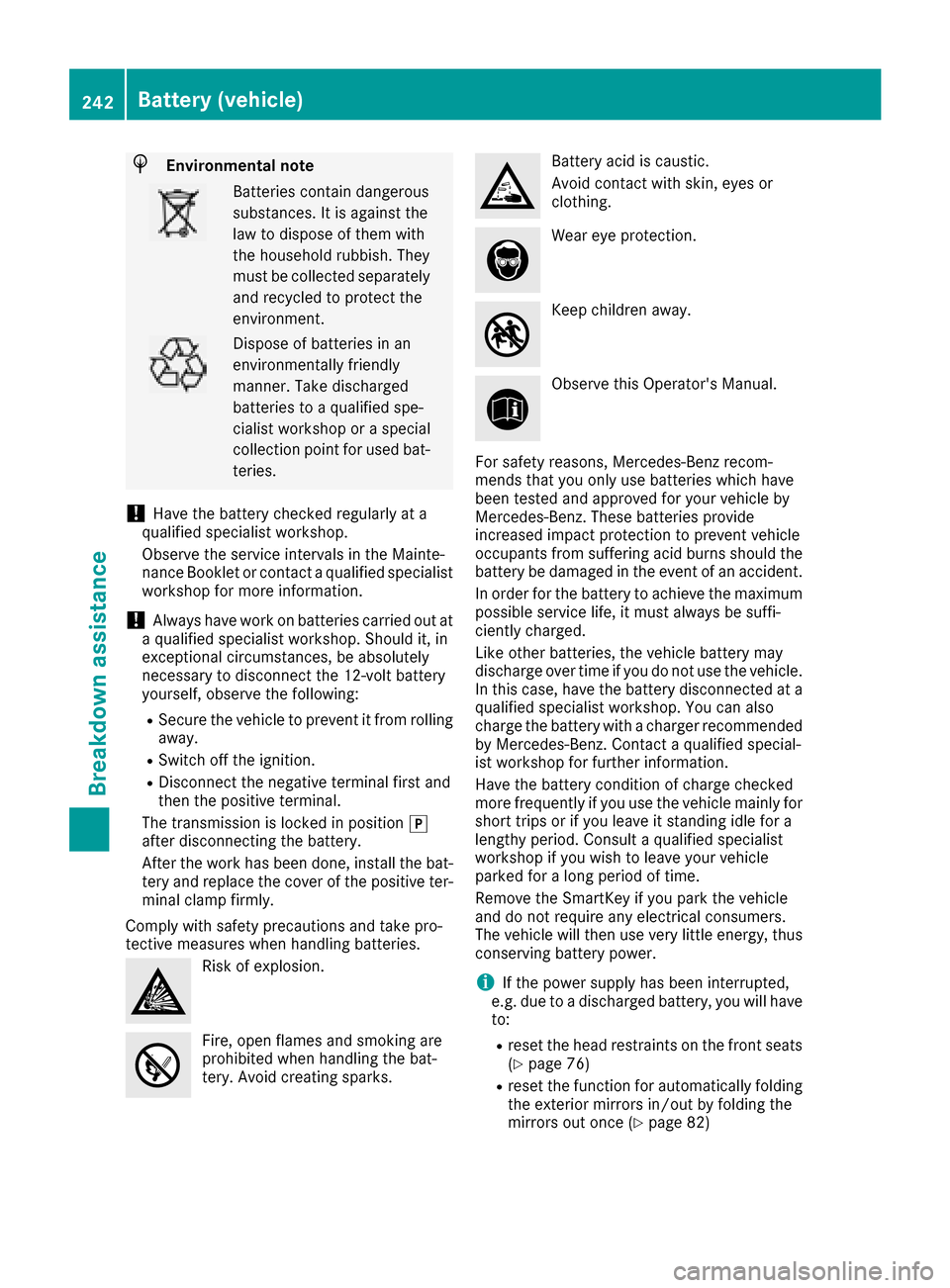
Risk of explosion.
Fire, open flames and smokin gare
prohibited when handling th ebat-
tery. Avoid creating sparks.
Batter yacid is caustic.
Avoid contac twith skin, eyes or
clothing.
Wear eye protection.
Keep children away.
Observe this Operator's Manual.
For safety reasons ,Mercedes-Ben zrecom-
mends that you onl yuse batteries whichh ave
been tested and approved for your vehicle by
Mercedes-Benz. Theseb atteries provide
increasedi mpactprotection to prevent vehicle
occupant sfroms ufferinga cid burnsshould the
battery be damagedint heeven tofana ccident.
In orderf or thebattery to achieve th emaximum
possible servicel ife, it must always be suffi-
ciently charged.
Likeo ther batteries,t hevehicle battery may
dischargeo ver timeifyou do not use th evehicle.
In this case ,have th ebattery disconnected at a
qualifieds pecialist workshop.Y ou can also
charge th ebattery with acharger recommended
by Mercedes-Benz. Contact aqualifieds pecial-
ist workshop for further information.
Hav ethe battery condition of charge checked
moref requently if you use th evehicle mainly for
shortt rips or if you leave it standin gidle for a
length yperiod. Consult aqualifieds pecialist
workshop if you wish to leave your vehicle
parked for alongp eriodoft ime.
Removet heSmartKey if you park th evehicle
and do not requirea ny electrical consumers.
The vehicle will then use veryl ittle energy, thus
conservingb attery power.
iIf thepower supply has been interrupted,
e.g .due to adischarged battery, you will have
to:
Rreset th ehead restraint sonthefront seats
(Ypage 76)
Rreset th efunction for automatically folding
th ee xteriorm irrorsin/out by folding the
mirrorso ut once(
Ypage 82)
242Battery (vehicle)
Breakdown assistance
Page 257 of 286
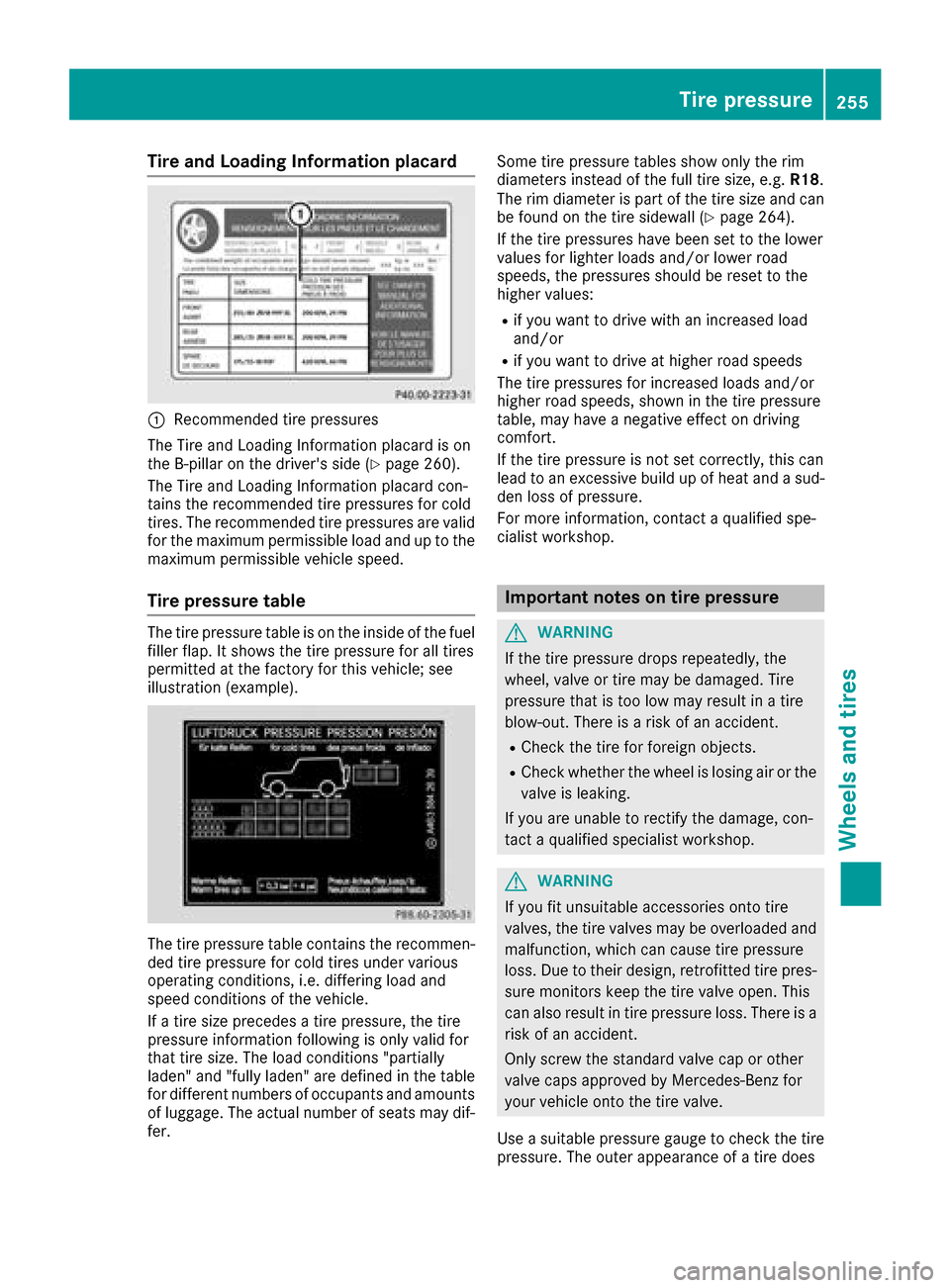
Tire and LoadingInfor matio nplacard
:Recommended tire pressures
The Tire and Loading Informatio nplacard is on
the B-pillar on the driver's side (
Ypage 260).
The Tire and Loading Informatio nplacard con-
tains the recommende dtire pressures for cold
tires. The recommende dtire pressures ar evalid
for the maximum permissibl eloa da nd up to the
maximum permissibl evehicl espeed.
Tire pressure table
The tire pressure table is on the insid eofthe fuel
fille rflap. It shows the tire pressure for al ltires
permitted at the factory for thisv ehicle; see
illustratio n(example).
The tire pressure table contains the recommen-
de dt ire pressure for col dtiresu nder various
operating conditions, i.e .differin gloa da nd
spee dconditions of the vehicle.
If at ire size precedes atire pressure, the tire
pressure informatio nfollowing is onl yvalid for
thatt ire size. The load conditions "partially
laden" and "fully laden" ar edefine dint he table
for different numbers of occupants and amounts of luggage.T he actual numbe rofseats mayd if-
fer. Some tire pressure table
sshowo nlyt he rim
diameters instea dofthe full tire size, e.g. R18.
The rim diamete rispartoft he tire size and can
be found on the tire sidewall (
Ypage 264).
If the tire pressures have been set to the lower
values for lighte rloads and/or lowe rroad
speeds ,the pressures shoul dbereset to the
highe rvalues :
Rif youwanttod rive with an increased load
and/or
Rif yo uwanttod rive at highe rroa ds peeds
The tire pressures for increased load sand/or
highe rroa ds peeds, shown in the tire pressure
table ,mayhave anegative effect on driving
comfort.
If the tire pressure is not set correctly, thisc an
lead to an excessive buil dupofheata nd asud-
de nlossofp ressure.
For mor
einformati
on, contactaquali fied spe-
cialist workshop.
Important notes on tire pressure
GWARNING
If the tire pressure drops repeatedly ,the
wheel, valve or tire maybed amaged.Tire
pressure thati stoo lo wmayresul tina tire
blow-out. There is ariskofana ccident.
RCheck the tire for foreign objects.
RCheck whether the whee lislosin gairor the
valve is leaking.
If yo uareunabl etorectify the damage,c on-
tact aquali fied specialis tworkshop.
GWARNING
If yo ufit unsuitable accessories onto tire
valves, the tire valve smaybe overloaded and
malfunction, which can cause tire pressure
loss. Due to their design, retrofitted tire pres- sure monitors kee pthe tire valve open. This
can also resul tintire pressure loss. There is a
ris kofana ccident.
Onlys crewt he standard valve cap or other
valve cap sapproved by Mercedes-Benz for
your vehicl eonto the tire valve.
Use asuitabl epressure gaug etocheck the tire
pressure. The outer appearance of atire does
Tire pressure255
Wheel sand tires
Z
Page 263 of 286
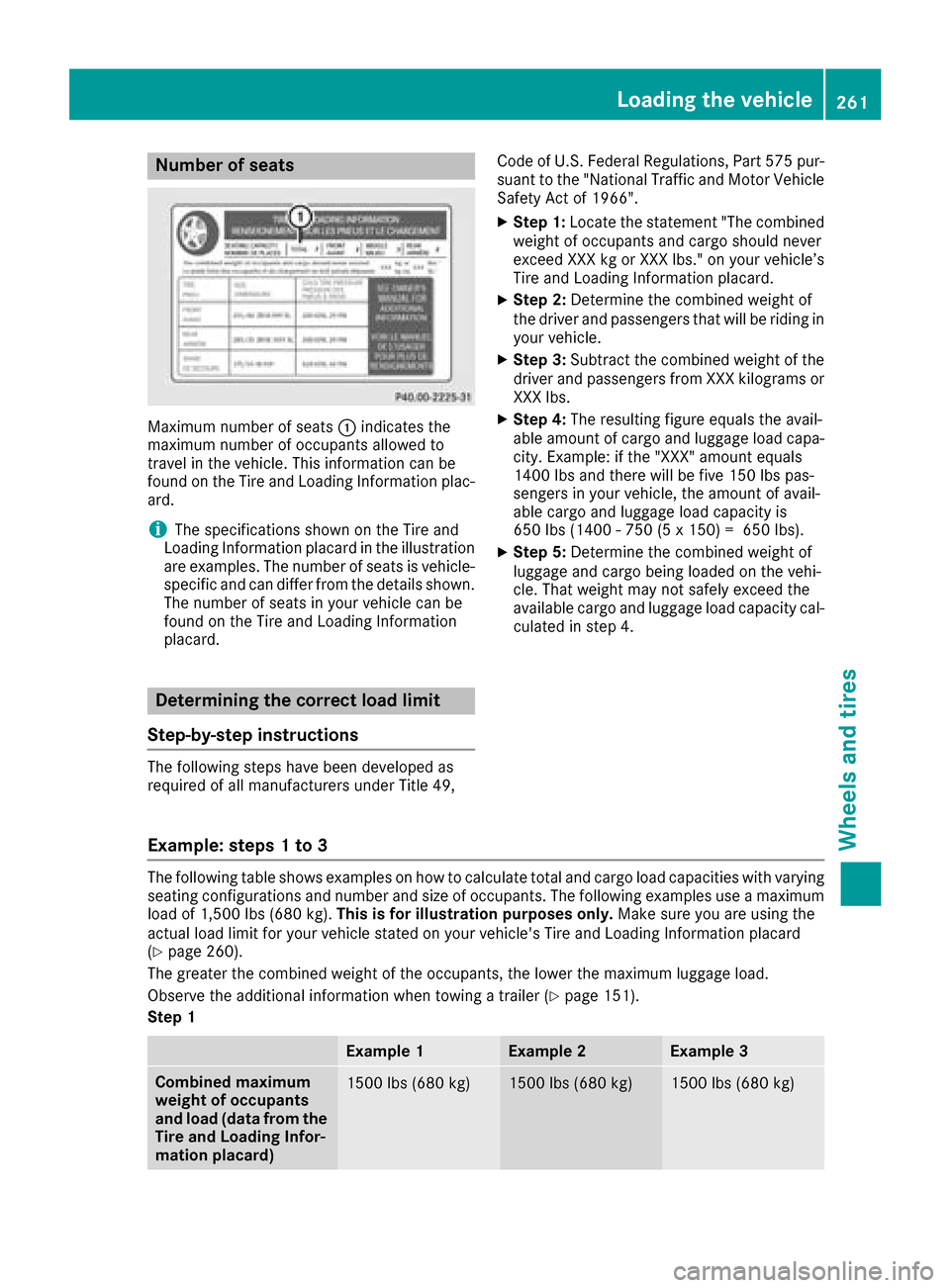
Numberofseats
Maximum numbe rofseats : indicates the
maximum numbe rofoccupants allowe dto
travel in the vehicle. This information can be
found on the Tire and Loading Informatio nplac-
ard.
iTh es pecifications shown on the Tire and
Loading Informatio nplacard in the illustration
ar ee xamples .The numbe rofseats is vehicle-
specifica nd can differf romthe details shown.
Th en umbe rofseats in your vehicl ecan be
found on the Tire and Loading Information
placard.
Determining the correc tloa dl im it
Step-by-ste pinstructions
Thef ollowing steps have been developed as
required of al lmanufacturers under Title 49, Code of U.S. Federa
lRegulat ions, Part 575 pur-
suant to the "Nationa lTraffica nd Motor Vehicle
Safety Act of 1966".
XSte p1:Locate the statement "The combined
weight of occupants and cargo shoul dnever
exceed XXX kg or XXX lbs." on your vehicle’s
Tire and Loading Informatio nplacard.
XSte p2:Determine the combined weight of
the driver and passengers tha twillber iding in
your vehicle.
XSte p3:Subtract the combined weight of the
driver and passengers fromX XX kilograms or
XXX lbs.
XSte p4:Th er esulting figure equals the avail-
able amount of cargo and luggag eloa dc apa-
city .Example: if the "XXX" amount equals
1400 lb sand there will be five 150 lb spas-
sengers in your vehicle, the amount of avail-
able cargo and luggag eloa dc apacity is
650 lb s(140 0-7 50 (5 x150) = 650 lbs).
XStep 5: Determine the combined weight of
luggage and cargo being loaded on the vehi-
cle. Thatw eight may not safely exceed the
available cargo and luggage loadc apacity cal-
culated in step 4.
Example :steps 1to3
The following tabl eshowse xamples on how to calculate total and cargo loadc apacities with varying
seating configurations and numbe rand size of occupants. The following examples use amaximum
loadof1 ,500 lbs (680 kg). This is for illustration purposes only. Make sure you are using the
actua lloa dlimitf or you rvehicle stated on you rvehicle's Tire and Loading Information placard
(
Ypag e260).
The greater the combined weight of the occupants, the lower the maximu mluggage load.
Observe the additiona linformation whe ntowing atrailer (
Ypag e151).
Step 1
Example 1Example 2Example 3
Combinedm aximum
weight of occupants
and load (data from the
Tire and Loading Infor-
mation placard)1500 lbs (680 kg)1500 lbs (680 kg)1500 lbs (680 kg)
Loading the vehicle261
Wheels and tires
Z
Page 271 of 286
PSI (pounds per squareinch)
Astandard unit of measure for tire pressure.
Aspect ratio
Relationship between tire height and tire width
in percent.
Tire pressure
This is pressure inside the tire applying an out-
ward force to each square inch of the tire's sur-
face. The tire pressure is specified in pounds per
square inch (psi), in kilopascals (kPa) or in bar.
The tire pressure should only be corrected when
the tires are cold.
Cold tire pressure
The tires are cold:
Rif the vehicle has been parked with the tires
out of direct sunlight for at least three hours
and
Rif the vehicle has not been driven further than
1m ile (1.6 km)
Tread
The part of the tire that comes into contact with
the road.
Bead
The tire bead ensures that the tire sits securely
on the wheel. There are several steel wires in the
bead to prevent the tire from coming loose from
the wheel rim.
Sidewall
The part of the tire between the tread and the
bead.
Weight of optional extras
The combined weight of those optional extras
that weigh more than the replaced standard
parts and more than 2.3 kg (5 lbs). These
optional extras, such as high-performance
brakes, level control, aroof rack or ahigh-per-
formanceb attery, are not included in the curb
weight and the weight of the accessories.
TIN (Tire Identification Number)
This is aunique identifier which can be used by
at ire manufacturer to identify tires, for example
for aproduct recall, and thus identify the pur-
chasers. The TIN is made up of the manufactur-
er's identity code, tire size, tire type code and
the manufacturing date.
Load bearing index
The load bearing index (also load index) is acode
that contains the maximum load bearing capa-
city of atire.
Traction
Traction is the result of friction between the tires
and the road surface.
TWR (Tongue Weight Rating)
The TWR specifies the maximum permissible
weight that the ball coupling of the trailer tow
hitch can support.
Treadwear indicators
Narrow bars (tread wear bars) that are distrib-
uted over the tire tread. If the tire tread is level
with the bars, the wear limit of áin (1.6 mm)
has been reached.
Occupant distribution
The distribution of occupants in avehicle at their
designated seating positions.
Total load limit
Nominal load and luggage load plus 68 kg
(150 lbs) multiplied by the number of seats in
the vehicle.
Changing awheel
Flat tire
You can find information on what to do in the
event of aflat tire in the "Breakdown assistance"
section (
Ypage 240).
Rotating the wheels
GWARNING
Interchanging the front and rear wheels may
severely impair the driving characteristics if
the wheels or tires have different dimensions. The wheel brakes or suspension components
may also be damaged. There is arisk of acci-
dent.
Rotate front and rear wheels only if the wheels and tires are of the same dimensions.
Changing awheel269
Wheels and tires
Z