2017 MERCEDES-BENZ G-Class warning
[x] Cancel search: warningPage 245 of 286

Charging thebattery
!
Only use battery chargers witham aximum
chargin gvoltage of 14.8 V.
GWARNING
During chargin gand jump-starting, explosive
gases can escape from th ebattery. Thereisa
ris kofane xplosion.
Particularly avoid fire, open flames, creating
sparks and smoking. Ensure there is sufficient
ventilatio nwhile chargin gand jump-starting.
Do no tlean ove rabattery.
GWARNING
Battery acid is caustic .Thereisar iskofi njury.
Avoid contac twiths kin, eyes or clothing .Do
no tinhale any battery gases.Don otlean over
th eb attery. Keep childre naway from batter-
ies. Wash away battery acid immediately with
plenty of clean wate rand seek medical atten-
tion.
GWARNING
Ad ischarged battery can freezeatt empera-
tures below freezing point. When jump-start-
ing th evehicle or chargin gthe battery, gases
can escape from th ebattery. Thereisar isko f
an explosion.
Allow th efroze nbattery to thaw out before
chargin gitorjump-starting.
!Only charge th ebattery usingt hejump-
starting connection point.
The jump-startin gconnection pointisint he
enginec ompartmen t(
Ypage 243).
XOpen thehood.
XConnect th ebattery charge rtothepositive
terminal and ground pointint hesame order
as when connecting th edonor battery in the
jump-startin gprocedure (
Ypage 243).
Keep away from fir eand open flames. Do not
lean ove rabattery. Never charge th ebattery if it
is still installed in th evehicle ,unless you use a
battery charge rwhichh as been tested and
approved by Mercedes-Benz. Abattery charger
unit specially adapted for Mercedes-Ben zvehi-
cle sand tested and approved by Mercedes-
Ben zisa vailable as an accessory. It permits the
chargin gofthebattery in its installed position.
Contac tanauthorized Mercedes-Ben zCenter
for further informatio nand availability. Read the
battery charger's operatin ginstructionsb efore
chargin gthe battery.
If th ewarning and indic
ator lamps do no
tlight up
on th einstrumen tcluste rwhen temperatures
are low, it is probably because th edischarged
battery has frozen.Int hisc asey ou may neither
jump-star tthe vehicle no rcharge th ebattery.
The servic elife of athawed-out battery may be
shorter. The starting characteristic scan be
impaired, particularly at low temperatures. Have
th et hawed-out battery checked at aqualified
specialist workshop.
Jump-starting
For th ejump-startin gprocedure, use only th ejump-startin gconnection pointint heenginec om-
partment, consisting of apositiv etermi nal and aground point.
GWARNING
Battery acid is caustic .Thereisar iskofi njury.
Avoid contac twiths kin, eyes or clothing .Donotinhale any battery gases.Don otlean ove rthe
battery. Keep childre naway from batteries .Wash away battery acid immediately withp lenty of
clean wate rand seek medical attention.
GWARNING
During chargin gand jump-starting, explosive gases can escape from th ebattery. Thereisar isk
of an explosion.
Jump-starting243
Breakdown assistance
Z
Page 246 of 286

Particularly avoid fire, open flames, creatingsparks and smoking. Ensure there is sufficient ven-
tilation while charging and jump-starting. Do not lean over abattery.
GWARNING
During the charging process, abattery produces hydrogen gas. If ashort circuit occurs or sparks
are created, the hydrogen gas can ignite. There is arisk of an explosion.
RMake sure that the positive terminal of aconnected battery does not come into contact with
vehicle parts.
RNever place metal object sortools on abattery.
RIt is importan tthat you observe the described order of the battery terminals when connecting
and disconnectin gabattery.
RWhen jump-starting, make sure that the battery poles with identical polarity are connected.
RIt is particularly importan ttoobserve the described order when connectin gand disconnecting
the jumper cables.
RNever connect or disconnect the battery terminals while the engine is running.
GWARNING
Ad ischarged battery can freeze at temperatures below freezin gpoint. When jump-starting the
vehicle or charging the battery, gases can escape from the battery. There is arisk of an explosion.
Allow the frozen battery to thaw out before charging it or jump-starting.
!Avoid repeated and lengthy starting attempts. Otherwise, the catalytic converter could be
damaged by the non-combusted fuel.
If the warning and indicator lamps do not light up on the instrument cluster when temperatures are
low, it is probably because the discharged battery has frozen. In this case, you may neither charge
the battery nor jump-start the vehicle. The service life of athawed-out battery may be shorter .The
starting characteristics can be impaired, particularly at low temperatures. Have the thawed-out
battery checked at aqualified specialist workshop.
Do not start the vehicle using arapid charging device. If your vehicle's battery is discharged, the
engine can be jump-started from another vehicle or from asecond battery using jumper cables.
Observe the following points:
RThe battery is not accessible in all vehicles. If the other vehicle's battery is not accessible, jump-
start the vehicle using asecond battery or ajump-starting device.
RYou may only jump-start the vehicle when the engine and exhaust system are cold.
RDo not start the engine if the battery is frozen. Let the battery thaw first.
RJump-starting may be performed only using batteries with anominal voltage of 12 V.
ROnly use jumper cables which have asufficient cross-section and insulated terminal clamps.
RIf the battery is fully discharged, leave the battery that is being used to jump-start connected for
afew minutes before attempting to start .This charges the battery slightly.
RMake sure that the two vehicles do not touch.
Make sure that:
Rthe jumper cables are not damaged.
Rwhen the jumper cables are connected to the battery, uninsulated sections of the terminal clamp
do not come into contact with other metal sections.
Rthe jumper cables cannot come into contact with parts which can move when the engine is
running, such as the V-belt pulley or the fan.
244Jump-starting
Breakdown assistance
Page 248 of 286
Towingand tow-starting
Important safety notes
GWARNING
Functions relevant to safety ar erestricted or
no longe ravailable if:
Rthe engine is not running.
Rthe brake system or the powe rsteerin gis
malfunctioning.
Rthere is amalfunctio ninthe voltag esuppl y
or the vehicle's electrical system.
If your vehicl eisbeing towed ,muchm ore
force mayben ecessary to stee rorbrake.
There is ariskofana ccident.
In such cases, us eatow bar. Before towing,
make sure thatt he steeringmoves freely.
GWARNING
Yo uc an no longe rstee rthe vehicl eifthe
steerin gwheel lock hasb eene ngaged .There
is ar iskofana ccident.
Alway sswitch off the ignition when towing the
vehicl ewithat ow cable or atow bar.
GWARNING
When towing or tow-startin ganotherv ehicle
and its weight is greate rthant he permissible
gross weight of your vehicle, the:
Rthe towing ey ecould detach itself
Rthe vehicle/trailer combinatio ncould roll-
over.
There is ariskofana ccident.
When towing or tow-startin ganotherv ehicle,
its weight shoul dnot be greate rthant he per-
missibl egross weight of your vehicle.
Detail sonthe permissibl egross vehicl eweigh t
of your vehicl ecan be found on the vehicl eide n-
tification plate (
Ypage 275).
!When DISTRONICP LUSort he HOLD func-
tio nisa ctivated ,the vehicl ebrakes automat-
icall yinc ertain situations. To avoi
ddamag etothe vehicle, deactivate
DISTRONICP LUSa nd the HOLD functio nin
the following or similar situations:
Rwhen towing the vehicle
Rin the car wash
!The vehicl ecan be towed amaximum of
30 miles (50km). The towing spee dof30mph
(50 km/h )mustn ot be exceeded.
If the vehicl ehasto be towed mor ethan
30 miles (50km), the entire vehicl emustb e
raised and transported.
!Onlys ecurethe tow cable or tow ba rtothe
towing eyes. Yo ucould otherwis edamag ethe
vehicle.
!Do not tow with sling-typ eequipment .This
could damage the vehicle.
!Do not us ethe towing ey efor recovery. This
could damage the vehicle. If in doubt, have
the vehicl erecovered using acrane.
!When towing ,pulla wa yslowly and
smoothly. If the tractiv epower is too high, the
vehicles could be damaged.
!Your vehicles is equipped with an automatic
transmission. Therefore ,you must not have
the vehicl etow-started .The transmission
mayo therwis ebedamaged .
It is better to have the vehicl etransporte dthan
to have it towed away.
If the transferc asec an be shifted into the Neu-
tral position, yo ucan tow away the vehicle.
If the transferc asec anno tbes hifted into the
Neutral position, yo ucan tow away the vehicle
with one axl eraised. Please bear the following in
mind:
Rremove the propeller shaft between the trans-
fer cas eand the rolling axle.
Rturnthe SmartKeytop osition 1in the igni-
tio nlock.
The battery must be connected and charged.
Otherwise, you:
Rcanno tturnt he SmartKeytop osition 2in
the ignition lock
Rcanno tshift the automatic transmission to
position i
Disar mthe automatic locking featur ebefor et he
vehicl eistowed (
Ypage 67).Y oucould other-
wise be locked outw henp ushing or towing the
vehicle.
246Towin gand tow-starting
Breakdow nassistance
Page 249 of 286
Towingeyes
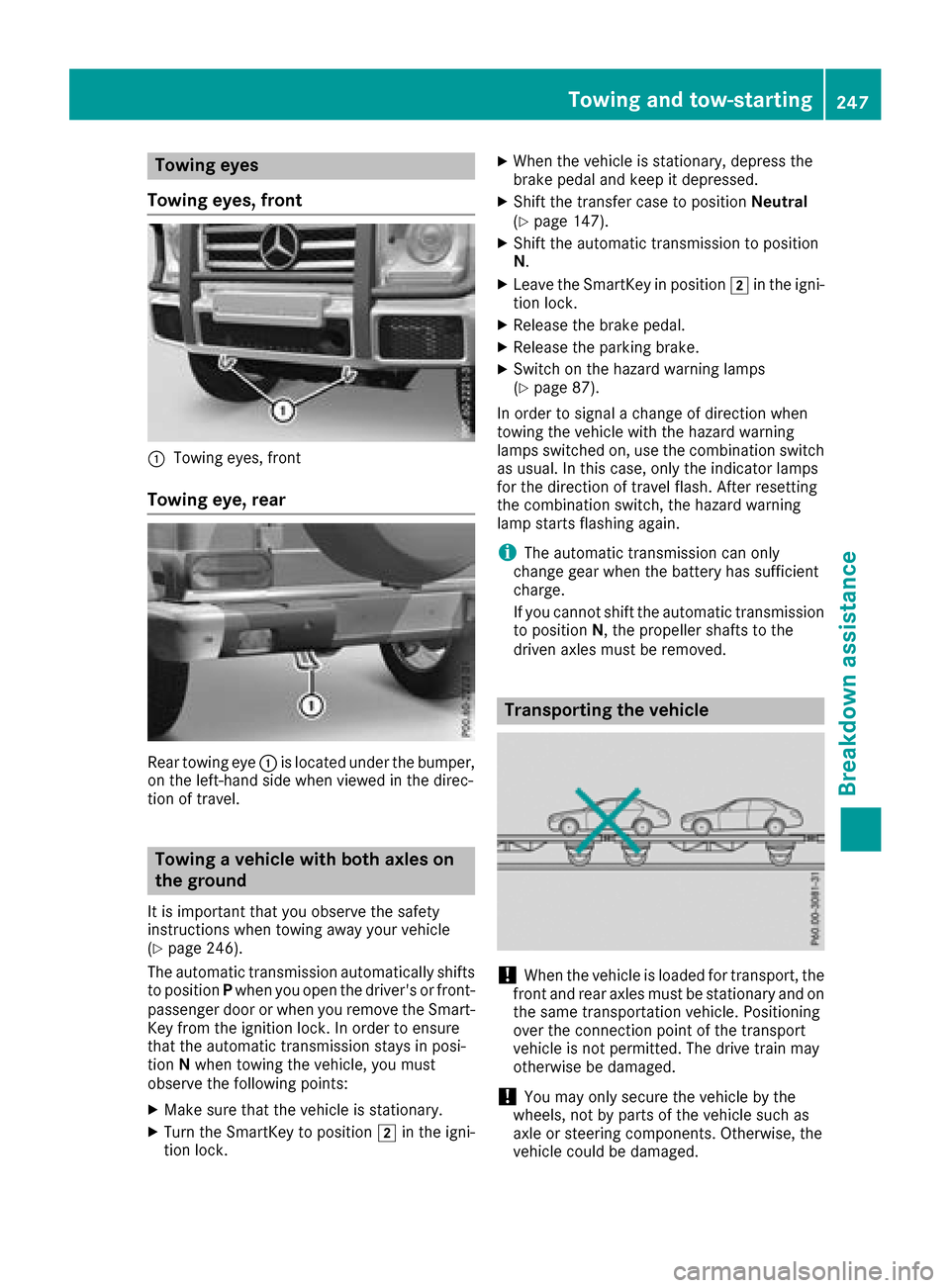
Towin geyes, front
:Towing eyes, front
Towin geye,rear
Rear towing eye :is locate dunder the bumper,
on the left-hand side when viewe dinthe direc-
tio noft ravel.
Towin gavehicle with both axles on
the ground
It is important thaty ouobserve the safety
instructions when towing away your vehicle
(
Ypage 246).
The automatic transmission automaticall yshifts
to position Pwhen yo uopenthe driver's or front-
passenge rdoororw heny ou remove the Smart-
Key fromt he ignition lock. In order to ensure
thatt he automatic transmission stays in posi-
tion Nwhen towing the vehicle, yo umust
observe the following points:
XMake sure thatt he vehicleisstationary.
XTurn the SmartKeytop osition 2in the igni-
tio nlock.
XWhen the vehicl eisstationary, depress the
brake peda land kee pitdepressed.
XShift the transferc asetop osition Neutral
(Ypage 147).
XShift the automatic transmission to position
N.
XLeave the SmartKeyinp osition2in the igni-
tio nlock.
XReleas ethe brake pedal.
XReleas ethe parkin gbrake.
XSwitch on the hazar dwarning lamps
(Ypage 87).
In order to signa lachange of direction when
towing the vehicl ewitht he hazar dwarning
lamps switched on, us ethe combinatio nswitch
as usual. In thisc ase, onlythe indicator lamps
for the direction of travel flash. After res etting
th
e combinatio nswitch ,the hazar dwarning
lamp starts flashing again.
iThe automatic transmission can only
change gear when the battery hass ufficient
charge.
If yo ucanno tshift the automatic transmission
to position N,the propeller shafts to the
driven axles must be removed.
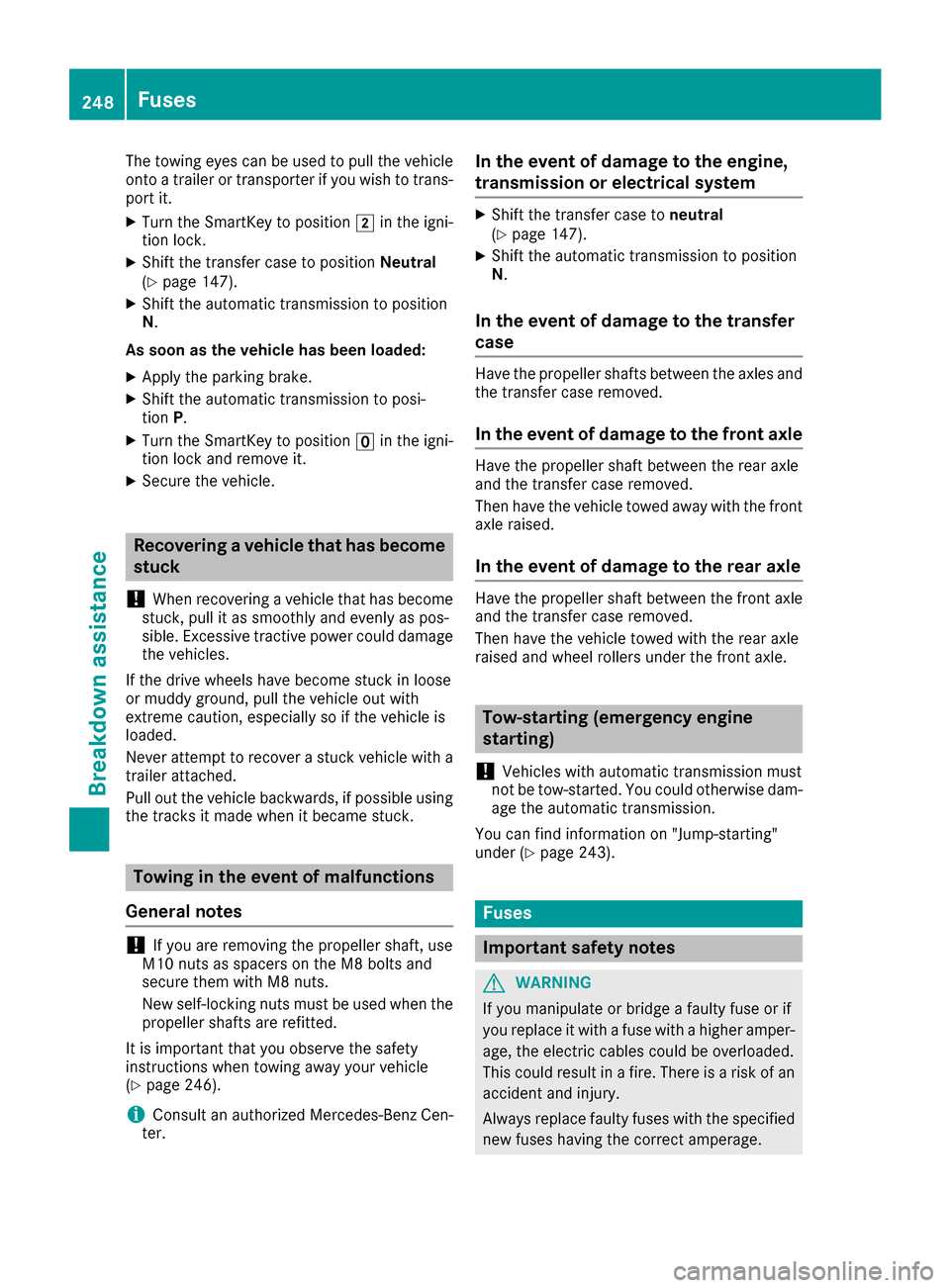
Transporting the vehicle
!When the vehicl eisloade dfor transport, the
front and rea raxles must be stationar yand on
the same transportatio nvehicle. Positioning
ove rthe connectio npoint of the transport
vehicl eisnot permitted .The drive train may
otherwis ebedamaged .
!Youm ayonl ysecur ethe vehicl ebythe
wheels ,not by parts of the vehicl esucha s
axl eors teerin gcomponents. Otherwise, the
vehicl ecould be damaged.
Towin gand tow-starting247
Breakdow nassistance
Z
Page 250 of 286
The towing eyes can be used to pull the vehicle
ontoatrailer or transporter if you wish to trans-
port it.
XTurn the SmartKey to position 2in the igni-
tion lock.
XShift the transfer case to position Neutral
(Ypage 147).
XShift the automatic transmission to position
N .
As soon as the vehicle has been loaded:
XApply the parking brake.
XShift the automatic transmission to posi-
tion P.
XTurn the SmartKey to position uin the igni-
tion lock and remove it.
XSecure the vehicle.
Recovering avehicle thath as become
stuck
!
When recovering avehicle that has become
stuck ,pull it as smoothly and evenly as pos-
sible. Excessive tractive power could damage
the vehicles.
If the drive wheels have become stuck in loose
or muddy ground, pull the vehicle out with
extreme caution, especially so if the vehicle is
loaded.
Never attempt to recover astuck vehicle with a
trailer attached.
Pull out the vehicle backwards, if possible using the track sitmade when it became stuck.
Towing in the event of malfunctions
General notes
!If you are removing the propeller shaft, use
M10 nuts as spacers on the M8 bolts and
secure them with M8 nuts.
New self-locking nuts must be used when the
propeller shafts are refitted.
It is important that you observe the safety
instructions when towing away your vehicle
(
Ypage 246).
iConsult an authorized Mercedes-Benz Cen-
ter.
In the event of damage to the engine,
transmission or electrical system
XShift the transfer case to neutral
(Ypage 147).
XShift the automatic transmission to position
N .
In the event of damage to the transfer
case
Have the propeller shafts between the axles and
the transfer case removed.
In the event of damage to the front axle
Have the propeller shaft between the rear axle
and the transfer case removed.
Then have the vehicle towed away with the front
axle raised.
In the event of damage to the rear axle
Have the propeller shaft between the front axle
and the transfer case removed.
Then have the vehicle towed with the rear axle
raised and wheel rollers under the front axle.
Tow-starting (emergency engine
starting)
!
Vehicles with automatic transmission must
not be tow-started. You could otherwise dam-
age the automatic transmission.
You can find information on "Jump-starting"
under (
Ypage 243).
Fuses
Important safety notes
GWARNING
If you manipulate or bridge afaulty fuse or if
you replace it with afuse with ahigher amper-
age, the electric cables could be overloaded.
This could result in afire. There is arisk of an
accident and injury.
Always replace faulty fuses with the specified
new fuses having the correcta mperage.
248Fuses
Breakdown assistance
Page 253 of 286
Important safety notes
GWARNING
If wheels and tires of th ewrong siz eare used,
th ew hee lbrakes or suspension component s
may be damaged. Ther eisariskofana cci-
dent.
Always replace wheels and tires wit hthose
that fulfill th especification softheoriginal
part .
When replacing wheels, mak esuretou se the
correct:
Rdesignation
Rmodel
When replacing tires ,makes uretou se the
correct:
Rdesignation
Rmanufacturer
Rmodel
GWarning
Af lat tire severely impairs th edriving ,steer -
ing and braking characteristics of th evehicle.
Ther eisar iskofana ccident.
do no tdrivew ithaf lat tire. Immediately
replace th eflat tire wit hyour spar ewheel, or
consult aqualified specialist workshop.
Accessories that are no tapprove dfor your vehi-
cle by Mercedes-Ben zorare notbein gused cor-
rectl ycan impair th eoperating safety.
Before purchasing and usin gnon-ap proved
accessories, visit aqualified specialist work-
sho pand ask about :
Rsuitability
Rlegal stipulation s
Rfactory recommendation s
Further information regarding wheels and tires
can be foun dunder "Wheel/tire combinations"
(
Ypage 273).
You can ask for information regarding permitte d
wheel/tire combination satanauthorized
Mercedes-Ben zCenter. Information on tire pressur
ecan be found:
Ron th eTirea nd Loading Information placard
on th eB-pillar on th edriver' sside
(
Ypage 260)
Rin th etirep ressur etable in th efuel filler flap
(Ypage 119)
Runder "Tir epressure" (Ypage 254)
Operation
Information on driving
Checkthe tire pressur ewhen th evehicl eis
heavily laden and adjust prio rtoatrip.
While driving ,pay attention to vibrations, noises
and unusual handlin gcharacteristics ,e.g.p ull-
ing to on eside .This may indicat ethatthe
wheels or tires are damaged. If you suspec ttha t
at ireisd efective, reduce your spee dimmedi-
ately. Stop th evehicl eass oonasp ossible to
chec kthe wheels and tires for damage. Hidden
tire damag ecould also be causing th eunusual
handlin gcharacteristics .Ifyou fin dnos ignsof
damage, hav ethe tires and wheels checke data
qualified specialist workshop.
When parking your vehicle, mak esuret hatthe
tires do no tget deformed by th ecurboro ther
obstacles. If they canno tbeavoided, driv eover
obstacles suc hascurbs slowly and at an obtuse
angle. You could otherwise damag ethe whee l
rim sand tires .
Regularchecking of wheels and tires
GWARNIN G
Damaged tires can caus etirei nflation pres-
sur eloss .Asar esult,you could lose control of
your vehicle. Ther eisariskofa ccident.
Chec kthe tires regularly for sign sofdamage
and replace any damaged tires immediately.
Chec kwheels and tires for damag eatleast once
am onth .Chec kwheels and tires after driving
off-road or on roug hroads. Damaged wheels
can caus ealoss of tire pressure.
Pay particular attention to damag esucha s:
Rcut sint hetires
Rpunctures in th etires
Rtears in th etires
Operation251
Wheels and tires
Z
Page 254 of 286

Rbulges on tires
Rdeformation or severe corrosion on wheels
Regularly checkt he tire tread depth and the
condition of the tread across the whole width of
the tire (
Ypage 252). In order to inspec tthe
inne rside of the tire surface, turn the steering
wheel to full lock.
All wheels must have avalve cap to protect the
valve against dirt and moisture. Do not install
anythin gontot he valve other than the standard
valve cap or avalve cap approved by Mercedes-
Benzf or your vehicle. Do not use any other valve
caps or systems ,e.g. tire pressure monitoring
systems.
You should regularly checkt he pressure of all
your tires includin gthe spare wheel, particularly
prior to long trips. Adjust the tire pressure as
necessary (
Ypage 254).
The servicel ife of tires depends, among other
things, on the following factors:
RDriving style
RTire pressure
RDistance covered
Notes on tir etread
GWARNING
Insufficientt ire tread will reduce tire traction.
The tire is no longer able to dissipate water.
This means that on wet road surfaces,t he risk
of hydroplaning increases, in particular where speed is not adapted to suit the driving con-
ditions. There is arisk of accident.
If the tire pressure is too high or too low, tires
may exhibit differentl evels of wear at differ-
ent location sonthe tire tread. Thus, you
should regularly checkt he tread depth and
the condition of the tread across the entire
width of all tires.
Minimum tire tread depth for:
RSummer tires: âin (3 mm)
RM+S tires: ãin (4 mm)
For safety reasons ,replace the tires before
the legally prescribed limit for the minimum
tire tread depth is reached.
Marking :shows where the bar indicator
(arrow) for tread wear is integrated int othe tire
tread.
Treadwear indicators (TWI) are required by law. Six indicators are positioned on the tire tread.
They are visible onc eatread depth of approx-
imately áin (1.6 mm) has been reached. If this
is the case, the tire is so worn that it must be
replaced.
Selecting, mounting and replacing
tires
ROnly mount tires and wheels of the same type
and make.
ROnly mount tires of the correct size ont othe
wheels.
RBreak in new tires at moderates peeds for the
first 60 miles (100 km). The new tires only
reach their full performanc eafter this dis-
tance.
RDo not drive with tires which have too little
tread depth, as this significantly reduces the
traction on wet roads (hydroplaning).
RReplace the tires after six years at the latest,
regardless of wear. This also applies to the
spare wheel.
Winter operation
General notes
Have your vehicle winter-proofed at aqualified
specialist workshop at the onset of winter.
Observe the notes in the "Changing awheel"
section (
Ypage 269).
252Winter operation
Wheels and tires
Page 255 of 286
Drivingwiths ummer tires
At temperature sbelo w45‡( +7 †), elasticity in
summe rtires is significantly lower and thus also
traction and braking power. Change the tires on
you rvehicle to M+S tires .Using summe rtires at
very cold temperatures coul dcause cracks to
form, therebyd amaging the tires permanently.
Mercedes-Benz cannot accep tresponsibility for
this type of damage.
GWARNING
Damaged tires can cause tire inflation pres-
sure loss.Asar esult, you couldlose control of
you rvehicle. There is arisk of accident.
Check the tires regularly for signs of damage
and replace any damaged tires immediately.
M+S tires
GWARNING
M+S tires with atire tread depth of less than
ã in (4 mm )are not suitabl efor use in winter
and do not provide sufficient traction. There is
ar isk of an accident.
M+S tires with atread depth of less than ãin
(4 mm) must be replaced immediately.
GWARNING
Wheela nd tire dimensions as wel lasthe type
of tire can vary between the spare wheel and
the wheel to be replaced .When the spare
wheel is mounted ,driving characteristics may
be severely affected .There is arisk of an acci-
dent.
In order to reduce risks:
Ryou should thereforea dapt yourdriving
styl eand drive carefully.
Rnever mount more than one spare wheel
that differs from the wheel to be replaced.
Ronly use aspare wheel that differs from the
wheel to be replaced for ashort time.
Rdo not deactivate ESP®.
Rhave aspare wheel that differs from the
wheel that has beenc hangedreplaced at
the nearest qualified specialist workshop.
You must observe the correct wheel and
tire dimensions as wel lasthe wheel type.
Do not exceed amaximu mspeedof50m ph
(80 km/h) if aspare wheel of adifferent size is
installed.
At temperatures below 45 ‡(+7 †), use winter
tires or all-season tires. Both type softire are
identified by the M+S marking.
Only winter tires bearing the isnowflake
symbol in addition to the M+S marking provide
the best possibleg rip in wintry road conditions.
Only these tires wil lallow driving safety systems
such as ABS and ESP
®to function optimally in
winter. Theset ires have beend eveloped specif-
ically for driving in snow.
Use M+S tires of the same make and tread on all
wheels to maintain safe handling characteris-
tics.
Always observe the maximu mpermissible
speeds pecified for the M+S tires you have
mounted.
When you have mounted the M+S tires:
XCheck the tire pressures (Ypag e257).
XRestart the tire pressure monitor
(Ypag e259).
Snowc hains
GWARNING
If you drive too fast with snow chains moun-
ted, they may snap. As aresult, you could
injure others and damage the vehicle. There is
ar isk of an accident.
Observe the maximu mpermissible speedf or
operation with snow chains.
!Information about the use of snow chain
compatibleA MG winter tires is applicable for
AMG tires. Use of snow chains is only per-
missible with these tires.
!On some tire sizes there is not enoug hspace
for snow chains. To avoi ddamage to the vehi-
cle or tires, observe the "Wheel and tire com-
binations" section unde r"Tires and wheels".
Wintero peration253
Wheels and tires
Z