2017 MERCEDES-BENZ E-CLASS ESTATE lock
[x] Cancel search: lockPage 148 of 585
Changing
thef ront bulbs (vehicles wit hhalo‐
ge nh eadla mps) Fi
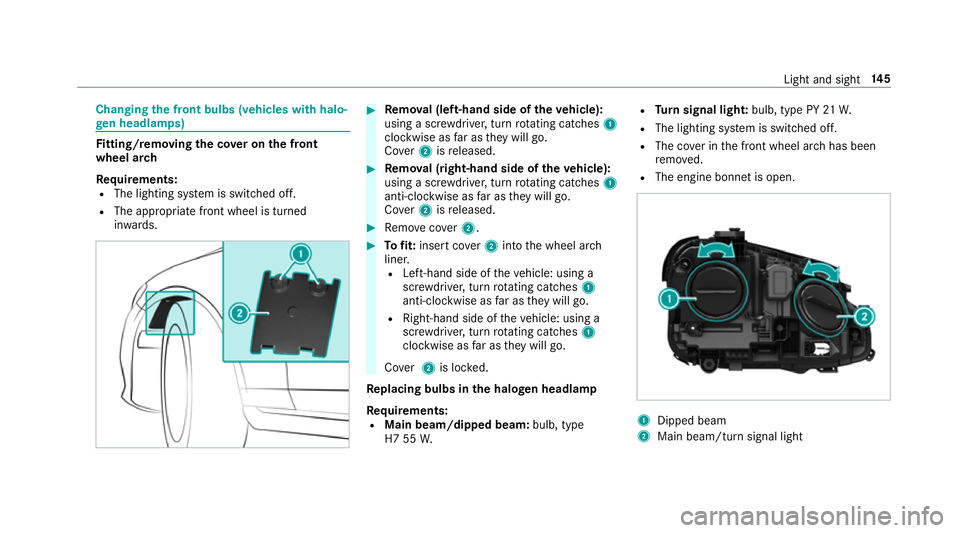
tting/ removing the co vero nthe front
whee larch
Re quirements:
R The lightin gsystemiss witched off.
R The appropriat efront wheel is turned
in wa rds. #
Remo val(left-hand side of thev ehicle):
using ascrew driver ,tur nr otating catches 1
clockwise as farast heyw ill go.
Co ver 2isreleased. #
Remo val(right-hand side of thev ehicle):
using ascrew driver ,tur nr otating catches 1
anti-clockwise as farast heyw ill go.
Co ver 2isreleased. #
Remo vecover 2. #
Tofit: inse rtco ver 2intot he wheel ar ch
liner.
R Left-hand side of thev ehicle: using a
scr ewdriver ,tur nr otating catches 1
anti-clockwise as farast heyw ill go.
R Right-han dside of thev ehicle: using a
scr ewdriver ,tur nr otating catches 1
clockwise as farast heyw ill go.
Co ver 2is loc ked.
Re placing bulbs in the halo genh eadla mp
Requ irements:
R Main beam/dipped beam: bulb, type
H7 55 W. R
Turn signal light: bulb, type PY 21W.
R The lighting sy stem is switched off.
R The co verint he front wheel ar chhas been
re mo ved.
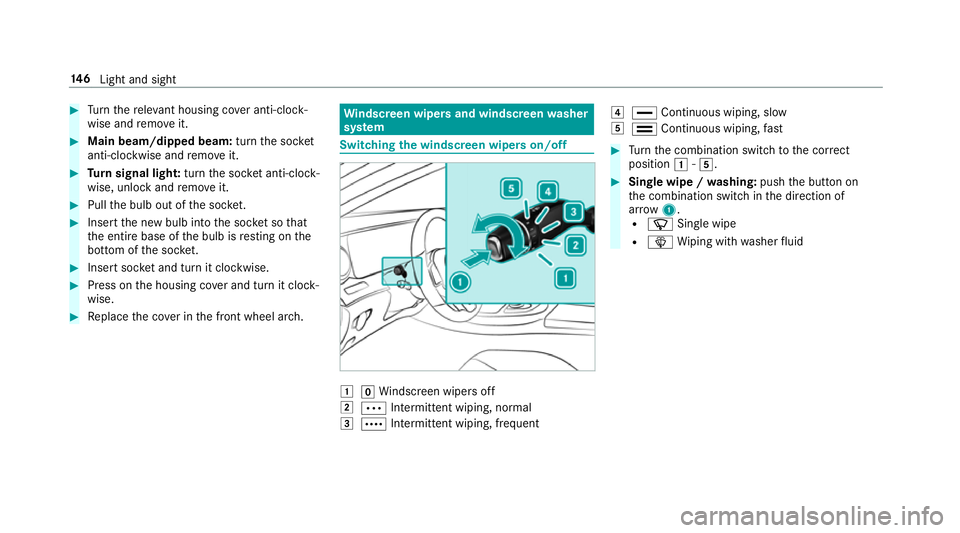
R The engin ebonn etis open. 1
Dipped beam
2 Main beam/tur nsignal light Light and sight
14 5
Page 149 of 585
#
Turn ther ele vant housing co vera nti-clock‐
wise and remo veit. #
Main beam/dipped beam: turnthe soc ket
anti-clockwis eand remo veit. #
Turn signal light: turnthe soc keta nti-clo ck‐
wise, unloc kand remo veit. #
Pull theb ulb out of thes ocket. #
Inse rtthen ew bulb int othe soc ketsot hat
th ee ntir ebase of theb ulb is resting on the
bottom of thes ocket. #
Inse rtsoc keta nd tur nitclock wise. #
Press on theh ousing co vera nd tur nitclock‐
wise. #
Replace thec over in thef ront wheel ar ch. Wi
ndscreen wiper sand windscreen washer
sy stem Switching
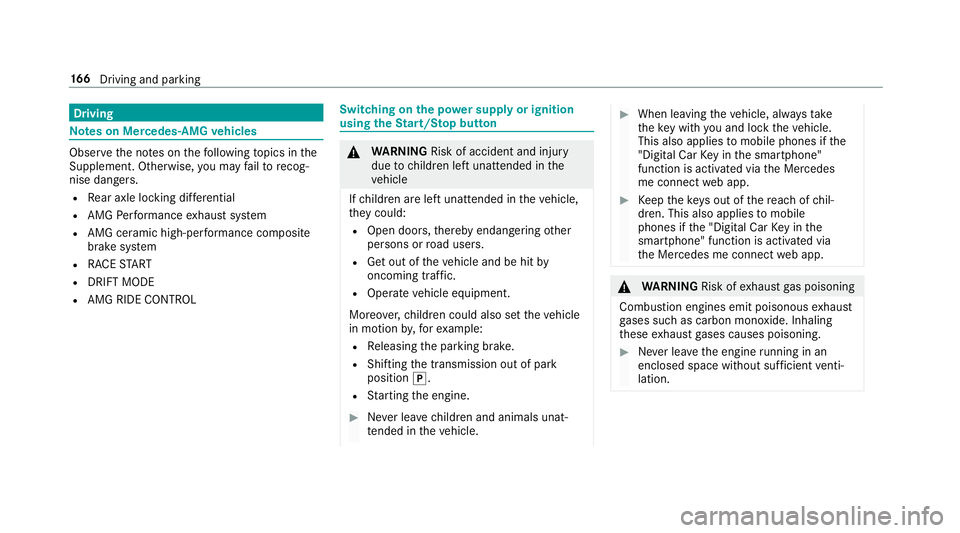
thew indscreen wiper son/off 1
gWindsc reen wiper soff
2 Ä Intermittent wiping, normal
3 Å Intermittent wiping, frequent 4
° Continuous wiping, slow
5 ¯ Continuous wiping, fast #
Turn thec ombination switc htothe cor rect
position 1-5. #
Singlew ipe /washing: pushtheb utton on
th ec ombination switc hinthe direction of
ar row 1.
R í Single wipe
R î Wiping wit hwashe rfluid 14 6
Light and sight
Page 169 of 585
Driving
Note
sonM ercedes-AMG vehicles Obser
vethen otes on thef ollowing topics in the
Supplement. Otherwise, youm ayfailto recog‐
nise dangers.
R Rear axle lockin gdiffe re ntial
R AMG Performance exhaus tsystem
R AMG ceramic high-per form anc ecomposite
brak esystem
R RACE START
R DRIFT MODE
R AMG RIDE CONTROL Switching on
thep owe rsupp lyor ignition
using theS tart/ Stopbutton &
WARNING Risk of accident and inju ry
due tochildren lef tunat tende dint he
ve hicle
If ch ildren ar eleftu nat tende dint hevehicle,
th ey could:
R Ope ndoors,t hereb yendangering other
persons or road users.
R Getout of thev ehicle and be hit by
oncoming traf fic.
R Ope rate ve hicle equipment.
Moreo ver,ch ildren could also se tthe vehicle
in motion by,for example:
R Releasing thep arking brake.
R Shifting thet ransmission out of park
position j.
R Startin gthe engine. #
Neverlea ve children and animals unat‐
te nde dint hevehicle. #
When leaving thev ehicle, alw ayst ake
th ek eywit hyou and loc kthe vehicle.
This also applies tomobil ephones if the
"Digital Car Keyint he smartphone"
function is activated via theM ercedes
me connect weba pp. #
Keep thek eyso ut of ther eac hofc hil‐
dren. This also applies tomobile
phones if the" Digital Car Keyint he
smartphone" function is activated via
th eM ercedes me connect weba pp. &
WARNING Risk ofexhaus tgas poisoning
Combustio nengines emit poisonous exhaust
ga ses suc hascarbon monoxide. Inhaling
th ese exhaus tgases causes poisoning. #
Neverlea ve thee ngine running in an
enclose dspace wi thout suf ficient venti‐
lation. 16 6
Driving and pa rking
Page 174 of 585
To
preser vethee ngine during thef irst 1,500 km:
R driv eatv arying road speeds and engine
speeds.
R driv eind rive program Cor E.
R chang egear befor ethe revc ounter needl eis
Ôof thew aytother ed area of ther ev coun‐
te r.
R do no tshif td ow nag ear manuall yinorder to
brake.
R avoidoverstra inin gthe vehicle, e.g. driving at
full thro ttle.
R do no tdepress thea ccelera torp eda lpast
th ep ressur epoint (kickdown).
R onlyincrease thee ngine speed gradually and
accelera tethev ehicle tofull spee dafter
1, 500 km.
This also applie swhent he engine or parts of the
driv etra in ha vebeen replaced.
Please also obser vethef ollowing running-in
no tes:
R In cer tain drivin gand drivin gsafet ys ystems,
th es ensor sadjus tautomaticall ywhile acer‐ ta
in dis tance is driven af tert he vehicle has
been delivered or af terr epairs. Full sy stem
ef fectivenes sisnotachie vedu ntil thee nd of
th is teach-in process.
R Brak elinings, brak ediscsa nd tyres that are
either ne worhavebeen replaced onl yach‐
ie ve optimum braking ef fect and grip af ter
se veralh undred kilom etre sofd riving. Com‐
pensat efor ther educed braking ef fect by
applying greater forc etot he brak epedal. Note
sond riving &
WARNING Risk of accident du eto
object sinthe driver's foot we ll
Object sinthe driver's foot we ll ma yimp ede
pedal tra velorb lockad epressed pedal.
This jeopardises theo perating and road
saf etyoft hevehicle. #
Stow all object sinthevehicle securely
so that they canno tget intot he driver's
fo ot we ll. #
Alw aysf itth ef loor mats securel yand
as prescribed in order toensur ethat
th er eisa lway ss ufficient room fort he
pedals. #
Do no tuse loose floor mats and do not
place floor mats on topofo ne ano ther. &
WARNING Risk of accident du eto
unsuitable foot we ar
Operatin gthe pedals ma ybeimpaired by
we aring unsuitable foot we ar,e .g.:
R plat form shoes
R high-heeled shoes
R slippers #
Alw aysw ear suitable foot we ar when
drivin gsot hatyouc an operat ethe ped‐
als safel y. Driving and pa
rking 171
Page 186 of 585
Re
quirements:
R unloc kthe vehicle.
% Do no tget intot he vehicle again during the
re fuelling process. Otherwise, electros tatic
ch arge could buil dupagain.
Obser vethen otes on operating fluids
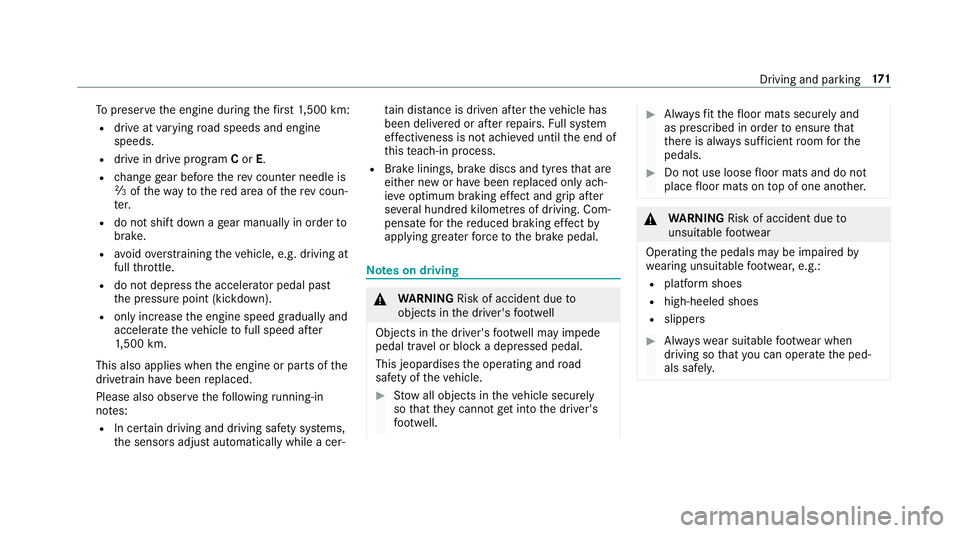
(→ pag e452). 1
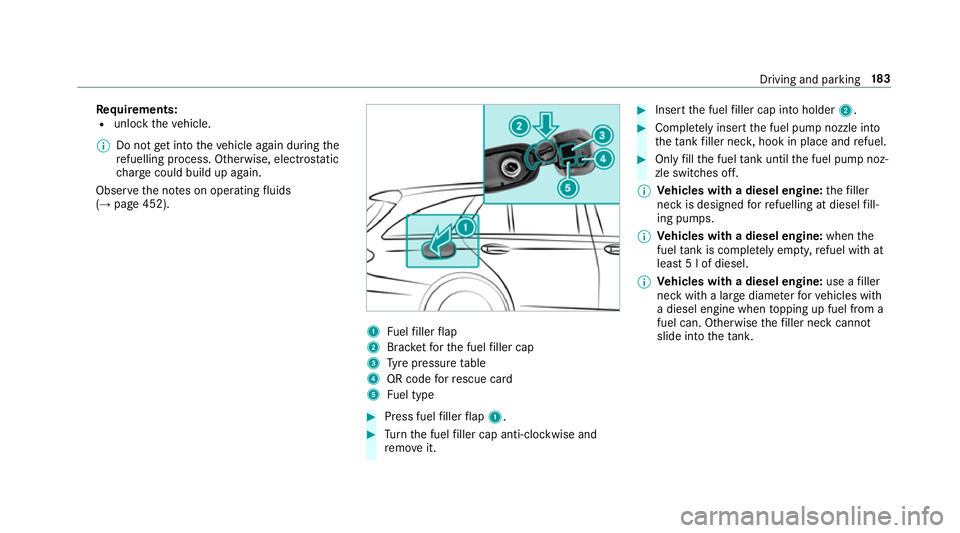
Fuelfiller flap
2 Brac ketfor thef uel filler cap
3 Tyre pressur etable
4 QR code forr escue card
5 Fuel type #
Press fuel filler flap 1. #
Turn thef uel filler cap anti-clockwise and
re mo veit. #
Inser tthe fuel filler cap int oholder 2. #
Comple tely inse rtthef uel pum pnozzle into
th et ank filler nec k,hook in place and refuel. #
Onlyfillthef uel tank unti lthe fuel pum pnoz‐
zle switches off.
% Vehicles with adiesel engine: thef iller
nec kisd esigned forr efuelling at diesel fill‐
ing pumps.
% Vehicles with adiesel engine: whenthe
fuel tank is compl etelye mp ty,r efuel wit hat
lea st5lofd iesel.
% Vehicles with adiesel engine: useafiller
nec kwithal arge diame terf or vehicles with
ad iesel engine when topping up fuel from a
fuel can. Otherwise thef iller nec kcannot
slide int othe tank. Driving and pa
rking 18 3
Page 188 of 585
The
following announcements appear in order in
th em ultifunction displa ywhen theA dBlue ®
tank
requ iresrefilling:
R Refill AdBlue See Owner's Manual .The
Ad Blue ®
re ser voir is down tother eser ve
le ve l.
R Refill AdBlue No star tinXXX km .You can
onl ydrive thev ehicle overthe dis tance
shown. TopupA dBlue®
as soon as possible.
R Refill AdBlue Start not possible.T hevehicle
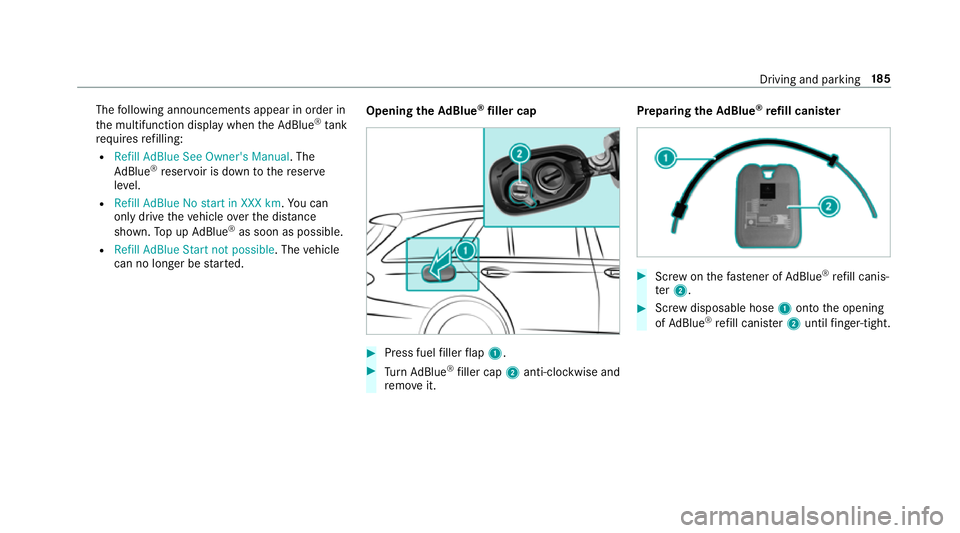
can no longer be star ted. Opening
theA dBlue ®
filler cap #
Press fuel filler flap 1. #
Turn AdBlue ®
filler cap 2anti-clockwise and
re mo veit. Preparing
theA dBlue ®
re fill canis ter #
Screw onthef astener of AdBlue ®
re fill canis‐
ter 2. #
Screw disposable hose 1ontothe opening
of Ad Blue ®
re fill canis ter2 until finger-tight. Driving and pa
rking 18 5
Page 198 of 585
Fu
nction of ther adar senso rs Some driving and driving sa
fety sy stems use
ra dar sensor stomonitor thea reainf ront of,
behind or next tothev ehicle (depending on the
ve hicle's equipment).
Depending on thev ehicle's equipment, ther adar
senso rsarei ntegrated behind theb umpers
and/or behind ther adiator grille. Keep these
parts free of dirt, ice and slush (→ page402).
The sensor smustn otbe co vered, fore xamp le
by bicycle rack s, ove rhanging loads or radar-
re flecting sticke rs.F ollowing an impact and in
th ee vent of associated dama ge,w hic hm aynot
be visible, totheb umper sorradiator grille, ha ve
th ef unction of ther adar senso rscheckedata
qu alified specialis tworks hop. The driver assis‐
ta nce sy stem ma ynolonger workproperly. Overvie
wofdriving sy stems and driving
saf etys ystems In
this section, youw illfind informatio nabout
th ef ollowing driving sy stems and driving saf ety
sy stems:
R 360° Camer a(→pag e229)
R ABS (A nti-lock Braking System)
(→ pag e195)
R ActiveD ista nce Assi stDISTRONIC
(→ page 209)
R Adaptiv ebrake light s(→pag e205)
R AIRB ODYC ONTROL (→ page219 )
R ActiveB rake Assi st (→pag e201 )
R ActiveL aneK eeping Assis t(→pag e250)
R ATTENTION ASSIS T(→ pag e244)
R BAS(Brake Assist System) (→ page196)
R DYNA MIC BODY CONTROL (→ page219 )
R EBD ( Electronic Brakeforce Distribution)
(→ pag e200)
R ESP ®
(Elect ronic Stability Program)
(→ pag e196) R
Hill StartA ssist
R HOL Dfunction (→ page218)
R STEER CONTROL (→ page 201)
R ActiveS teering Assis t(→ pag e215 )
R Limi ter( →pag e206)
R ActiveP arking Assis t(→pag e233)
R Parking Assis tPARKTRONIC (→ page 223)
R Reversing camer a(→pag e227)
R Cruise control (→ page206)
R Blin dSpotA ssis tand ActiveB lind Spo tAssist
( → pag e248)
R Traf ficS ign Assi st (→pag e246) Fu
nctions of ABS (anti-loc kbraking sy stem) AB
Sr egulates theb rake pressur eincritical driv‐
ing situations:
R During braking, e.g. at maximum full-s top
braking or insuf ficient traction of thet yres,
th ew heels ar epreve nted from blocking.
R Vehicle steerability while braking is ensured. Driving and parking
19 5
Page 199 of 585
If ABS inter
venes when braking, youw illfeel a
pulsing in theb rake pedal. The pulsating brake
pedal can be an indication of hazardous road
condition sand can ser veas areminder totake
ex trac arew hile driving.
Sy stem limitations
R ABSisa ctivefroms peeds of appr ox.
8k m/h.
R ABS ma ybeimpaire dorm aynotfunction if a
malfunction has occur reda nd they el‐
low ! ABSwarning lam plight supc ontin‐
uousl yinthe instrument clus tera fter the
engine is star ted. Fu
nction of BAS(Brak eAssis tSystem) &
WARNING Risk of an accident caused by
am alfunctio ninBAS (Brak eAssistSys‐
te m)
If BA Sism alfunctioning ,the braking dis tance
in an emergency braking situatio nis
increased. #
Dep ress theb rake pedal wit hfull force
in emer gency braking situations. ABS
pr eve nts thew heels from locking. BA
Ss uppo rtsy our emer gency braking situation
wit ha dditional brak eforce.
If yo ud epress theb rake pedal quickl y,BA Sis
acti vated:
R BASa utomatically boosts theb rake pres‐
sure.
R BASc an sho rten theb raking dis tance.
R ABS pr events thew heels from locking.
The brakes will function as usual oncey ou
re lease theb rake pedal. BASisd eactivated. Fu
nctions of ESP ®
(Electronic Stability Pro‐
gr am) &
WARNING Risk of skidding if ESP ®
is
malfunctioning
If ESP ®
is malfunctioning ,ESP ®
canno tcarry
out vehicle stabilisation .Inaddition ,other
driving saf etys ystems ar eswitched off. #
Driv eonc arefull y. #
Have ESP ®
ch eckedataq ualified spe‐
cialis tworks hop. &
WARNING Risk of skidding if ESP ®
is
deactivated
If yo ud eactivat eESP®
,E SP ®
canno tcarry
out vehicle stabilisation. #
ESP ®
shoul donly be deacti vatedint he
fo llowing situations. 19 6
Driving and pa rking