Page 36 of 640
361-1. For safe use
RC300h_EE(OM24740E)
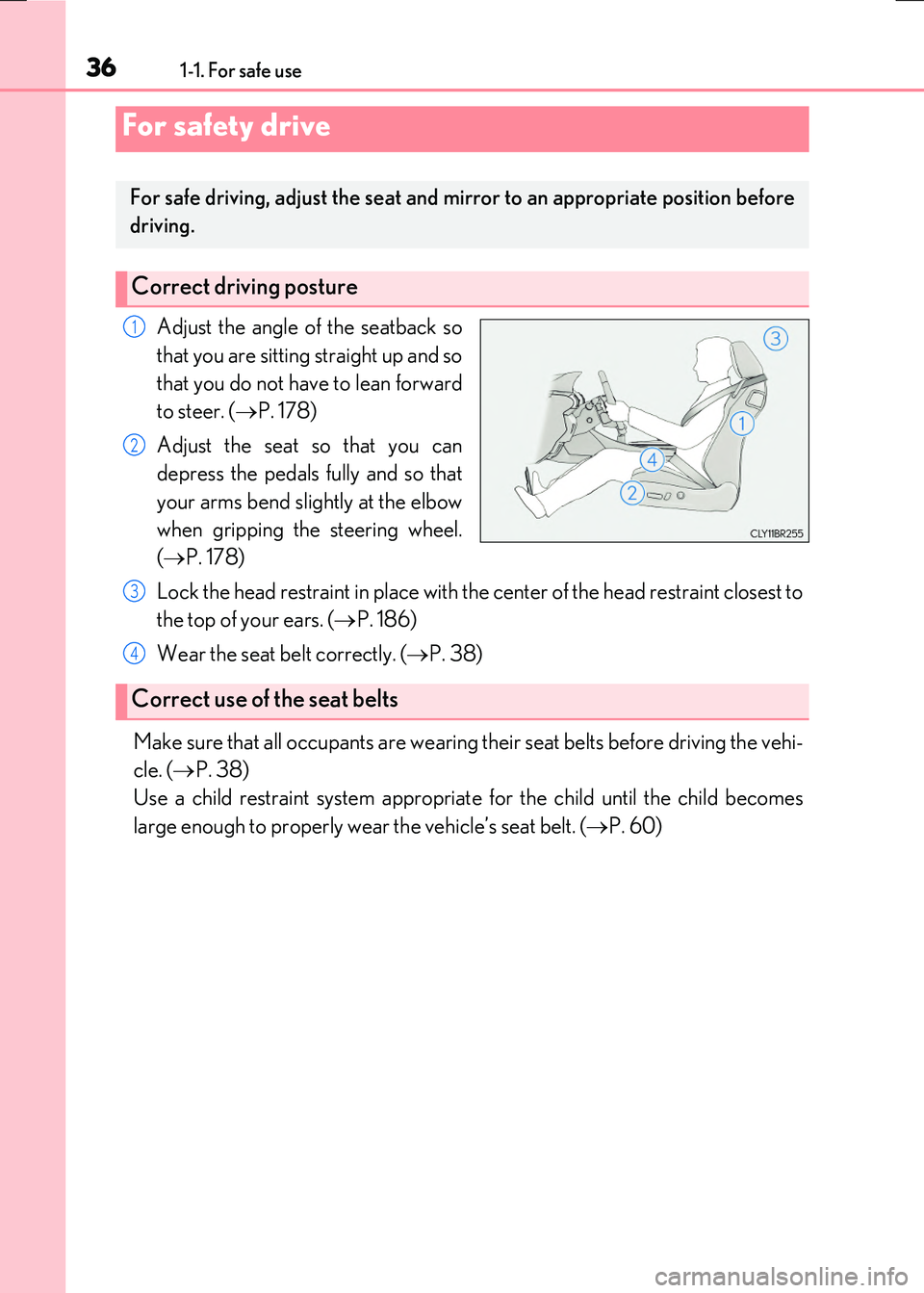
Adjust the angle of the seatback so
that you are sitting straight up and so
that you do not have to lean forward
to steer. ( P. 178)
Adjust the seat so that you can
depress the pedals fully and so that
your arms bend slightly at the elbow
when gripping the steering wheel.
( P. 178)
Lock the head restraint in place with the center of the head restraint closest to
the top of your ears. ( P. 186)
Wear the seat belt correctly. ( P. 38)
Make sure that all occupants are wearing their seat belts before driving the vehi-
cle. ( P. 38)
Use a child restraint system appropriat e for the child until the child becomes
large enough to properly wear the vehicle’s seat belt. ( P. 60)
For safety drive
For safe driving, adjust the seat and mirror to an appropriate position before
driving.
Correct driving posture
1
2
Correct use of the seat belts
3
4
Page 37 of 640

371-1. For safe use
1
For safety and security
RC300h_EE(OM24740E)
Make sure that you can see backward clearly by adjusting the inside and outside
rear view mirrors properly. ( P. 191, 193)
Adjusting the mirrors
WARNING
Observe the following precautions.
Failure to do so may result in death or serious injury.
●Do not adjust the position of the driver’s seat while driving. Doing so could cause the driver to lose control of the vehicle.
●Do not place a cushion between the driver or passenger and the seatback.A cushion may prevent correct posture from being achieved, and reduce the effec-tiveness of the seat be lt and head restraint.
●Do not place anything under the front seats. Objects placed under the front seats may become jammed in the seat tracks and stopthe seat from locking in place. This may lead to an accident and the adjustment mech-
anism may also be damaged.
●Always observe the legal speed limit when driving on public roads.
●When driving over long distances, take regular breaks before you start to feel tired.
Also, if you feel tired or sleepy while drivin g, do not force yourself to continue driving and take a break immediately.
Page 43 of 640
431-1. For safe use
1
For safety and security
RC300h_EE(OM24740E)
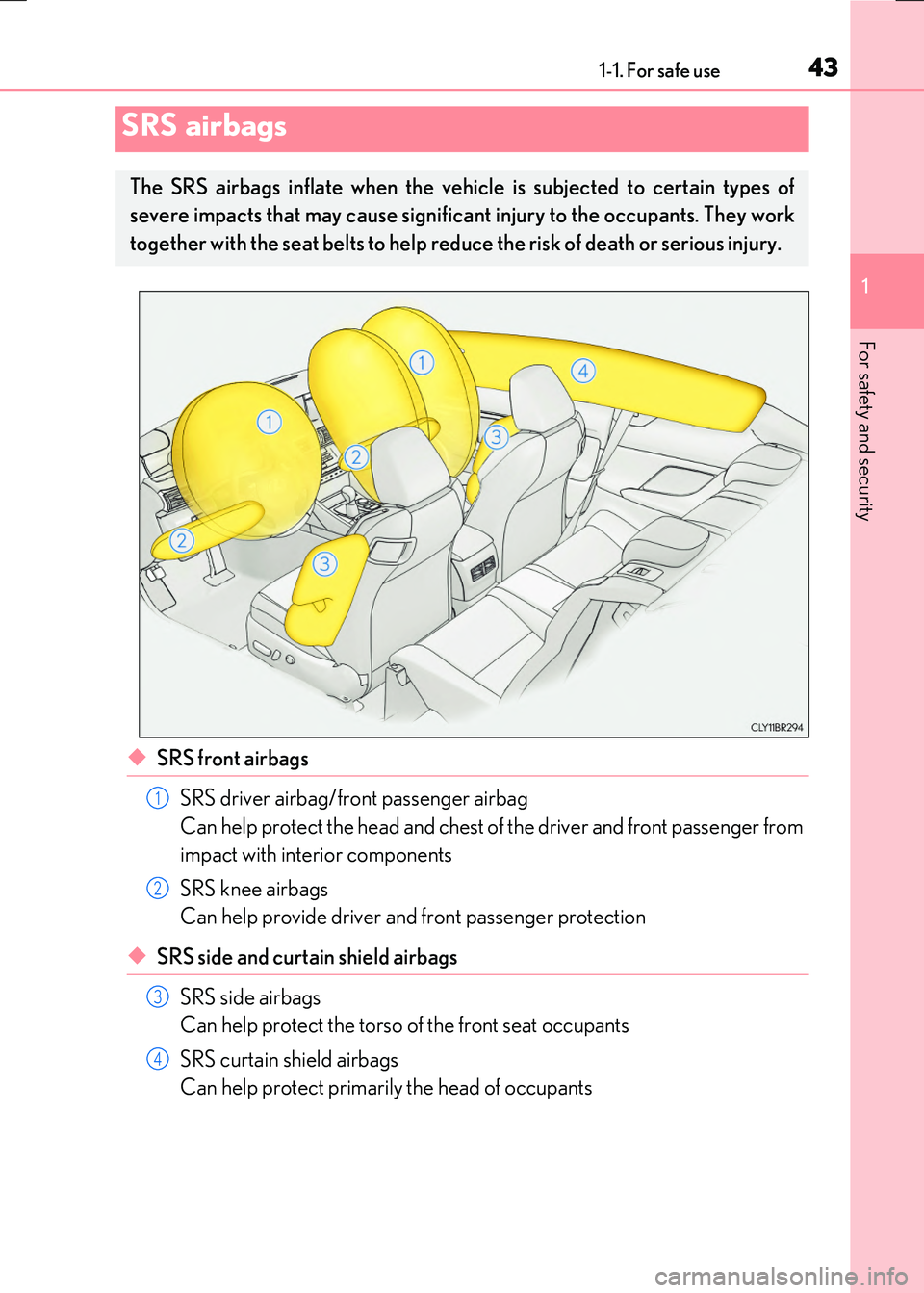
◆SRS front airbags
SRS driver airbag/front passenger airbag
Can help protect the head and chest of the driver and front passenger from
impact with interior components
SRS knee airbags
Can help provide driver and front passenger protection
◆SRS side and curtain shield airbags
SRS side airbags
Can help protect the torso of the front seat occupants
SRS curtain shield airbags
Can help protect primarily the head of occupants
SRS airbags
The SRS airbags inflate when the vehicle is subjected to certain types of
severe impacts that may cause signific ant injury to the occupants. They work
together with the seat belts to help reduce the risk of death or serious injury.
1
2
3
4
Page 45 of 640

451-1. For safe use
1
For safety and security
RC300h_EE(OM24740E)
The main SRS airbag system and Pop Up Hood components are shown above.
The SRS airbag system and Pop Up Hood are controlled by the airbag sensor
assembly. As the airbags deploy, a chemical reaction in the inflators quickly fills
the airbags with non-toxic gas to help restrain the motion of the occupants.
When the Pop Up Hood is activated, a non-toxic gas is released due to a chemi-
cal reaction in the lifters, which causes the pistons to eject quickly and raise the
rear portion of the hood. (Pop Up Hood: P. 56)
WARNING
■SRS airbag precautions
Observe the following precaution s regarding the SRS airbags. Failure to do so may cause death or serious injury.
●The driver and all passengers in the vehicle must wear their seat belts properly.The SRS airbags are supplemental devices to be used with the seat belts.
●The SRS driver airbag deploys with considerable force, and can cause death or seri-
ous injury especially if the driv er is very close to the airbag.
Since the risk zone for the driver’s airbag is the first 50 - 75 mm (2 - 3 in.) of inflation, placing yourself 250 mm (10 in.) from your driver airbag provides you with a clear
margin of safety. This distance is measured from the center of the steering wheel to your breastbone. If you sit less than 250 mm (10 in.) away now, you can change yourdriving position in several ways:
• Move your seat to the rear as far as you can while still reaching the pedals com- fortably.• Slightly recline the back of the seat.
Although vehicle designs vary, many drivers can achieve the 250 mm (10 in.) dis- tance, even with the driver seat all the way forward, simply by reclining the back ofthe seat somewhat. If reclining the back of your seat makes it hard to see the road,
raise yourself by using a firm, non-slippery cushion, or raise the seat if your vehicle has that feature.• If your steering wheel is adjustable, tilt it downward. This points the airbag toward
your chest instead of your head and neck. The seat should be adjusted as recommend ed above, while still maintaining control of the foot pedals, steering wheel, and your view of the instrument panel controls.
Page 47 of 640

471-1. For safe use
1
For safety and security
RC300h_EE(OM24740E)
WARNING
■SRS airbag precautions
●Do not hang coat hangers or hard objects on the coat hooks. All of these items could become projectiles and may cause death or serious injury, should the SRS curtain
shield airbags deploy.
●If a vinyl cover is put on the area where the SRS knee airbag will deploy, be sure to remove it.
●Do not use seat accessories which cover the parts where the SRS side airbags inflateas they may interfere with inflation of th e airbags. Such accessories may prevent the side airbags from activating correctly, disable the system or cause the side airbags to
inflate accidentally, resulting in death or serious injury.
●Do not allow anyone to kneel on the passen-
ger seats toward the door or put their head or hands outside the vehicle.
●Do not attach anything to or lean anythingagainst areas such as the dashboard, steeringwheel pad and lower portion of the instru-
ment panel. These items can become projectiles when theSRS driver, front passenger and knee airbags
deploy.
●Do not attach anything to areas such as a door, windshield, side window, front or rear pillar,roof side rail and assist grip. (Except for the
speed limit sticker P. 568)
Page 65 of 640
651-1. For safe use
1
For safety and security
RC300h_EE(OM24740E)
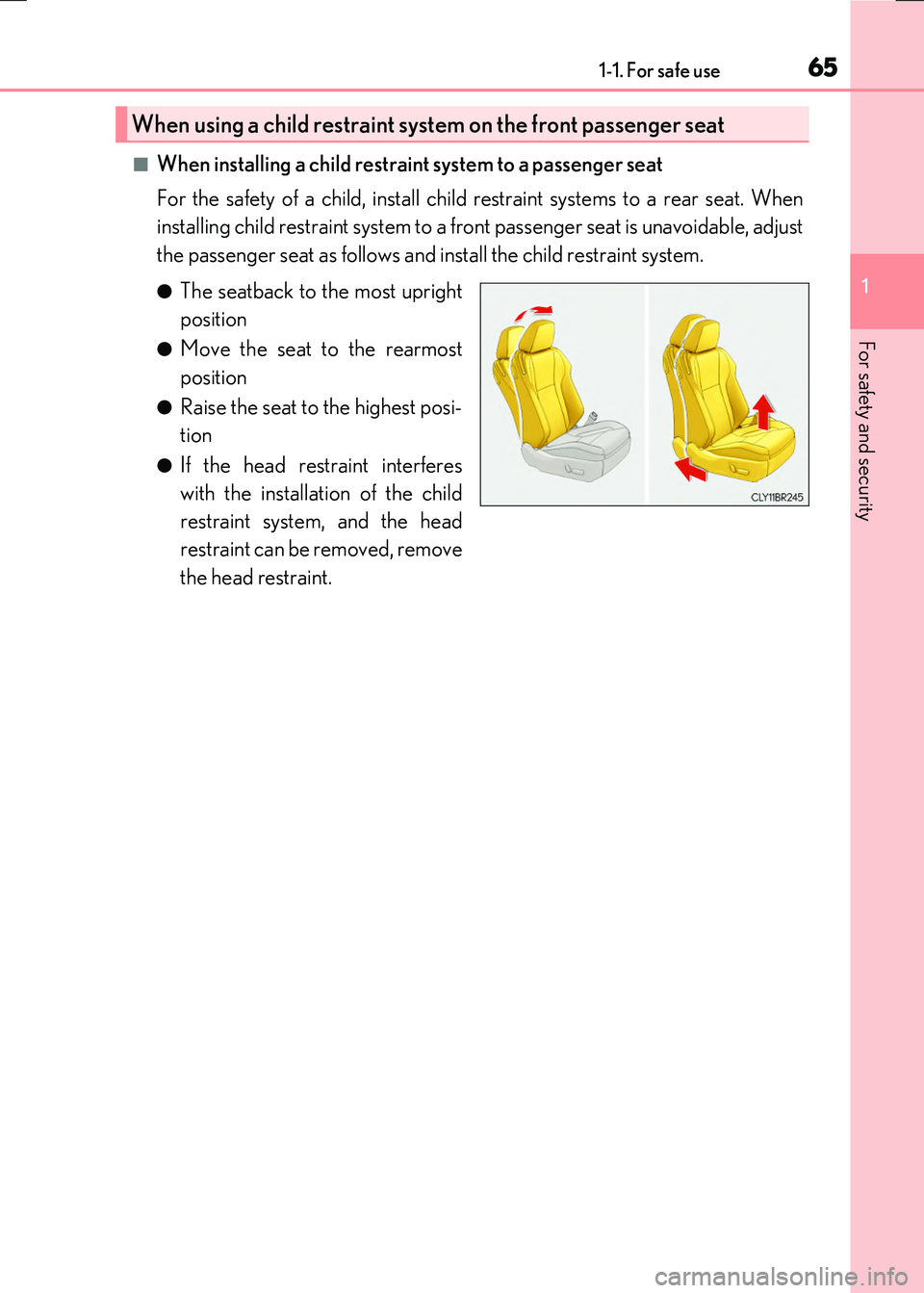
■When installing a child restraint system to a passenger seat
For the safety of a child, install child restraint systems to a rear seat. When
installing child restraint system to a front passenger seat is unavoidable, adjust
the passenger seat as follows and install the child restraint system.
●The seatback to the most upright
position
●Move the seat to the rearmost
position
●Raise the seat to the highest posi-
tion
●If the head restraint interferes
with the installation of the child
restraint system, and the head
restraint can be removed, remove
the head restraint.
When using a child restraint system on the front passenger seat
Page 67 of 640
671-1. For safe use
1
For safety and security
RC300h_EE(OM24740E)
WARNING
■When installing a child restraint system
●Do not allow the child to lean his/her head or any part of his/her body against the
door or the area of the seat, front pillars or roof side rails from which the SRS side airbags or SRS curtain shield airbags deploy even if the child is seated in the childrestraint system. It is dangerous if the SRS side and curtain shield airbags inflate, and
the impact could cause death or serious injury to the child.
●When a junior seat is installed, always en sure that the shoulder belt is positioned across the center of the child’s shoulder. Th e belt should be kept away from the child’s
neck, but not so that it could fall off the child’s shoulder.
When using a child restraint system on a rear seat
WARNING
■When installing a child restraint system
Observe the following precautions.
Failure to do so may result in death or serious injury.
●Use child restraint system suitable to the age and size of the child and install it to the rear seat.
●Do not allow the child to lean his/her head or any part of his/her body against the
door or the area of the seat , rear pillars or roof side rails from which the SRS curtain shield airbag deploys even if the child is se ated in the child restraint system. It is dan- gerous if the SRS curtain shield airbag inflates, and the impact could cause death or
serious injury to the child.
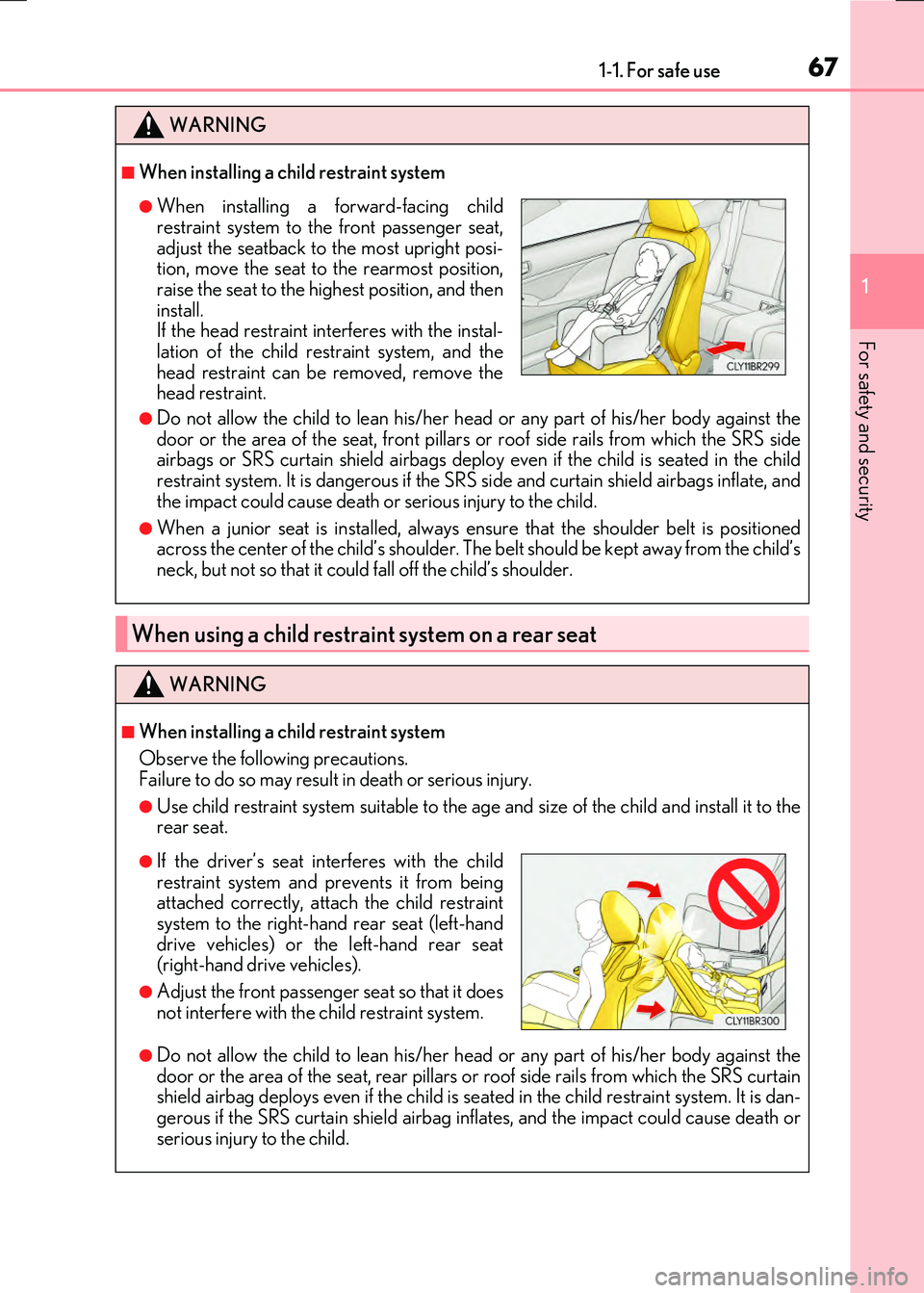
●When installing a forward-facing child
restraint system to the front passenger seat, adjust the seatback to the most upright posi-tion, move the seat to the rearmost position,
raise the seat to the highest position, and then install.If the head restraint interferes with the instal-
lation of the child restraint system, and the head restraint can be removed, remove thehead restraint.
●If the driver’s seat interferes with the child
restraint system and prevents it from being attached correctly, attach the child restraintsystem to the right-hand rear seat (left-hand
drive vehicles) or the left-hand rear seat (right-hand drive vehicles).
●Adjust the front passenger seat so that it does
not interfere with the child restraint system.
Page 71 of 640

711-1. For safe use
1
For safety and security
RC300h_EE(OM24740E)
*1: Adjust the front seatback to the most upright position. Move the front seat to the
rearmost position.
If the head restraint interferes with your child restraint system, and the head restraint
can be removed, remove the head restraint. If the passenger seat is equipped with a
vertical height adjuster, it must be placed in the upper most position.
Follow these procedures:
• For installing a baby se at with support base
If the baby seat interferes with the seatback when latching the baby seat into the
support base, adjust the seatback rear ward until there is no interference.
• For installing a forward-facing child seat
If there is gap between the child seat and the seatback, tilt the seatback until good
contact is achieved. If the seat belt should er anchor is ahead of the child seat belt
guide, move the seat cushion forward.
• For installing a junior seat
If the child in your child restraint system is in a very upright position, adjust the
seatback to the most comfortable position.
If the seat belt shoulder anchor is ahead of the child seat belt guide,
move the seat cushion forward.
*2: If the head restraint interferes with your child restraint system, and the head restraint
can be removed, remove the head restraint.
●Adjust the front seat so that it does not interfere with the child or child restraint
system.
●The child restraint systems mentioned in the table may not be available out-
side of the EU area.
●Other child restraint systems which are different from the systems mentioned
in the table can be used, but the suitability of the systems must be carefully
checked with the child restraint system manufacturer concerned and the
seller of those seats.