2017 LEXUS RC200T inflation pressure
[x] Cancel search: inflation pressurePage 6 of 724

TABLE OF CONTENTS6
RC200t_RC F_EE(OM24728E)
7-1. Maintenance and care
Cleaning and protecting
the vehicle exterior................ 506
Cleaning and protecting
the vehicle interior .....................511
7-2. Maintenance
Maintenance
requirements.............................. 514
7-3. Do-it-yourself maintenance
Do-it-yourself service
precautions ................................. 516
Hood ................................................ 518
Positioning a floor jack.............. 519
Engine compartment................522
Tires ................................................ 535
Tire inflation pressure...............557
Wheels........................................... 559
Air conditioning filter................. 561
Electronic key battery ..............563
Checking and replacing
fuses ..............................................566
Light bulbs .....................................570
8-1. Essential information
Emergency flashers ................. 580
If your vehicle has to
be stopped in an
emergency.................................. 581
8-2. Steps to take in an
emergency
If your vehicle needs to
be towed .................................... 582
If you think something is
wrong .......................................... 589
Fuel pump shut off
system ......................................... 590
If a warning light turns
on or a warning buzzer
sounds........................................... 591
If a warning message is
displayed..................................... 597
If you have a flat tire
(vehicles with a spare
tire) ................................................. 619
If you have a flat tire
(vehicles with an
emergency tire puncture
repair kit) ....................................633
If the engine will not start ........648
If the electronic key does
not operate properly ............ 650
If the vehicle battery is
discharged .................................654
7Maintenance and care8When trouble arises
Page 13 of 724

13Pictorial index
RC200t_RC F_EE(OM24728E)
Doors . . . . . . . . . . . . . . . . . . . . . . . . . . . . . . . . . . . . . . . . . . . . . . . . . . . . . . . . . . . . . . . . P. 164
Locking/unlocking . . . . . . . . . . . . . . . . . . . . . . . . . . . . . . . . . . . . . . . . . . . . . . . . . . . . . P. 164
Opening/closing the side window . . . . . . . . . . . . . . . . . . . . . . . . . . . . . . . . . . . . . .P. 227 Locking/unlocking by using the mechanical key . . . . . . . . . . . . . . . . . . . . . . . P. 650Warning lights/warning messages. . . . . . . . . . . . . . . . . . . . . . . . . . . . . . . .P. 593, 599
Windshield wipers . . . . . . . . . . . . . . . . . . . . . . . . . . . . . . . . . . . . . . . . . . . . . . . . . . . P. 273
Precautions against winter season . . . . . . . . . . . . . . . . . . . . . . . . . . . . . . . . . . . . . P. 384To prevent freezing (windshield wiper de-icer)*. . . . . . . . . . . . . . . . . . . . . . . P. 485
Precautions against car wash . . . . . . . . . . . . . . . . . . . . . . . . . . . . . . . . . . . . . . . . . . P. 508
Fuel filler door . . . . . . . . . . . . . . . . . . . . . . . . . . . . . . . . . . . . . . . . . . . . . . . . . . . . . . . P. 281
Refueling method. . . . . . . . . . . . . . . . . . . . . . . . . . . . . . . . . . . . . . . . . . . . . . . . . . . . . . . P. 281 Fuel type/fuel tank capacity . . . . . . . . . . . . . . . . . . . . . . . . . . . . . . . . . . . . . . . . . . . . P. 671
Tires. . . . . . . . . . . . . . . . . . . . . . . . . . . . . . . . . . . . . . . . . . . . . . . . . . . . . . . . . . . . . . . . . .P. 535
Tire size/inflation pressure. . . . . . . . . . . . . . . . . . . . . . . . . . . . . . . . . . . . . . . . . . . . . .P. 679 Winter tires/tire chains . . . . . . . . . . . . . . . . . . . . . . . . . . . . . . . . . . . . . . . . . . . . . . . . P. 384Checking/rotation/tire pressure warning system . . . . . . . . . . . . . . . . . . . . . . P. 535
Coping with flat tires. . . . . . . . . . . . . . . . . . . . . . . . . . . . . . . . . . . . . . . . . . . . . . P. 619, 633
Hood . . . . . . . . . . . . . . . . . . . . . . . . . . . . . . . . . . . . . . . . . . . . . . . . . . . . . . . . . . . . . . . . . P. 518
Opening . . . . . . . . . . . . . . . . . . . . . . . . . . . . . . . . . . . . . . . . . . . . . . . . . . . . . . . . . . . . . . . P. 518
Engine oil . . . . . . . . . . . . . . . . . . . . . . . . . . . . . . . . . . . . . . . . . . . . . . . . . . . . . . . . . . . . . . . P. 671 Coping with overheating . . . . . . . . . . . . . . . . . . . . . . . . . . . . . . . . . . . . . . . . . . . . . . P. 659Warning messages . . . . . . . . . . . . . . . . . . . . . . . . . . . . . . . . . . . . . . . . . . . . . . . . . . . . P. 599
Headlights/front position lights/daytime running lights/
turn signal lights . . . . . . . . . . . . . . . . . . . . . . . . . . . . . . . . . . . . . . . . . . . . . . . P. 260, 264
Front fog lights* . . . . . . . . . . . . . . . . . . . . . . . . . . . . . . . . . . . . . . . . . . . . . . . . . . . . . P. 271
1
2
3
4
5
Light bulbs of the exterior lights for driving (Replacing method: P. 570, Watts: P. 682)
*: If equipped
6
7
Page 138 of 724
1382. Instrument cluster
RC200t_RC F_EE(OM24728E)
■Suspension of the settings display
In the following situations, operation of th e settings display will be temporarily sus- pended.
●When a warning message appears on the multi-information display
●When the vehicle begins to move
■Tire pressure (if equipped)
●It may take a few minutes to display the tire inflation pressure after the engine switch is
turned to IGNITION ON mode. It may also take a few minutes to display the tire infla- tion pressure after inflation pressure has been adjusted.
●“---” may be displayed if the tire position information cannot be determined due to
unfavorable radio wave conditions.
●Tire inflation pressure changes with temperature. The displayed values may also be dif- ferent from the values measured using a tire pressure gauge.
■When disconnecting and reconnecting battery terminals
The drive information data will be reset.
■Liquid crystal display
P. 130
WARNING
■Caution for use while driving
●When operating the multi-information display while driving, pay extra attention to the safety of the area around the vehicle.
●Do not look continuously at the multi-info rmation display while driving as you may fail to see pedestrians, objects on the road, etc. ahead of the vehicle.
■The information display at low temperatures
Allow the interior of the vehicle to warm up before using the liquid crystal information display. At extremely low temperatures, th e information display monitor may respond slowly, and display changes may be delayed.
For example, there is a lag between the dr iver’s shifting and the new gear number appearing on the display. This lag could cau se the driver to downshift again, causing rapid and excessive engine braking and po ssibly an accident resulting in death or
injury.
■Cautions during setting up the display
As the engine needs to be running during setting up the display, ensure that the vehicle
is parked in a place with adequate ventilation. In a closed area such as a garage, exhaust gases including harmful carbon monoxide (CO) may collect and enter thevehicle. This may lead to death or a serious health hazard.
NOTICE
■While setting up the display
To prevent battery discharge, ensure that the engine is running while setting up the dis- play features.
Page 147 of 724
1472. Instrument cluster
2
Instrument cluster
RC200t_RC F_EE(OM24728E)
●Switching the display
To switch to advanced display, press .
To return to normal display, press .
●Resetting the record of maximum G-forces
With the record of maximum G-forces displayed, press and hold to
reset the display.
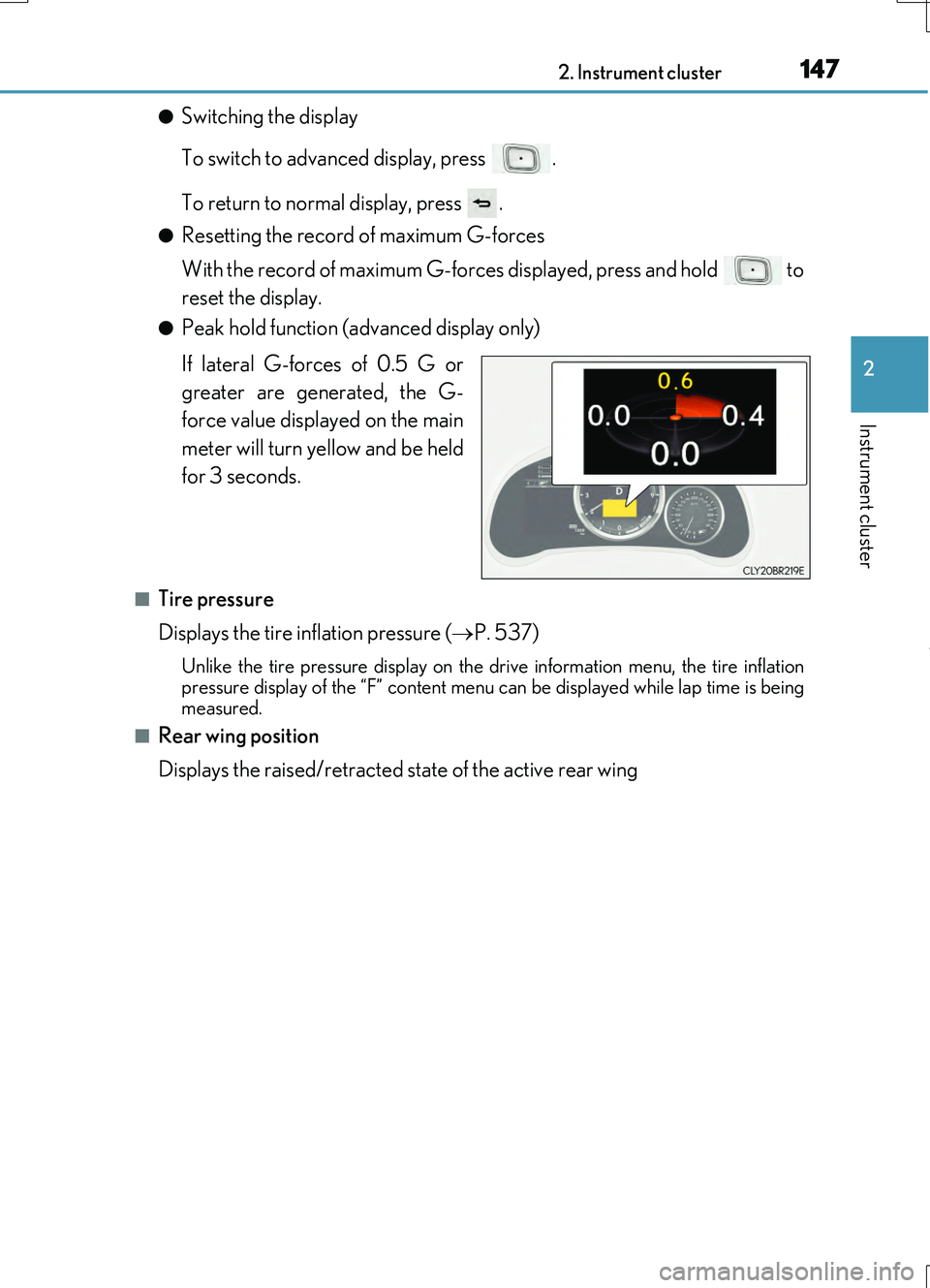
●Peak hold function (advanced display only)
If lateral G-forces of 0.5 G or
greater are generated, the G-
force value displayed on the main
meter will turn yellow and be held
for 3 seconds.
■Tire pressure
Displays the tire inflation pressure ( P. 537)
Unlike the tire pressure display on the dr ive information menu, the tire inflation
pressure display of the “F” content menu can be displayed while lap time is being
measured.
■Rear wing position
Displays the raised/retracted state of the active rear wing
Page 150 of 724

1502. Instrument cluster
RC200t_RC F_EE(OM24728E)
■Suspension of the settings display
In the following situations, operation of th e settings display will be temporarily sus- pended.
●When a warning message appears on the multi-information display
●When the vehicle begins to move
■Tire pressure
●It may take a few minutes to display the tire inflation pressure after the engine switch is turned to IGNITION ON mode. It may also take a few minutes to display the tire infla-tion pressure after inflation pressure has been adjusted.
●“---” may be displayed if the tire position information cannot be determined due to unfavorable radio wave conditions.
●Tire inflation pressure changes with temperature. The displayed values may also be dif-
ferent from the values measured using a tire pressure gauge.
■When disconnecting and reconnecting battery terminals
The following information data will be reset:
●Drive information
●Lap timer: Measured lap times, history
●G-force: Record of the maximum G-forces
■Using the lap timer
If the engine is stopped while a lap is being timed, the lap timer will stop and the lap time up to that point will be recorded.
■Liquid crystal display
P. 130
WARNING
■Caution for use while driving
●When operating the multi-information display while driving, pay extra attention to the
safety of the area around the vehicle.
●Do not look continuously at the multi-info rmation display while driving as you may fail to see pedestrians, objects on the road, etc. ahead of the vehicle.
■The information display at low temperatures
Allow the interior of the vehicle to warm up before using the liquid crystal information display. At extremely low temperatures, th e information display monitor may respond
slowly, and display changes may be delayed. For example, there is a lag between the dr iver’s shifting and the new gear number appearing on the display. This lag could cau se the driver to downshift again, causing
rapid and excessive engine braking and po ssibly an accident resulting in death or injury.
■Cautions during setting up the display
As the engine needs to be running during setting up the display, ensure that the vehicle is parked in a place with adequate ventilation. In a closed area such as a garage,exhaust gases including harmful carbon monoxide (CO) may collect and enter the
vehicle. This may lead to death or a serious health hazard.
Page 317 of 724

3174-5. Using the driving support systems
4
Driving
RC200t_RC F_EE(OM24728E)
■Temporary cancelation of the LDA system functions
If any of the following occurs, the LDA system functions will be temporarily canceled. The functions will resume after the necessary operating conditions have returned.
●The turn signal lever is operated.
●The vehicle speed deviates from the operating range of the LDA system functions.
●When the lane lines cannot be recognized while driving.
●When the lane departure warning sounds.
The lane departure warning function will not operate again for a several seconds after it has been activated, even if the vehicle leaves the lane again.
■The lane departure warning
Depending on the audio system sound level or air conditioning fan noise while the audio system or air conditioning system is in use, it may be difficult to hear the warning sound.
■After the vehicle has been parked in the sun
The LDA system may not be available and a warning message ( P. 603) will be dis- played for a while after driving has started. When the temperature in the cabin decreasesand the temperature around the camera sensor ( P. 314) becomes suitable for its oper-
ation, the functions will begin to operate.
■If there are lane markers on only one side of the vehicle
The lane departure warning will not operate fo r the side on which lane markers could not
be recognized.
■Conditions in which the function may not operate correctly
In the following situations, the camera sensor may be unable to recognize lane markers
causing the lane departure warning function to operate incorrectly. However, this does not indicate a malfunction.
●When driving through an area with no lane markers, such as a tollbooth, a crossing or
before a ticket checkpoint
●When driving on a sharp curve
●When lane markers are extremely narrow or extremely wide
●When the vehicle leans to one side an unusual amount due to a heavy load or improper tire inflation pressure
●When the following distance between your vehicle and the vehicle ahead is extremely
short
●When the lane markers are yellow (These ma y be more difficult for the system to rec- ognize compared to white markers.)
●When the lane markers are broken, Botts’ dots (raised pavement markers) or stones
●When the lane markers are on a curb etc.
●When lane markers are obscured or partially obscured by sand, dirt, etc.
●When there are shadows on the road running parallel with lane markers, or if a shadow covers the lane markers
●When driving on a partic ularly bright road surface, such as concrete
●When driving on a road surface that is bright due to reflected light
●When driving in a location where the light level changes rapidly, such as the entrance to
or exit from a tunnel
Page 505 of 724
505
7Maintenance and care
RC200t_RC F_EE(OM24728E)
7-1. Maintenance and care
Cleaning and protecting
the vehicle exterior ................506
Cleaning and protecting
the vehicle interior..................... 511
7-2. Maintenance
Maintenance
requirements ............................. 514
7-3. Do-it-yourself
maintenance
Do-it-yourself service
precautions................................. 516
Hood ................................................ 518
Positioning a floor jack ............. 519
Engine compartment ............... 522
Tires .................................................535
Tire inflation pressure .............. 557
Wheels ...........................................559
Air conditioning filter ................ 561
Electronic key battery.............. 563
Checking and replacing
fuses.............................................. 566
Light bulbs..................................... 570
Page 516 of 724

516
RC200t_RC F_EE(OM24728E)
7-3. Do-it-yourself maintenance
Do-it-yourself service precautions
If you perform maintenance by yourself, be sure to follow the correct proce-
dure as given in these sections.
ItemsParts and tools
Battery condition ( P. 530)
•Warm water•Baking soda•Grease
• Conventional wrench (for terminal clamp bolts)
• Distilled water
Engine/intercooler coolant level
( P. 527)
• “Toyota Super Long Life Coolant” or a similar high quality ethylene glycol-based non-silicate, non-amine, non-nitriteand non-borate coolant with long-life hybrid organic acid
technology “Toyota Super Long Life Coolant” is pre-mixed with 50%coolant and 50% deionized water.
• Funnel (used only for adding coolant)
Engine oil level ( P. 524)
• “Toyota Genuine Motor Oil” or equivalent
•Rag or paper towel
• Funnel (used only for adding engine oil)
Fuses
( P. 566)• Fuse with same amperage rating as original
Light bulbs ( P. 570)
• Bulb with same number and wattage rating as original
• Phillips-head screwdriver• Flathead screwdriver
•Wrench
Radiator, condenser and intercooler radi-ator
( P. 529)
Tire inflation pressure ( P. 557)• Tire pressure gauge• Compressed air source
Washer fluid
( P. 534)
• Water or washer fluid containing antifreeze (for winter use)
• Funnel (used only for adding water or washer fluid)