2017 HYUNDAI IX20 child seat
[x] Cancel search: child seatPage 77 of 456
Safety features of your vehicle
60
3
Additional safety precautions Never let passengers ride in the
cargo area or on top of a folded-
down back seat. All occupants should
sit upright, fully back in their seats with
their seat belts on and their feet on the
floor.
Passengers should not move out of
or change seats while the vehicle is
moving. A passenger who is not wear-
ing a seat belt during a crash or emer-
gency stop can be thrown against the
inside of the vehicle, against other
occupants, or out of the vehicle.
Each seat belt is designed torestrain one occupant. If more than
one person uses the same seat belt,
they could be seriously injured or killedin a collision.
Do not use any accessories on seatbelts. Devices claiming to improve
occupant comfort or reposition the seat
belt can reduce the protection provided
by the seat belt and increase the
chance of serious injury in a crash.
Passengers should not place hardor sharp objects between them-
selves and the air bags. Carrying
hard or sharp objects on your lap or in
your mouth can result in injuries if an
air bag inflates.
Keep occupants away from the air
bag covers. All occupants should sit
upright, fully back in their seats with
their seat belts on and their feet on the
floor. If occupants are too close to the
air bag covers, they could be injured if
the air bags inflate.
Do not attach or place objects on or
near the air bag covers. Any object
attached to or placed on the front or
side impact air bag covers could inter-
fere with the proper operation of the air
bags.
Do not modify the front seats.Modification of the front seats could
interfere with the operation of the sup-
plemental restraint system sensing
components or side impact air bags.
Do not place items under the frontseats. Placing items under the front
seats could interfere with the operation
of the supplemental restraint system
sensing components and wiring har-
nesses.
Never hold an infant or child on yourlap. The infant or child could be seri-
ously injured or killed in the event of a
crash. All infants and children should
be properly restrained in appropriate
child safety seats or seat belts in therear seat. Adding equipment to or modifying
your air bag-equipped vehicle
If you modify your vehicle by changing
your vehicle's frame, bumper system,
front end or side sheet metal or ride
height, this may affect the operation of
your vehicle's air bag system.
WARNING
Sitting improperly or out of posi- tion can cause occupants to be
shifted too close to a deploying
air bag, strike the interior struc-
ture or be thrown from the vehicle
resulting in serious injury ordeath.
Always sit upright with the seat- back in an upright position, cen-tered on the seat cushion with
your seat belt on, legs comfort-
ably extended and your feet on
the floor.
procarmanuals.com
Page 108 of 456
Features of your vehicle
30
4
✽✽
NOTICE
The sunroof cannot tilt when it is in the
slide position but can slide while in a tilt
position.
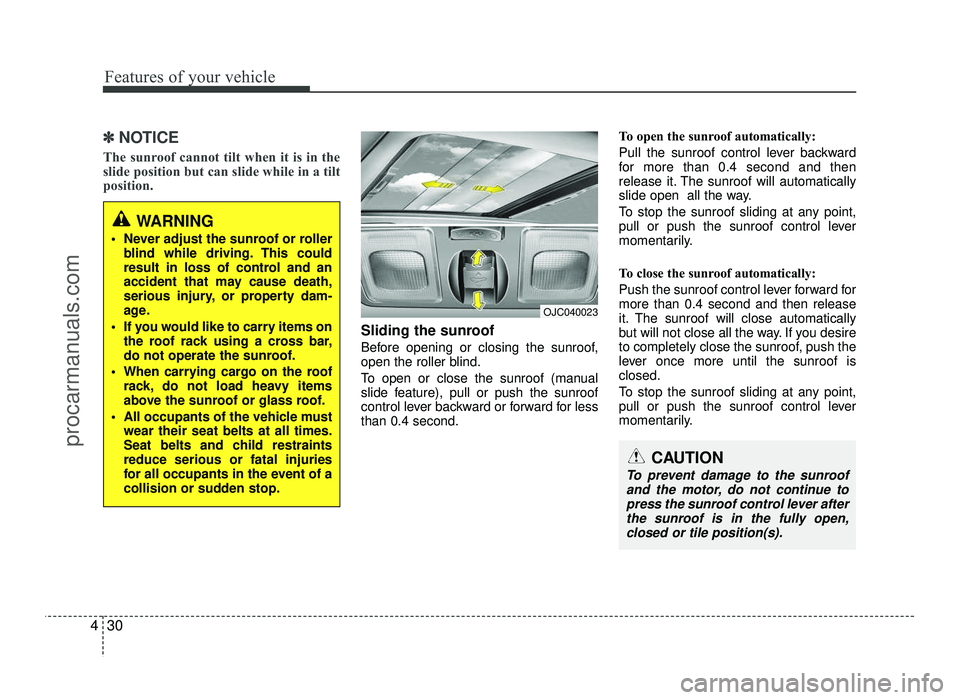
Sliding the sunroof
Before opening or closing the sunroof,
open the roller blind.
To open or close the sunroof (manual
slide feature), pull or push the sunroof
control lever backward or forward for lessthan 0.4 second. To open the sunroof automatically:
Pull the sunroof control lever backward
for more than 0.4 second and then
release it. The sunroof will automatically
slide open all the way.
To stop the sunroof sliding at any point,
pull or push the sunroof control lever
momentarily.
To close the sunroof automatically:
Push the sunroof control lever forward for more than 0.4 second and then release
it. The sunroof will close automatically
but will not close all the way. If you desire
to completely close the sunroof, push the
lever once more until the sunroof isclosed.
To stop the sunroof sliding at any point,
pull or push the sunroof control lever
momentarily.
OJC040023
WARNING
Never adjust the sunroof or roller blind while driving. This could
result in loss of control and an
accident that may cause death,
serious injury, or property dam-
age.
If you would like to carry items on the roof rack using a cross bar,
do not operate the sunroof.
When carrying cargo on the roof rack, do not load heavy items
above the sunroof or glass roof.
All occupants of the vehicle must wear their seat belts at all times.
Seat belts and child restraintsreduce serious or fatal injuries
for all occupants in the event of a
collision or sudden stop.
CAUTION
To prevent damage to the sunroof
and the motor, do not continue topress the sunroof control lever after the sunroof is in the fully open,
closed or tile position(s).
procarmanuals.com
Page 234 of 456
Before entering vehicle
• Be sure that all windows, outside mir-ror(s), and outside lights are clean.
Check the condition of the tires.
Check under the vehicle for any sign of leaks.
Be sure there are no obstacles behind you if you intend to back up. Necessary inspections
Fluid levels, such as engine oil, engine
coolant, brake fluid, and washer fluid
should be checked on a regular basis,
with the exact interval depending on the
fluid. Further details are provided in sec-
tion 7, “Maintenance”.
Before starting
Close and lock all doors.
Position the seat so that all controls are
easily reached.
Adjust the inside and outside rearview mirrors.
Be sure that all lights work.
Check all gauges.
Check the operation of warning lights when the ignition switch is turned to the ON position.
Release the parking brake and make sure the brake warning light goes out.
For safe operation, be sure you are famil-
iar with your vehicle and its equipment.
53
Driving your vehicle
BEFORE DRIVING
WARNING
All passengers must be properly
belted whenever the vehicle is mov-
ing. Refer to “Seat belts” in section
3 for more information on their
proper use.
WARNING
Always check the surrounding
areas near your vehicle for people,
especially children, before putting a
car into D (Drive) or R (Reverse).
WARNING
Driving while distracted can result
in a loss of vehicle control, that
may lead to an accident, severe
personal injury, and death. The dri-
ver’s primary responsibility is in
the safe and legal operation of a
vehicle, and use of any handheld
devices, other equipment, or vehi-
cle systems which take the driver’s
eyes, attention and focus away
from the safe operation of a vehicle
or which are not permissible by law
should never be used during oper-
ation of the vehicle.
procarmanuals.com
Page 254 of 456
523
Driving your vehicle
Automatic transaxle operation
The automatic transaxle has 6 forward
speeds and one reverse speed. The indi-
vidual speeds are selected automatically,depending on the position of the shift
lever.
✽✽NOTICE
The first few shifts on a new vehicle, if
the battery has been disconnected, may
be somewhat abrupt. This is a normal
condition, and the shifting sequence will
adjust after shifts are cycled a few times
by the TCM (Transaxle Control Module)
or PCM (Powertrain Control Module).
For smooth operation, depress the brake pedal when shifting from N (Neutral) to a
forward or reverse gear.
WARNING - Automatic
transaxle
Always check the surrounding areas near your vehicle for peo-
ple, especially children, beforeshifting a car into D (Drive) or R
(Reverse).
Before leaving the driver’s seat, always make sure the shift lever
is in the P (Park) position; then
set the parking brake fully and
shut the engine off. Unexpected
and sudden vehicle movementcan occur if these precautions
are not followed in the order iden-tified.
Do not use the engine brake (shifting from a high gear to
lower gear) rapidly on slippery
roads. The vehicle may slip caus-ing an accident.
CAUTION
To avoid damage to your
transaxle, do not accelerate theengine in R (Reverse) or any for-
ward gear position with the brakes on.
When stopped on an upgrade, do not hold the vehicle with enginepower. Use the service brake or
the parking brake.
Do not shift from N (Neutral) or P (Park) into D (Drive), or R
(Reverse) when the engine isabove idle speed.
procarmanuals.com
Page 449 of 456
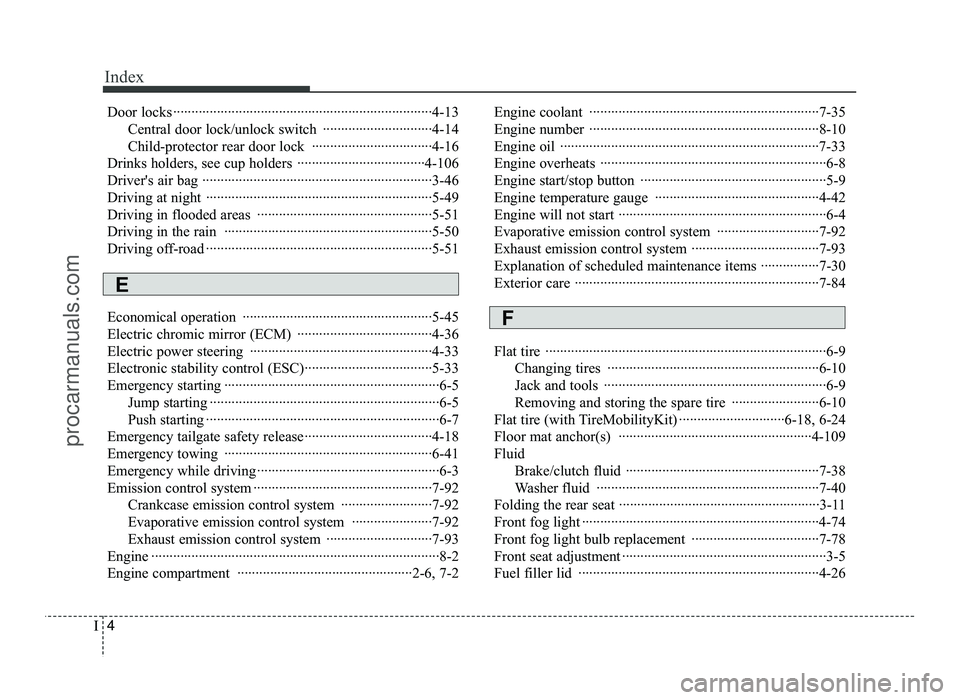
Index
4
I
Door locks ·······································································4-13
Central door lock/unlock switch ······························4-14
Child-protector rear door lock ·································4-16
Drinks holders, see cup holders ···································4-106
Driver's air bag ·······························································3-46
Driving at night ······························································5-49
Driving in flooded areas ················································5-51
Driving in the rain ·························································5-50
Driving off-road ······························································5-51
Economical operation ····················································5-45
Electric chromic mirror (ECM) ·····································4-36
Electric power steering ··················································4-33
Electronic stability control (ESC)···································5-33
Emergency starting ···························································6-5 Jump starting ·······························································6-5
Push starting ································································6-7
Emergency tailgate safety release···································4-18
Emergency towing ·························································6-41
Emergency while driving ··················································6-3
Emission control system ·················································7-92 Crankcase emission control system ·························7-92
Evaporative emission control system ······················7-92
Exhaust emission control system ·····························7-93
Engine ···············································································8-2
Engine compartment ················································2-6, 7-2 Engine coolant ·······························································7-35
Engine number ·······························································8-10
Engine oil ·······································································7-33
Engine overheats ······························································6-8
Engine start/stop button ···················································5-9
Engine temperature gauge ·············································4-42
Engine will not start ·························································6-4
Evaporative emission control system ····························7-92
Exhaust emission control system ···································7-93
Explanation of scheduled maintenance items ················7-30
Exterior care ···································································7-84
Flat tire ·············································································6-9
Changing tires ··························································6-10
Jack and tools ·····························································6-9
Removing and storing the spare tire ························6-10
Flat tire (with TireMobilityKit) ·····························6-18, 6-24
Floor mat anchor(s) ·····················································4-109
Fluid Brake/clutch fluid ·····················································7-38
Washer fluid ·····························································7-40
Folding the rear seat ·······················································3-11
Front fog light ·································································4-74
Front fog light bulb replacement ···································7-78
Front seat adjustment ························································3-5
Fuel filler lid ··································································4-26
E
F
procarmanuals.com