2017 HYUNDAI ELANTRA SE height
[x] Cancel search: heightPage 351 of 586
5-31
Driving your vehicle
5
ABS is an electronic braking system
that helps prevent a braking skid.
ABS allows the driver to steer and
brake at the same time.
Using ABS
To obtain the maximum benefit from
your ABS in an emergency situation,
do not attempt to modulate your
brake pressure and do not try to
pump your brakes. Depress your
brake pedal as hard as possible.
When you apply your brakes under
conditions which may lock the
wheels, you may hear sounds from
the brakes, or feel a corresponding
sensation in the brake pedal. This is
normal and it means your ABS is
active.
ABS does not reduce the time or dis-
tance it takes to stop the vehicle.
Always maintain a safe distance from
the vehicle in front of you.
ABS will not prevent a skid that
results from sudden changes in
direction, such as trying to take a
corner too fast or making a sudden
lane change. Always drive at a safe
speed for the road and weather con-
ditions.ABS cannot prevent a loss of stabili-
ty. Always steer moderately when
braking hard. Severe or sharp steer-
ing wheel movement can still cause
your vehicle to veer into oncoming
traffic or off the road.
On loose or uneven road surfaces,
operation of the anti-lock brake sys-
tem may result in a longer stopping
distance than for vehicles equipped
with a conventional brake system.
The ABS warning light ( ) will stay
on for several seconds after the igni-
tion switch is in the ON position.
During that time, the ABS will go
through self-diagnosis and the light
will go off if everything is normal. If
the light stays on, you may have a
problem with your ABS. Contact an
authorized HYUNDAI dealer as soon
as possible(Continued)
Drive your vehicle at reduced
speeds during the following
conditions:
Rough, gravel or snow-cov-
ered roads.
On roads where the road sur-
face is pitted or has different
surface height.
Tire chains are installed on
your vehicle.
The safety features of an ABS
or ESC equipped vehicle should
not be tested by high speed
driving or cornering. This could
endanger the safety of yourself
or others.
Page 368 of 586
5-48
Driving your vehicle
Limitations of the System
The driver must be cautious in the
below situations, because the sys-
tem may not detect other vehicles or
objects in certain circumstances.
- The vehicle drives on a curved roador through a tollgate.
- The sensor is polluted with rain, snow, mud, etc.
- The rear bumper where the sensor is located is covered with a foreign
object such as a bumper sticker, a
bumper guard, a bike stand, etc.
- The rear bumper is damaged, or the sensor is out of the original
default position.
- The vehicle height gets lower or higher due to heavy loading in a
trunk, abnormal tire pressure, etc.
- The vehicle drives in inclement weather such as heavy rain or
snow.
- There is a fixed object near the vehicle, such as a guardrail.
- A big vehicle is near such as a bus or truck. - A motorcycle or bicycle is near.
- A flat trailer is near.
- If the vehicle has started at the
same time as the vehicle next to
you and has accelerated.
- When the other vehicle passes at a very fast speed.
- While changing lanes.
- While going down or up a steep road where the height of the lane is
different.
- When the other vehicle approaches very close.
- When a trailer or carrier is installed.
- When the temperature of the rear bumper is high.
- When the sensors are blocked by the other vehicles, walls or parking-
lot pillars.
- When the detected vehicle also moves back, as your vehicle drives
back.
- If there are small objects in the detecting area such as a shopping
cart or a baby carriage.
- If there is a low height vehicle such as a sports car. - When other vehicles are close to
your vehicle.
- When the vehicle in the next lane moves two lanes away from you
OR when the vehicle two lanes
away moves to the next lane from
you.
- When driving through a narrow road with many trees or bushes.
Information
This device complies with Part 15 of
the FCC rules.
Operation is subject to the following
two conditions:
1. This device may not cause harmful interference, and
2. This device must accept any inter- ference received, including interfer-
ence that may cause undesired
operation.
i
Page 409 of 586
5-89
Driving your vehicle
5
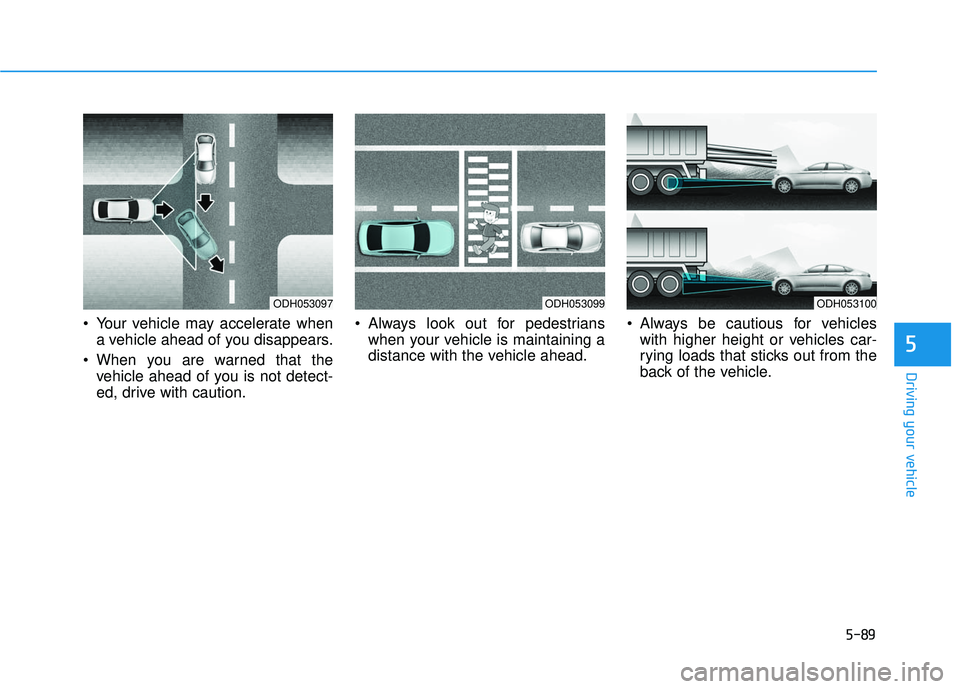
Your vehicle may accelerate whena vehicle ahead of you disappears.
When you are warned that the vehicle ahead of you is not detect-
ed, drive with caution. Always look out for pedestrians
when your vehicle is maintaining a
distance with the vehicle ahead. Always be cautious for vehicles
with higher height or vehicles car-
rying loads that sticks out from the
back of the vehicle.
ODH053097ODH053099ODH053100
Page 510 of 586
7-50
Maintenance
Tire Maintenance
In addition to proper inflation, correct
wheel alignment helps to decrease
tire wear. If you find a tire is worn
unevenly, have your dealer check the
wheel alignment.
When you have new tires installed,
make sure they are balanced. This
will increase vehicle ride comfort and
tire life. Additionally, a tire should
always be rebalanced if it is removed
from the wheel.
Tire Sidewall Labeling
This information identifies and
describes the fundamental charac-
teristics of the tire and also provides
the tire identification number (TIN)
for safety standard certification. The
TIN can be used to identify the tire in
case of a recall.
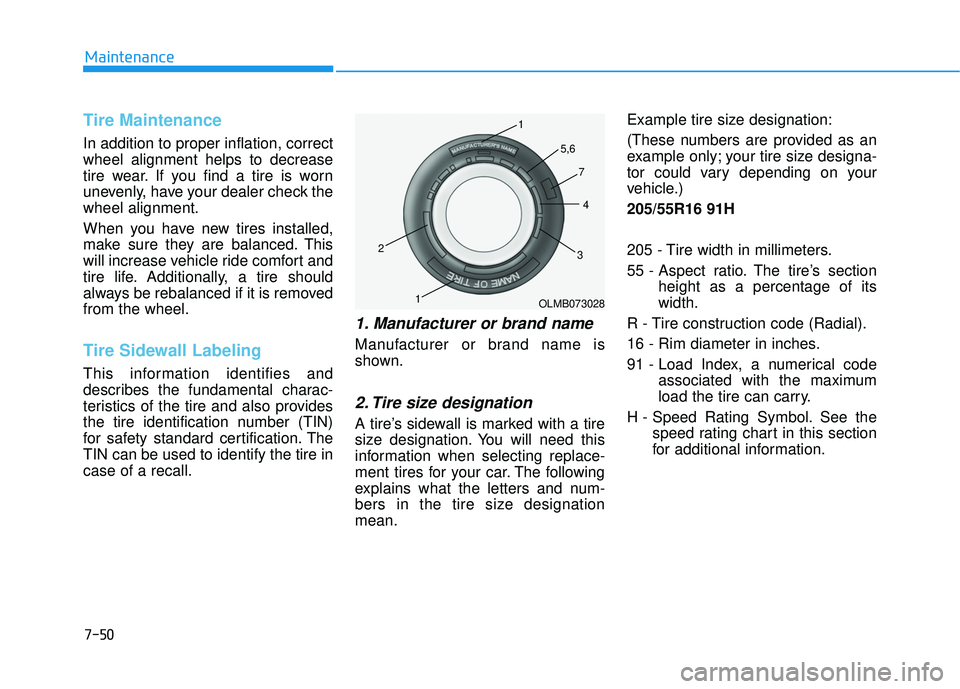
1. Manufacturer or brand name
Manufacturer or brand name is
shown.
2. Tire size designation
A tire’s sidewall is marked with a tire
size designation. You will need this
information when selecting replace-
ment tires for your car. The following
explains what the letters and num-
bers in the tire size designation
mean.Example tire size designation:
(These numbers are provided as an
example only; your tire size designa-
tor could vary depending on your
vehicle.)
205/55R16 91H
205 - Tire width in millimeters.
55 - Aspect ratio. The tire’s section
height as a percentage of its
width.
R - Tire construction code (Radial).
16 - Rim diameter in inches.
91 - Load Index, a numerical code associated with the maximum
load the tire can carry.
H - Speed Rating Symbol. See the speed rating chart in this section
for additional information.
OLMB073028
1
1
2
34
5,6
7
Page 514 of 586
7-54
Maintenance
Tire Terminology and
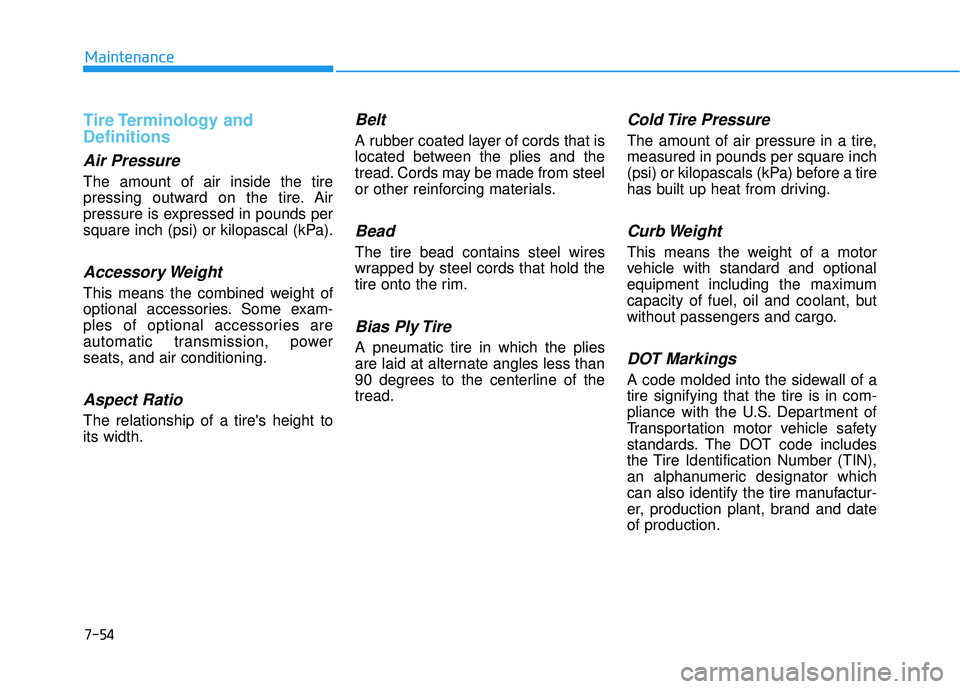
Definitions
Air Pressure
The amount of air inside the tire
pressing outward on the tire. Air
pressure is expressed in pounds per
square inch (psi) or kilopascal (kPa).
Accessory Weight
This means the combined weight of
optional accessories. Some exam-
ples of optional accessories are
automatic transmission, power
seats, and air conditioning.
Aspect Ratio
The relationship of a tire's height to
its width.
Belt
A rubber coated layer of cords that is
located between the plies and the
tread. Cords may be made from steel
or other reinforcing materials.
Bead
The tire bead contains steel wires
wrapped by steel cords that hold the
tire onto the rim.
Bias Ply Tire
A pneumatic tire in which the plies
are laid at alternate angles less than
90 degrees to the centerline of the
tread.
Cold Tire Pressure
The amount of air pressure in a tire,
measured in pounds per square inch
(psi) or kilopascals (kPa) before a tire
has built up heat from driving.
Curb Weight
This means the weight of a motor
vehicle with standard and optional
equipment including the maximum
capacity of fuel, oil and coolant, but
without passengers and cargo.
DOT Markings
A code molded into the sidewall of a
tire signifying that the tire is in com-
pliance with the U.S. Department of
Transportation motor vehicle safety
standards. The DOT code includes
the Tire Identification Number (TIN),
an alphanumeric designator which
can also identify the tire manufactur-
er, production plant, brand and date
of production.
Page 562 of 586
D
DI
IM
M E
EN
N S
SI
IO
O N
NS
S
8-2
Specifications, Consumer information and Reporting safety defects
E
EN
N G
GI
IN
N E
E
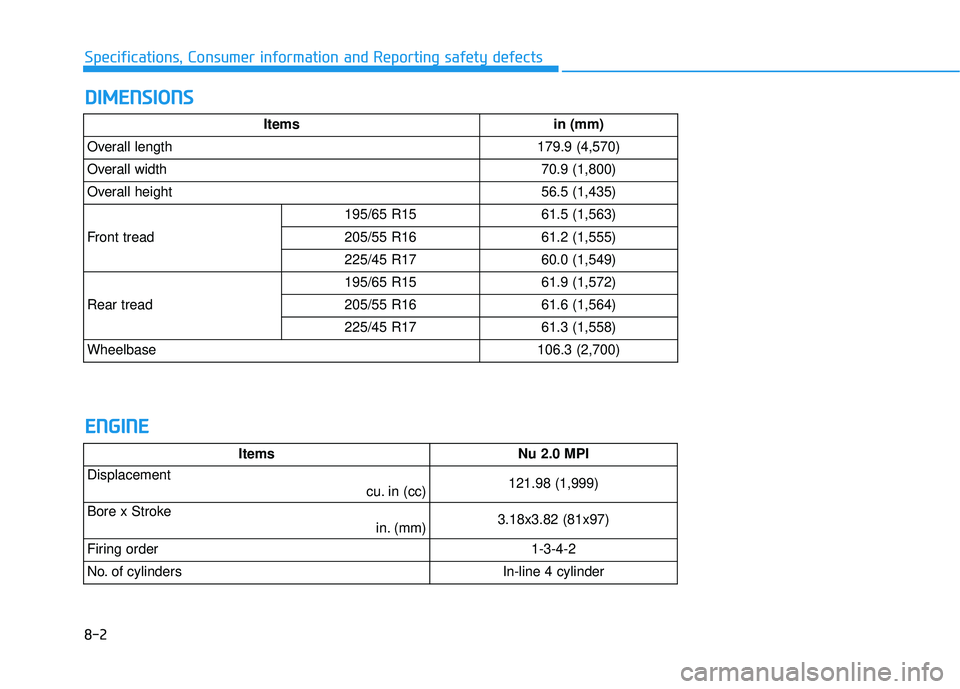
Itemsin (mm)
Overall length179.9 (4,570)
Overall width70.9 (1,800)
Overall height56.5 (1,435)
Front tread
195/65 R1561.5 (1,563)
205/55 R1661.2 (1,555)
225/45 R1760.0 (1,549)
Rear tread
195/65 R1561.9 (1,572)
205/55 R1661.6 (1,564)
225/45 R1761.3 (1,558)
Wheelbase106.3 (2,700)
Items Nu 2.0 MPI
Displacement
cu. in (cc)121.98 (1,999)
Bore x Stroke in. (mm)3.18x3.82 (81x97)
Firing order1-3-4-2
No. of cylindersIn-line 4 cylinder
Page 579 of 586
I-6
Exhaust emission control system....................................7-97
Explanation of scheduled maintenance items.................7-24
Exterior care....................................................................7-89\
Exterior lights ...............................................................3-107
Exterior overviewFront ........................................................................\
.....2-2
Rear ........................................................................\
......2-3
Flat tire Jack and tools .............................................................6-15
Jack label ....................................................................6-22\
Tire Mobility Kit ........................................................6-22
Use of compact spare tires .........................................6-20
Floor mat anchor(s).......................................................3-157
Fluid Brake/clutch fluid .......................................................7-33
Washer fluid ...............................................................7-34
Front lamps ...................................................................3-115
Front seats ........................................................................\
.2-6
Fuel filler door ................................................................3-58
Fuel gauge .......................................................................3\
-65
Fuel requirements .............................................................F-7
Fuse/relay panel description Instrument panel fuse panel .......................................7-66
Engine compartment fuse panel .................................7-69 Fuses ........................................................................\
.......7-60
Blade type fuse ...........................................................7-65
Cartridge type fuse .....................................................7-65
Engine compartment panel fuse replacement ............7-63
Fuse switch .................................................................7-62
Fuse/relay panel description .......................................7-66
Instrument panel fuse replacement.............................7-61
Main fuse ....................................................................7-64\
Multi fuse ...................................................................7-64
Gauges........................................................................\
.....3-63
Glove box......................................................................3-\
151
Hazard warning flasher .....................................................6-2
Hazardous driving conditions .........................................5-92
Head restraints ................................................................2-15
Headlamp delay function ..............................................3-113
Headlamp position ........................................................3-109
Headlight bulb replacement ............................................7-72
Heater Automatic climate control system............................3-133
Manual climate control system ................................3-123
Height adjustment ...........................................................2-25
High beam operation.....................................................3-109
Highway driving .............................................................5-95
Index
F
G
H
Page 583 of 586

I-10
Rear center seatbelt .........................................................2-30
Rear seats ........................................................................\
2-12Folding the rear seat ...................................................2-12
Recommended cold tire inflation pressures ...................7-45
Recommended lubricants and capacities ..........................8-7 Recommended SAE viscosity number .........................8-9
Remote key Battery replacement......................................................3-7
Removable towing hook .................................................6-33
Replacement light bulb ...................................................7-72
Reverse Parking Aid Function ........................................3-42
Rocking the vehicle ........................................................5-92
Room lamp ....................................................................3-115
Rotation (Tire) ................................................................7-47
Safety messages ................................................................F-6
Scheduled maintenance services.......................................7-7
Seat belt warning light ....................................................2-23
Seat belts ........................................................................\
.2-22 3-point system with convertible locking retractor (Rear passenger's side) ............................................2-25
3-point system with emergency locking retractor (Driver's side) ..........................................................2-25
Additional seat belt safety precautions ......................2-31
Care of seat belts ........................................................2-34 Do not lie down ..........................................................2-33
Height adjustment ......................................................2-25
Keep belts clean and dry ............................................2-34
One person per belt ....................................................2-33
Periodic inspection .....................................................2-34
Pre-tensioner seat belt ................................................2-28
Rear center seatbelt ....................................................2-30
Seat belt restraint system............................................2-25
Seat belt safety precautions ........................................2-22
Seat belt use and children...........................................2-3\
1
Seat belt use during pregnancy ..................................2-31
Seat belt warning light ...............................................2-23
Transporting an injured person ..................................2-33
When to replace seat belts..........................................2-34
Seat warmers ...................................................................2-19
Seatback pocket ..............................................................2-12
Seats ........................................................................\
..........2-4 Armrest (Rear seats) ...................................................2-14
Head restraints ............................................................2-15
Manual adjustment (Front seats) ..................................2-7
Power adjustment (Front seats) ....................................2-9
Rear seats....................................................................2-12\
Safety precautions ........................................................2-5
Seat warmers ..............................................................2-19
Seatback pocket ..........................................................2-12
Shift lever auto door lock ...............................................3-17
Shift lock system.............................................................5-24
Shift-lock release ............................................................5-24
Index
R
S