2017 FORD SUPER DUTY fuel
[x] Cancel search: fuelPage 568 of 636
PROTECT YOURSELF FROM THE RISING
COST OF VEHICLE REPAIRS WITH A FORD
PROTECT EXTENDED SERVICE PLAN.
Ford Protect Extended Service
Plans (U.S. Only)
Ford Protect means peace of mind. It’
s the
extended service plan backed by Ford
Motor Company, and provides more
protection beyond the New Vehicle Limited
Warranty coverage. When you visit your
Ford Dealer, Insist on genuine Ford Protect
extended service plans!
Ford Protect Can Quickly Pay for Itself
One trip to the Service Center could easily
exceed the price of your Ford Protect
Extended Service Plan. With Ford Protect
you minimize your risk for unexpected
repair bills and rising repair costs.
Up to 1,000+ Covered Vehicle
Components
There are four mechanical Ford Protect
with different levels of coverage. Ask your
authorized dealer for details.
1. PremiumCARE - Our most comprehensive coverage. With over
1,000 covered components, this plan
is so complete it’ s probably easier to
list what’ s not covered.
2. ExtraCARE - Covers 113 components, and includes many high-tech items.
3. BaseCARE - Covers 84 components.
4. PowertrainCARE - Covers 29 critical components.
Ford Protect Extended Service Plans are
honored by all authorized Ford dealers in
the U.S., Canada and Mexico. That means you get:
•
Reliable, quality service at any Ford or
Lincoln dealership.
• Repairs performed by factory trained
technicians, using genuine parts.
Rental Car Reimbursement
1st day Rental Benefit
If you bring your car into your dealer for
service, we ’ll give you a loaner to use for
the day.
Extended Rental Benefits
If your vehicle is kept overnight for covered
repairs, you are eligible for rental car
coverage, including bumper to bumper
warranty repairs, and Field Service Actions.
Roadside Assistance
Exclusive 24/7 roadside assistance,
including:
• Towing, flat-tire change and battery
jump starts.
• Out of fuel and lock-out assistance.
• Travel expense reimbursement for
lodging, meals and rental car.
• Assistance for taxi, shuttle, rental car
coverage or other transportation.
Transferable Coverage
If you sell your vehicle before your Ford
Protect plan coverage expires, you can
transfer any remaining coverage to the new
owner. Which should give you and your
potential buyer a little more peace of mind.
565
Super Duty (TFE) Canada/United States of America, enUSA, First Printing Ford Protect
Page 571 of 636
Ford Motor Company has recommended
maintenance intervals for various parts
and component systems based upon
engineering testing. Ford Motor Company
relies upon this testing to determine the
most appropriate mileage for replacement
of oils and fluids to protect your vehicle at
the lowest overall cost to you and
recommends against maintenance
schedules that deviate from the scheduled
maintenance information.
We strongly recommend the use of only
genuine Ford, Motorcraft or
Ford-authorized re-manufactured
replacement parts engineered for your
vehicle.
Additives and Chemicals
This owner's manual and the Ford
Workshop Manual list the recommended
additives and chemicals for your vehicle.
We do not recommend using chemicals or
additives not approved by us as part of
your vehicle
’s normal maintenance. Please
consult your warranty information. Oils, Fluids and Flushing
In many cases, fluid discoloration is a
normal operating characteristic and, by
itself, does not necessarily indicate a
concern or that the fluid needs to be
changed. However, a qualified expert, such
as the factory-trained technicians at your
dealership, should inspect discolored fluids
that also show signs of overheating or
foreign material contamination
immediately.
Make sure to change your vehicle
’s oils and
fluids at the specified intervals or in
conjunction with a repair. Flushing is a
viable way to change fluid for many vehicle
sub-systems during scheduled
maintenance. It is critical that systems are
flushed only with new fluid that is the same
as that required to fill and operate the
system or using a Ford-approved flushing
chemical.
Owner Checks and Services
Make sure you perform the following basic
maintenance checks and inspections every
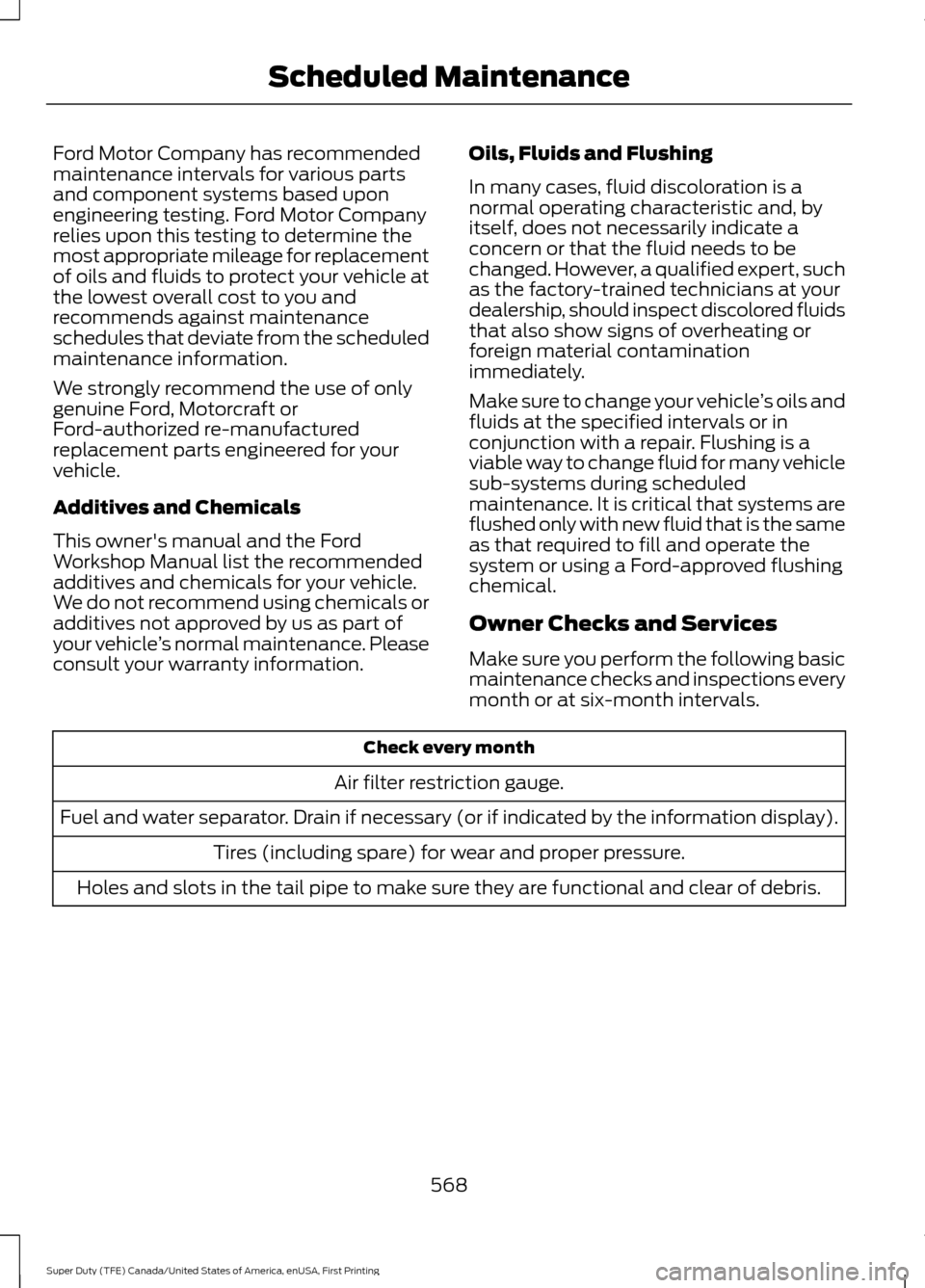
month or at six-month intervals. Check every month
Air filter restriction gauge.
Fuel and water separator. Drain if necessary (or if indicated by the information display). Tires (including spare) for wear and proper pressure.
Holes and slots in the tail pipe to make sure they are functional and clear of debris.
568
Super Duty (TFE) Canada/United States of America, enUSA, First Printing Scheduled Maintenance
Page 575 of 636
Diesel Engine(s)
Intelligent Oil-Life Monitor
Your vehicle has an Intelligent Oil-Life
Monitor that determines when you should
change the engine oil based on how you
use your vehicle. By using several
important factors in its calculations, the
monitor helps reduce the cost of owning
your vehicle and reduces environmental
waste at the same time.
This means you do not have to remember
to change the oil on a mileage-based
schedule. Your vehicle lets you know when
an oil change is due by displaying a
message in the information display.
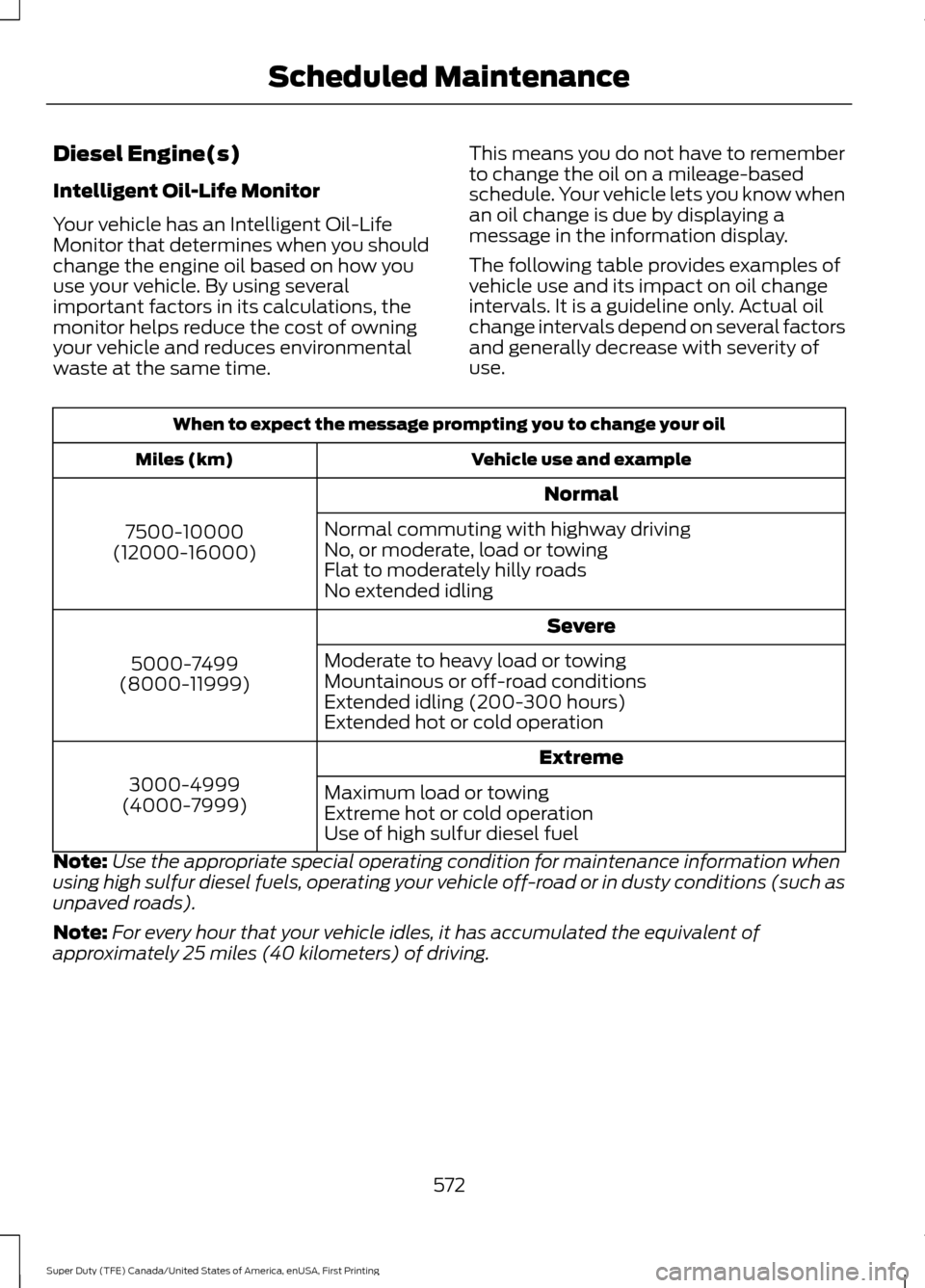
The following table provides examples of
vehicle use and its impact on oil change
intervals. It is a guideline only. Actual oil
change intervals depend on several factors
and generally decrease with severity of
use.When to expect the message prompting you to change your oil
Vehicle use and example
Miles (km)
Normal
7500-10000
(12000-16000) Normal commuting with highway driving
No, or moderate, load or towing
Flat to moderately hilly roads
No extended idling
Severe
5000-7499
(8000-11999) Moderate to heavy load or towing
Mountainous or off-road conditions
Extended idling (200-300 hours)
Extended hot or cold operation
Extreme
3000-4999
(4000-7999) Maximum load or towing
Extreme hot or cold operation
Use of high sulfur diesel fuel
Note: Use the appropriate special operating condition for maintenance information when
using high sulfur diesel fuels, operating your vehicle off-road or in dusty conditions (such as
unpaved roads).
Note: For every hour that your vehicle idles, it has accumulated the equivalent of
approximately 25 miles (40 kilometers) of driving.
572
Super Duty (TFE) Canada/United States of America, enUSA, First Printing Scheduled Maintenance
Page 576 of 636
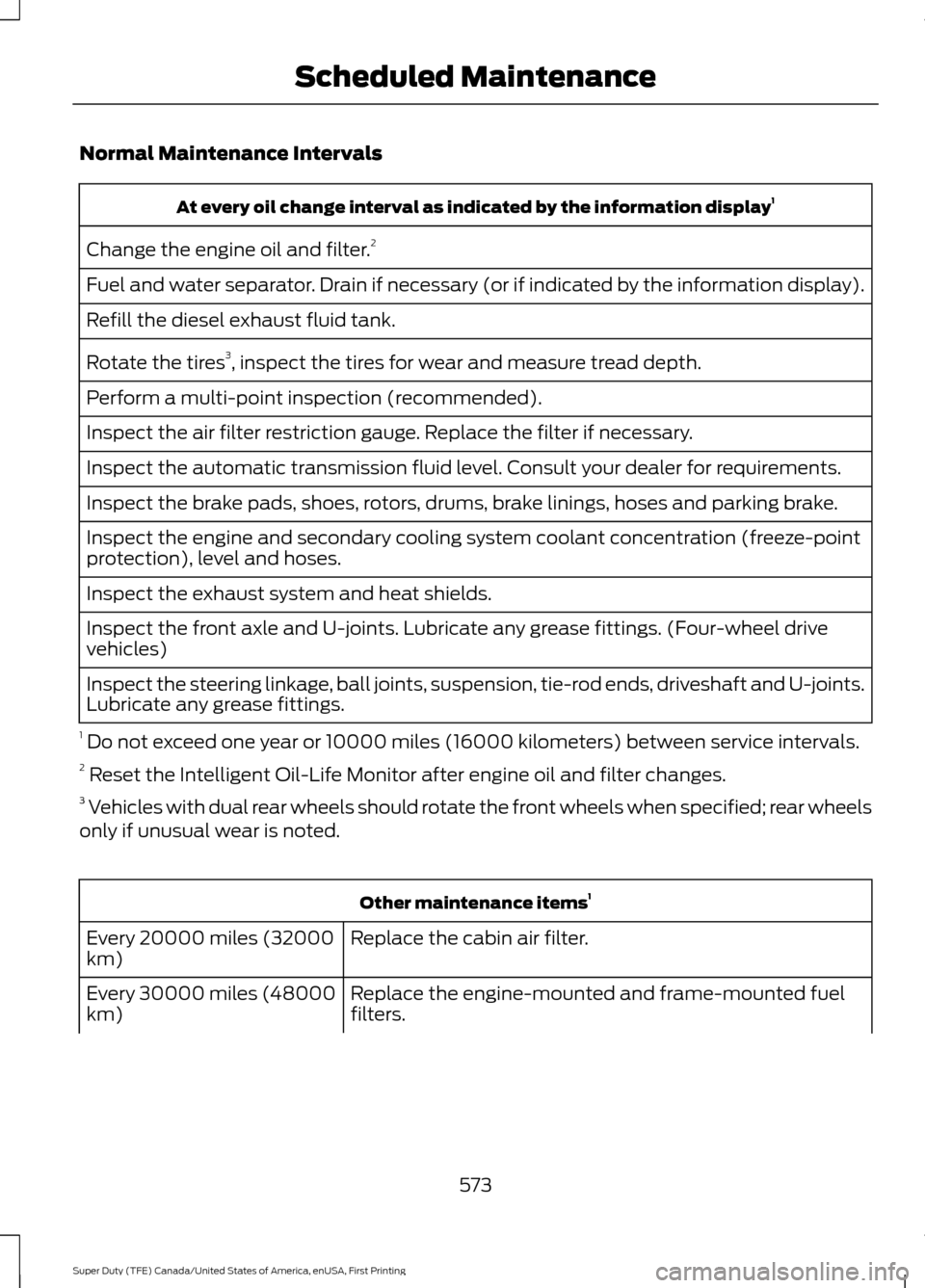
Normal Maintenance Intervals
At every oil change interval as indicated by the information display
1
Change the engine oil and filter. 2
Fuel and water separator. Drain if necessary (or if indicated by the information display).
Refill the diesel exhaust fluid tank.
Rotate the tires 3
, inspect the tires for wear and measure tread depth.
Perform a multi-point inspection (recommended).
Inspect the air filter restriction gauge. Replace the filter if necessary.
Inspect the automatic transmission fluid level. Consult your dealer for requirements.
Inspect the brake pads, shoes, rotors, drums, brake linings, hoses and parking brake.
Inspect the engine and secondary cooling system coolant concentration (freeze-point
protection), level and hoses.
Inspect the exhaust system and heat shields.
Inspect the front axle and U-joints. Lubricate any grease fittings. (Four-wheel drive
vehicles)
Inspect the steering linkage, ball joints, suspension, tie-rod ends, driveshaft and U-joints.
Lubricate any grease fittings.
1 Do not exceed one year or 10000 miles (16000 kilometers) between service intervals.
2 Reset the Intelligent Oil-Life Monitor after engine oil and filter changes.
3 Vehicles with dual rear wheels should rotate the front wheels when specified; rear wheels
only if unusual wear is noted. Other maintenance items
1
Replace the cabin air filter.
Every 20000 miles (32000
km)
Replace the engine-mounted and frame-mounted fuel
filters.
Every 30000 miles (48000
km)
573
Super Duty (TFE) Canada/United States of America, enUSA, First Printing Scheduled Maintenance
Page 580 of 636
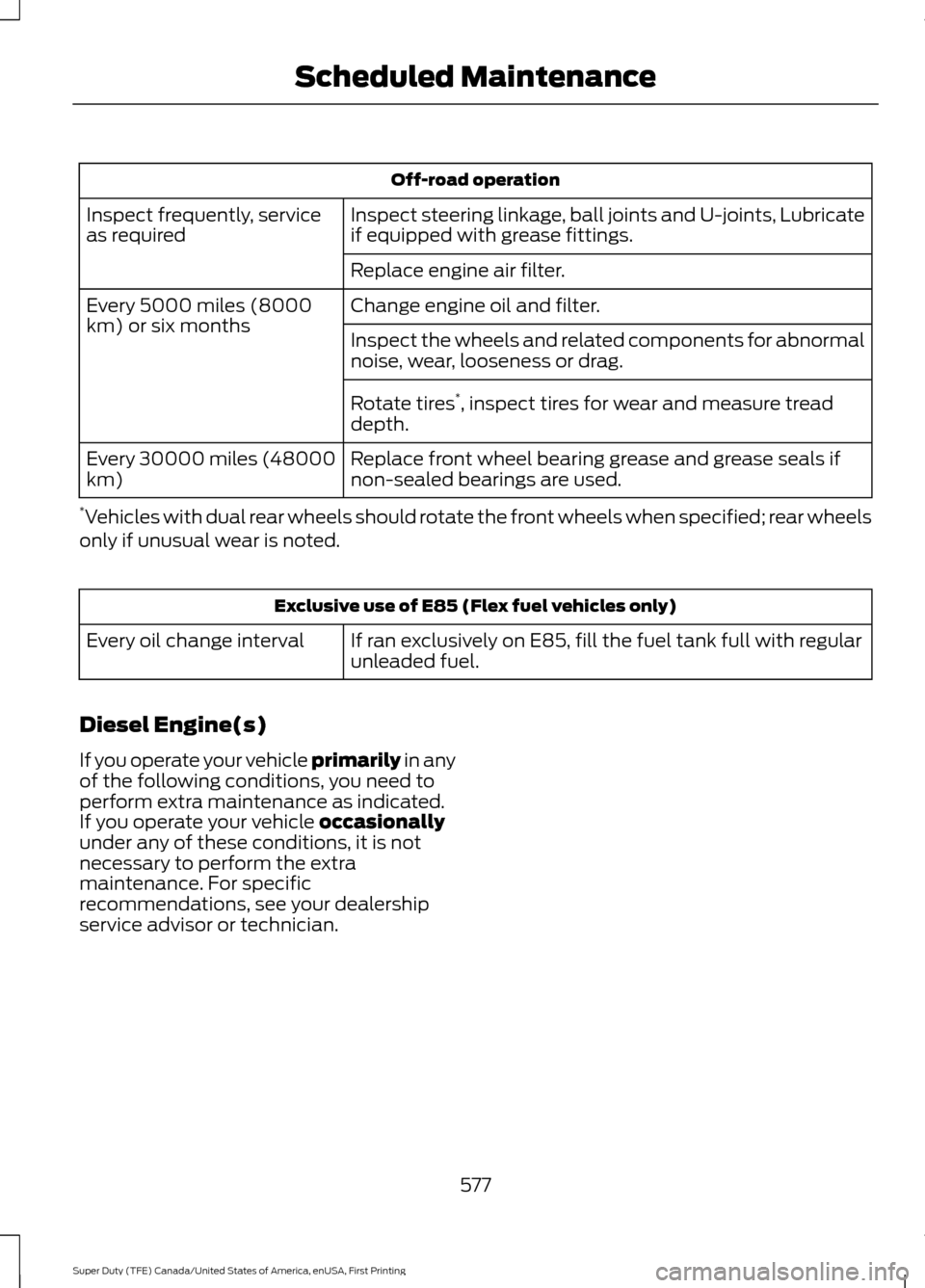
Off-road operation
Inspect steering linkage, ball joints and U-joints, Lubricate
if equipped with grease fittings.
Inspect frequently, service
as required
Replace engine air filter.
Change engine oil and filter.
Every 5000 miles (8000
km) or six months
Inspect the wheels and related components for abnormal
noise, wear, looseness or drag.
Rotate tires*
, inspect tires for wear and measure tread
depth.
Replace front wheel bearing grease and grease seals if
non-sealed bearings are used.
Every 30000 miles (48000
km)
* Vehicles with dual rear wheels should rotate the front wheels when specified; rear wheels
only if unusual wear is noted. Exclusive use of E85 (Flex fuel vehicles only)
If ran exclusively on E85, fill the fuel tank full with regular
unleaded fuel.
Every oil change interval
Diesel Engine(s)
If you operate your vehicle primarily in any
of the f
ollowing conditions, you need to
perform extra maintenance as indicated.
If you operate your vehicle
occasionally
under any of these conditions, it is not
necessary to perform the extra
maintenance. For specific
recommendations, see your dealership
service advisor or technician.
577
Super Duty (TFE) Canada/United States of America, enUSA, First Printing Scheduled Maintenance
Page 581 of 636
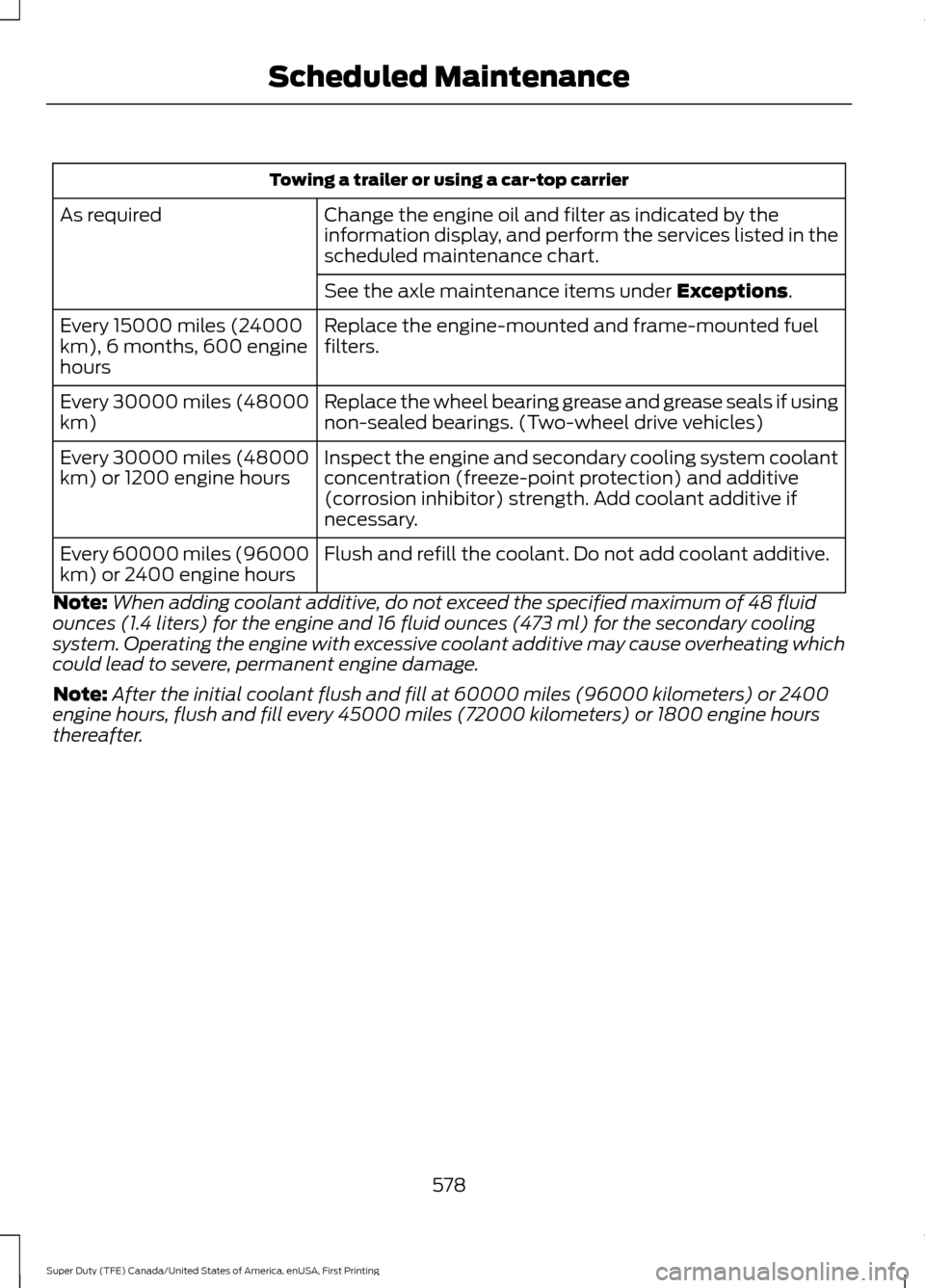
Towing a trailer or using a car-top carrier
Change the engine oil and filter as indicated by the
information display, and perform the services listed in the
scheduled maintenance chart.
As required
See the axle maintenance items under Exceptions.
Replace the engine-mounted and frame-mounted fuel
filters.
Every 15000 miles (24000
km), 6 months, 600 engine
hours
Replace the wheel bearing grease and grease seals if using
non-sealed bearings. (Two-wheel drive vehicles)
Every 30000 miles (48000
km)
Inspect the engine and secondary cooling system coolant
concentration (freeze-point protection) and additive
(corrosion inhibitor) strength. Add coolant additive if
necessary.
Every 30000 miles (48000
km) or 1200 engine hours
Flush and refill the coolant. Do not add coolant additive.
Every 60000 miles (96000
km) or 2400 engine hours
Note: When adding coolant additive, do not exceed the specified maximum of 48 fluid
ounces (1.4 liters) for the engine and 16 fluid ounces (473 ml) for the secondary cooling
system. Operating the engine with excessive coolant additive may cause overheating which
could lead to severe, permanent engine damage.
Note: After the initial coolant flush and fill at 60000 miles (96000 kilometers) or 2400
engine hours, flush and fill every 45000 miles (72000 kilometers) or 1800 engine hours
thereafter.
578
Super Duty (TFE) Canada/United States of America, enUSA, First Printing Scheduled Maintenance
Page 582 of 636
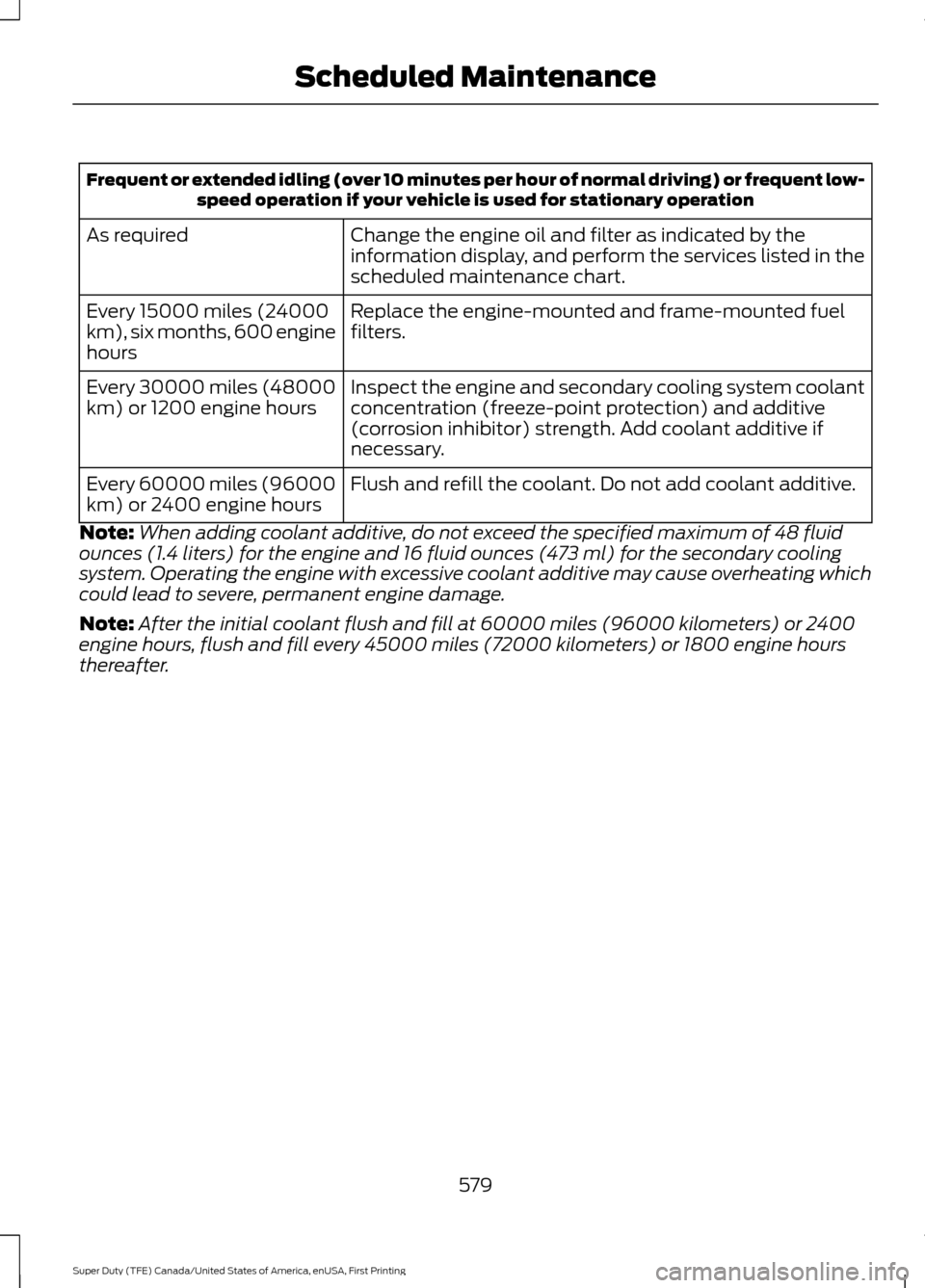
Frequent or extended idling (over 10 minutes per hour of normal driving) or frequent low-
speed operation if your vehicle is used for stationary operation
Change the engine oil and filter as indicated by the
information display, and perform the services listed in the
scheduled maintenance chart.
As required
Replace the engine-mounted and frame-mounted fuel
filters.
Every 15000 miles (24000
km), six months, 600 engine
hours
Inspect the engine and secondary cooling system coolant
concentration (freeze-point protection) and additive
(corrosion inhibitor) strength. Add coolant additive if
necessary.
Every 30000 miles (48000
km) or 1200 engine hours
Flush and refill the coolant. Do not add coolant additive.
Every 60000 miles (96000
km) or 2400 engine hours
Note: When adding coolant additive, do not exceed the specified maximum of 48 fluid
ounces (1.4 liters) for the engine and 16 fluid ounces (473 ml) for the secondary cooling
system. Operating the engine with excessive coolant additive may cause overheating which
could lead to severe, permanent engine damage.
Note: After the initial coolant flush and fill at 60000 miles (96000 kilometers) or 2400
engine hours, flush and fill every 45000 miles (72000 kilometers) or 1800 engine hours
thereafter.
579
Super Duty (TFE) Canada/United States of America, enUSA, First Printing Scheduled Maintenance
Page 583 of 636
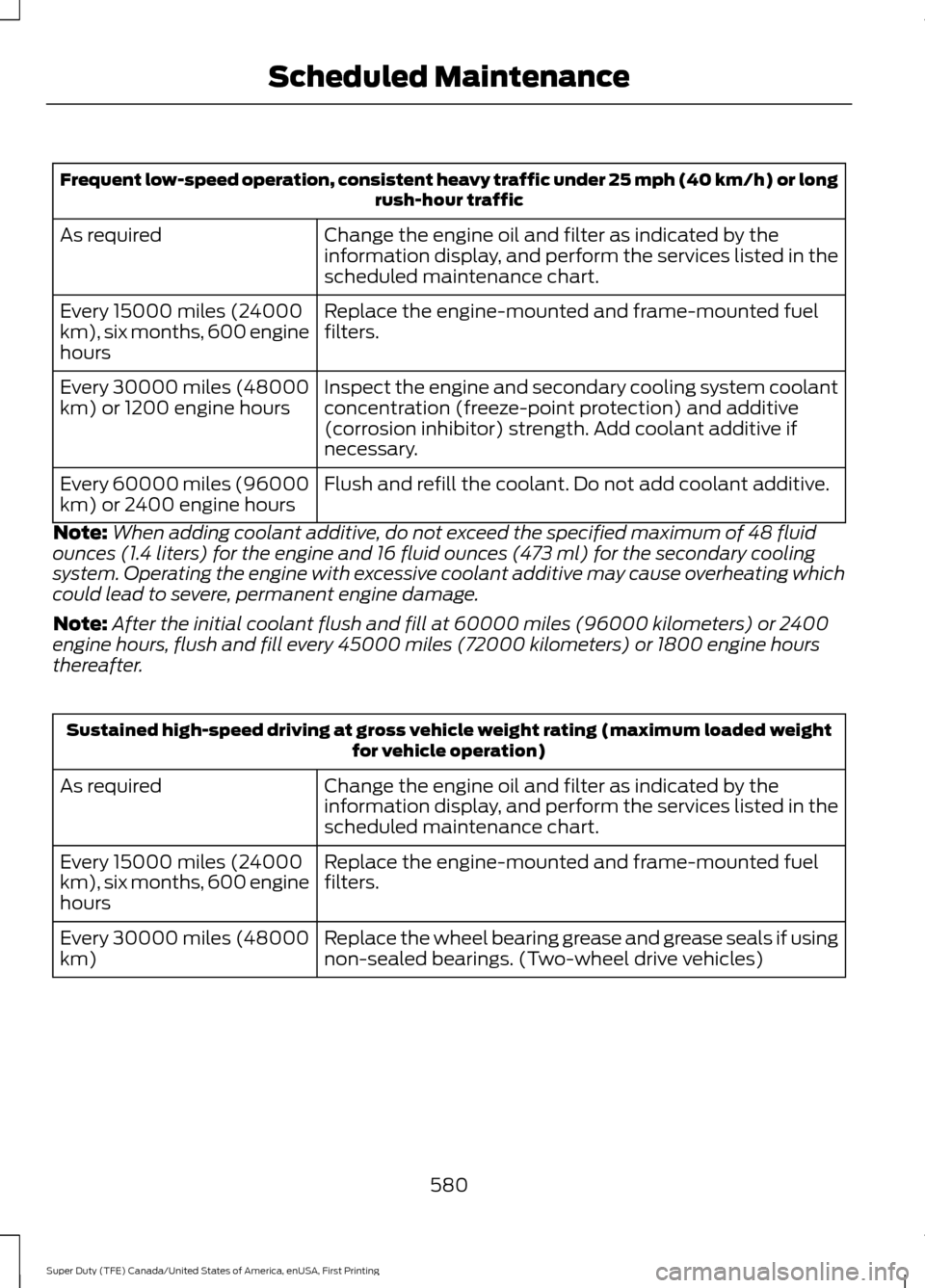
Frequent low-speed operation, consistent heavy traffic under 25 mph (40 km/h) or long
rush-hour traffic
Change the engine oil and filter as indicated by the
information display, and perform the services listed in the
scheduled maintenance chart.
As required
Replace the engine-mounted and frame-mounted fuel
filters.
Every 15000 miles (24000
km), six months, 600 engine
hours
Inspect the engine and secondary cooling system coolant
concentration (freeze-point protection) and additive
(corrosion inhibitor) strength. Add coolant additive if
necessary.
Every 30000 miles (48000
km) or 1200 engine hours
Flush and refill the coolant. Do not add coolant additive.
Every 60000 miles (96000
km) or 2400 engine hours
Note: When adding coolant additive, do not exceed the specified maximum of 48 fluid
ounces (1.4 liters) for the engine and 16 fluid ounces (473 ml) for the secondary cooling
system. Operating the engine with excessive coolant additive may cause overheating which
could lead to severe, permanent engine damage.
Note: After the initial coolant flush and fill at 60000 miles (96000 kilometers) or 2400
engine hours, flush and fill every 45000 miles (72000 kilometers) or 1800 engine hours
thereafter. Sustained high-speed driving at gross vehicle weight rating (maximum loaded weight
for vehicle operation)
Change the engine oil and filter as indicated by the
information display, and perform the services listed in the
scheduled maintenance chart.
As required
Replace the engine-mounted and frame-mounted fuel
filters.
Every 15000 miles (24000
km), six months, 600 engine
hours
Replace the wheel bearing grease and grease seals if using
non-sealed bearings. (Two-wheel drive vehicles)
Every 30000 miles (48000
km)
580
Super Duty (TFE) Canada/United States of America, enUSA, First Printing Scheduled Maintenance