2017 FORD SUPER DUTY fuel
[x] Cancel search: fuelPage 393 of 636
USING SNOW CHAINS
WARNING
Snow tires must be the same size,
load index, speed rating as those
originally provided by Ford. Use of
any tire or wheel not recommended by
Ford can affect the safety and
performance of your vehicle, which could
result in an increased risk of loss of vehicle
control, vehicle rollover, personal injury and
death. Additionally, the use of
non-recommended tires and wheels could
cause steering, suspension, axle, transfer
case or power transfer unit failure. Note:
Do not use snow chains on vehicles
with 20 inch wheels and tires.
The tires on your vehicle have all-weather
treads to provide traction in rain and snow.
However, in some climates, you may need
to use snow tires and cables. If you need
to use cables, it is recommended that steel
wheels (of the same size and
specifications) be used, as cables may chip
aluminum wheels.
Note: The suspension insulation and
bumpers will help prevent vehicle damage.
Do not remove these components from your
vehicle when using snow tires and chains.
Follow these guidelines when using snow
tires and chains:
• If possible, avoid fully loading your
vehicle
• Use only SAE Class S chains.
• Install chains securely, verifying that
the chains do not touch any wiring,
brake lines or fuel lines. •
Drive cautiously. If you hear the chains
rub or bang against your vehicle, stop
and retighten the chains. If this does
not work, remove the chains to prevent
damage to your vehicle.
• Remove the tire chains when they are
no longer needed. Do not use tire
chains on dry roads.
If you have any questions regarding snow
chains or cables, please contact your
authorized dealer.
TIRE PRESSURE MONITORING
SYSTEM
Vehicle Tire Pressure Monitoring
System WARNING
The tire pressure monitoring system
is not a substitute for manually
checking tire pressures. You should
periodically check tire pressures using a
pressure gauge. Failure to correctly
maintain tire pressures could increase the
risk of tire failure, loss of control, vehicle
rollover and personal injury. Each tire, including the spare (if
provided), should be checked
monthly when cold and inflated
to the inflation pressure recommended by
the vehicle manufacturer on the vehicle
placard or tire inflation pressure label. (If
your vehicle has tires of a different size
than the size indicated on the vehicle
placard or tire inflation pressure label, you
should determine the proper tire inflation
pressure for those tires.)
390
Super Duty (TFE) Canada/United States of America, enUSA, First Printing Wheels and Tires
Page 394 of 636
As an added safety feature, your vehicle
has been equipped with a Tire Pressure
Monitoring System (TPMS) that
illuminates a low tire pressure telltale
when one or more of your tires is
significantly under-inflated. Accordingly,
when the low tire pressure telltale
illuminates, you should stop and check
your tires as soon as possible, and inflate
them to the proper pressure. Driving on a
significantly under-inflated tire causes the
tire to overheat and can lead to tire failure.
Under-inflation also reduces fuel efficiency
and tire tread life, and may affect the
vehicle
’s handling and stopping ability.
Please note that the TPMS is not a
substitute for proper tire maintenance, and
it is the driver ’s responsibility to maintain
correct tire pressure, even if under-inflation
has not reached the level to trigger
illumination of the TPMS low tire pressure
telltale.
Your vehicle has also been equipped with
a TPMS malfunction indicator to indicate
when the system is not operating properly.
The TPMS malfunction indicator is
combined with the low tire pressure
telltale. When the system detects a
malfunction, the telltale will flash for
approximately one minute and then remain
continuously illuminated. This sequence
will continue upon subsequent vehicle
start-ups as long as the malfunction exists.
When the malfunction indicator is
illuminated, the system may not be able
to detect or signal low tire pressure as
intended. TPMS malfunctions may occur
for a variety of reasons, including the
installation of replacement or alternate
tires or wheels on the vehicle that prevent
the TPMS from functioning properly.
Always check the TPMS malfunction
telltale after replacing one or more tires or
wheels on your vehicle to ensure that the
replacement or alternate tires and wheels
allow the TPMS to continue to function
properly. This device complies with Part 15 of the
FCC Rules and with Industry Canada
license-exempt RSS standard(s).
Operation is subject to the following two
conditions:
•
This device may not cause harmful
interference.
• This device must accept any
interference received, including
interference that may cause undesired
operation.
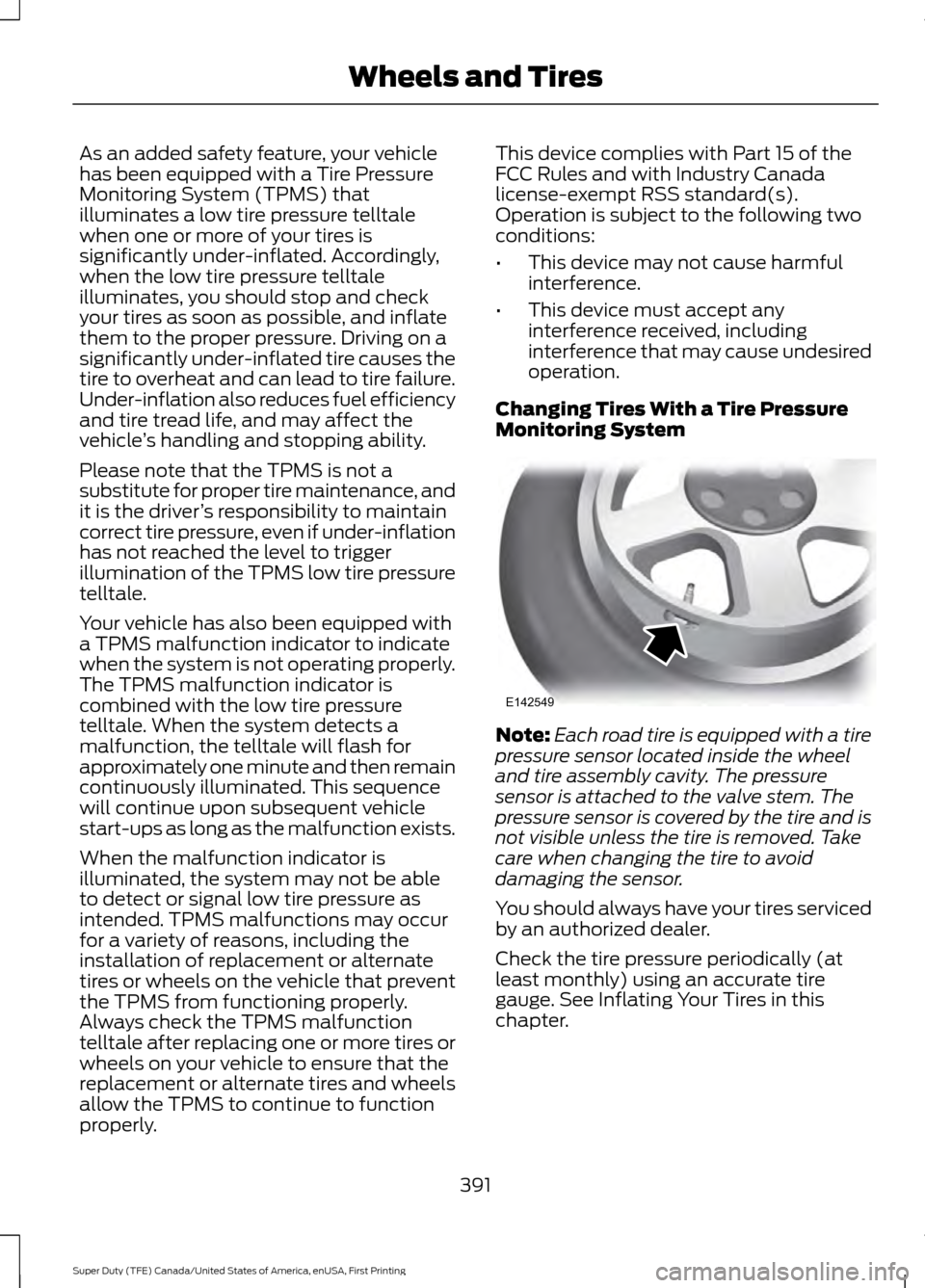
Changing Tires With a Tire Pressure
Monitoring System Note:
Each road tire is equipped with a tire
pressure sensor located inside the wheel
and tire assembly cavity. The pressure
sensor is attached to the valve stem. The
pressure sensor is covered by the tire and is
not visible unless the tire is removed. Take
care when changing the tire to avoid
damaging the sensor.
You should always have your tires serviced
by an authorized dealer.
Check the tire pressure periodically (at
least monthly) using an accurate tire
gauge. See Inflating Your Tires in this
chapter.
391
Super Duty (TFE) Canada/United States of America, enUSA, First Printing Wheels and TiresE142549
Page 414 of 636
ENGINE SPECIFICATIONS - 6.2L
6.2L V8 Engine
Engine
378
Cubic inches
Minimum 87 octane
Required fuel
1-5-4-8-6-3-7-2
Firing order
Coil on plug
Ignition system
0.041-0.047 in (1.04-1.20 mm)
Spark plug gap
9.8:1
Compression ratio
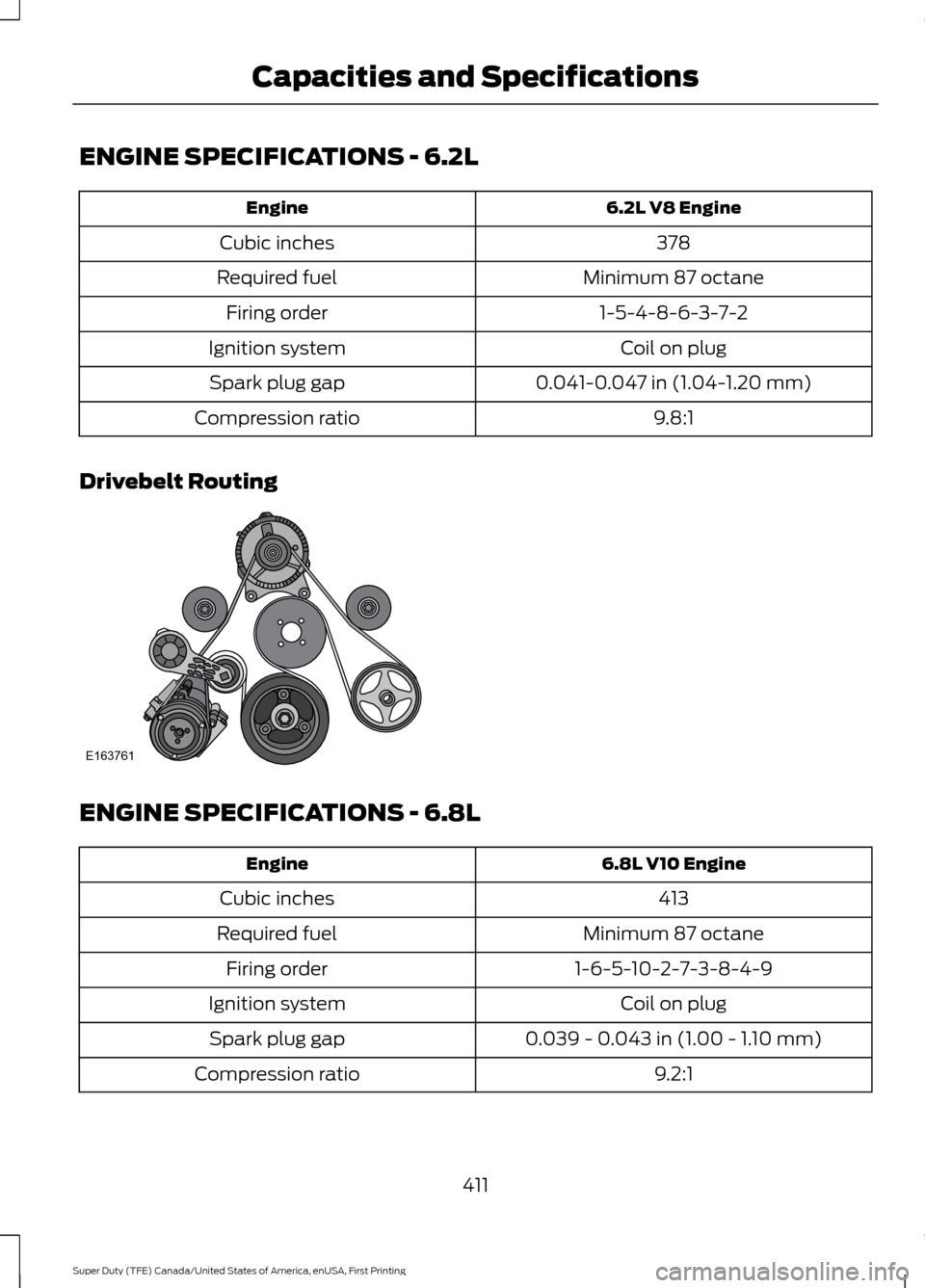
Drivebelt Routing ENGINE SPECIFICATIONS - 6.8L
6.8L V10 Engine
Engine
413
Cubic inches
Minimum 87 octane
Required fuel
1-6-5-10-2-7-3-8-4-9
Firing order
Coil on plug
Ignition system
0.039 - 0.043 in (1.00 - 1.10 mm)
Spark plug gap
9.2:1
Compression ratio
411
Super Duty (TFE) Canada/United States of America, enUSA, First Printing Capacities and SpecificationsE163761
Page 415 of 636
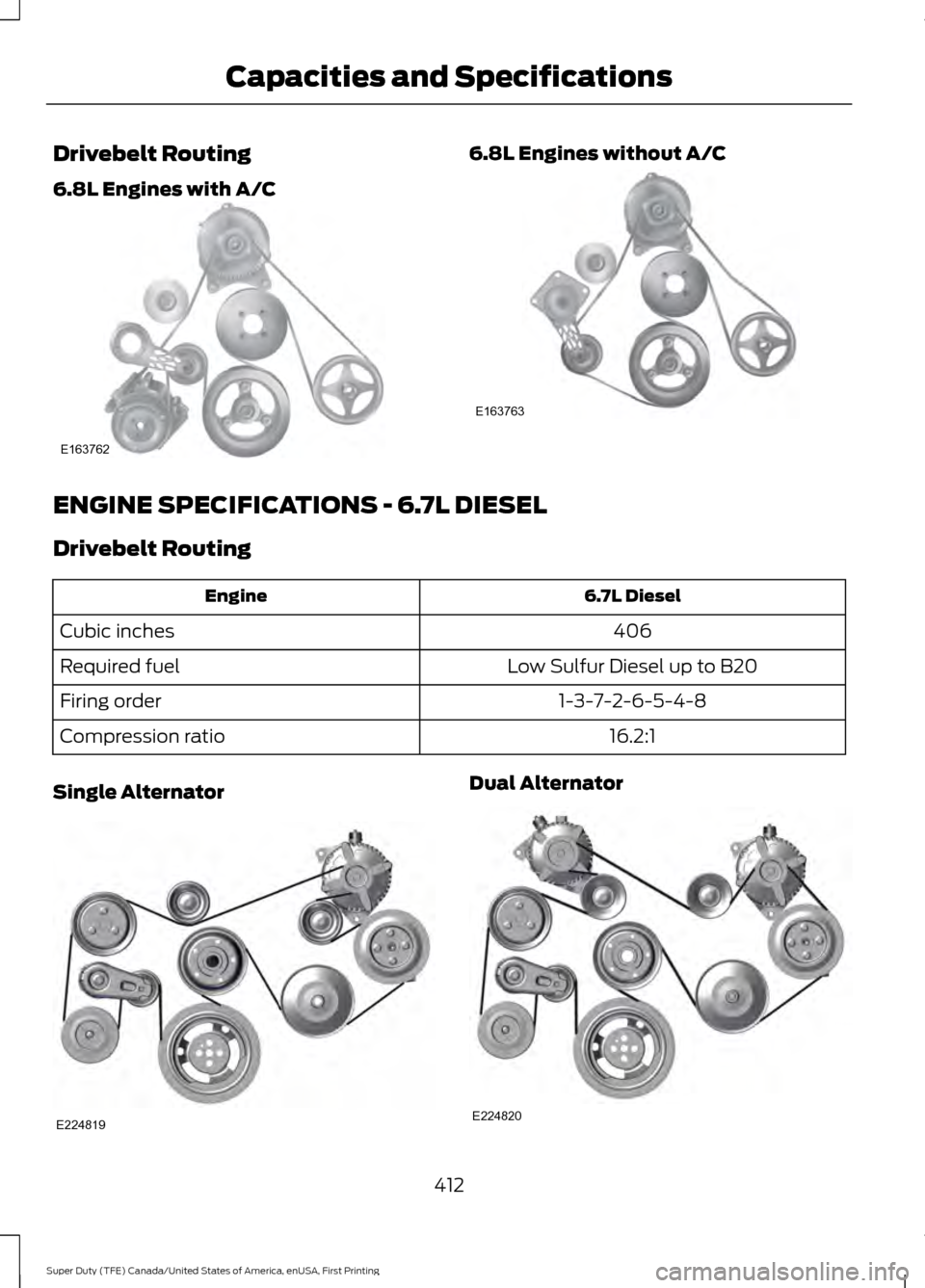
Drivebelt Routing
6.8L Engines with A/C 6.8L Engines without A/C
ENGINE SPECIFICATIONS - 6.7L DIESEL
Drivebelt Routing
6.7L Diesel
Engine
406
Cubic inches
Low Sulfur Diesel up to B20
Required fuel
1-3-7-2-6-5-4-8
Firing order
16.2:1
Compression ratio
Single Alternator Dual Alternator
412
Super Duty (TFE) Canada/United States of America, enUSA, First Printing Capacities and SpecificationsE163762 E163763 E224819 E224820
Page 418 of 636
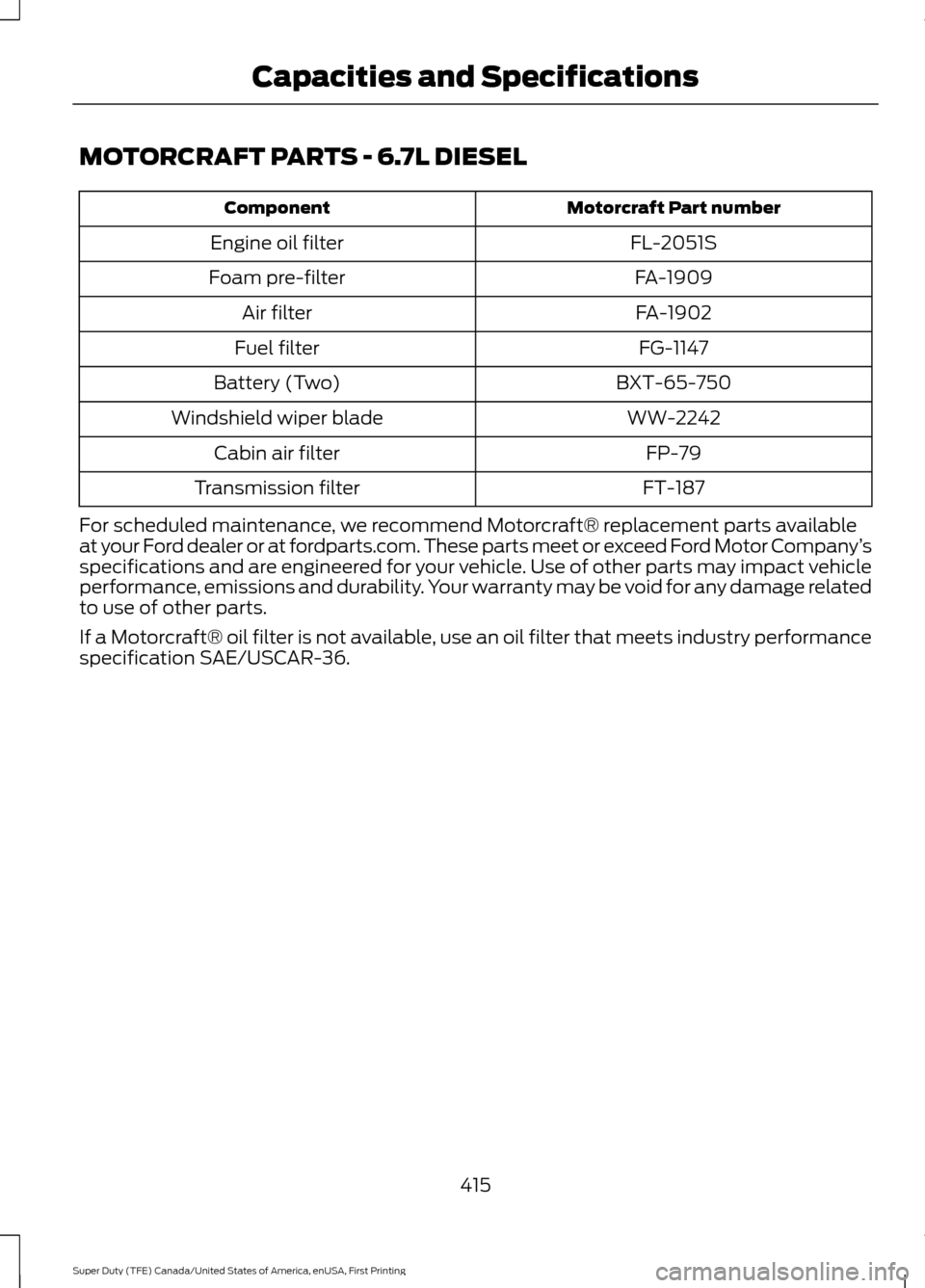
MOTORCRAFT PARTS - 6.7L DIESEL
Motorcraft Part number
Component
FL-2051S
Engine oil filter
FA-1909
Foam pre-filter
FA-1902
Air filter
FG-1147
Fuel filter
BXT-65-750
Battery (Two)
WW-2242
Windshield wiper blade
FP-79
Cabin air filter
FT-187
Transmission filter
For scheduled maintenance, we recommend Motorcraft® replacement parts available
at your Ford dealer or at fordparts.com. These parts meet or exceed Ford Motor Company ’s
specifications and are engineered for your vehicle. Use of other parts may impact vehicle
performance, emissions and durability. Your warranty may be void for any damage related
to use of other parts.
If a Motorcraft® oil filter is not available, use an oil filter that meets industry performance
specification SAE/USCAR-36.
415
Super Duty (TFE) Canada/United States of America, enUSA, First Printing Capacities and Specifications
Page 421 of 636
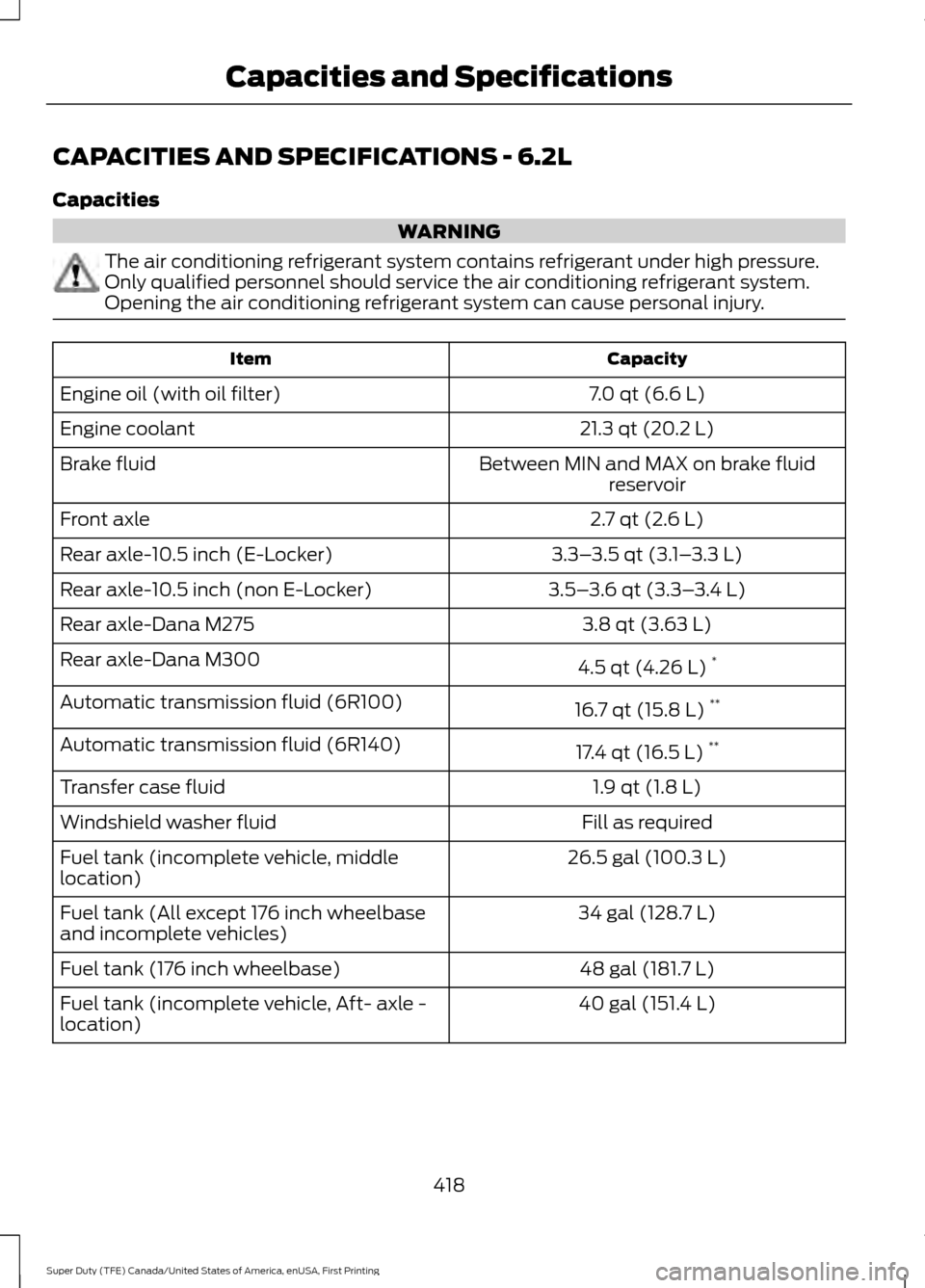
CAPACITIES AND SPECIFICATIONS - 6.2L
Capacities
WARNING
The air conditioning refrigerant system contains refrigerant under high pressure.
Only qualified personnel should service the air conditioning refrigerant system.
Opening the air conditioning refrigerant system can cause personal injury.
Capacity
Item
7.0 qt (6.6 L)
Engine oil (with oil filter)
21.3 qt (20.2 L)
Engine coolant
Between MIN and MAX on brake fluidreservoir
Brake fluid
2.7 qt (2.6 L)
Front axle
3.3–3.5 qt (3.1– 3.3 L)
Rear axle-10.5 inch (E-Locker)
3.5–3.6 qt (3.3– 3.4 L)
Rear axle-10.5 inch (non E-Locker)
3.8 qt (3.63 L)
Rear axle-Dana M275
4.5 qt (4.26 L)*
Rear axle-Dana M300
16.7 qt (15.8 L)**
Automatic transmission fluid (6R100)
17.4 qt (16.5 L)**
Automatic transmission fluid (6R140)
1.9 qt (1.8 L)
Transfer case fluid
Fill as required
Windshield washer fluid
26.5 gal (100.3 L)
Fuel tank (incomplete vehicle, middle
location)
34 gal (128.7 L)
Fuel tank (All except 176 inch wheelbase
and incomplete vehicles)
48 gal (181.7 L)
Fuel tank (176 inch wheelbase)
40 gal (151.4 L)
Fuel tank (incomplete vehicle, Aft- axle -
location)
418
Super Duty (TFE) Canada/United States of America, enUSA, First Printing Capacities and Specifications
Page 425 of 636
If you use oil and fluids that do not meet
the defined specification and viscosity
grade, this may lead to:
•
Component damage which is not
covered by the vehicle warranty.
• Longer engine cranking periods.
• Increased emission levels.
• Reduced engine performance.
• Reduced fuel economy.
• Degraded brake performance.
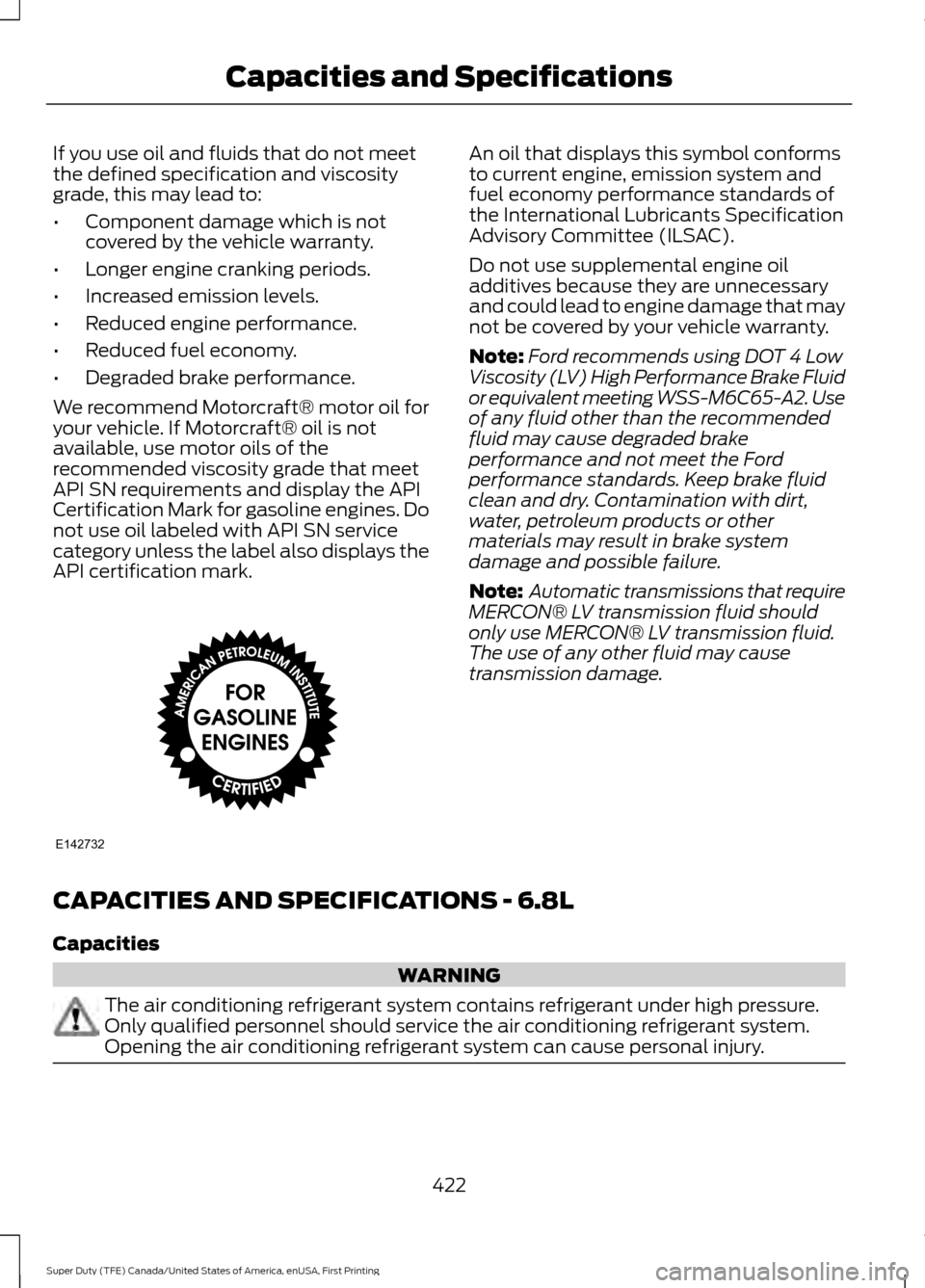
We recommend Motorcraft® motor oil for
your vehicle. If Motorcraft® oil is not
available, use motor oils of the
recommended viscosity grade that meet
API SN requirements and display the API
Certification Mark for gasoline engines. Do
not use oil labeled with API SN service
category unless the label also displays the
API certification mark. An oil that displays this symbol conforms
to current engine, emission system and
fuel economy performance standards of
the International Lubricants Specification
Advisory Committee (ILSAC).
Do not use supplemental engine oil
additives because they are unnecessary
and could lead to engine damage that may
not be covered by your vehicle warranty.
Note:
Ford recommends using DOT 4 Low
Viscosity (LV) High Performance Brake Fluid
or equivalent meeting WSS-M6C65-A2. Use
of any fluid other than the recommended
fluid may cause degraded brake
performance and not meet the Ford
performance standards. Keep brake fluid
clean and dry. Contamination with dirt,
water, petroleum products or other
materials may result in brake system
damage and possible failure.
Note: Automatic transmissions that require
MERCON® LV transmission fluid should
only use MERCON® LV transmission fluid.
The use of any other fluid may cause
transmission damage.
CAPACITIES AND SPECIFICATIONS - 6.8L
Capacities WARNING
The air conditioning refrigerant system contains refrigerant under high pressure.
Only qualified personnel should service the air conditioning refrigerant system.
Opening the air conditioning refrigerant system can cause personal injury.
422
Super Duty (TFE) Canada/United States of America, enUSA, First Printing Capacities and SpecificationsE142732
Page 426 of 636
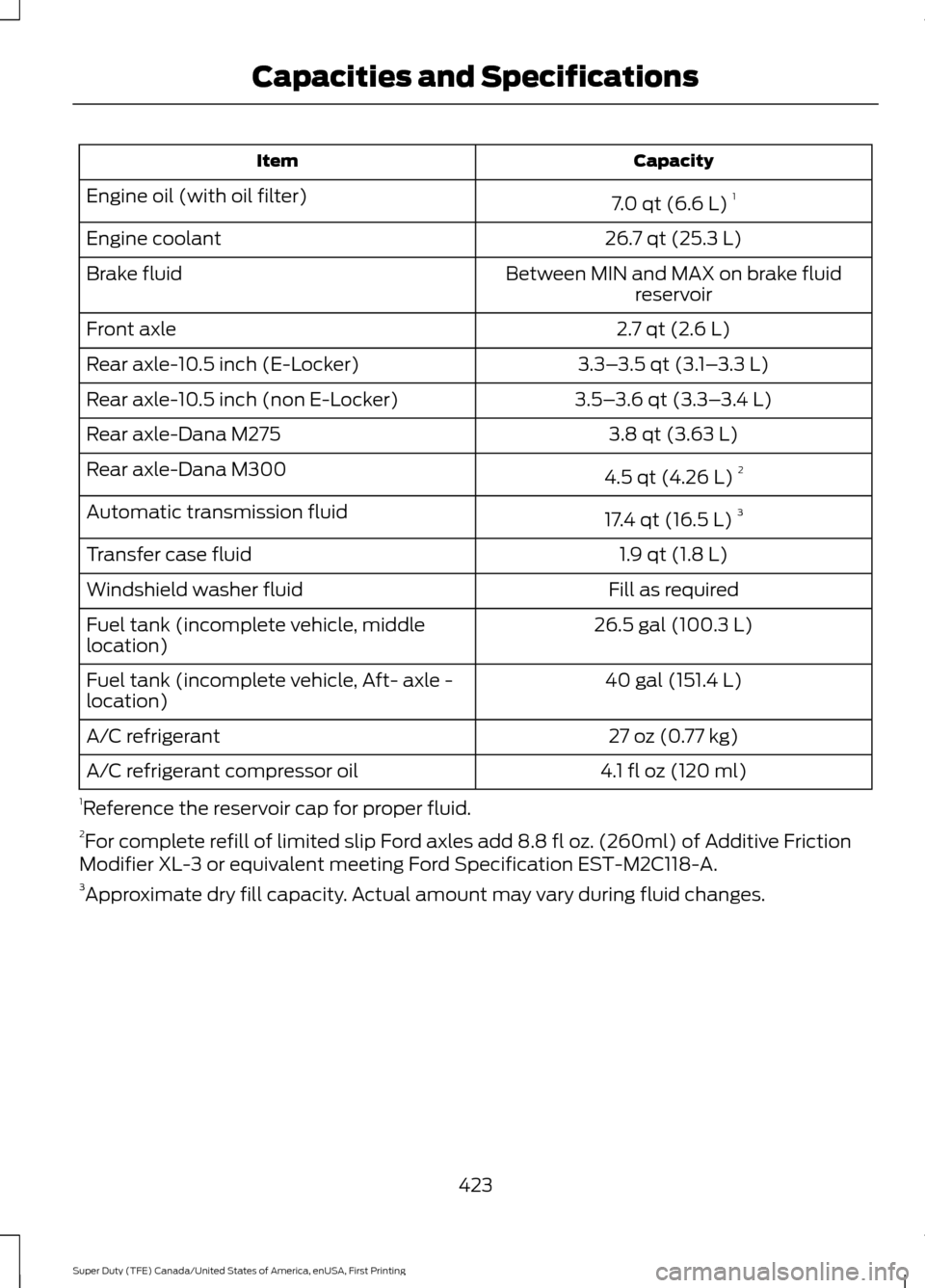
Capacity
Item
7.0 qt (6.6 L)1
Engine oil (with oil filter)
26.7 qt (25.3 L)
Engine coolant
Between MIN and MAX on brake fluidreservoir
Brake fluid
2.7 qt (2.6 L)
Front axle
3.3–3.5 qt (3.1– 3.3 L)
Rear axle-10.5 inch (E-Locker)
3.5–3.6 qt (3.3– 3.4 L)
Rear axle-10.5 inch (non E-Locker)
3.8 qt (3.63 L)
Rear axle-Dana M275
4.5 qt (4.26 L)2
Rear axle-Dana M300
17.4 qt (16.5 L)3
Automatic transmission fluid
1.9 qt (1.8 L)
Transfer case fluid
Fill as required
Windshield washer fluid
26.5 gal (100.3 L)
Fuel tank (incomplete vehicle, middle
location)
40 gal (151.4 L)
Fuel tank (incomplete vehicle, Aft- axle -
location)
27 oz (0.77 kg)
A/C refrigerant
4.1 fl oz (120 ml)
A/C refrigerant compressor oil
1 Reference the reservoir cap for proper fluid.
2 For complete refill of limited slip Ford axles add 8.8 fl oz. (260ml) of Additive Friction
Modifier XL-3 or equivalent meeting Ford Specification EST-M2C118-A.
3 Approximate dry fill capacity. Actual amount may vary during fluid changes.
423
Super Duty (TFE) Canada/United States of America, enUSA, First Printing Capacities and Specifications