2017 FORD POLICE INTERCEPTOR SEDAN hood release
[x] Cancel search: hood releasePage 20 of 358
Audio control. See Audio Control (page 54).
N
Horn.
O
Steering wheel adjustment
See Adjusting the Steering Wheel (page 54).
P
Hood release. See
Opening and Closing the Hood (page 169).
Q
Cruise control switches. See
Using Cruise Control (page 124).
R
Lighting control. See
Lighting (page 58).
S
17
Taurus (CPH) Police, Canada/United States of America, enUSA, First Printing At a Glance
Page 95 of 358
1. Press the accelerator pedal down
one-third to one-half of its travel, and
then crank the engine.
2. When the engine starts, release the key, then gradually release the
accelerator pedal as the engine speed
increases. If the engine still does not
start, repeat Step 1.
Stopping the Engine When Your
Vehicle is Stationary
1. Shift into park (P).
2. Turn the key to the off position.
3. Apply the parking brake.
Stopping the Engine When Your
Vehicle is Moving WARNING
Switching off the engine when the
vehicle is still moving will result in a
loss of brake and steering assistance.
The steering will not lock, but higher effort
will be required. When the ignition is
switched off, some electrical circuits,
including air bags, warning lamps and
indicators may also be off. If the ignition
was turned off accidentally, you can shift
into neutral (N) and re-start the engine. 1.
Shift into neutral and use the brakes to
bring your vehicle to a safe stop.
2. When your vehicle has stopped, shift into park (P) and switch the ignition
off.
3. Apply the parking brake. Guarding Against Exhaust Fumes WARNING
If you smell exhaust fumes inside
your vehicle, have your vehicle
checked by your authorized dealer
immediately. Do not drive your vehicle if
you smell exhaust fumes. Carbon
monoxide is present in exhaust fumes.
Take precautions to avoid its dangerous
effects. Important Ventilating Information
If you stop your vehicle and then leave the
engine idling for long periods, we
recommend that you do one of the
following:
•
Open the windows at least 1 in (3 cm).
• Set your climate control to outside air.
ENGINE BLOCK HEATER (If
Equipped) WARNINGS
Failure to follow engine block heater
instructions could result in property
damage or serious personal injury.
Do not use your heater with
ungrounded electrical systems or
two-pronged adapters. There is a risk
of electrical shock. Do not fully close the hood, or allow
it to drop under its own weight when
using the engine block heater. This
could damage the power cable and may
cause an electrical short resulting in fire,
injury and property damage. Note:
The heater is most effective when
outdoor temperatures are below 0°F
(-18°C).
92
Taurus (CPH) Police, Canada/United States of America, enUSA, First Printing Starting and Stopping the Engine
Page 173 of 358
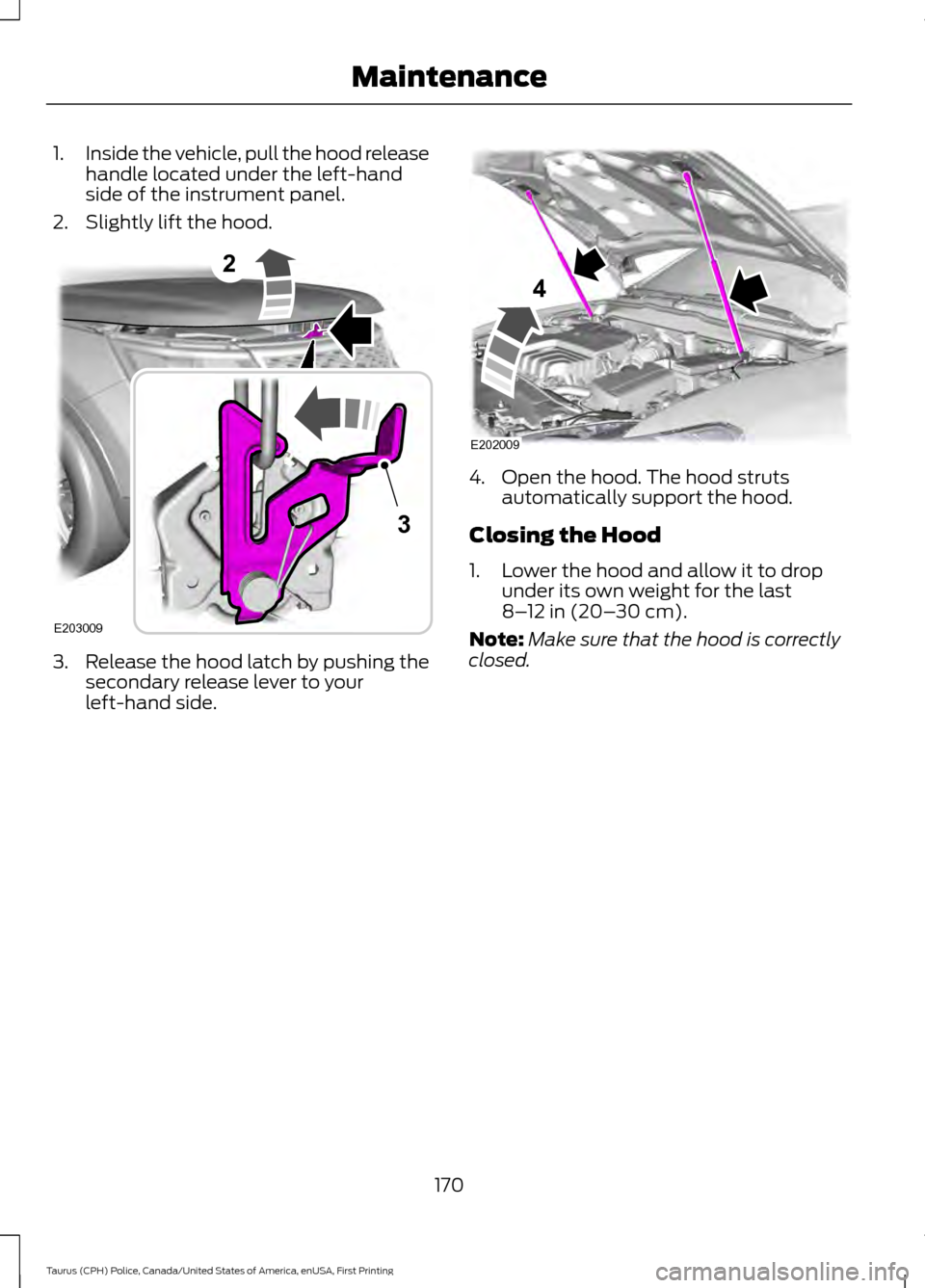
1.
Inside the vehicle, pull the hood release
handle located under the left-hand
side of the instrument panel.
2. Slightly lift the hood. 3. Release the hood latch by pushing the
secondary release lever to your
left-hand side. 4. Open the hood. The hood struts
automatically support the hood.
Closing the Hood
1. Lower the hood and allow it to drop under its own weight for the last
8–12 in (20– 30 cm).
Note: Make sure that the hood is correctly
closed.
170
Taurus (CPH) Police, Canada/United States of America, enUSA, First Printing Maintenance2
E203009
3 E202009
4
Page 176 of 358
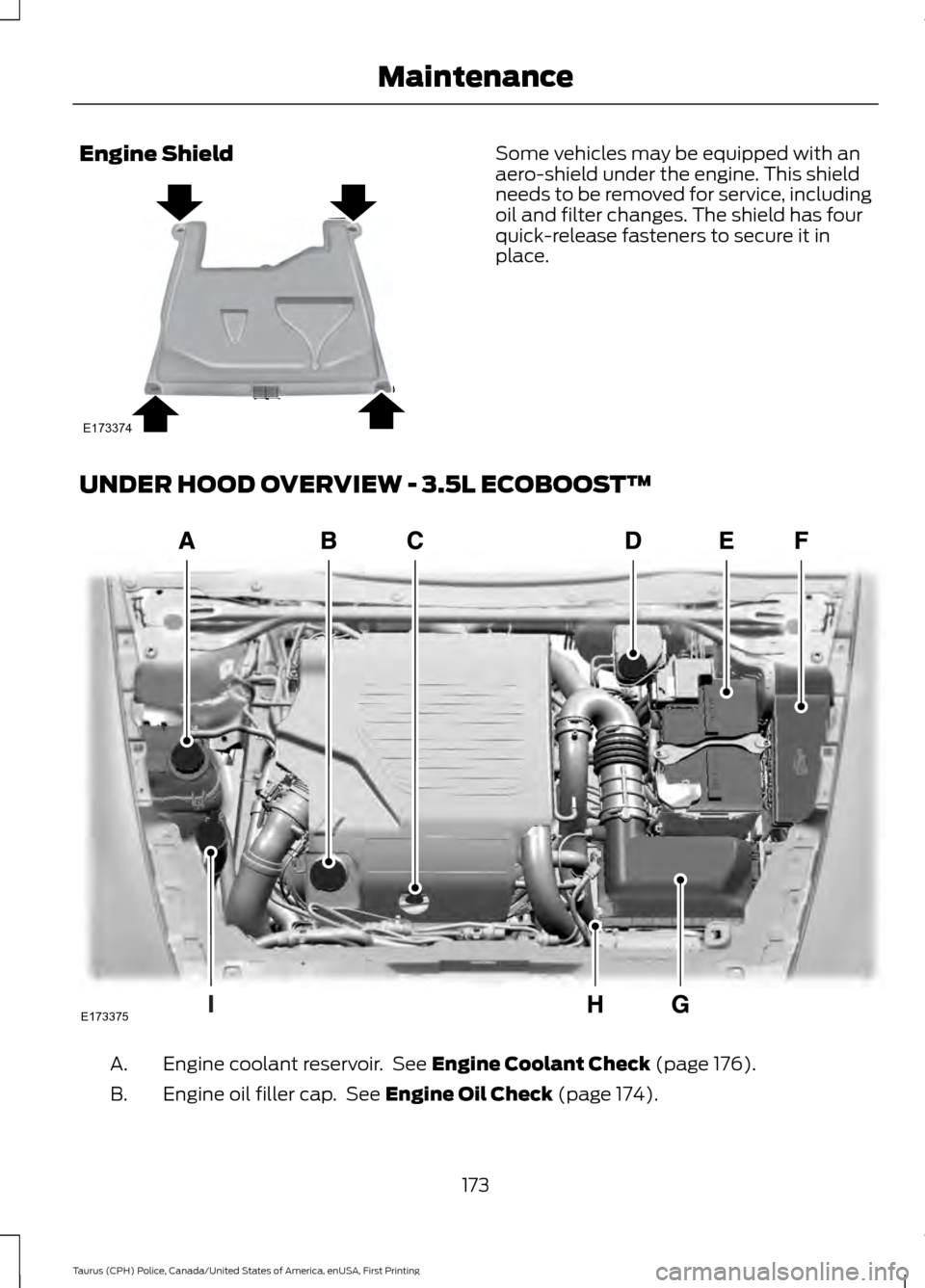
Engine Shield Some vehicles may be equipped with an
aero-shield under the engine. This shield
needs to be removed for service, including
oil and filter changes. The shield has four
quick-release fasteners to secure it in
place.
UNDER HOOD OVERVIEW - 3.5L ECOBOOST™ Engine coolant reservoir. See Engine Coolant Check (page 176).
A.
Engine oil filler cap. See
Engine Oil Check (page 174).
B.
173
Taurus (CPH) Police, Canada/United States of America, enUSA, First Printing MaintenanceE173374 E173375
Page 202 of 358
•
With your foot on the brake, shift
through all the gears while the engine
is running.
• We recommend that you change the
engine oil before you use your vehicle
again.
Fuel system
• Fill the fuel tank with high-quality fuel
until the first automatic shutoff of the
fuel pump nozzle.
Cooling system
• Protect against freezing temperatures.
• When removing your vehicle from
storage, check coolant fluid level.
Confirm that there are no cooling
system leaks and that fluid is at the
recommended level.
Battery
• Check and recharge as necessary. Keep
connections clean.
• If storing your vehicle for more than 30
days without recharging the battery,
we recommend that you disconnect
the battery cables to maintain battery
charge for quick starting.
Note: It is necessary to reset memory
features if battery cables are disconnected.
Brakes
• Make sure the brakes and parking brake
release fully.
Tires
• Maintain recommended air pressure. Miscellaneous
•
Make sure all linkages, cables, levers
and pins under your vehicle are covered
with grease to prevent rust.
• Move vehicles at least 25 ft (7.5 m)
every 15 days to lubricate working parts
and prevent corrosion.
Removing Vehicle From Storage
When your vehicle is ready to come out of
storage, do the following:
• Wash your vehicle to remove any dirt
or grease film build-up on window
surfaces.
• Check windshield wipers for any
deterioration.
• Check under the hood for any foreign
material that may have collected
during storage such as mice or squirrel
nests.
• Check the exhaust for any foreign
material that may have collected
during storage.
• Check tire pressures and set tire
inflation per the Tire Label.
• Check brake pedal operation. Drive
your vehicle
15 ft (4.5 m) back and
forth to remove rust build-up.
• Check fluid levels (including coolant,
oil and gas) to make sure there are no
leaks, and fluids are at recommended
levels.
• If you remove the battery, clean the
battery cable ends and check for
damage.
Contact an authorized dealer if you have
any concerns or issues.
199
Taurus (CPH) Police, Canada/United States of America, enUSA, First Printing Vehicle Care
Page 354 of 358
Interior Luggage Compartment
Release............................................................52
Interior Mirror...................................................64 Auto-Dimming Mirror......................................... 64
Introduction.........................................................7
J
Jump Starting the Vehicle.........................148
Connecting the Jumper Cables..................... 148
Jump Starting....................................................... 149
Preparing Your Vehicle..................................... 148
Removing the Jumper Cables........................ 149
K
Keys and Remote Controls
........................48
L
Lighting Control
..............................................58
Headlamp Flasher............................................... 59
High Beams............................................................ 58
Spot Lamp Control.............................................. 59
Lighting..............................................................58 General Information............................................ 58
Load Carrying.................................................132
Load Limit........................................................132 Special Loading Instructions for Owners of
Pick-up Trucks and Utility-type
Vehicles.............................................................. 137
Vehicle Loading - with and without a Trailer.................................................................. 132
Locking and Unlocking................................50 Battery Saver.......................................................... 51
Hidden Rear Door Locks.................................... 50
Illuminated Entry................................................... 51
Illuminated Exit...................................................... 51
Locking and Unlocking the Doors with the Key Blade............................................................. 51
Opening a Rear Door From the Inside...........51
Opening the Luggage Compartment............51
Power Door Locks................................................ 50
Remote Control.................................................... 50
Lug Nuts See: Changing a Road Wheel........................ 218M
Maintenance..................................................169
General Information.......................................... 169
Manual Climate Control
..............................80
Manual Seats..................................................86
Lumbar Adjustment............................................ 87
Moving the Seat Backward and Forward.............................................................. 86
Recline Adjustment............................................ 86
Media Hub
.......................................................257
Message Center See: Information Displays.................................. 71
Mirrors See: Heated Windows and Mirrors................82
See: Windows and Mirrors................................ 62
Mobile Communications Equipment.......13
Motorcraft Parts - 2.0L EcoBoost™.................................................226
Motorcraft Parts - 3.5L Duratec.............228
Motorcraft Parts - 3.5L Ecoboost™.................................................229
Motorcraft Parts - 3.7L
...............................230
N
Normal Scheduled Maintenance..........304 Intelligent Oil-Life Monitor™........................ 304
Normal Maintenance Intervals.................... 305
O
Oil Change Indicator Reset........................176
Oil Check See: Engine Oil Check........................................ 174
Opening and Closing the Hood...............169 Closing the Hood................................................ 170
Opening the Hood............................................. 169
Ordering Additional Owner's Literature.......................................................155
Obtaining a French Owner ’s Manual..........156
Overhead Console.........................................89
P
Parking Aids
....................................................120
Principle of Operation....................................... 120
Parking Brake
..................................................116
351
Taurus (CPH) Police, Canada/United States of America, enUSA, First Printing Index