2017 FORD POLICE INTERCEPTOR SEDAN center console
[x] Cancel search: center consolePage 5 of 358
Lighting
General Information.....................................58
Lighting Control
..............................................58
Instrument Lighting Dimmer.....................59
Daytime Running Lamps............................59
Direction Indicators
.......................................60
Interior Lamps
.................................................60
Windows and Mirrors
Power Windows
..............................................62
Exterior Mirrors
................................................63
Interior Mirror...................................................64
Sun Visors.........................................................65
Instrument Cluster
Gauges...............................................................66
Warning Lamps and Indicators.................67
Audible Warnings and Indicators.............70
Information Displays
General Information.......................................71
Information Messages
..................................74
Climate Control
Manual Climate Control
..............................80
Hints on Controlling the Interior Climate...........................................................81
Heated Windows and Mirrors....................82
Cabin Air Filter
.................................................83
Seats
Sitting in the Correct Position...................84
Head Restraints
..............................................84
Manual Seats
..................................................86
Power Seats
.....................................................87
Auxiliary Power Points
Auxiliary Power Points.................................88 Storage Compartments
Center Console
...............................................89
Overhead Console.........................................89
Starting and Stopping the Engine
General Information
.....................................90
Ignition Switch
................................................90
Starting a Gasoline Engine........................90
Engine Block Heater......................................92
Police Engine Idle Feature..........................93
Fuel and Refueling
Safety Precautions
........................................95
Fuel Quality - E85..........................................96
Fuel Quality - Gasoline.................................97
Fuel Filler Funnel Location
..........................97
Running Out of Fuel......................................98
Refueling...........................................................99
Fuel Consumption
........................................101
Emission Control System..........................102
Transmission
Automatic Transmission...........................105
All-Wheel Drive
Using All-Wheel Drive
................................108
Brakes
General Information
.....................................115
Hints on Driving With Anti-Lock Brakes............................................................115
Parking Brake
..................................................116
Traction Control
Principle of Operation..................................117
Using Traction Control.................................117
2
Taurus (CPH) Police, Canada/United States of America, enUSA, First Printing Table of Contents
Page 43 of 358

feet comfortably extended on the floor.
Sitting improperly can increase the chance
of injury in a crash event. For example, if
an occupant slouches, lies down, turns
sideways, sits forward, leans forward or
sideways, or puts one or both feet up, the
chance of injury during a crash is greatly
increased.
If you think that the status of the passenger
airbag off indicator lamp is incorrect, check
for the following:
•
Objects lodged underneath the seat.
• Objects between the seat cushion and
the center console.
• Objects hanging off the seatback.
• Objects stowed in the seatback map
pocket.
• Objects placed on the occupant's lap.
• Cargo interference with the seat
• Other passengers pushing or pulling on
the seat.
• Rear passenger feet and knees resting
or pushing on the seat.
The conditions listed above may cause the
weight of a properly seated occupant to
be incorrectly interpreted by the front
passenger sensing system. The person in
the front passenger seat may appear
heavier or lighter due to the conditions
described in the list above. Make sure the front passenger
sensing system is operating
properly. See Crash Sensors
and Airbag Indicator (page 43).
If the airbag readiness light is lit, do the
following:
The driver and adult passengers should
check for objects lodged underneath the
front passenger seat, or cargo interfering
with the seat. If there are lodged objects, or cargo is
interfering with the seat, take the following
steps to remove the obstruction:
•
Pull the vehicle over.
• Turn the vehicle off.
• Driver and adult passengers should
check for any objects lodged
underneath the front passenger seat
or cargo interfering with the seat.
• Remove the obstruction(s) (if found).
• Restart the vehicle.
• Wait at least two minutes and verify
that the airbag readiness light is no
longer illuminated.
• If the airbag readiness light remains
illuminated, this may or may not be a
problem due to the front passenger
sensing system.
Do not attempt to repair or service the
system. Take your vehicle immediately to
an authorized dealer.
If it is necessary to modify an advanced
front airbag system to accommodate a
person with disabilities, contact the Ford
Customer Relationship Center. See
Getting the Services You Need
(page
151).
SIDE AIRBAGS WARNINGS
Do not place objects or mount
equipment on or near the airbag
cover, on the side of the seatbacks
(of the front seats), or in front seat areas
that may come into contact with a
deploying airbag. Failure to follow these
instructions may increase the risk of
personal injury in the event of a crash.
40
Taurus (CPH) Police, Canada/United States of America, enUSA, First Printing Supplementary Restraints SystemE67017
Page 47 of 358
Airbags and Police Equipment
WARNINGS
Do not place objects or mount
equipment in front of the airbag
module cover or in front of the seat
areas that may come in contact with a
deploying airbag. Failure to follow this
instruction could result in personal injury. Dash, tunnel or console-mounted
equipment should not be placed
outside of the specified zone. Failure
to follow this instruction could result in
personal injury. Do not mount equipment between
the side of front seat to the door trim
to block deployment of the side
airbag. Failure to follow this instruction
could result in personal injury. Dual driver and passenger airbags, and side
airbags affect the way police equipment
can be mounted in police vehicles.
Any surfaces that could come into contact
with an airbag, once it has deployed, must
not damage the airbag or alter its
deployment path.
Once the airbag has fully deployed, any
peripheral equipment surfaces that could
come into contact with the airbag (such
as when the airbag deflates with the
loading of an occupant) must not damage
the airbag or alter its deployment path.
Sharp edges, corners or protrusions could
damage the nylon airbag material and
reduce the effectiveness of the airbag.
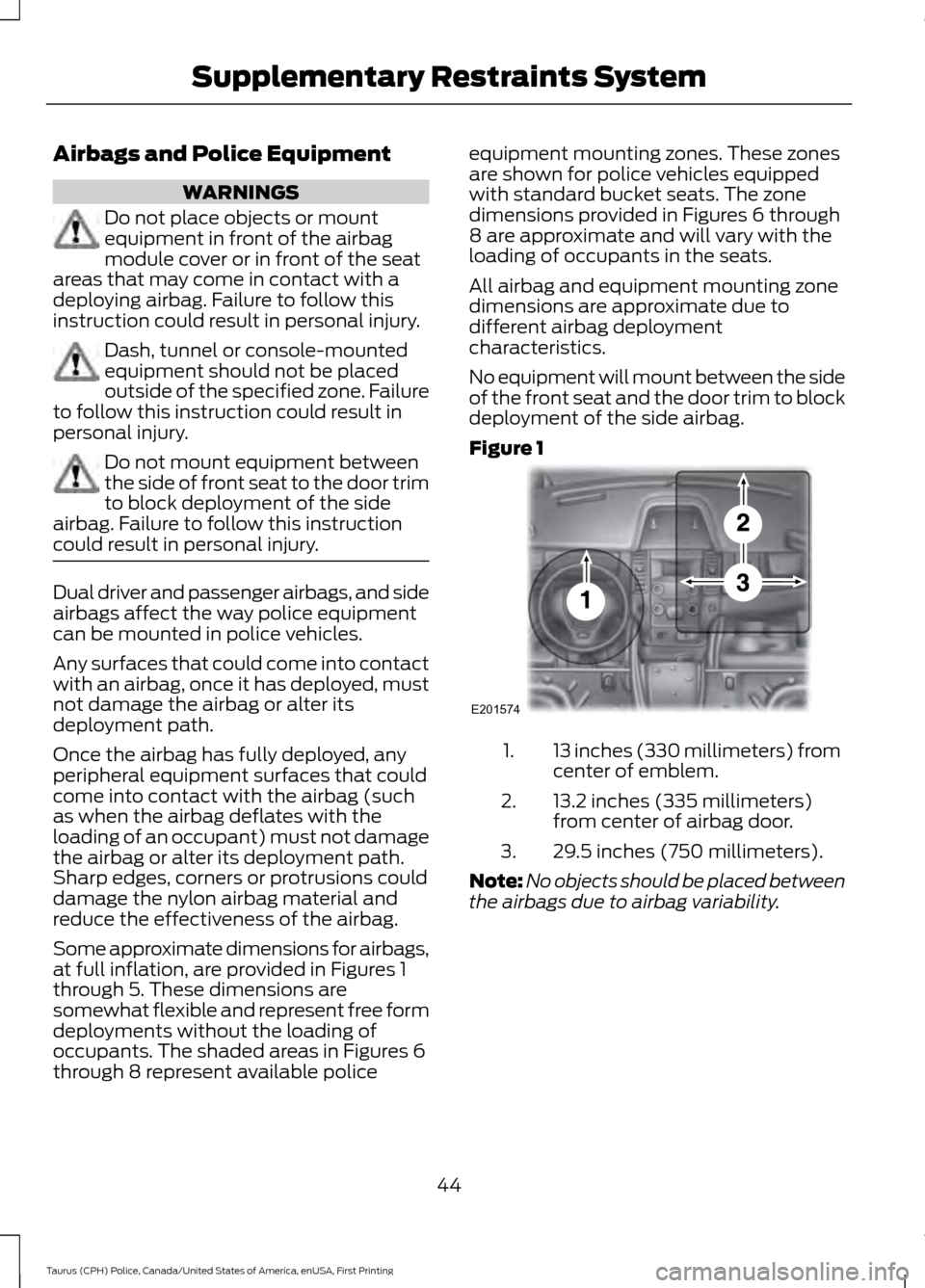
Some approximate dimensions for airbags,
at full inflation, are provided in Figures 1
through 5. These dimensions are
somewhat flexible and represent free form
deployments without the loading of
occupants. The shaded areas in Figures 6
through 8 represent available police equipment mounting zones. These zones
are shown for police vehicles equipped
with standard bucket seats. The zone
dimensions provided in Figures 6 through
8 are approximate and will vary with the
loading of occupants in the seats.
All airbag and equipment mounting zone
dimensions are approximate due to
different airbag deployment
characteristics.
No equipment will mount between the side
of the front seat and the door trim to block
deployment of the side airbag.
Figure 1
13 inches (330 millimeters) from
center of emblem.
1.
13.2 inches (335 millimeters)
from center of airbag door.
2.
29.5 inches (750 millimeters).
3.
Note: No objects should be placed between
the airbags due to airbag variability.
44
Taurus (CPH) Police, Canada/United States of America, enUSA, First Printing Supplementary Restraints SystemE201574
Page 49 of 358
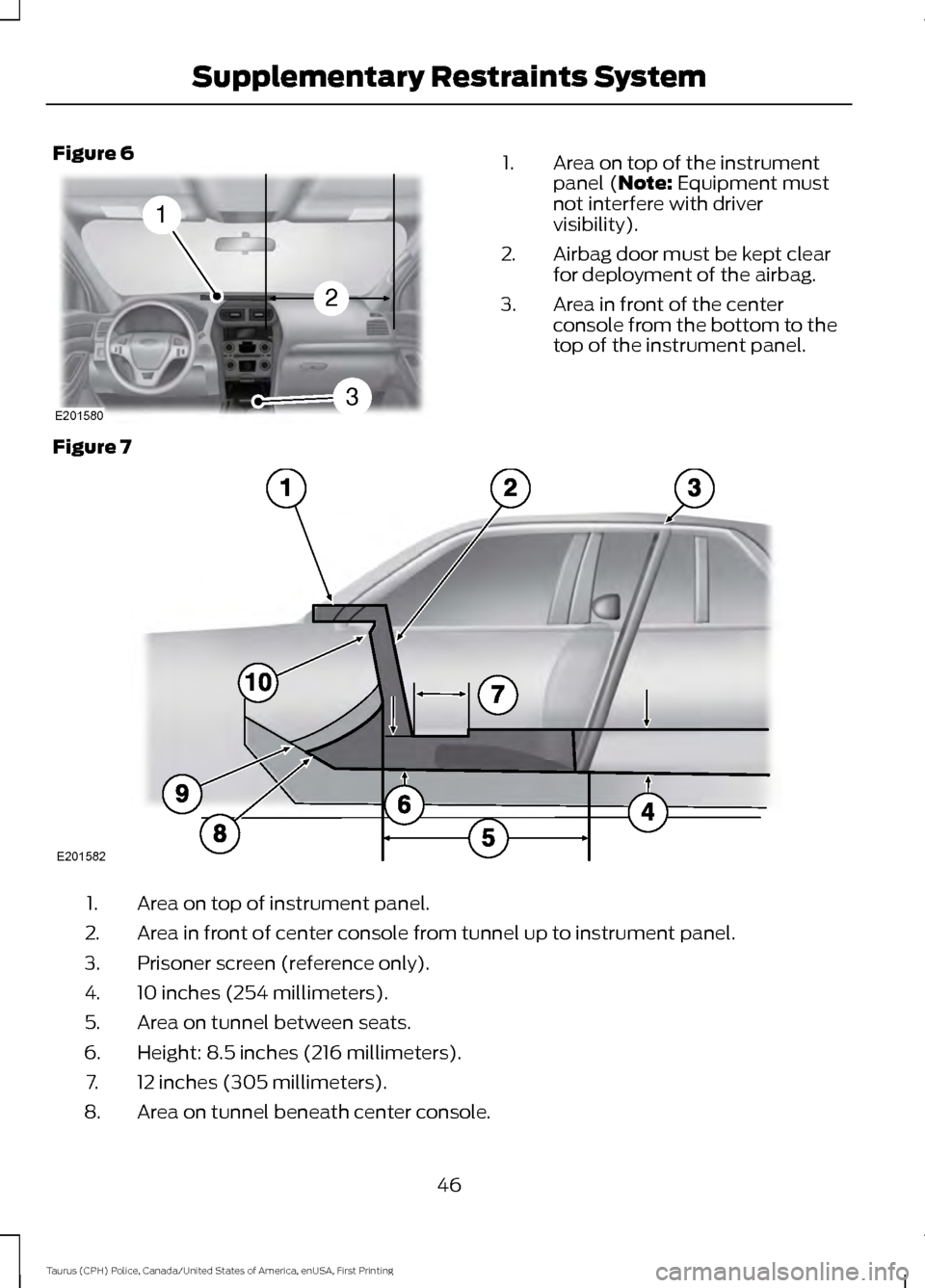
Figure 6
Area on top of the instrument
panel (Note: Equipment must
not interfere with driver
visibility).
1.
Airbag door must be kept clear
for deployment of the airbag.
2.
Area in front of the center
console from the bottom to the
top of the instrument panel.
3.
Figure 7 Area on top of instrument panel.
1.
Area in front of center console from tunnel up to instrument panel.
2.
Prisoner screen (reference only).
3.
10 inches (254 millimeters).
4.
Area on tunnel between seats.
5.
Height: 8.5 inches (216 millimeters).
6.
12 inches (305 millimeters).
7.
Area on tunnel beneath center console.
8.
46
Taurus (CPH) Police, Canada/United States of America, enUSA, First Printing Supplementary Restraints System1
3
2
E201580 E201582
Page 91 of 358
12 Volt DC Power Point
WARNINGS
Do not plug optional electrical
accessories into the cigar lighter
socket. Incorrect use of the cigar
lighter can cause damage not covered by
the vehicle warranty, and can result in fire
or serious injury. Do not use a power point for
operating a cigar lighter. Incorrect
use of the power points can cause
damage not covered by the vehicle
warranty, and can result in fire or serious
injury. Note:
When you switch the ignition on, you
can use the socket to power 12 volt
appliances with a maximum current rating
of 15 amps.
If the power supply does not work after you
switch the ignition off, switch the ignition
on.
Note: Do not hang any accessory from the
accessory plug.
Note: Do not use the power point over the
vehicle capacity of 12 volt DC 180 watts or
a fuse may blow.
Note: Always keep the power point caps
closed when not in use.
Do not insert objects other than an
accessory plug into the power point. This
will damage the power point and blow the
fuse.
Run the vehicle for full capacity use of the
power point.
To prevent the battery from running out of
charge:
• Do not use the power point longer than
necessary when the vehicle is not
running.
• Do not leave devices plugged in
overnight or when you park your vehicle
for extended periods. Locations
Power points may be in the following
locations:
•
On the instrument panel.
• Inside the center console.
88
Taurus (CPH) Police, Canada/United States of America, enUSA, First Printing Auxiliary Power Points
Page 92 of 358
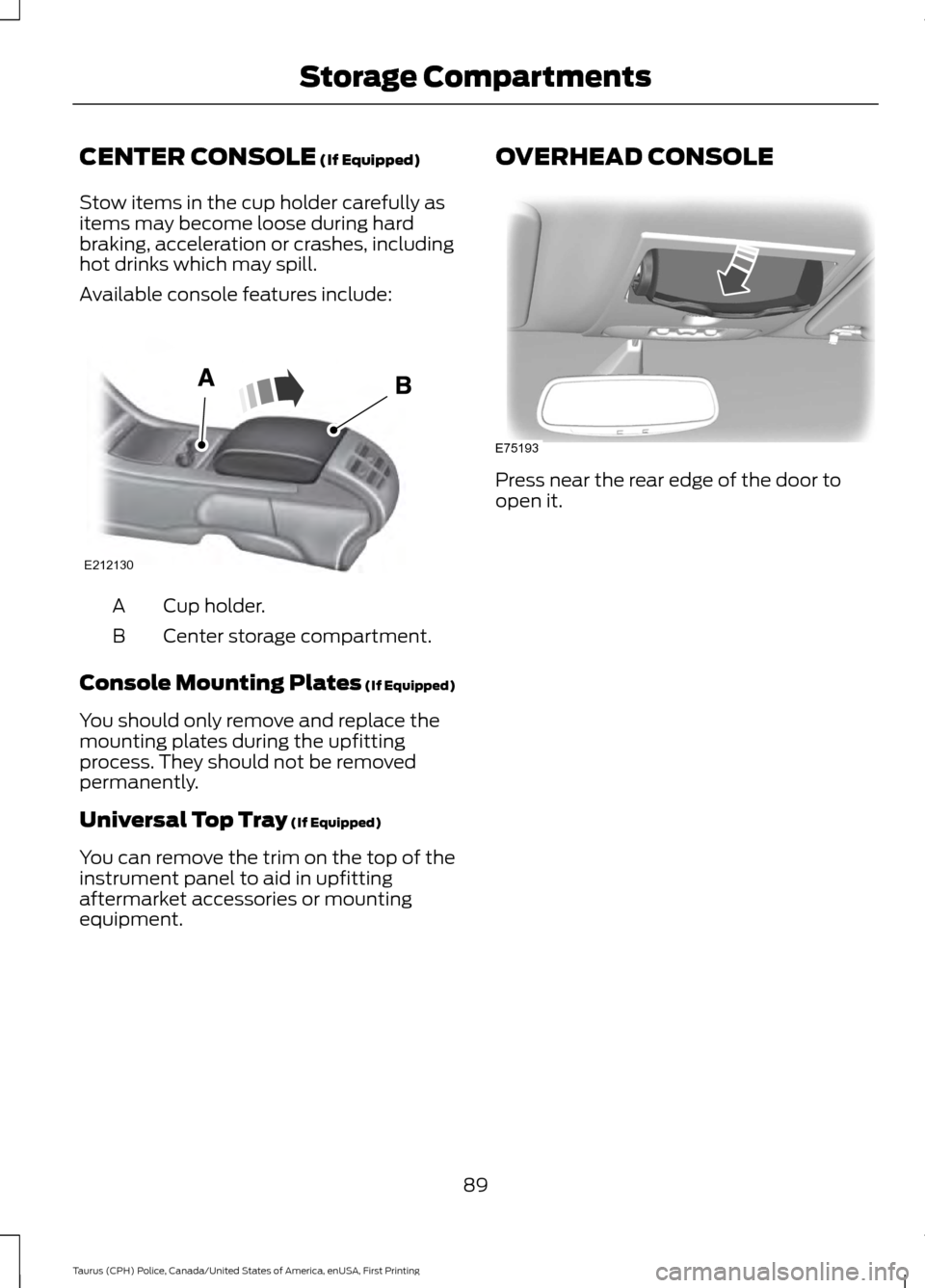
CENTER CONSOLE (If Equipped)
Stow items in the cup holder carefully as
items may become loose during hard
braking, acceleration or crashes, including
hot drinks which may spill.
Available console features include: Cup holder.
A
Center storage compartment.
B
Console Mounting Plates (If Equipped)
You should only remove and replace the
mounting plates during the upfitting
process. They should not be removed
permanently.
Universal Top Tray
(If Equipped)
You can remove the trim on the top of the
instrument panel to aid in upfitting
aftermarket accessories or mounting
equipment. OVERHEAD CONSOLE
Press near the rear edge of the door to
open it.
89
Taurus (CPH) Police, Canada/United States of America, enUSA, First Printing Storage CompartmentsE212130 E75193
Page 121 of 358

PRINCIPLE OF OPERATION
WARNINGS
Vehicle modifications involving
braking system, aftermarket roof
racks, suspension, steering system,
tire construction and wheel and tire size
may change the handling characteristics
of your vehicle and may adversely affect
the performance of the electronic stability
control system. In addition, installing any
stereo loudspeakers may interfere with
and adversely affect the electronic stability
control system. Install any aftermarket
stereo loudspeaker as far as possible from
the front center console, the tunnel, and
the front seats in order to minimize the risk
of interfering with the electronic stability
control sensors. Reducing the
effectiveness of the electronic stability
control system could lead to an increased
risk of loss of vehicle control, vehicle
rollover, personal injury and death. Remember that even advanced
technology cannot defy the laws of
physics. It’
s always possible to lose
control of a vehicle due to inappropriate
driver input for the conditions. Aggressive
driving on any road condition can cause
you to lose control of your vehicle
increasing the risk of personal injury or
property damage. Activation of the
electronic stability control system is an
indication that at least some of the tires
have exceeded their ability to grip the road;
this could reduce the operator ’s ability to
control the vehicle potentially resulting in
a loss of vehicle control, vehicle rollover,
personal injury and death. If your electronic
stability control system activates, SLOW
DOWN. The system automatically turns on each
time you switch the ignition on. If a fault occurs in either the stability
control or the traction control system, you
may experience the following conditions:
•
The stability and traction control light
illuminates steadily.
• The stability control and traction
control systems do not enhance your
vehicle's ability to maintain traction of
the wheels.
If a driving condition activates either the
stability control or the traction control
system you may experience the following
conditions:
• The stability and traction control light
flashes.
• Your vehicle slows down.
• Reduced engine power.
• A vibration in the brake pedal.
• The brake pedal is stiffer than usual.
• If the driving condition is severe and
your foot is not on the brake, the brake
pedal may move as the system applies
higher brake force.
The stability control system has several
features built into it to help you maintain
control of your vehicle:
Electronic Stability Control
The system enhances your vehicle ’s ability
to prevent skids or lateral slides by
applying brakes to one or more of the
wheels individually and, if necessary,
reducing engine power.
Traction Control
The system enhances your vehicle ’s ability
to maintain traction of the wheels by
detecting and controlling wheel spin. See
Using Traction Control (page 117).
118
Taurus (CPH) Police, Canada/United States of America, enUSA, First Printing Stability Control
Page 162 of 358
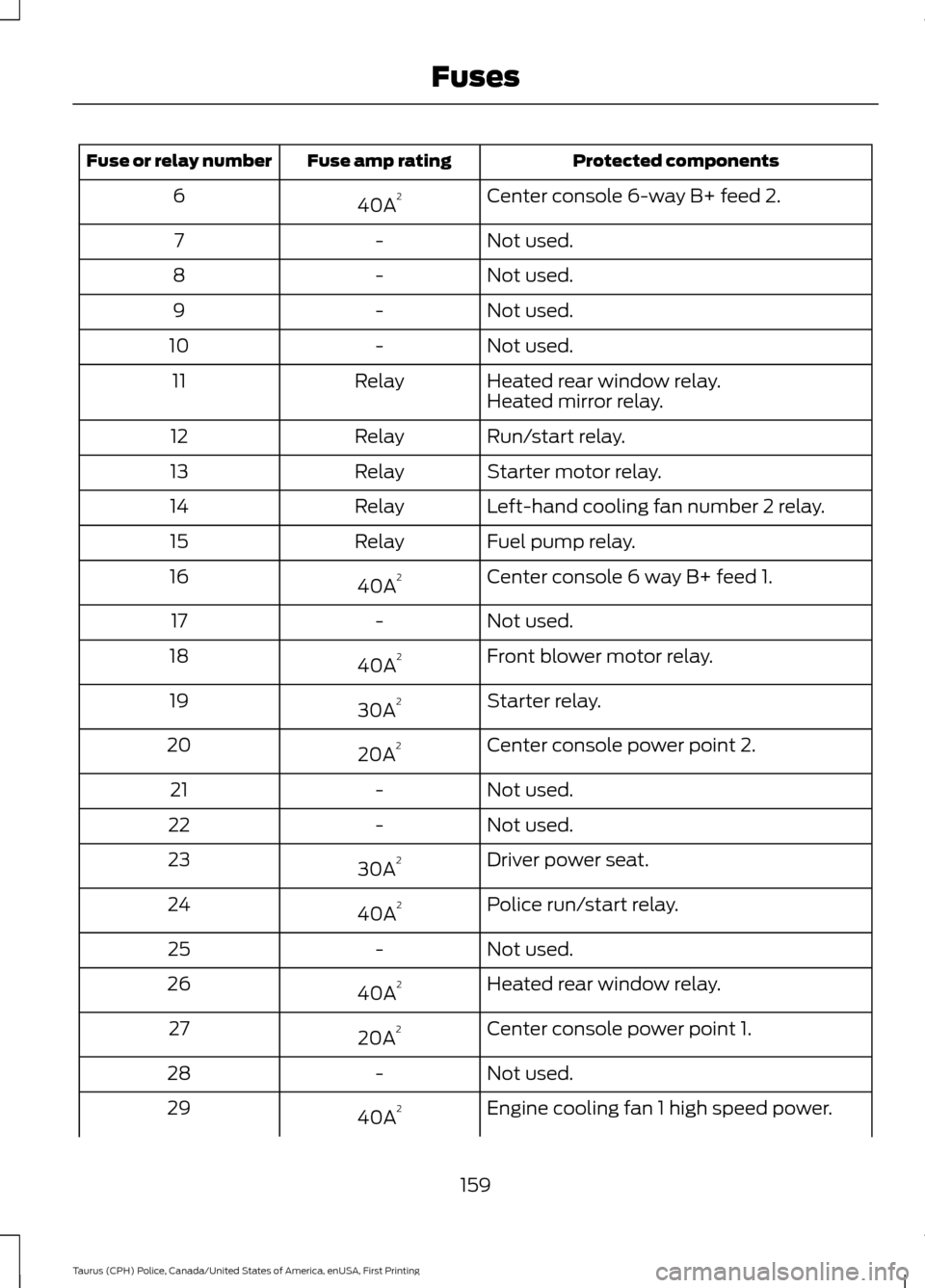
Protected components
Fuse amp rating
Fuse or relay number
Center console 6-way B+ feed 2.
40A 2
6
Not used.
-
7
Not used.
-
8
Not used.
-
9
Not used.
-
10
Heated rear window relay.
Relay
11
Heated mirror relay.
Run/start relay.
Relay
12
Starter motor relay.
Relay
13
Left-hand cooling fan number 2 relay.
Relay
14
Fuel pump relay.
Relay
15
Center console 6 way B+ feed 1.
40A 2
16
Not used.
-
17
Front blower motor relay.
40A 2
18
Starter relay.
30A 2
19
Center console power point 2.
20A 2
20
Not used.
-
21
Not used.
-
22
Driver power seat.
30A 2
23
Police run/start relay.
40A 2
24
Not used.
-
25
Heated rear window relay.
40A 2
26
Center console power point 1.
20A 2
27
Not used.
-
28
Engine cooling fan 1 high speed power.
40A 2
29
159
Taurus (CPH) Police, Canada/United States of America, enUSA, First Printing Fuses