2017 FORD F150 air filter
[x] Cancel search: air filterPage 323 of 599

Engine oil dipstick. See Engine Oil Dipstick (page 322).
D.
Brake fluid reservoir. See
Brake Fluid Check (page 328).
E.
Air filter assembly. See
Changing the Engine Air Filter (page 339).
F.
Engine coolant reservoir. See
Engine Coolant Check (page 323).
G.
Windshield washer fluid reservoir. See
Washer Fluid Check (page 329).
H.
UNDER HOOD OVERVIEW - 3.5L ECOBOOST™ Windshield washer fluid reservoir. See
Washer Fluid Check (page 329).
A.
Battery. See
Changing the 12V Battery (page 329).
B.
Engine oil filler cap. See
Engine Oil Check (page 322).
C.
Engine oil dipstick. See
Engine Oil Dipstick (page 322).
D.
Brake fluid reservoir. See
Brake Fluid Check (page 328).
E.
Engine coolant reservoir. See
Engine Coolant Check (page 323).
F.
320
F-150 (TFC) Canada/United States of America, enUSA, First Printing MaintenanceA
A
BDEFC
GHE166496
Page 324 of 599

Air filter assembly. See Changing the Engine Air Filter (page 339).
G.
Power distribution box. See
Fuses (page 307).
H.
UNDER HOOD OVERVIEW - 5.0L Windshield washer fluid reservoir. See
Washer Fluid Check (page 329).
A.
Battery. See
Changing the 12V Battery (page 329).
B.
Engine oil filler cap. See
Engine Oil Check (page 322).
C.
Engine oil dipstick. See
Engine Oil Dipstick (page 322).
D.
Brake fluid reservoir. See
Brake Fluid Check (page 328).
E.
Engine coolant reservoir. See
Engine Coolant Check (page 323).
F.
Air filter assembly. See
Changing the Engine Air Filter (page 339).
G.
Power distribution box. See
Fuses (page 307).
H.
321
F-150 (TFC) Canada/United States of America, enUSA, First Printing MaintenanceE166494
AAABACADAEAF
AAAGAAAH
Page 332 of 599
WASHER FLUID CHECK
WARNING
If you operate your vehicle in
temperatures below 40°F (5°C), use
washer fluid with antifreeze
protection. Failure to use washer fluid with
antifreeze protection in cold weather could
result in impaired windshield vision and
increase the risk of injury or accident. Add fluid to fill the reservoir if the level is
low. Only use a washer fluid that meets
Ford specifications. See Capacities and
Specifications (page 381).
State or local regulations on volatile
organic compounds may restrict the use
of methanol, a common windshield washer
antifreeze additive. Washer fluids
containing non-methanol antifreeze
agents should be used only if they provide
cold weather protection without damaging
the vehicle ’s paint finish, wiper blades or
washer system.
FUEL FILTER
Your vehicle is equipped with a lifetime
fuel filter that is integrated with the fuel
tank. Regular maintenance or replacement
is not needed.
CHANGING THE 12V BATTERY WARNINGS
Batteries normally produce explosive
gases which can cause personal
injury. Therefore, do not allow
flames, sparks or lighted substances to
come near the battery. When working near
the battery, always shield your face and
protect your eyes. Always provide correct
ventilation. WARNINGS
When lifting a plastic-cased battery,
excessive pressure on the end walls
could cause acid to flow through the
vent caps, resulting in personal injury and
damage to the vehicle or battery. Lift the
battery with a battery carrier or with your
hands on opposite corners. Keep batteries out of reach of
children. Batteries contain sulfuric
acid. Avoid contact with skin, eyes or
clothing. Shield your eyes when working
near the battery to protect against possible
splashing of acid solution. In case of acid
contact with skin or eyes, flush
immediately with water for a minimum of
15 minutes and get prompt medical
attention. If acid is swallowed, call a
physician immediately. Battery posts, terminals and related
accessories contain lead and lead
compounds. Wash hands after
handling. This vehicle may be fitted with more
than one battery. Removing the
battery cables from only one battery
does not disconnect your vehicle electrical
system. Make sure you disconnect the
battery cables from all batteries when
disconnecting power. Failure to do so may
cause serious personal injury or property
damage. Your vehicle is fitted with a Motorcraft
maintenance-free battery which normally
does not require additional water.
When a battery replacement is required,
you must use a recommended
replacement battery that matches the
electrical requirements of the vehicle.
Note:
After cleaning or replacing the
battery, make sure you reinstall the battery
cover or shield.
329
F-150 (TFC) Canada/United States of America, enUSA, First Printing Maintenance
Page 342 of 599
CHANGING THE ENGINE AIR
FILTER
WARNING
To reduce the risk of vehicle damage
and personal burn injuries, do not
start your engine with the air cleaner
removed and do not remove it while the
engine is running. Note:
Failure to use the correct air filter
element may result in severe engine
damage. Resulting component damage
may not be covered by the vehicle Warranty.
Note: When servicing the air cleaner, do not
allow foreign material to enter the air
induction system. The engine is susceptible
to damage from even small particles.
When changing the air filter element, use
only the air filter element listed. See
Capacities and Specifications (page
381).
Change the air filter element at the proper
intervals. See
Scheduled Maintenance
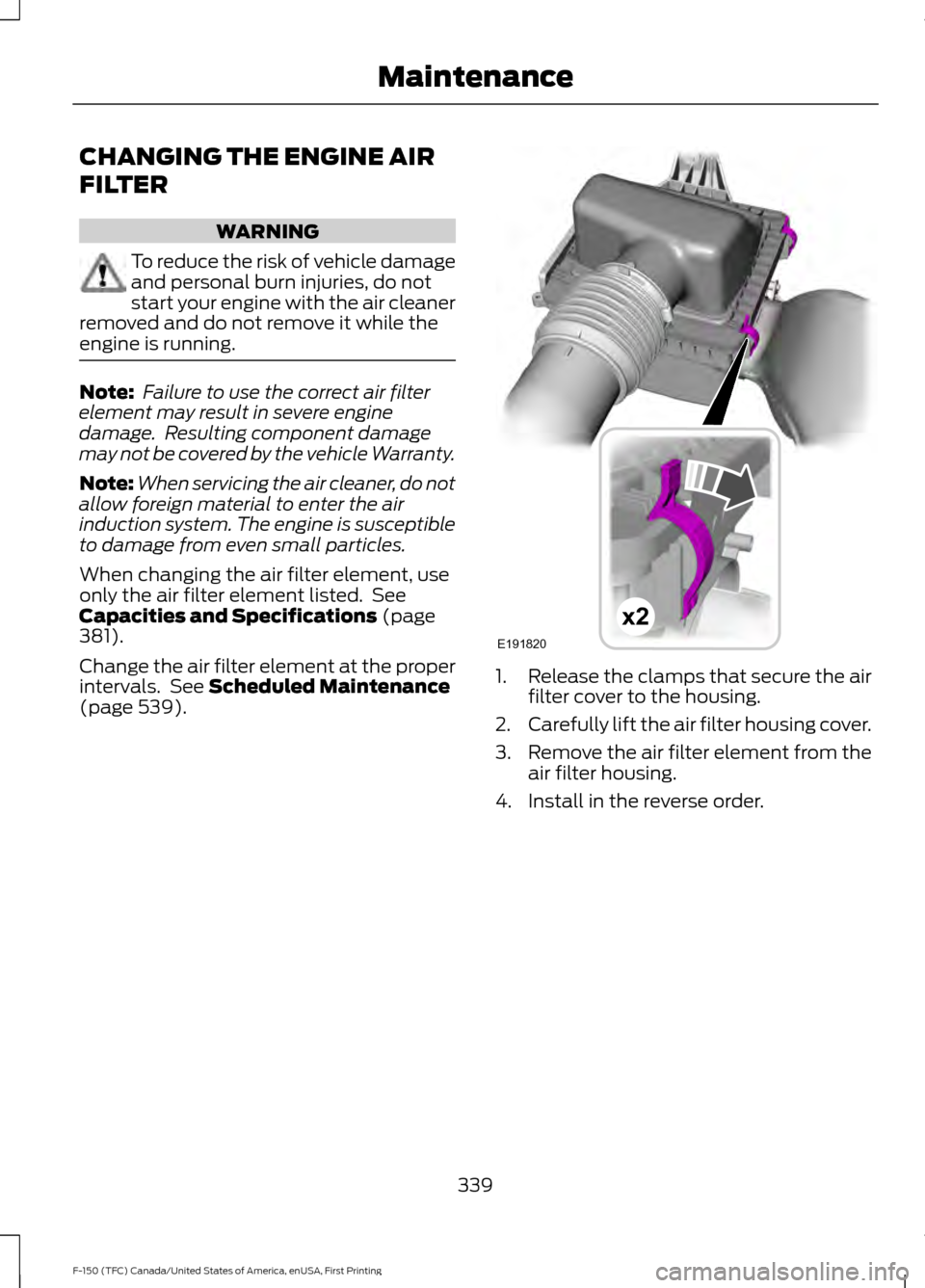
(page 539). 1.
Release the clamps that secure the air
filter cover to the housing.
2. Carefully lift the air filter housing cover.
3. Remove the air filter element from the
air filter housing.
4. Install in the reverse order.
339
F-150 (TFC) Canada/United States of America, enUSA, First Printing MaintenanceE191820x2
Page 346 of 599

•
Never wash or rinse any ignition coil,
spark plug wire or spark plug well, or
the area in and around these locations.
• Cover the battery, power distribution
box, and air filter assembly to prevent
water damage when cleaning the
engine.
CLEANING THE WINDOWS AND
WIPER BLADES
Car wash chemicals and environmental
fallout can result in windshield and wiper
blade contamination. Dirty windshield and
wipers will result in poor windshield wiper
operation. Keep the windshield and wiper
blades clean to maintain windshield wiper
performance.
To clean the windshield and wiper blades:
• Clean the windshield with a
non-abrasive glass cleaner. When
cleaning the interior of the windshield,
avoid getting any glass cleaner on the
instrument panel or door panels. Wipe
any glass cleaner off these surfaces
immediately.
• For windshields contaminated with
tree sap, chemicals, wax or bugs, clean
the entire windshield using steel wool
(no greater than 0000 grade) in a
circular motion and rinse with water.
• Clean the wiper blades with isopropyl
rubbing alcohol or windshield washer
concentrate.
Note: Do not use razor blades or other
sharp objects to clean or remove decals
from the inside of the heated rear window.
The vehicle warranty does not cover
damage caused to the heated rear window
grid lines. CLEANING THE INTERIOR WARNINGS
Do not use cleaning solvents, bleach
or dye on the vehicle
’s safety belts,
as these actions may weaken the
belt webbing. On vehicles equipped with
seat-mounted airbags, do not use
chemical solvents or strong
detergents. Such products could
contaminate the side airbag system and
affect performance of the side airbag in a
collision. For fabric, carpets, cloth seats, safety belts
and seats equipped with side airbags:
•
Remove dust and loose dirt with a
vacuum cleaner.
• Remove light stains and soil with
Motorcraft Professional Strength
Carpet & Upholstery Cleaner.
• If grease or tar is present on the
material, spot-clean the area first with
Motorcraft Spot and Stain Remover. In
Canada, use Motorcraft Multi-Purpose
Cleaner.
• If a ring forms on the fabric after spot
cleaning, clean the entire area
immediately (but do not oversaturate)
or the ring will set.
• Do not use household cleaning
products or glass cleaners, which can
stain and discolor the fabric and affect
the flame retardant abilities of the seat
materials.
343
F-150 (TFC) Canada/United States of America, enUSA, First Printing Vehicle Care
Page 350 of 599

•
Lubricate all hood, door and luggage
compartment hinges and latches with
a light grade oil.
• Cover interior trim to prevent fading.
• Keep all rubber parts free from oil and
solvents.
Engine
• Change the engine oil and filter prior to
storage because used engine oil
contains contaminates which may
cause engine damage.
• Start the engine every 15 days for a
minimum of 15 minutes. Run at fast idle
with the climate controls set to defrost
until the engine reaches normal
operating temperature.
• With your foot on the brake, shift
through all the gears while the engine
is running.
• We recommend that you change the
engine oil before you use your vehicle
again.
Fuel system
• Fill the fuel tank with high-quality fuel
until the first automatic shutoff of the
fuel pump nozzle.
Cooling system
• Protect against freezing temperatures.
• When removing your vehicle from
storage, check coolant fluid level.
Confirm that there are no cooling
system leaks and that fluid is at the
recommended level. Battery
•
Check and recharge as necessary. Keep
connections clean.
• If storing your vehicle for more than 30
days without recharging the battery,
we recommend that you disconnect
the battery cables to maintain battery
charge for quick starting.
Note: It is necessary to reset memory
features if battery cables are disconnected.
Brakes
• Make sure the brakes and parking brake
release fully.
Tires
• Maintain recommended air pressure.
Miscellaneous
• Make sure all linkages, cables, levers
and pins under your vehicle are covered
with grease to prevent rust.
• Move vehicles at least 25 ft (7.5 m)
every 15 days to lubricate working parts
and prevent corrosion.
Removing Vehicle From Storage
When your vehicle is ready to come out of
storage, do the following:
• Wash your vehicle to remove any dirt
or grease film build-up on window
surfaces.
• Check windshield wipers for any
deterioration.
• Check under the hood for any foreign
material that may have collected
during storage such as mice or squirrel
nests.
• Check the exhaust for any foreign
material that may have collected
during storage.
347
F-150 (TFC) Canada/United States of America, enUSA, First Printing Vehicle Care
Page 386 of 599

ENGINE SPECIFICATIONS - 5.0L
5.0L V8
Engine
302
Cubic inches
1-3-7-2-6-5-4-8
Firing order
Coil on plug
Ignition system
.049-.053 in. (1.25 - 1.35 mm)
Spark plug gap
10.5:1
Compression ratio
Drivebelt Routing MOTORCRAFT PARTS - 2.7L ECOBOOST™
2.7L Ecoboost
Component
FA-1883
Air filter element.
FL-2062
Oil filter.
BAGM-48H6-760
Battery.
BAGM-94RH7-800
(King Ranch, Lariat and Premium)
SP-542
Spark plugs.
WW-2242
Windshield wiper blade.
FP-79
Cabin air filter.
383
F-150 (TFC) Canada/United States of America, enUSA, First Printing Capacities and SpecificationsE167465
Page 387 of 599

For scheduled maintenance, we
recommend Motorcraft® replacement
parts available at your Ford dealer or at
fordparts.com. These parts meet or exceed
Ford Motor Company
’s specifications and
are engineered for your vehicle. Use of
other parts may impact vehicle
performance, emissions and durability.
Your warranty may be void for any damage related to use of other parts.
If a Motorcraft® oil filter is not available,
use an oil filter that meets industry
performance specification
SAE/USCAR-36.
For spark plug replacement, contact an
authorized dealer. Replace the spark plugs
at the appropriate intervals. See
Scheduled Maintenance (page 539).
MOTORCRAFT PARTS - 3.5L Motorcraft Part number
Component
FA-1883
Air filter element.
FL-500-S
Oil filter.
BXT-48H6-610
Battery.
SP-520
Spark plugs.
FT-138
Transmission filter.
WW-2242
Windshield wiper blade.
FP-79
Cabin air filter.
We recommend Motorcraft replacement
parts available at your Ford dealer or at
fordparts.com for scheduled maintenance.
These parts meet or exceed Ford Motor
Company ’s specifications and are
engineered for your vehicle. Use of other
parts may impact vehicle performance,
emissions and durability. Your warranty
may be void for any damage related to use
of other parts. If a Motorcraft oil filter is not available, use
an oil filter that meets industry
performance specification
SAE/USCAR-36.
For spark plug replacement, contact an
authorized dealer. Replace the spark plugs
at the appropriate intervals. See
Scheduled Maintenance
(page 539).
384
F-150 (TFC) Canada/United States of America, enUSA, First Printing Capacities and Specifications