Page 95 of 216

WARNING
116)It is dangerous to run the engine in
enclosed areas. The engine takes in
oxygen and releases carbon dioxide,
carbon monoxide and other toxic gases.
117)Remember that the brake servo
and power steering are not operational until
the engine has been started, therefore
you need to apply much more force than
usual to the brake pedal and steering
wheel.
118)If the engine fails to start with a gear
engaged, the potentially dangerous
situation due to the fact that the gearbox is
automatically placed in neutral will be
signalled by an acoustic signal.
WARNING
38)If the warning lightflashes for 60
seconds after starting or during an
extended towing period, this indicates a
problem in the glow plug preheating
system. You can use the vehicle as usual if
the engine starts but you should contact
a Fiat Dealership as soon as possible.
39)It is advisable not to demand maximum
performance from your vehicle (e.g.
excessive acceleration, long distances at
maximum rpm, excessively intense braking,
etc.) when it is first used.
40)When the engine is off, do not leave
the key turned to MAR to prevent
unnecessary electrical consumption from
draining the battery.41)Never bump start the engine by
pushing, towing or coasting downhill. This
could cause fuel to flow into the catalytic
converter and damage it beyond repair.
42)There must therefore always be some
petrol in the tank to protect the petrol
pump and to guarantee temporary
switching from LPG or Methane to petrol
operation, if high performance is required.
43)A quick burst on the accelerator
before stopping the engine serves no
practical purpose; it wastes fuel and is
especially damaging to turbocharged
engines.
PARKING THE
VEHICLE
When parking and leaving the car,
proceed as follows:
engage a gear (1st gear if facing
uphill or reverse if facing downhill) and
leave the wheels turned;
stop the engine and engage the
handbrake;
always remove the ignition key.
Block the wheels with a wedge or a
stone if the car is parked on a steep
slope.
On versions equipped with Dualogic
transmission, wait for the letter P to be
displayed before releasing the brake
pedal.
WARNING Never leave the car with the
gearbox in neutral (or, on versions
equipped with Dualogic transmission,
before putting the gear lever in the
P position).
Handbrake
194) 195) 196)
The handbrake lever is located between
the two front seats.
Handbrake engagement: pull lever A
fig. 77 upwards until the vehicle is
braked.
93
Page 100 of 216

IMPORTANT During parking
manoeuvres requiring a lot of steering,
the steering may become harder; this is
normal and is due to the intervention
of the system to protect the electric
steering motor from overheating so no
intervention is required. When the
vehicle is used again later on,
the power steering will work normally.
WARNING
123)It is absolutely forbidden to carry out
any after-market operation involving
steering system or steering column
modifications (e.g. installation of anti-theft
device) that could adversely affect
performance and safety, invalidate the
warranty and also result in non-compliance
of the vehicle with type-approval
requirements.124)Before servicing the vehicle, switch off
the engine and remove the key from the
ignition switch to activate the steering lock.
This is especially important when the
vehicle wheels are not touching the
ground. If this is not possible (for example if
the key needs to be turned to MAR or the
engine must be running), remove the
main fuse that protects the electric power
steering.
ECO FUNCTION
(for versions/markets, where provided)
To activate the function press the ECO
button fig. 83.
When the ECO function is active, the
car is set for driving characterised
by reduced fuel consumption. When
the function is active, the
corresponding LED on the button
switches on.
This function stays in the memory and,
when the vehicle is started again, the
system keeps the setting it had before
the engine was stopped. Press the
ECO button again to deactivate the
function and restore the normal driving
setting.
82F1D0025
83F1D0140
98
STARTING AND DRIVING
Page 122 of 216

If the required pressure is reached,
continue driving. Do not exceed
80 km/h. Avoid sudden acceleration or
braking. After driving for about 8 km /
5 miles, position the vehicle in a safe
and suitable area and engage the
handbrake. Take the kit, ensure that the
on-off button A (fig. 117) is in the0
position and insert the electrical
connector in the car’s 12V socket.
Remove the repaired tyre’s valve cap,
take out the black inflation tube and
screw it firmly onto the valve. Inspect
the pressure gauge F to check the tyre
pressure.
If the pressure is lower than 1.8 bar /
26 psi, the TYRE IS TOO DAMAGED
AND CANNOT BE REPAIRED.
Disconnect, put the kit back in its
compartment and call roadside
assistance.
If the pressure is equal to or higher
than 1.8 bar / 26 psi, switch on the
compressor to reach the required
pressure. Disconnect and replace the
kit in the specific compartment. Drive
carefully to a specialist or the
manufacturer’s dealership as soon as
possible.PRESSURE RESTORING
Take out the black inflation tube and
screw it firmly onto the tyre valve. Press
the button B fig. 118 to adjust any
tyre overpressure.
CARTRIDGE
REPLACEMENT
Only use Fix&Go original cartridges
which can be purchased at Fiat
Dealership. Press the release button C
and lift it to remove the cartridge A
fig. 118. Insert the new cartridge and
press it firmly downwards.
WARNING
147)The information required by the
applicable regulation is indicated on the
Fix&Go kit package label. Compliance with
the indications on the label is an essential
condition to ensure the safety and the
effectiveness of the Fix&Go kit. Carefully
read the label before use, avoid improper
use. Fix&Go is subject to expiration and
must be replaced periodically. The kit
should be used by adults and cannot be
used by children.
WARNING
55)Show the package and the label to the
personnel charged with handling the tyre
treated with the tyre repair kit.
56)Fix&Go provides a temporary repair,
therefore the tyre must be examined and
repaired by a specialist as soon as
possible. The sealing fluid is effective at
temperatures between -40°C and +50°C. It
is possible to repair tyres which have
been damaged on tread up to a diameter
of 4mm; however, tyres damaged on
their side cannot be repaired. Before using
Fix&Go kit, ensure that the tyre isn't
excessively damaged and that the rim is in
good condition, otherwise do not use it
and call roadside assistance. Do not
remove foreign bodies from the tyre. Do
not let the compressor turned on for more
than 20 consecutive minutes - overheating
hazard.
118F1D0150
120
IN AN EMERGENCY
Page 131 of 216

Thousands of kilometres 15 30 45 60 75 90 105 120 135 150
Years12345678910
Check and, if necessary, top-up the Dualogic gearbox oil
level (2)
Check manual gearbox with drive transmission idler unit
(PTU) oil level (Panda Cross and Panda 4x4 versions only)
Check rear differential oil level (Panda Cross and Panda
4x4 versions only)
Visually inspect condition of: LPG pipes and connectors,
LPG tank fixing (LPG versions only)
Check fuel system operation and parameters using the
diagnosis socket (LPG versions only)
Visually inspect condition of: methane pipes and
connectors and methane cylinder fastening, restore if
necessary (Natural Power versions only) (3)
Check pressure regulator and replace internal filter, if
necessary (Natural Power versions only) (3)
Check fuel system operation and parameters using self-
diagnosis socket (Natural Power versions only)
Check torque tightening of cylinder fastening bands
(Natural Power versions only)
Check pressure regulator heating pipes sealing (Natural
Power versions only)
(2) Check to be carried out every year for cars on the road in countries with particularly severe climates (cold countries).
(3) Or every year.
129
Page 203 of 216
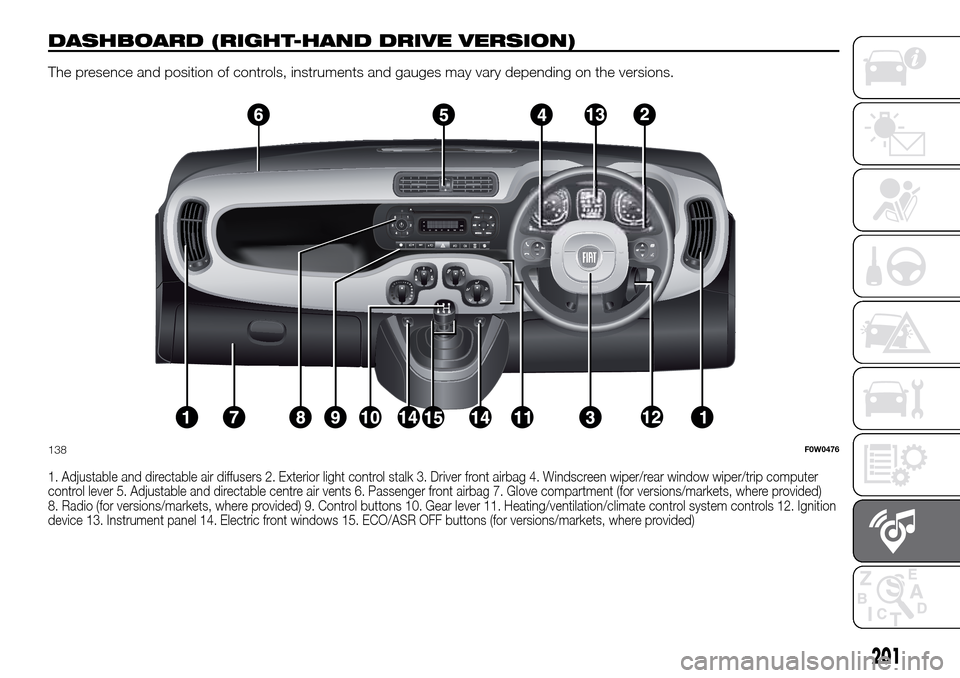
DASHBOARD (RIGHT-HAND DRIVE VERSION)
The presence and position of controls, instruments and gauges may vary depending on the versions.
1. Adjustable and directable air diffusers 2. Exterior light control stalk 3. Driver front airbag 4. Windscreen wiper/rear window wiper/trip computer
control lever 5. Adjustable and directable centre air vents 6. Passenger front airbag 7. Glove compartment (for versions/markets, where provided)
8. Radio (for versions/markets, where provided) 9. Control buttons 10. Gear lever 11. Heating/ventilation/climate control system controls 12. Ignition
device 13. Instrument panel 14. Electric front windows 15. ECO/ASR OFF buttons (for versions/markets, where provided)
138F0W0476
201