Page 278 of 370
Inspect the wheel mounting surface prior to mounting
the tire and remove any corrosion or loose particles.
Tighten the lug nuts/bolts in a star pattern until each
nut/bolt has been tightened twice.After 25 miles (40 km) check the lug nut/bolt torque to
be sure that all the lug nuts/bolts are properly seated
against the wheel.
WARNING!
To avoid the risk of forcing the vehicle off the jack,
do not tighten the lug nuts fully until the vehicle
has been lowered. Failure to follow this warning
may result in personal injury.
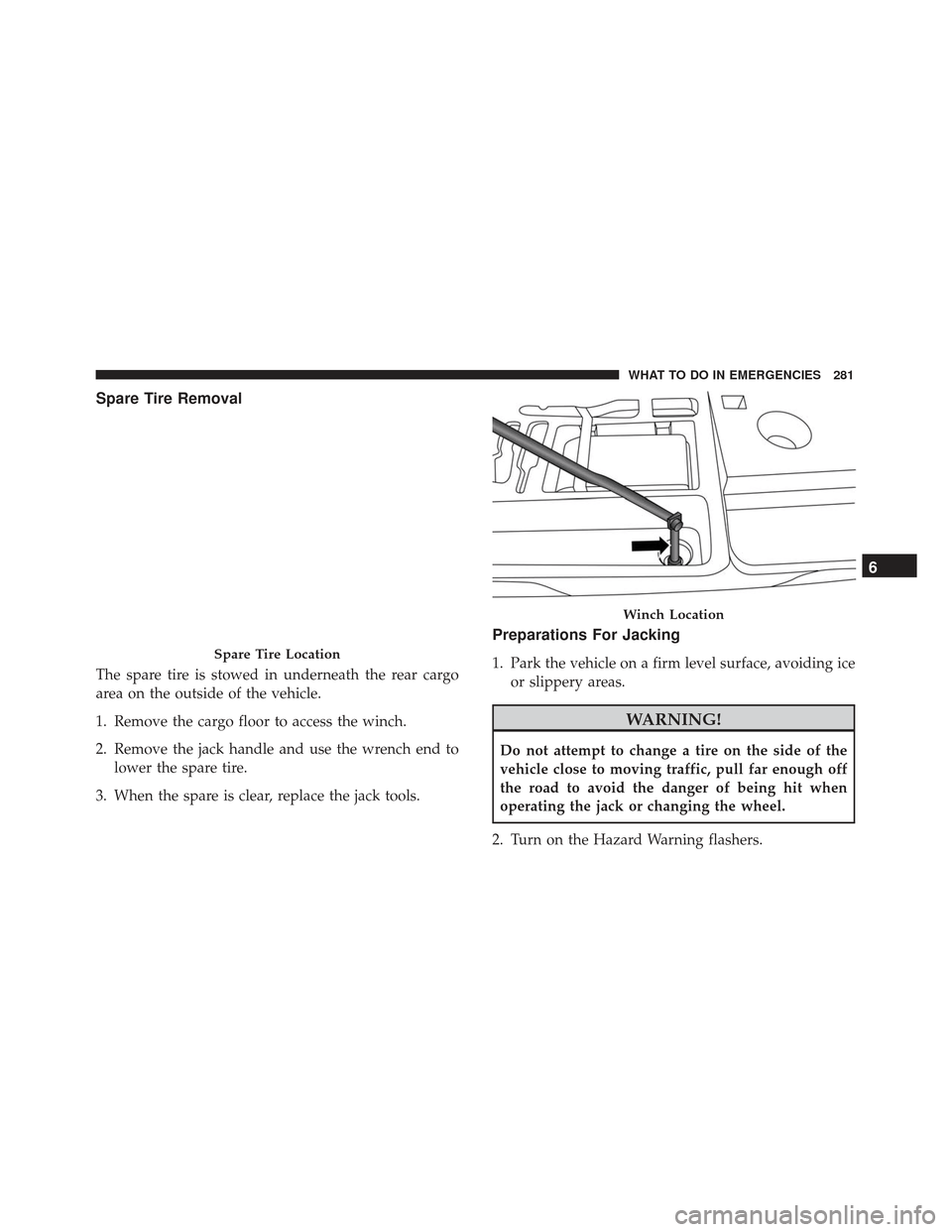
Wheel Mounting Surface
Torque Patterns
276 WHAT TO DO IN EMERGENCIES
Page 279 of 370

TIRE SERVICE KIT
If a tire is punctured, you can make a first emergency
repair using the Tire Service Kit located in the rear
storage area under the cargo floor.Tire punctures of up to 1/4 of an inch (6mm) can be
repaired; the kit can be used in all weather conditions.
Do not remove the foreign object from the punctured
tire, i.e., screw or nail.
Remove the Tire Service Kit from the vehicle, take it out
from the bag and place it near the punctured tire. Screw
the clear flexible filling tube to the tire valve.
WARNING!
•
Do not attempt to seal a tire on the side of the
vehicle closest to traffic. Pull far enough off the
road to avoid the danger of being hit when using
the Tire Service Kit.
• Do not use Tire Service Kit or drive the vehicle
under the following circumstances:
– If the puncture in the tire tread is approxi- mately 1/4 inch (6 mm) or larger.
– If the tire has any sidewall damage.
– If the tire has any damage from driving with extremely low tire pressure.
– If the tire has any damage from driving on a flat tire.
– If the wheel has any damage.
(Continued)
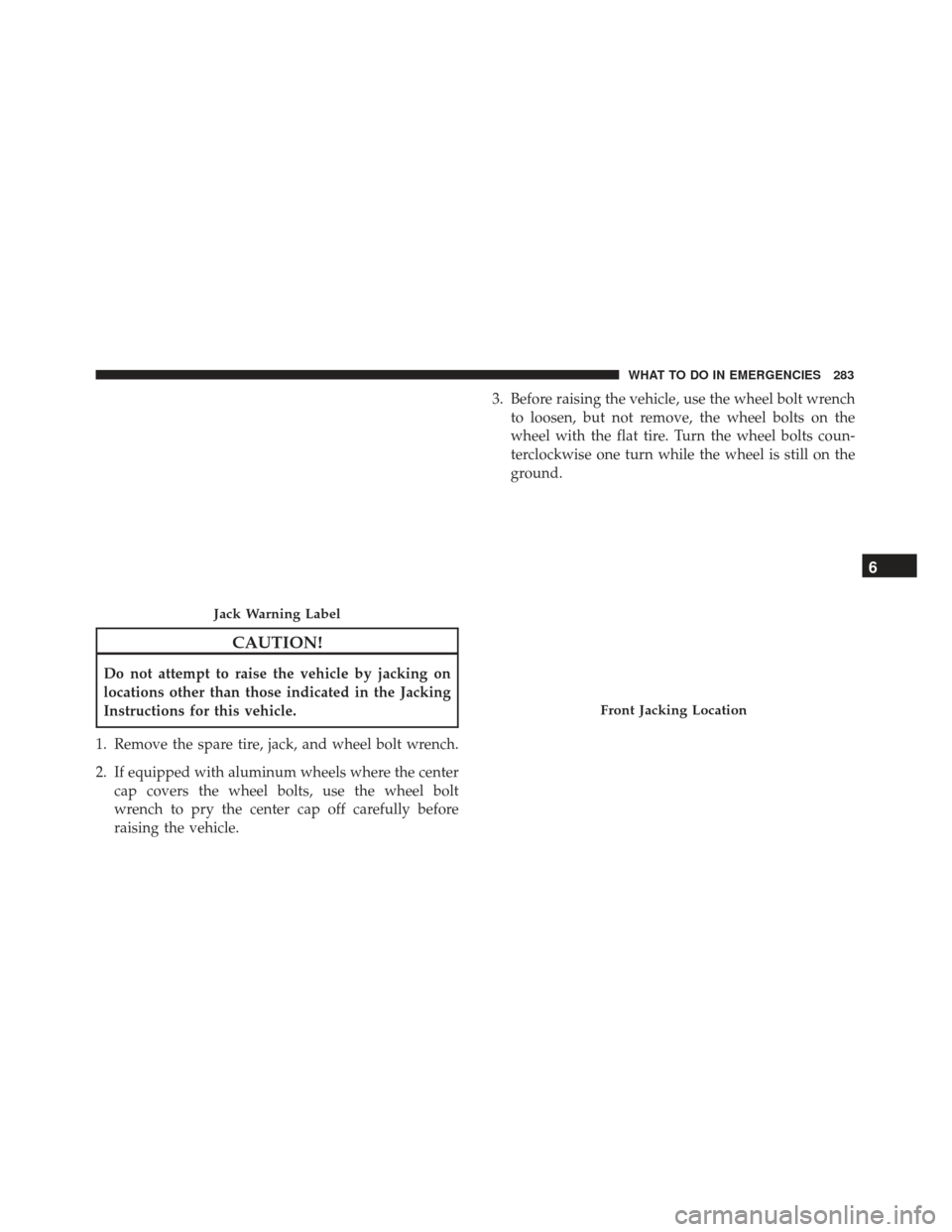
Tire Service Kit Components
1 — Power Plug (located on bottom side of Tire Service Kit)
2 — Sealant Hose (Clear)
3 — Power Button
4 — Pressure Gauge
5 — Sealant Bottle
6
WHAT TO DO IN EMERGENCIES 277
Page 280 of 370

WARNING!(Continued)
– If you are unsure of the condition of the tire or
the wheel.
• Keep Tire Service Kit away from open flames or
heat source.
• A loose Tire Service Kit thrown forward in a
collision or hard stop could endanger the occu-
pants of the vehicle. Always stow the Tire Service
Kit in the place provided. Failure to follow these
warnings can result in injuries that are serious or
fatal to you, your passengers, and others around
you.
• Take care not to allow the contents of Tire Service
Kit to come in contact with hair, eyes, or clothing.
Tire Service Kit sealant is harmful if inhaled,
swallowed, or absorbed through the skin. It
causes skin, eye, and respiratory irritation. Flush
immediately with plenty of water if there is any
contact with eyes or skin. Change clothing as soon
as possible, if there is any contact with clothing.
• Tire Service Kit Sealant solution contains latex. In
case of an allergic reaction or rash, consult a
physician immediately. Keep Tire Service Kit out
(Continued)
WARNING! (Continued)
of reach of children. If swallowed, rinse mouth
immediately with plenty of water and drink
plenty of water. Do not induce vomiting! Consult
a physician immediately.
Insert the power plug into the vehicle power outlet
socket. Start the vehicle engine.
Push the Tire Service Kit power button to the “I”
position. The electric compressor will be turned on,
sealant and air will inflate the tire.
Minimum 26 psi (1.8 bar) of pressure should be reached
within 20 minutes. If the pressure has not been reached,
turn off and remove the Tire Service Kit, drive the
vehicle 30 feet (10 meters) back and forth, to better
distribute the sealant inside the tire.
Attach the Clear flexible filling and tube of the com-
pressor directly to the tire valve and repeat the inflation
process.
When the correct pressure has been reached, start
driving the vehicle to uniformly distribute the sealant
inside the tire. After 10 minutes, stop and check the tire
pressure. If the pressure is below 19 psi (1.3 bar), do not
278 WHAT TO DO IN EMERGENCIES
Page 282 of 370
JACKING AND TIRE CHANGING — IF
EQUIPPED
WARNING!
•Do not attempt to change a tire on the side of the
vehicle close to moving traffic. Pull far enough off
the road to avoid the danger of being hit when
operating the jack or changing the wheel.
• Being under a jacked-up vehicle is dangerous.
The vehicle could slip off the jack and fall on you.
You could be crushed. Never put any part of your
body under a vehicle that is on a jack. If you need
to get under a raised vehicle, take it to a service
center where it can be raised on a lift.
• Never start or run the engine while the vehicle is
on a jack.
• The jack is designed to be used as a tool for
changing tires only. The jack should not be used
to lift the vehicle for service purposes. The ve-
hicle should be jacked on a firm level surface
only. Avoid ice or slippery areas.
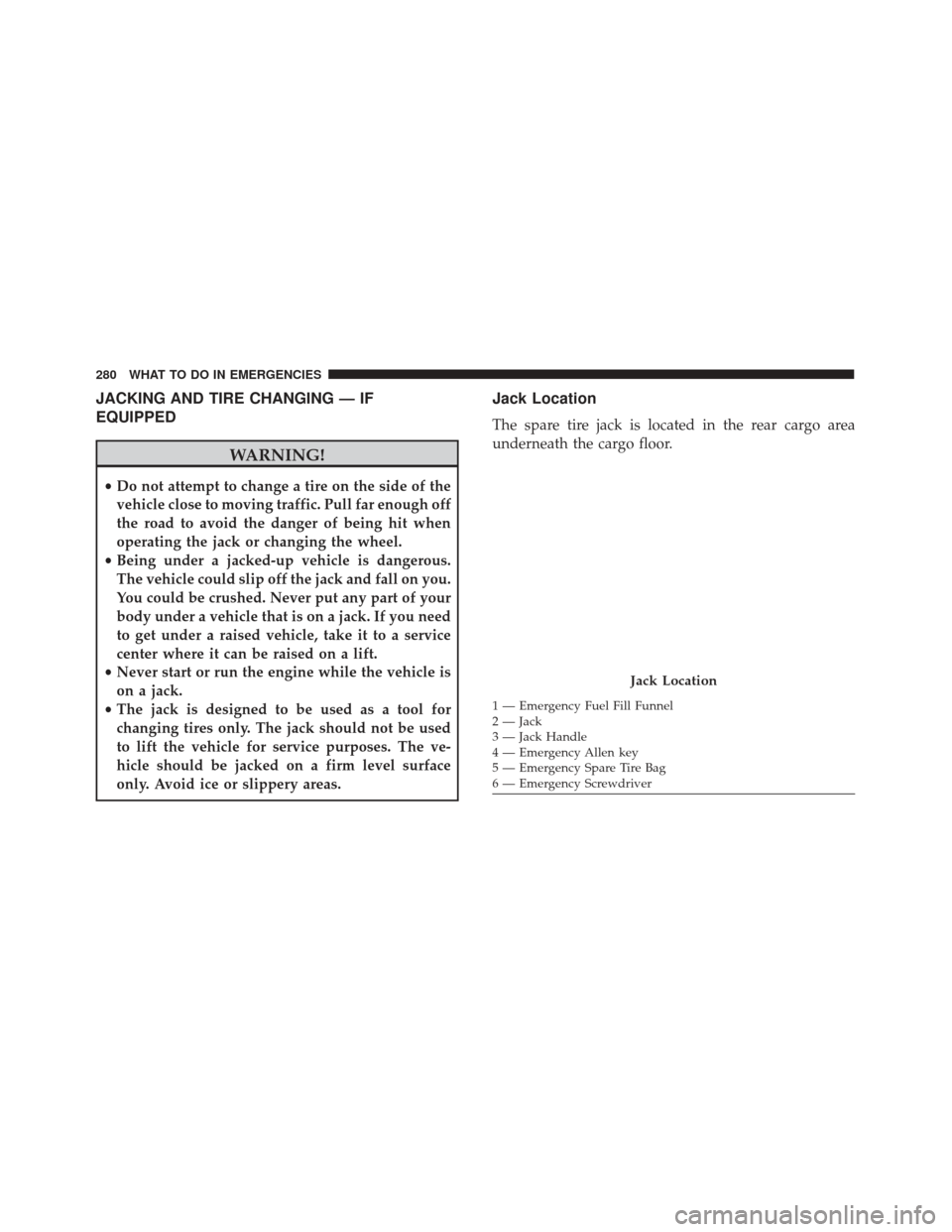
Jack Location
The spare tire jack is located in the rear cargo area
underneath the cargo floor.
Jack Location
1 — Emergency Fuel Fill Funnel
2 — Jack
3 — Jack Handle
4 — Emergency Allen key
5 — Emergency Spare Tire Bag
6 — Emergency Screwdriver
280 WHAT TO DO IN EMERGENCIES
Page 283 of 370
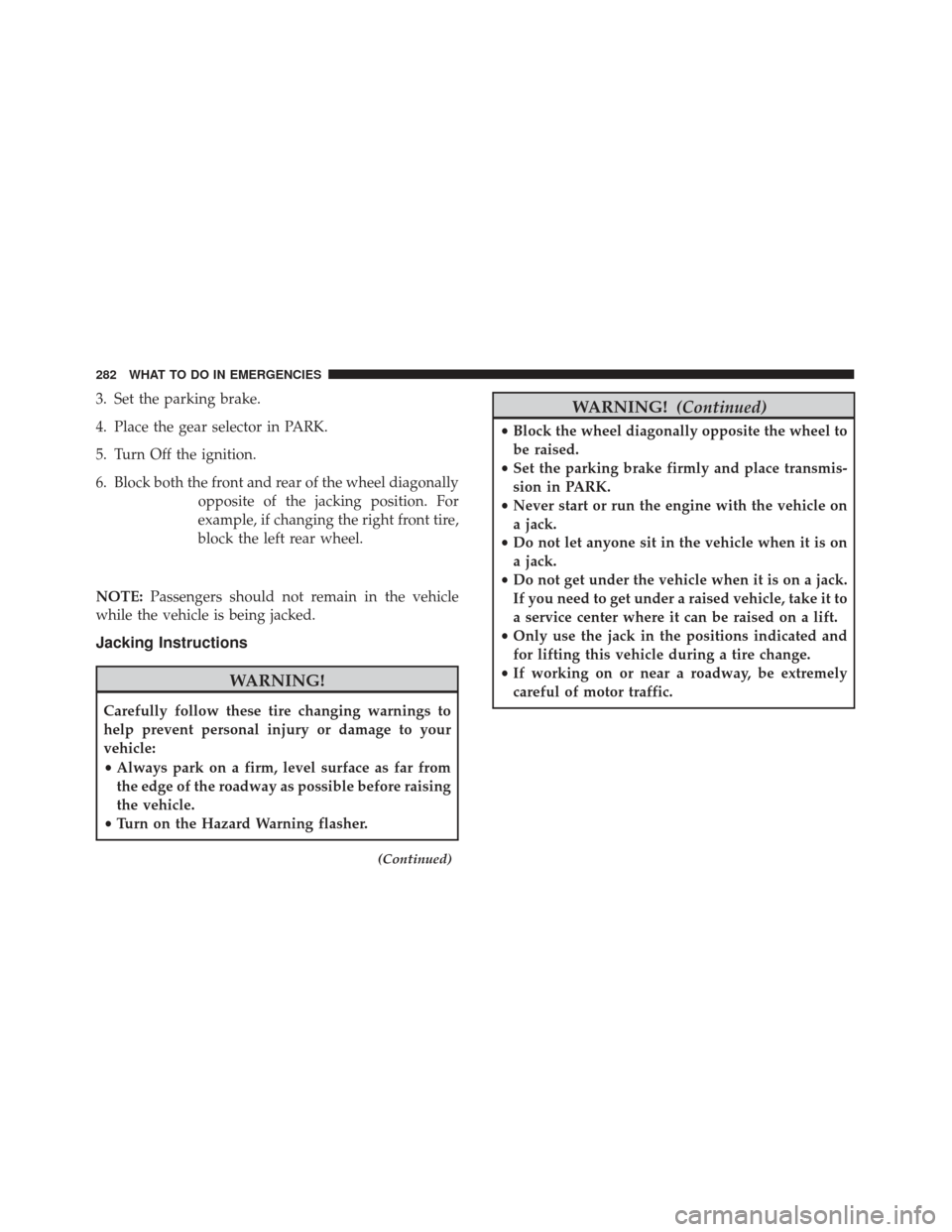
Spare Tire Removal
The spare tire is stowed in underneath the rear cargo
area on the outside of the vehicle.
1. Remove the cargo floor to access the winch.
2. Remove the jack handle and use the wrench end tolower the spare tire.
3. When the spare is clear, replace the jack tools.
Preparations For Jacking
1. Park the vehicle on a firm level surface, avoiding ice or slippery areas.
WARNING!
Do not attempt to change a tire on the side of the
vehicle close to moving traffic, pull far enough off
the road to avoid the danger of being hit when
operating the jack or changing the wheel.
2. Turn on the Hazard Warning flashers.
Spare Tire Location
Winch Location
6
WHAT TO DO IN EMERGENCIES 281
Page 284 of 370
3. Set the parking brake.
4. Place the gear selector in PARK.
5. Turn Off the ignition.
6. Block both the front and rear of the wheel diagonallyopposite of the jacking position. For
example, if changing the right front tire,
block the left rear wheel.
NOTE: Passengers should not remain in the vehicle
while the vehicle is being jacked.
Jacking Instructions
WARNING!
Carefully follow these tire changing warnings to
help prevent personal injury or damage to your
vehicle:
• Always park on a firm, level surface as far from
the edge of the roadway as possible before raising
the vehicle.
• Turn on the Hazard Warning flasher.
(Continued)
WARNING! (Continued)
•Block the wheel diagonally opposite the wheel to
be raised.
• Set the parking brake firmly and place transmis-
sion in PARK.
• Never start or run the engine with the vehicle on
a jack.
• Do not let anyone sit in the vehicle when it is on
a jack.
• Do not get under the vehicle when it is on a jack.
If you need to get under a raised vehicle, take it to
a service center where it can be raised on a lift.
• Only use the jack in the positions indicated and
for lifting this vehicle during a tire change.
• If working on or near a roadway, be extremely
careful of motor traffic.
282 WHAT TO DO IN EMERGENCIES
Page 285 of 370
CAUTION!
Do not attempt to raise the vehicle by jacking on
locations other than those indicated in the Jacking
Instructions for this vehicle.
1. Remove the spare tire, jack, and wheel bolt wrench.
2. If equipped with aluminum wheels where the center cap covers the wheel bolts, use the wheel bolt
wrench to pry the center cap off carefully before
raising the vehicle. 3. Before raising the vehicle, use the wheel bolt wrench
to loosen, but not remove, the wheel bolts on the
wheel with the flat tire. Turn the wheel bolts coun-
terclockwise one turn while the wheel is still on the
ground.
Jack Warning Label
Front Jacking Location
6
WHAT TO DO IN EMERGENCIES 283
Page 286 of 370
NOTE:There are front and rear jacking locations on
each side of the body (as indicated by the traingular lift
point symbols on the sill molding).
4. Place the jack underneath the lift area that is closest to the flat tire. Turn the jack screw clockwise to firmly
engage the jack saddle with the lift area of the sill
flange, centering the jack saddle between the locating
notches on the sill flange.
5. Raise the vehicle just enough to remove the flat tire and install the spare tire.
WARNING!
Raising the vehicle higher than necessary can make
the vehicle less stable. It could slip off the jack and
hurt someone near it. Raise the vehicle only enough
to remove the tire.
6. Remove the wheel bolts and tire.
7. Mount the spare tire.
CAUTION!
Be sure to mount the spare tire with the valve stem
facing outward. The vehicle could be damaged if
the spare tire is mounted incorrectly.
NOTE: •For vehicles so equipped, do not attempt to install
a center cap or wheel cover on the compact spare.
• Refer to “Compact Spare Tire” and to “Limited-Use
Spare” under “Tires—General Information” in
“Starting and Operating” for additional warnings,
cautions, and information about the spare tire, its
use, and operation.Rear Jacking Location
284 WHAT TO DO IN EMERGENCIES