Page 68 of 300
Windblocker
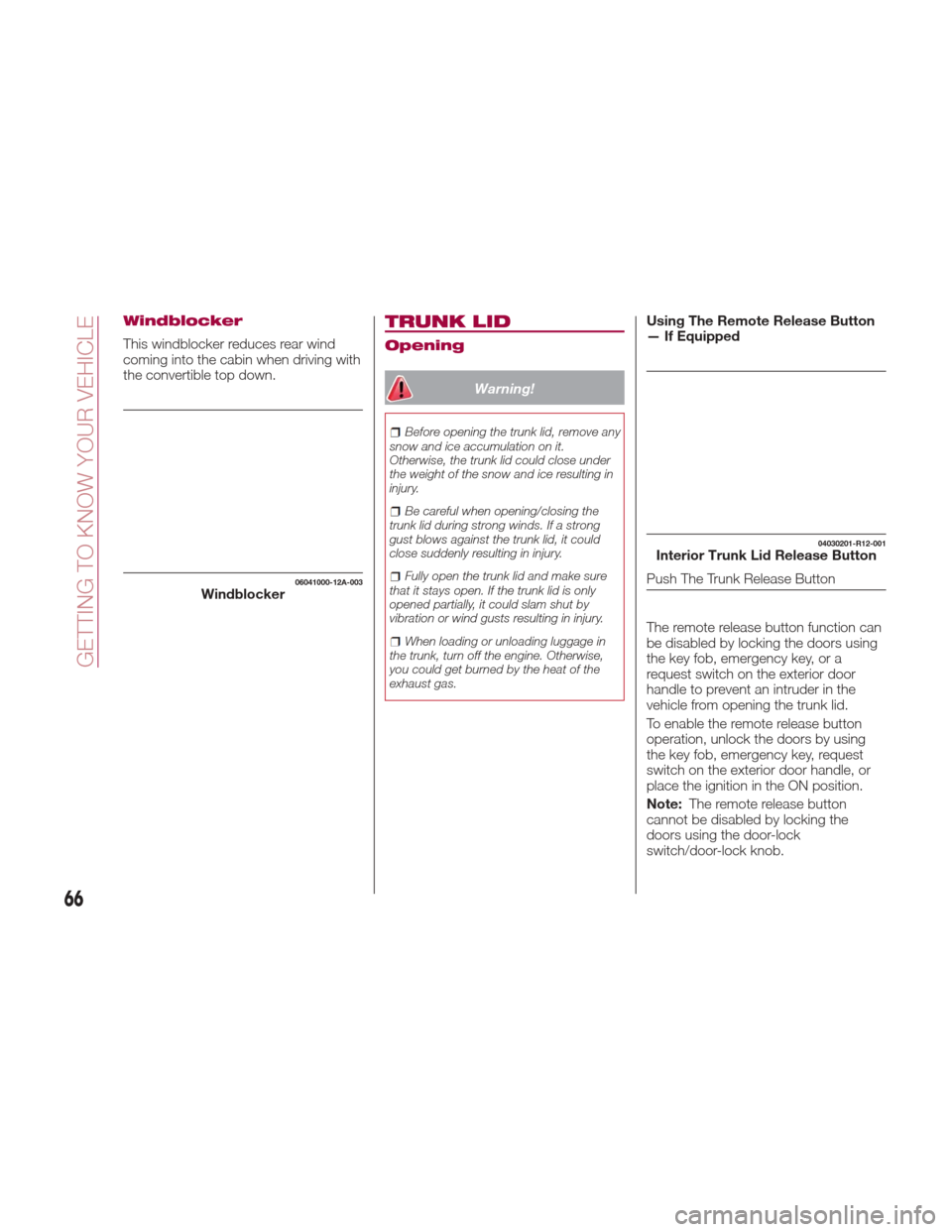
This windblocker reduces rear wind
coming into the cabin when driving with
the convertible top down.
TRUNK LID
Opening
Warning!
Before opening the trunk lid, remove any
snow and ice accumulation on it.
Otherwise, the trunk lid could close under
the weight of the snow and ice resulting in
injury.
Be careful when opening/closing the
trunk lid during strong winds. If a strong
gust blows against the trunk lid, it could
close suddenly resulting in injury.
Fully open the trunk lid and make sure
that it stays open. If the trunk lid is only
opened partially, it could slam shut by
vibration or wind gusts resulting in injury.
When loading or unloading luggage in
the trunk, turn off the engine. Otherwise,
you could get burned by the heat of the
exhaust gas.
Using The Remote Release Button
— If Equipped
The remote release button function can
be disabled by locking the doors using
the key fob, emergency key, or a
request switch on the exterior door
handle to prevent an intruder in the
vehicle from opening the trunk lid.
To enable the remote release button
operation, unlock the doors by using
the key fob, emergency key, request
switch on the exterior door handle, or
place the ignition in the ON position.
Note: The remote release button
cannot be disabled by locking the
doors using the door-lock
switch/door-lock knob.
06041000-12A-003Windblocker
04030201-R12-001Interior Trunk Lid Release Button
Push The Trunk Release Button
66
GETTING TO KNOW YOUR VEHICLE
Page 72 of 300
3. Lower the hood slowly to a height of
about 8 in (20 cm) above its closed
position and then let it drop.
Warning!
Be sure the hood is fully latched before
driving your vehicle. If the hood is not fully
latched, it could open when the vehicle is
in motion and block your vision. Failure to
follow this warning could result in serious
injury or death.
Caution!
To prevent possible damage, do not slam
the hood to close it. Lower hood to
approximately 8 in (20 cm) and drop the
hood to close. Make sure hood is fully
closed for both latches. Never drive vehicle
unless hood is fully closed, with both
latches engaged.
CONVERTIBLE TOP
(SOFT TOP)
Lowering The
Convertible Top
Warning!
Do not sit on the folded convertible top,
otherwise the convertible top could be
damaged or you may fall off and be injured.
Proceed as follows:
1. Make sure the parking brake is
applied and the engine is off.
2. Make sure there are no objects
which have been placed in the area
where the convertible top is to be
retracted.
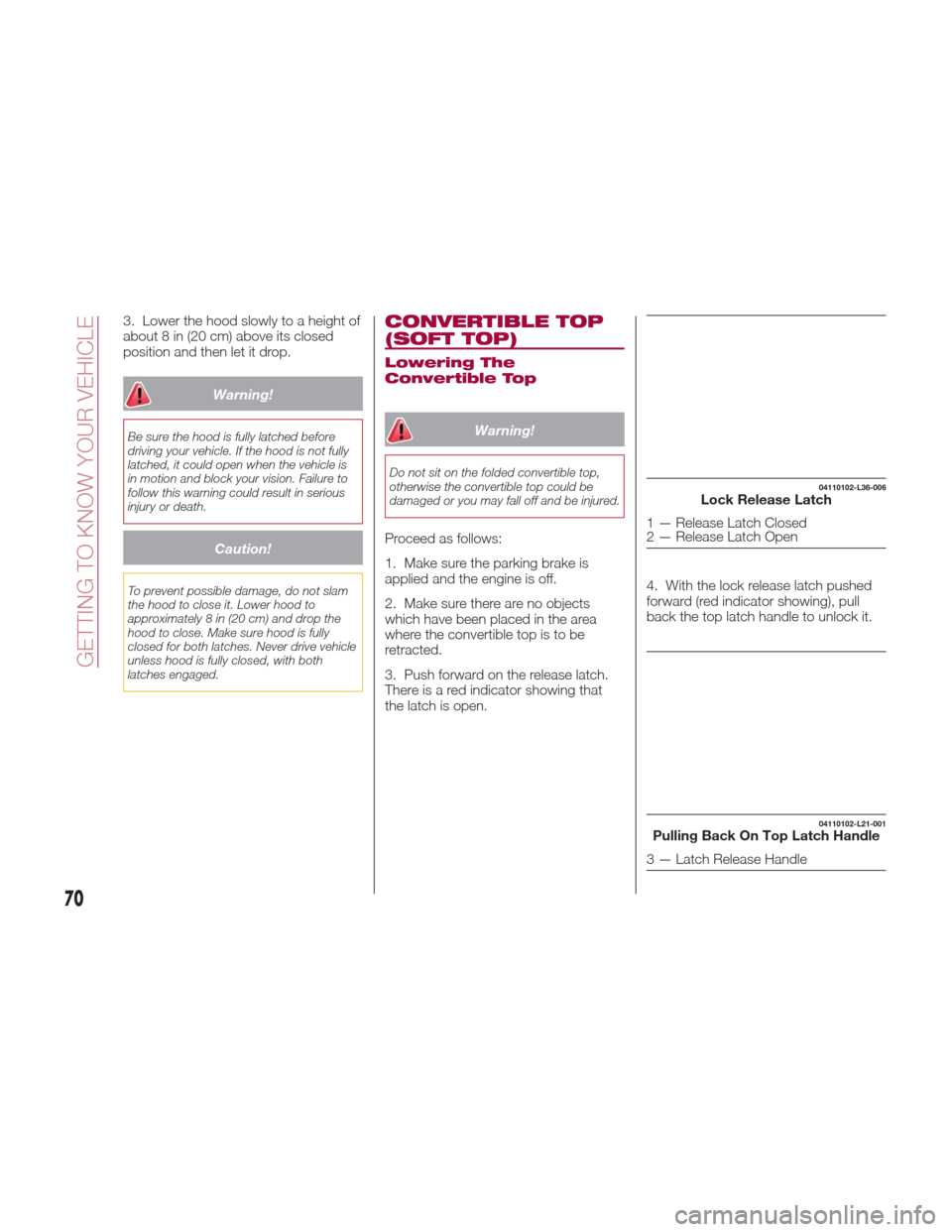
3. Push forward on the release latch.
There is a red indicator showing that
the latch is open.4. With the lock release latch pushed
forward (red indicator showing), pull
back the top latch handle to unlock it.
04110102-L36-006Lock Release Latch
1 — Release Latch Closed
2 — Release Latch Open
04110102-L21-001Pulling Back On Top Latch Handle
3 — Latch Release Handle
70
GETTING TO KNOW YOUR VEHICLE
Page 74 of 300
Raising The Convertible
To p
Proceed as follows:
1. Make sure the parking brake is
applied and the engine is turned off.
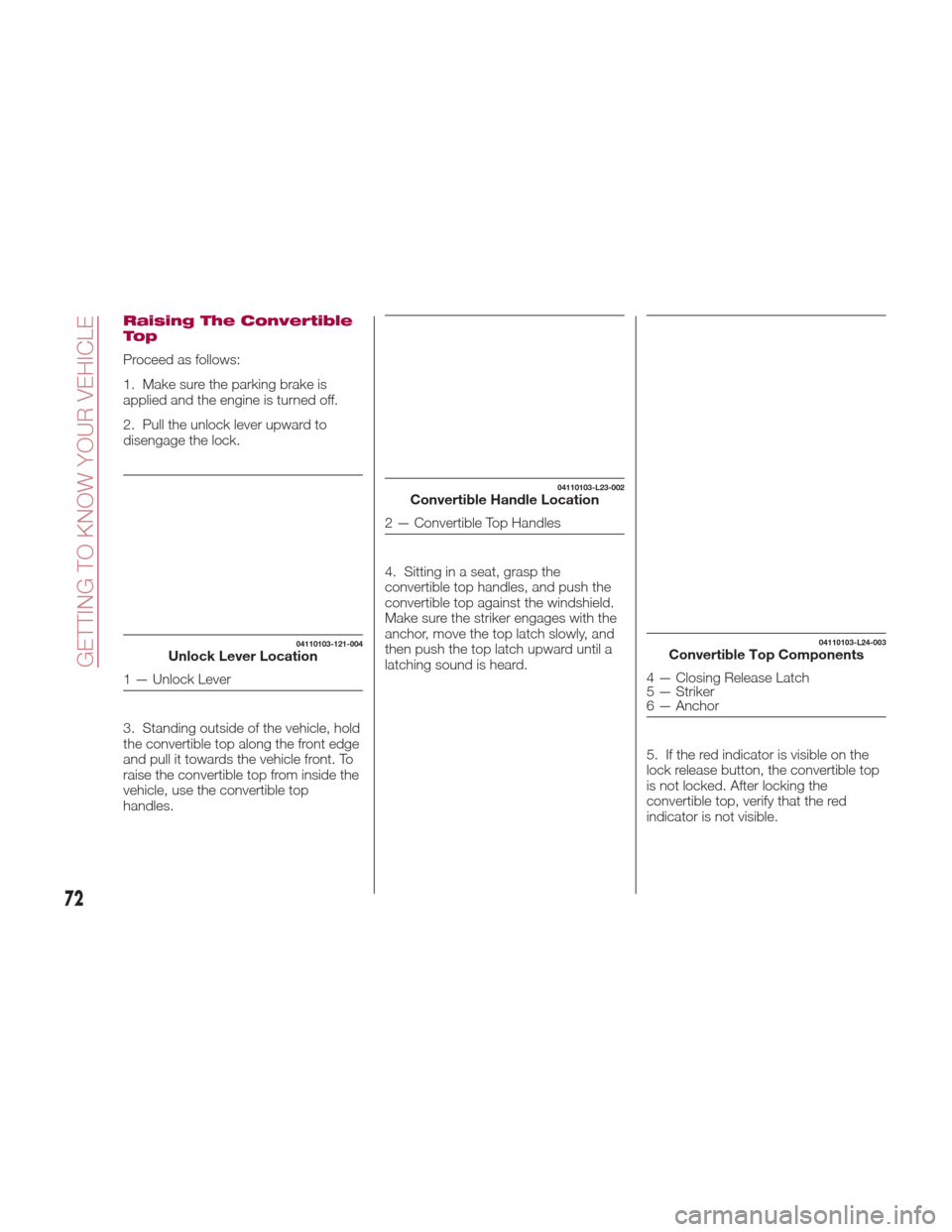
2. Pull the unlock lever upward to
disengage the lock.
3. Standing outside of the vehicle, hold
the convertible top along the front edge
and pull it towards the vehicle front. To
raise the convertible top from inside the
vehicle, use the convertible top
handles.4. Sitting in a seat, grasp the
convertible top handles, and push the
convertible top against the windshield.
Make sure the striker engages with the
anchor, move the top latch slowly, and
then push the top latch upward until a
latching sound is heard.
5. If the red indicator is visible on the
lock release button, the convertible top
is not locked. After locking the
convertible top, verify that the red
indicator is not visible.
04110103-121-004Unlock Lever Location
1 — Unlock Lever
04110103-L23-002Convertible Handle Location
2 — Convertible Top Handles
04110103-L24-003Convertible Top Components
4 — Closing Release Latch
5 — Striker
6 — Anchor
72
GETTING TO KNOW YOUR VEHICLE
Page 76 of 300
Caution!
Before opening the convertible top,
make sure the rear window defroster
switch is turned off. Otherwise the heat
generated from the window defroster
could damage the convertible top and the
internal material.
Make sure nothing is on the convertible
top or near the back window when raising
or lowering the convertible top. Even small
objects may interfere and cause damage.
Do not drive through an automatic car
wash; it may damage the convertible top.
Do not raise or lower the convertible top
when the temperature is below 41 °F
(5 °C); this will damage the convertible top
material.
Do not lower the convertible top when
it's wet. If the convertible top dries while
folded, it will deteriorate and mold.
Do not raise or lower the convertible top
in a strong wind as it could damage the
convertible top or cause an unexpected
accident.
ELECTRIC POWER
STEERING
Power Steering
Electric power steering is only operable
when the engine is running.
If the engine is off or if the power
steering system is inoperable, you can
still steer, but it requires more physical
effort.
If the steering feels stiffer than usual
during normal driving or the steering
vibrates, contact your Authorized
Dealer.
The
warning light notifies the driver
of system abnormalities and operation
conditions.
Note: Never hold the steering wheel to
the extreme left or right for more than
five seconds with the engine running.
This could damage the power steering
system.
ENVIRONMENT
PROTECTION
SYSTEMS
Emission Control System
This vehicle is equipped with an
emission control system (the catalytic
converter is part of this system) that
enables the vehicle to comply with
existing exhaust emissions
requirements.
Ignoring the following precautions could
cause lead to accumulate on the
catalyst inside the converter or cause
the converter to get very hot. Either
condition will damage the converter and
cause poor performance:
USE ONLY UNLEADED FUEL.
Do not drive your vehicle with any
sign of engine malfunction.
Do not coast with the ignition off.
Do not descend steep grades in gear
with the ignition off.
Do not operate the engine at high
idle for more than two minutes.
74
GETTING TO KNOW YOUR VEHICLE
Page 77 of 300
Do not tamper with the emission
control system. All inspections and
adjustments must be made by your
Authorized Dealer.
Do not push-start or pull-start your
vehicle.
Under U.S. federal law, any modification
to the original-equipment emission
control system before the first sale and
registration of a vehicle is subject to
penalties. In some states, such
modification made on a used vehicle is
also subject to penalties.
While the engine is off, the sound of a
valve opening and closing can be heard
at the rear of the vehicle, however this
does not indicate an abnormality. The
vehicle has a self-checking device and
it operates while the engine is off.
Warning!
A hot exhaust system can start a fire if you
park over materials that can burn. Such
materials might be grass or leaves coming
into contact with your exhaust system. Do
not park or operate your vehicle in areas
where your exhaust system can contact
anything that can burn.
75
Page 79 of 300

ONBOARD
DIAGNOSTIC
SYSTEM — OBD II
Your vehicle is equipped with a
sophisticated Onboard Diagnostic
system called OBD II. This system
monitors the performance of the
emissions, engine, and automatic
transmission control systems. When
these systems are operating properly,
your vehicle will provide excellent
performance and fuel economy, as well
as engine emissions well within current
government regulations.
If any of these systems require service,
the OBD II system will turn on the
Malfunction Indicator Light (MIL). It will
also store diagnostic codes and other
information to assist your service
technician in making repairs. Although
your vehicle will usually be drivable and
not need towing, see your authorized
dealer for service as soon as possible.
Caution!
Prolonged driving with the MIL on could
cause further damage to the emission
control system. It could also affect fuel
economy and driveability. The vehicle must
be serviced before any emissions tests can
be performed.
If the MIL is flashing while the engine is
running, severe catalytic converter damage
and power loss will soon occur. Immediate
service is required.
Onboard Diagnostic
System (OBD II)
Cybersecurity
Your vehicle is required to have an
Onboard Diagnostic system (OBD II)
and a connection port to allow access
to information related to the
performance of your emissions
controls. Authorized service technicians
may need to access this information to
assist with the diagnosis and service of
your vehicle and emissions system.
Warning!
ONLY an authorized service technician
should connect equipment to the OBD II
connection port in order to diagnose or
service your vehicle.
If unauthorized equipment is connected
to the OBD II connection port, such as a
driver-behavior tracking device, it may:
Be possible that vehicle systems,
including safety related systems, could be
impaired or a loss of vehicle control could
occur that may result in an accident
involving serious injury or death.
Access, or allow others to access,
information stored in your vehicle systems,
including personal information.
For further information, refer to “Privacy
Practices” and “Uconnect
CyberSecurity” in “All About Uconnect
Access” in your Owner’s Manual Radio
Supplement and “Cybersecurity” in
“Multimedia”.
77
Page 80 of 300
CONTROL PANEL AND INSTRUMENTS
Instrument Cluster
1 — Odometer/Trip Computer And Trip Computer Button/Dashboard Illumination
2 — Tachometer
3 — Speedometer
4 — Automatic Transmission Info Display
5 — Odometer/Trip Computer Info/Engine Coolant Temperature Gauge/Fuel Gauge/Outside Temperature/Cruise Control/Info
Switch Display
05020100-667-333Spider Instrument Cluster
78
GETTING TO KNOW YOUR INSTRUMENT PANEL
Page 84 of 300
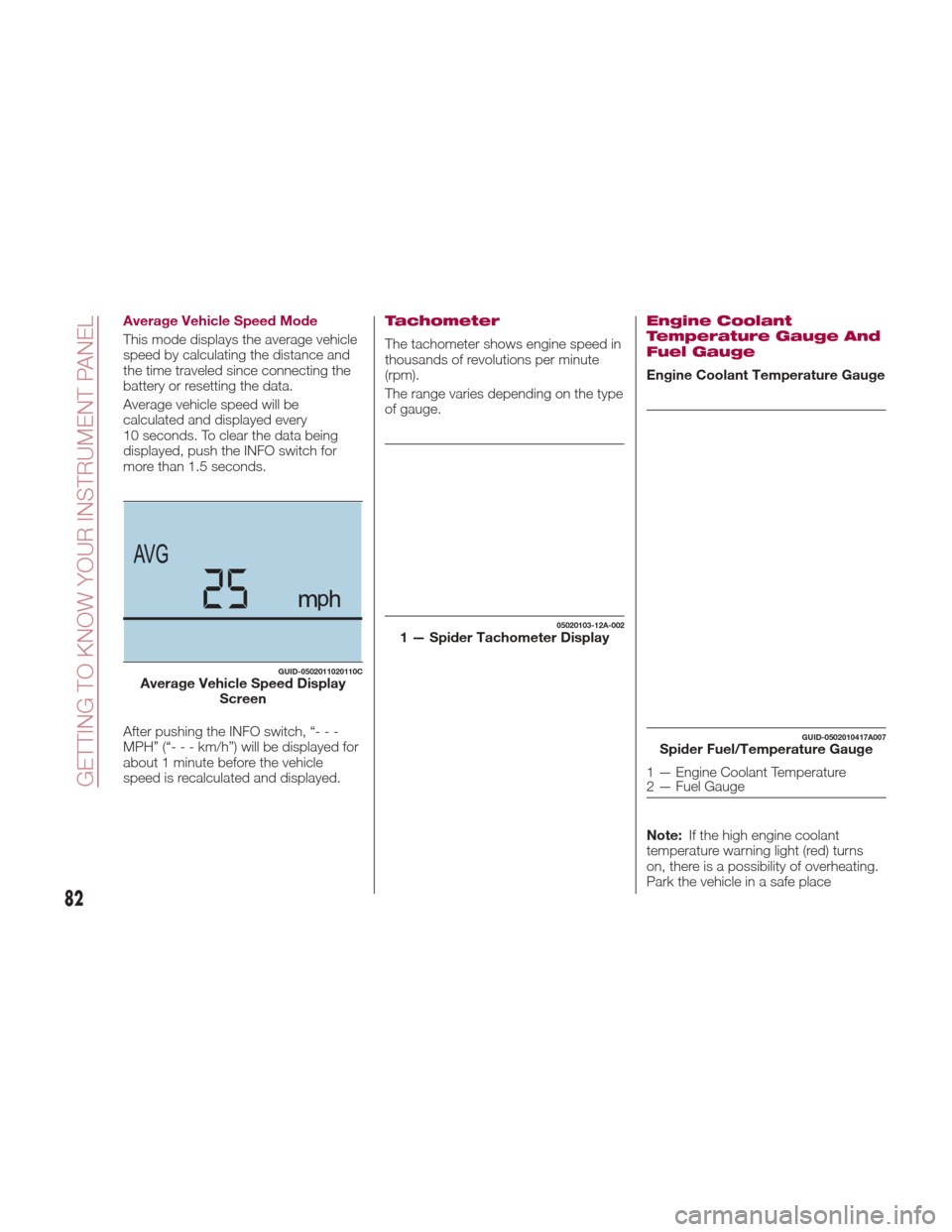
Average Vehicle Speed Mode
This mode displays the average vehicle
speed by calculating the distance and
the time traveled since connecting the
battery or resetting the data.
Average vehicle speed will be
calculated and displayed every
10 seconds. To clear the data being
displayed, push the INFO switch for
more than 1.5 seconds.
After pushing the INFO switch, “- - -
MPH” (“---km/h”)willbedisplayedfor
about 1 minute before the vehicle
speed is recalculated and displayed.Tachometer
The tachometer shows engine speed in
thousands of revolutions per minute
(rpm).
The range varies depending on the type
of gauge.
Engine Coolant
Temperature Gauge And
Fuel Gauge
Engine Coolant Temperature Gauge
Note:If the high engine coolant
temperature warning light (red) turns
on, there is a possibility of overheating.
Park the vehicle in a safe place
GUID-0502011020110CAverage Vehicle Speed Display Screen
05020103-12A-0021 — Spider Tachometer Display
GUID-0502010417A007Spider Fuel/Temperature Gauge
1 — Engine Coolant Temperature
2 — Fuel Gauge
82
GETTING TO KNOW YOUR INSTRUMENT PANEL