Page 244 of 300
Steps For Determining Correct
Load Limit—
(1) Locate the statement “The
combined weight of occupants and
cargo should never exceed XXX kg
or XXX lbs.” on your vehicle's
placard.
(2) Determine the combined weight
of the driver and passengers that
will be riding in your vehicle.
(3) Subtract the combined weight of
the driver and passengers from
XXX kg or XXX lbs.
(4) The resulting figure equals the
available amount of cargo and
luggage load capacity. For
example, if “XXX” amount equals
1400 lbs. and there will be five
150 lb passengers in your vehicle,
the amount of available cargo and
luggage load capacity is 650 lbs.
(1400-750 (5x150) = 650 lbs.)(5) Determine the combined weight
of luggage and cargo being loaded
on the vehicle. That weight may not
safely exceed the available cargo
and luggage load capacity
calculated in Step 4.
(6) If your vehicle will be towing a
trailer, load from your trailer will be
transferred to your vehicle. Consult
this manual to determine how this
reduces the available cargo and
luggage load capacity of your
vehicle.
Metric Example For Load Limit
For example, if “XXX” amount equals
635 kg and there will be five 68 kg
passengers in your vehicle, the amount
of available cargo and luggage load
capacity is 295 kg (635-340 (5x68) =
295 kg) as shown in step 4.
Note:
If your vehicle will be towing a trailer,
load from your trailer will be transferred
to your vehicle. The following table
shows examples on how to calculate
total load, cargo/luggage, and towing
capacities of your vehicle with varying
seating configurations and number and
size of occupants. This table is for
illustration purposes only and may not
be accurate for the seating and load
carry capacity of your vehicle.
For the following example, the
combined weight of occupants and
cargo should never exceed 865 lbs
(392 kg).
242
SERVICING AND MAINTENANCE
Page 248 of 300
Run Flat Tires — If Equipped
Run Flat tires allow you the capability to
drive 50 miles (80 km) at 50 mph
(80 km/h) after a rapid loss of inflation
pressure. This rapid loss of inflation is
referred to as the Run Flat mode. A Run
Flat mode occurs when the tire inflation
pressure is of/or below 14 psi (96 kPa).
Once a Run Flat tire reaches the run flat
mode it has limited driving capabilities
and needs to be replaced immediately.
A Run Flat tire is not repairable.
It is not recommended driving a vehicle
loaded at full capacity or to tow a trailer
while a tire is in the run flat mode.
See the tire pressure monitoring section
for more information.
Tire Spinning
When stuck in mud, sand, snow, or ice
conditions, do not spin your vehicle's
wheels above 30 mph (48 km/h) or for
longer than 30 seconds continuously
without stopping.
Refer to “Freeing A Stuck Vehicle” in “In
Case Of Emergency” for further
information.
Warning!
Fast spinning tires can be dangerous.
Forces generated by excessive wheel
speeds may cause tire damage or failure.
A tire could explode and injure someone.
Do not spin your vehicle's wheels faster
than 30 mph (48 km/h) for more than
30 seconds continuously when you are
stuck, and do not let anyone near a
spinning wheel, no matter what the speed.
Tread Wear Indicators
Tread wear indicators are in the original
equipment tires to help you in
determining when your tires should be
replaced.These indicators are molded into the
bottom of the tread grooves. They will
appear as bands when the tread depth
becomes a 1/16 of an inch (1.6 mm).
When the tread is worn to the tread
wear indicators, the tire should be
replaced. Refer to “Replacement Tires”
in this section for further information.
Life Of Tire
The service life of a tire is dependent
upon varying factors including, but not
limited to:
Driving style.
Tire pressure - Improper cold tire
inflation pressures can cause uneven
wear patterns to develop across the tire
tread. These abnormal wear patterns
will reduce tread life, resulting in the
need for earlier tire replacement.
Distance driven.
Performance tires, tires with a speed
rating of V or higher, and Summer tires
typically have a reduced tread life.
Rotation of these tires per the vehicle
maintenance schedule is highly
recommended.
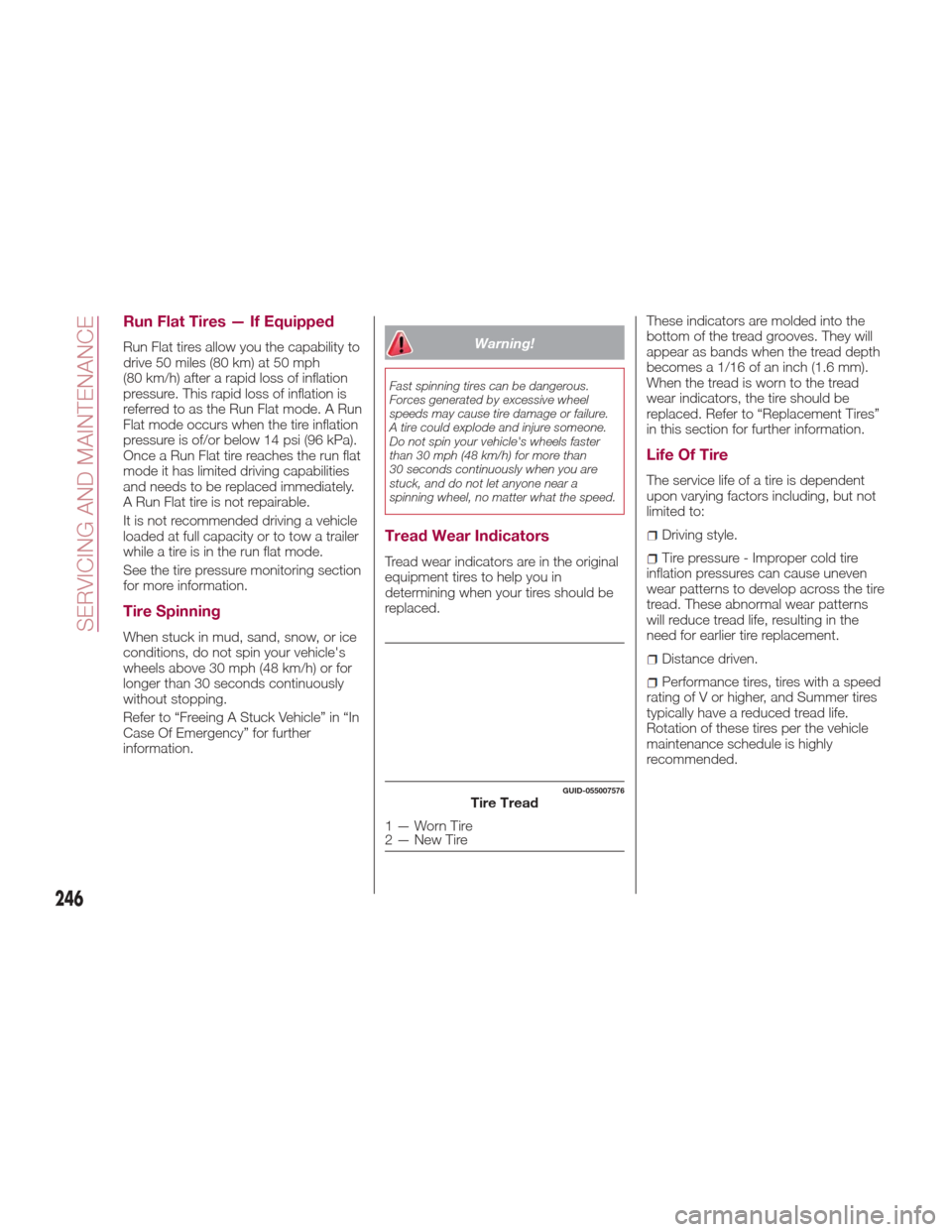
GUID-055007576Tire Tread
1—WornTire
2—NewTire
246
SERVICING AND MAINTENANCE
Page 292 of 300
Snow Tires..............248
Spare Tire ......204,248,249,250
Spinning ...............246
Tread Wear Indicators .......246
ToOpenDeckLid.............66
ToOpenHood...............69
Towing Disabled Vehicle ........221,223
Towing Eyes ............... .221
Towing trailers ..............178
TPMS (Tire Pressure Monitoring System) ................ .119
Transmission ...............268
Tread Wear Indicators ..........246
Trunk Lid Closing ..................68
Opening .................66
Trunk light (bulb replacement) .....195
Turn Signals .................41Undercoating ..............257
Uniform Tire Quality Grades . . .252,284
Vehicle Loading ..........177,241
Vehicle modifications/alterations .....4
Vent Operation ...............45
Warning Flasher, Hazard .......185
Warranty Information ..........283
Washer Operation ...........42,44
Washers, Windshield ...........42
Wheels and tires .............239
Window and headlight washer fluid (level check) ..............235
Window interiors (cleaning) ......261
Windows Driver/Passenger Window
Controls .................56
Power Windows ...........56
Window Lockout ...........58
Windshield wiper blades (replacing) ...............237 Windshield Wipers
............42
Windstop ..................66
Winter driving ...............180
Wiper blades ...............237
Wrecker Towing ..........221,223
INDEX