Page 177 of 292

175
PuncturE rEPAIr KItrepairing the tyre
- Apply the parking brake.
-
Unscrew the tyre valve cap, remove the
filling hose B and screw the ring E onto
the valve. -
Start the engine.
-
Insert the connector G
into the nearest
power socket on the vehicle.
-
Switch on the compressor by placing the
switch F in position "I" (on),
-
Inflate the tyre to a pressure of 5 bar
.
To obtain a more accurate reading, you are
advised to check the pressure value on the
pressure gauge H , with the compressor off.
-
Check that the switch
F on the
compressor is in position "0" (off).
This temporary puncture repair kit stowed
in a bag located in one of the front door
pockets.
It consists of:
-
a cartridge
A , containing the sealant
fluid, equipped with:
●
a filling hose
B ,
●
a sticker
c
indicating "max. 80
km/h",
which the driver must affix in full
view
(on the dashboard) after
repairing the tyre,
-
a quick guide to use of the repair kit,
-
a compressor
d
equipped with a
pressure gauge and unions,
-
adaptors, for the inflation of various
items.
QuIcK HELP
8
Puncture
Page 179 of 292

177
tOWInG
t
owing the vehicle
The removable towing eye is located in the
tool box under the front passenger seat.
Unclip the cover using a flat tool.
Screw the removable towing eye in fully.
Attach the approved towing arm to to the
removable towing eye.
Place the gear lever in neutral.
towing another vehicle
The fixed towing eye is located on the right
below the bumper.
Attach the approved towing arm to the
fixed
eye.
Failure to observe this requirement
may result in damage to certain braking
components and the lack of some braking
assistance systems when the engine is
re-started.
General recommendations
Observe the legislation in force in your
country.
Ensure that the weight of the towing vehicle
is higher than that of the towed vehicle.
The driver must remain at the wheel of the
towed vehicle and must have a valid driving
licence.
When towing a vehicle with all four wheels
on the ground, always use an approved
towing arm; rope and straps are prohibited.
The towing vehicle must move off gently.
When towing a vehicle with the engine off,
there is no longer any power assistance for
braking or steering.
In the following cases, you must always call
on a professional recovery service:
-
vehicle broken down on a motorway or
fast road,
-
four-wheel drive vehicle,
-
when it is not possible to put the
gearbox into neutral, unlock the
steering, or release the parking brake,
-
towing with only two wheels on the
ground,
-
where there is no approved towing arm
available...
QuIcK HELP
8
Being towed or towing
Page 185 of 292
183
d
1 - CAUTION
ORIGINAL LUBRICANTS AND FLUIDS
Engine oil Transmission
Radiater Brake system
Windscreen Washer Power steering
REFER TO OWNER HANDBOOK WEAR EYE PROTECTION
2 - SAFETY
The use of original parts, fluids and original lubrificants and respecting scheduled
maintenance guarantees your cars reliability and safety overtime.
3 - DANGER
KEEP OUT OF
CHILDREN'S REACH KEEP AWAY
FROM FLAMES DO NOT TOUCH
DO NOT OPEN CAP
WITH ENGINE WARM EXPLOSION
CORROSIVE LIQUID
MAY START AUTOMATICALLY EVEN
WITH ENGINE OFF HIGH PRESSURE GAS
DO NOT OPEN
AUTOMATIC ENGINE RESTART. EXTRACT THE KEY
FROM DASHBOARD WHEN BONNET HOOD IS OPENED HIGH VOLTAGE
QuIcK HELP
8
Precautions...
Page 195 of 292
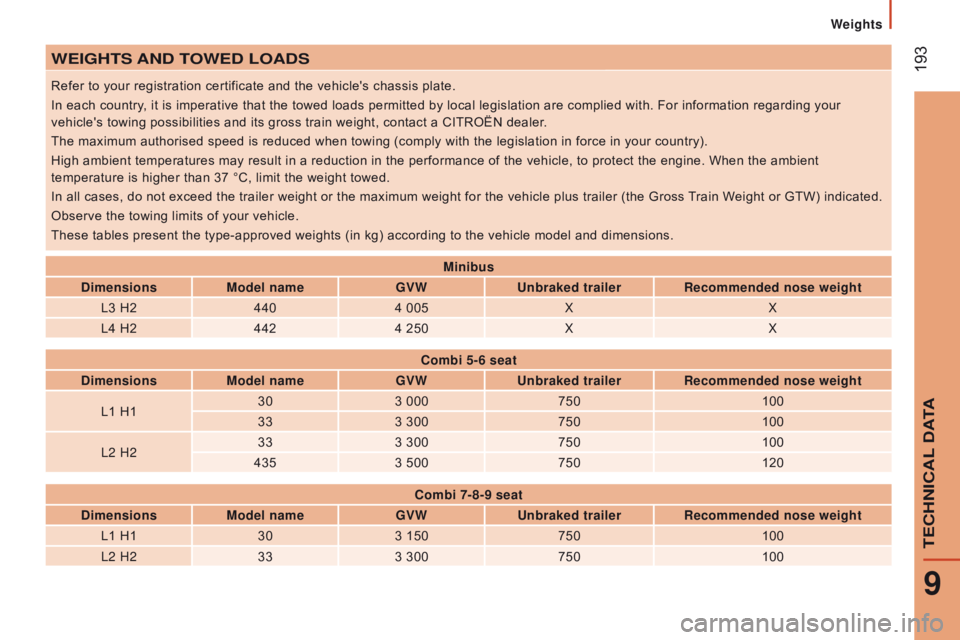
193WEIGHtS And tOWE d LOA d S
Refer to your registration certificate and the vehicle's chassis plate.
In each country, it is imperative that the towed loads permitted by local legislation are complied with. For information regarding your
vehicle's towing possibilities and its gross train weight, contact a CITROËN dealer.
The maximum authorised speed is reduced when towing (comply with the legislation in force in your country).
High ambient temperatures may result in a reduction in the performance of the vehicle, to protect the engine. When the ambient
temperature is higher than 37 °C, limit the weight towed.
In all cases, do not exceed the trailer weight or the maximum weight for the vehicle plus trailer (the Gross Train Weight or GTW) indicated.
Observe the towing limits of your vehicle.
These tables present the type-approved weights (in kg) according to the vehicle model and dimensions.
Minibus
d
imensions Model name GVW
u
nbraked trailer
r
ecommended nose weight
L3 H2 4404 005 X X
L4 H2 4424 250 X X
c
ombi 5-6 seat
d
imensions Model name GVW
u
nbraked trailer
r
ecommended nose weight
L1 H1 30
3 000 750 100
33 3 300 750 100
L2 H2 33
3 300 750 100
435 3 500 750 120
c
ombi 7-8-9 seat
d
imensions Model name GVW
u
nbraked trailer
r
ecommended nose weight
L1 H1 303 150 750 100
L2 H2 333 300 750 100
9
tEcHnIcAL dAtA
Weights
Page 196 of 292
194Va n
d
imensions Model name GVW
u
nbraked trailer
r
ecommended nose weight
L1 H1 28
2 800 750 100
30 3 000 750 100
33 3 300 750 100
35 3 500 750 100
435 3 500 750 120
440 4 005 750 120
L1 H2 30
3 000 750 100
33 3 300 750 100
35 3 500 750 100
L2 H1 30
3 000 750 100
33 3 300 750 100
35 3 500 750 100
435 3 500 750 120
L2 H2 30
3 000 750 100
33 3 300 750 100
35 3 500 750 100
435 3 500 750 120
440 4 005 750 120
Weights
Page 197 of 292
195Va n
d
imensions Model name GVW
u
nbraked trailer
r
ecommended nose weight
L3 H2 33
3 300 750 100
35 3 500 750 100
435 3 500 750 120
440 4 005 750 120
L3 H3 33
3 300 750 100
35 3 500 750 100
435 3 500 750 120
440 4 005 750 120
L4 H2 435
3 500 750 120
440 4 005 750 120
L4 H3 435
3 500 750 120
440 4 005 750 120
9
tEcHnIcAL dAtA
Weights
Page 201 of 292
199
PrESEntAtIO n
Chassis cab and floor cab versions have a cab, a fixed floor and two specific rear lamp
clusters.
These versions are also available with:
-
a crew cab,
-
a tipper body
.
changing a bulb
For more information on bulbs, refer to
the table "Types of bulb and lamp" in
the "Quick help" section.
r
ear lamps
Carry out the operations in reverse order to
refit each bulb.
1.
d
irection indicators
type B,
PY21W - 21W
2.
Brake lamps
type B,
P21W - 21W
3.
Sidelamps
type A,
W5W - 5W
4.
r
eversing lamps
type A,
W16W - 16W
5.
Foglamps
type A,
W16W - 16W-
Identify the failed bulb.
-
Remove the four lamp unit fixing screws.
-
Pull the lamp unit out towards you.
-
Replace the bulb.
For more information on these versions, refer to the correspond
ing section.
SPEcIAL FEAturES
chassis cab / Floor cab
10
Page 214 of 292

212
WEIGHtS And tOWE d LOA d S ( KG )
For more information, refer to your registration certificate.
In each country, it is imperative that the towed loads authorised by
local legislation are complied with. To find out your vehicle's towing
capacities and its gross train weight, consult a franchised dealer.
The maximum authorised speed is reduced when towing (comply
with the legislation in force in your country).
With load transfer, the braked trailer weight can be increased,
on condition that the equivalent of this load is removed from the
vehicle so that the GTW is not exceeded. Warning: towing with a
lightly loaded towing vehicle may have an adverse effect on its road
holding.
The GTW and towed load values indicated are valid up to a
maximum altitude of 1000 metres; the towed load mentioned must
be reduced by 10 % for each additional 1000 metres.
High ambient temperatures may result in a reduction in the
performance of the vehicle in order to protect the engine; when the
ambient temperature is higher than 37 °C, limit the towed weight.
The kerb weight is equal to the weight without load + driver (75
kg) +
fuel tank filled to 90%. Before towing a trailer, check
that:
-
the nose weight on the
towbar ball does not exceed
the value (S) indicated on
the trailer's weights plate,
-
the maximum trailer weight
is less than the value
indicated on the trailer's
weights plate and the Gross
Vehicle Weight (GVW)
does not exceed the value
indicated on the vehicle's
weights plate.
-
in the case of a self-
supporting trailer
, the Gross
Train Weight must not
exceed the value indicated
on the vehicle's weights
plate.
General points
tipper body


