Page 232 of 828
WARNING/INDICATOR LIGHTS AND MESSAGES
IMPORTANT:The warning/indicator light switches on
in the instrument panel together with a dedicated mes-
sage and/or acoustic signal when applicable. These
indications are indicative and precautionary and as such
must not be considered as exhaustive and/or alternative
to the information contained in the Owner Manual,
which you are advised to read carefully in all cases.
Always refer to the information in this chapter in the
event of a failure indication. All active telltales will display first, if applicable. The
system check menu may appear different based upon
equipment options and current vehicle status. Some
telltales are optional and may not appear.
230 GETTING TO KNOW YOUR INSTRUMENT PANEL
Page 253 of 828

NOTE:Prolonged driving with the Malfunction Indica-
tor Light (MIL) on could cause damage to the engine
control system. It also could affect fuel economy and
driveability. If the MIL is flashing, severe catalytic con-
verter damage and power loss will soon occur. Immedi-
ate service is required. NOTE:
A malfunctioning catalytic converter, as refer-
enced above, can reach higher temperatures than in
normal operating conditions. This can cause a fire if you
drive slowly or park over flammable substances such as
dry plants, wood, cardboard, etc. This could result in
death or serious injury to the driver, occupants or others.
Tire Pressure Monitoring Indicator Light
Yellow Telltale Light What It Means
Tire Pressure Monitoring Indicator Light
The warning light switches on and a message is displayed to indicate that the tire pressure
is lower than the recommended value and/or that slow pressure loss is occurring. In these
cases, optimal tire duration and fuel consumption may not be guaranteed.
Should one or more tires be in the condition mentioned above, the display will show the
indications corresponding to each tire in sequence.
4
GETTING TO KNOW YOUR INSTRUMENT PANEL 251
Page 261 of 828
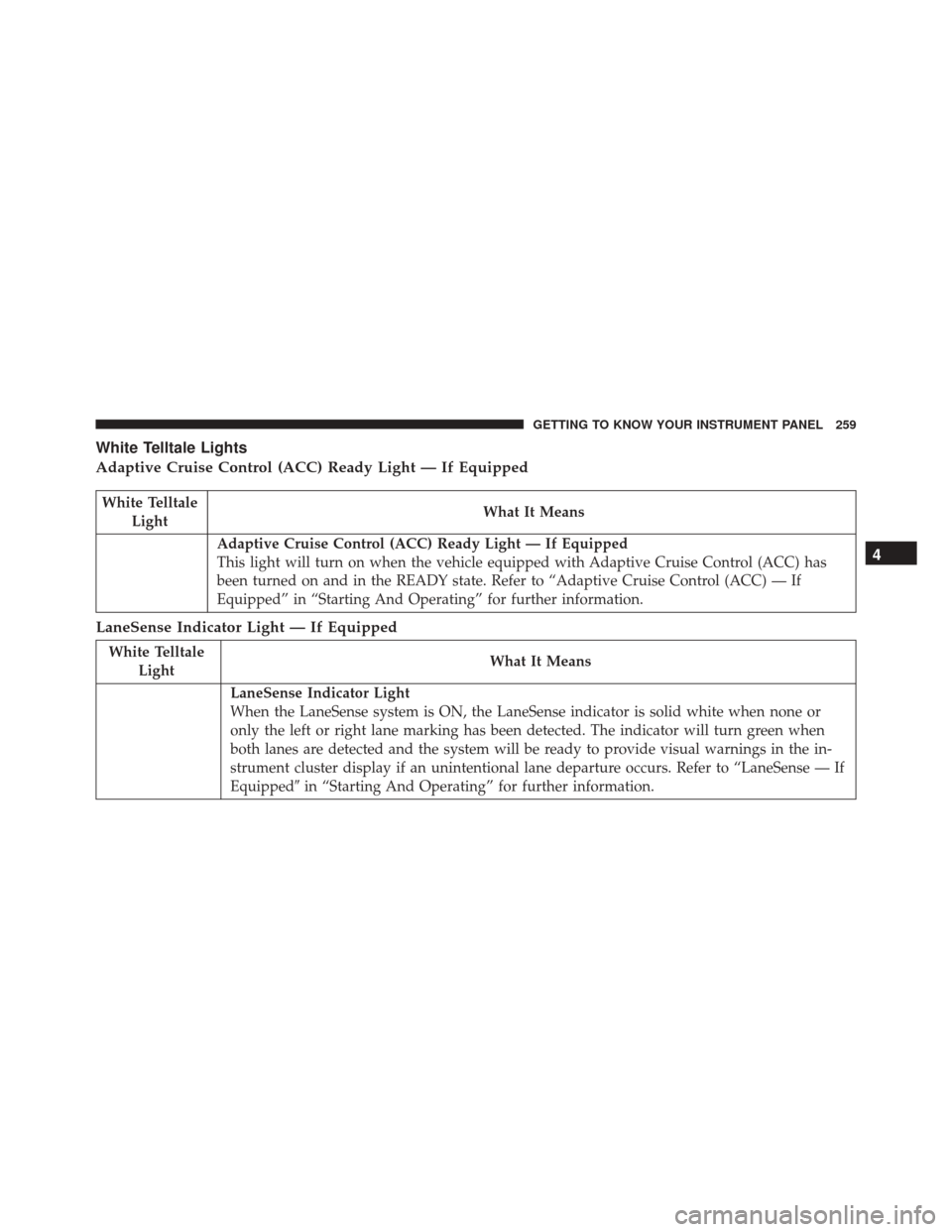
White Telltale Lights
Adaptive Cruise Control (ACC) Ready Light — If Equipped
White TelltaleLight What It Means
Adaptive Cruise Control (ACC) Ready Light — If Equipped
This light will turn on when the vehicle equipped with Adaptive Cruise Control (ACC) has
been turned on and in the READY state. Refer to “Adaptive Cruise Control (ACC) — If
Equipped” in “Starting And Operating” for further information.
LaneSense Indicator Light — If Equipped
White Telltale
Light What It Means
LaneSense Indicator Light
When the LaneSense system is ON, the LaneSense indicator is solid white when none or
only the left or right lane marking has been detected. The indicator will turn green when
both lanes are detected and the system will be ready to provide visual warnings in the in-
strument cluster display if an unintentional lane departure occurs. Refer to “LaneSense — If
Equipped�
in “Starting And Operating” for further information.
4
GETTING TO KNOW YOUR INSTRUMENT PANEL 259
Page 263 of 828

Speed Warning Light — If Equipped
White WarningLight What It Means
Speed Warning Light
When Speed Warning is turned on the speed warning telltale will illuminate in the instru-
ment cluster, with a number matching the set speed. Each time the set speed is exceeded, an
audible chime will sound for up to 10 seconds, or until the speed is no longer exceeded. The
telltale in the instrument cluster will also change from white to yellow, and a pop up warn-
ing message will pop up on the EVIC/DID screen. Speed Warning can be turned on and off
in the EVIC/DID, for further information refer to “EVIC/DID Display Menu Items” in “Get-
ting To Know Your Instrument Panel”
ONBOARD DIAGNOSTIC SYSTEM — OBD II
Your vehicle is equipped with a sophisticated Onboard
Diagnostic system called OBD II. This system monitors
the performance of the emissions, engine, and automatic
transmission control systems. When these systems are
operating properly, your vehicle will provide excellent performance and fuel economy, as well as engine emis-
sions well within current government regulations.
If any of these systems require service, the OBD II system
will turn on the Malfunction Indicator Light (MIL). It will
also store diagnostic codes and other information to
4
GETTING TO KNOW YOUR INSTRUMENT PANEL 261
Page 295 of 828

FCW Limited Warning
If the EVIC/DID displays “ACC/FCW Limited Function-
ality” or “ACC/FCW Limited Functionality Clean Front
Windshield” momentarily, there may be a condition that
limits FCW functionality. Although the vehicle is still
drivable under normal conditions, the active braking
may not be fully available. Once the condition that
limited the system performance is no longer present, the
system will return to its full performance state. If the
problem persists, see your authorized dealer.
Service FCW Warning
If the system turns off, and the EVIC/DID displays:
•ACC/FCW Unavailable Service Required
• Cruise/FCW Unavailable Service Required
This indicates there is an internal system fault. Although
the vehicle is still drivable under normal conditions, have
the system checked by an authorized dealer.
Tire Pressure Monitor System (TPMS)
The Tire Pressure Monitor System (TPMS) will warn the
driver of a low tire pressure based on the vehicle recom-
mended cold placard pressure.
The tire pressure will vary with temperature by approxi-
mately 1 psi (7 kPa) for every 12°F (6.5°C). This means
that when the outside temperature decreases, the tire
pressure will decrease. Tire pressure should always be set
based on cold inflation tire pressure. This is defined as
the tire pressure after the vehicle has not been driven for
at least three hours, or driven less than 1 mile (1.6 km)
after a three hour period. The cold tire inflation pressure
must not exceed the maximum inflation pressure molded
into the tire sidewall. Refer to “Tires” in “Maintaining
And Caring For Your Vehicle” for information on how to
properly inflate the vehicle’s tires. The tire pressure will
also increase as the vehicle is driven. This is normal and
there should be no adjustment for this increased pres-
sure.
5
SAFETY 293
Page 298 of 828

correct tire pressure using an accurate tire pressure
gauge, even if underinflation has not reached the level
to trigger illumination of the “Tire Pressure Monitor-
ing Telltale Light”.
• Seasonal temperature changes will affect tire pressure,
and the TPMS will monitor the actual tire pressure in
the tire.
Base System
The Tire Pressure Monitor System (TPMS) uses wireless
technology with wheel rim mounted electronic sensors to
monitor tire pressure levels. Sensors, mounted to each
wheel as part of the valve stem, transmit tire pressure
readings to the receiver module.
NOTE: It is particularly important for you to check the
tire pressure in all of the tires on your vehicle monthly
and to maintain the proper pressure. The TPMS consists of the following components:
•
Receiver Module
• Four Tire Pressure Monitoring Sensors
• Tire Pressure Monitoring Telltale Light
Tire Pressure Monitoring Low Pressure Warnings
The “Tire Pressure Monitoring Telltale Light” will
illuminate in the instrument cluster, a “LOW TIRE
PRESSURE” message will display in the instrument
cluster, an �Inflate to XX� message will be displayed and
a chime will sound when tire pressure is low in one or
more of the four active road tires. Should this occur, you
should stop as soon as possible, check the inflation
pressure of each tire on your vehicle, and inflate each tire
to the vehicle’s recommended cold placard pressure
value as shown in the �Inflate to XX�message. Once the
296 SAFETY
Page 301 of 828

The TPMS consists of the following components:
•Receiver Module
• Four Tire Pressure Monitoring Sensors
• Various Tire Pressure Monitoring System messages,
which display in the Electronic Vehicle Information
Center (EVIC) or Driver Information Display (DID).
• Tire Pressure Monitoring Telltale Light
Tire Pressure Monitoring Low Pressure Warnings
The “Tire Pressure Monitoring Telltale Light” will
illuminate in the instrument cluster and a chime
will sound when tire pressure is low in one or more of the
four active road tires. In addition, the EVIC/DID will
display an �Inflate to XX� message and a graphic showing
the pressure values of each tire with the low tire pressure
values in a different color. Should this occur, you should stop as soon as possible
and inflate the tires with low pressure (those in a
different color in the EVIC/DID graphic) to the vehicle’s
recommended cold placard pressure value as shown in
the
�Inflate to XX� message. Once the system receives the
updated tire pressures, the system will automaticallyTire Pressure Monitoring System
5
SAFETY 299
Page 302 of 828

update, the pressure values in the graphic display in the
EVIC/DID will return to their original color, and the
“Tire Pressure Monitoring Telltale Light” will turn off.
The vehicle may need to be driven for up to 20 minutes
above 15 mph (24 km/h) in order for the TPMS to receive
this information.
Service TPMS Warning
When a system fault is detected, the “Tire Pressure
Monitoring Telltale Light” will flash on and off for 75
seconds and then remain on solid. The system fault will
also sound a chime. In addition, the EVIC/DID will
display a�SERVICE SYSTEM� message for a minimum of
five seconds and then display dashes (- -) in place of the
pressure value to indicate which sensor is not being
received.
If the ignition is cycled, this sequence will repeat, pro-
viding the system fault still exists. If the system fault no longer exists, the “Tire Pressure Monitoring Telltale
Light” will no longer flash, and the “SERVICE SYSTEM
message will no longer display, and a pressure value will
display in place of the dashes. A system fault can occur
due to any of the following:
1. Jamming due to electronic devices or driving next to
facilities emitting the same radio frequencies as the
TPMS sensors.
2. Installing some form of aftermarket window tinting that affects radio wave signals.
3. Lots of snow or ice around the wheels or wheel housings.
4. Using tire chains on the vehicle.
5. Using wheels/tires not equipped with TPMS sensors.
300 SAFETY