2017 CHEVROLET MALIBU ECU
[x] Cancel search: ECUPage 274 of 419
Chevrolet Malibu Owner Manual (GMNA-Localizing-U.S./Canada/Mexico-10122664) - 2017 - crc - 5/23/16
Driving and Operating 273
.Turn off Forward AutomaticBraking when towing. SeeForward Automatic Braking(FAB)0260.
.The Front Pedestrian Brakingsystem should be set to Alert orOff when towing. SeeFrontPedestrian Braking (FPB)System0261.
{Warning
When towing a trailer, exhaust
gases may collect at the rear of
the vehicle and enter if the
liftgate, trunk/hatch, or rear-most
window is open.
When towing a trailer:
.Do not drive with theliftgate, trunk/hatch,or rear-most window open.
.Fully open the air outlets onor under the instrumentpanel.
(Continued)
Warning (Continued)
.Also adjust the climatecontrol system to a settingthat brings in only outsideair. See“Climate ControlSystems”in the Index.
For information about carbon
monoxide, seeEngine
Exhaust0232.
To w i n g a t r a i l e r r e q u i r e s a c e r t a i namount of experience. Thecombination you are driving islonger and not as responsive as thevehicle itself. Get acquainted withthe handling and braking of the rigbefore setting out for the open road.
Before starting, check all trailer hitchparts and attachments, safetychains, electrical connectors, lamps,tires, and mirrors. If the trailer haselectric brakes, start thecombination moving and then applythe trailer brake controller by handto be sure the brakes work.
During the trip, check occasionallyto be sure that the load is secureand the lamps and any trailerbrakes still work.
Towing with a Stability Control
System
When towing, the sound of thestability control system might beheard. The system is reacting to thevehicle movement caused by thetrailer, which mainly occurs duringcornering. This is normal whentowing heavier trailers.
Following Distance
Stay at least twice as far behind thevehicle ahead as you would whendriving the vehicle without a trailer.This can help to avoid situationsthat require heavy braking andsudden turns.
Passing
More passing distance is neededwhen towing a trailer. Because therig is longer, it is necessary to gofarther beyond the passed vehiclebefore returning to the lane.
Page 277 of 419
Chevrolet Malibu Owner Manual (GMNA-Localizing-U.S./Canada/Mexico-10122664) - 2017 - crc - 5/23/16
276 Driving and Operating
all the required tow equipment. andit has all the required traileringequipment. The weight of additionaloptional equipment, passengers,and cargo in the tow vehicle mustbe subtracted from the maximumtrailer weight.
Ask your dealer for traileringinformation or advice, or write us atour Customer Assistance Offices.SeeCustomer AssistanceOffices0385.
Weight of the Trailer Tongue
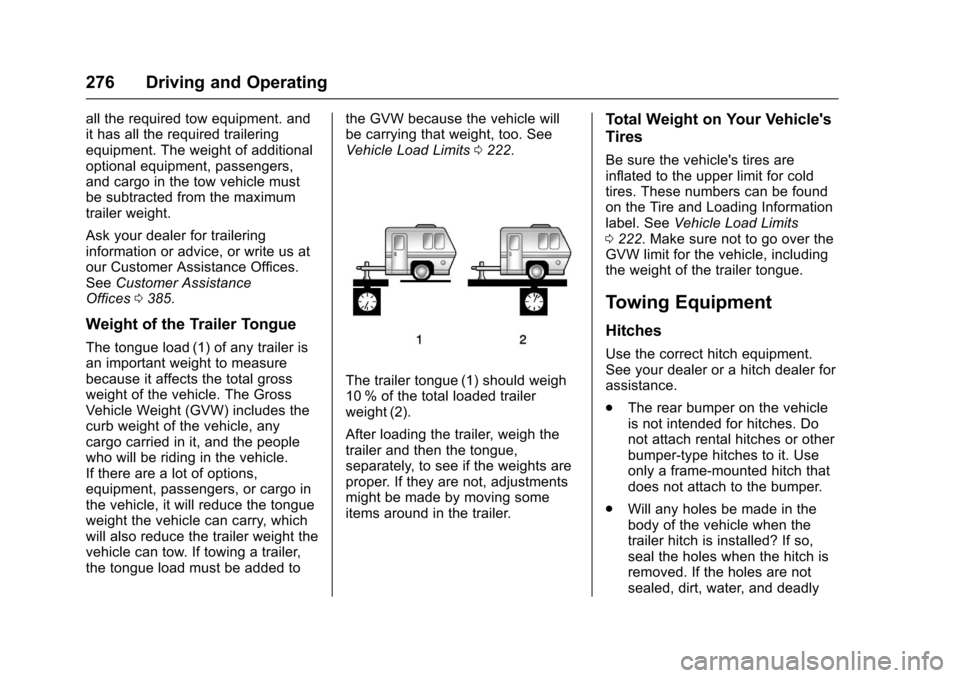
The tongue load (1) of any trailer isan important weight to measurebecause it affects the total grossweight of the vehicle. The GrossVehicle Weight (GVW) includes thecurb weight of the vehicle, anycargo carried in it, and the peoplewho will be riding in the vehicle.If there are a lot of options,equipment, passengers, or cargo inthe vehicle, it will reduce the tongueweight the vehicle can carry, whichwill also reduce the trailer weight thevehicle can tow. If towing a trailer,the tongue load must be added to
the GVW because the vehicle willbe carrying that weight, too. SeeVehicle Load Limits0222.
The trailer tongue (1) should weigh10 % of the total loaded trailerweight (2).
After loading the trailer, weigh thetrailer and then the tongue,separately, to see if the weights areproper. If they are not, adjustmentsmight be made by moving someitems around in the trailer.
Total Weight on Your Vehicle's
Tires
Be sure the vehicle's tires areinflated to the upper limit for coldtires. These numbers can be foundon the Tire and Loading Informationlabel. SeeVehicle Load Limits0222.MakesurenottogoovertheGVW limit for the vehicle, includingthe weight of the trailer tongue.
Towing Equipment
Hitches
Use the correct hitch equipment.See your dealer or a hitch dealer forassistance.
.The rear bumper on the vehicleis not intended for hitches. Donot attach rental hitches or otherbumper-type hitches to it. Useonly a frame-mounted hitch thatdoes not attach to the bumper.
.Will any holes be made in thebody of the vehicle when thetrailer hitch is installed? If so,seal the holes when the hitch isremoved. If the holes are notsealed, dirt, water, and deadly
Page 283 of 419
Chevrolet Malibu Owner Manual (GMNA-Localizing-U.S./Canada/Mexico-10122664) - 2017 - crc - 5/23/16
282 Vehicle Care
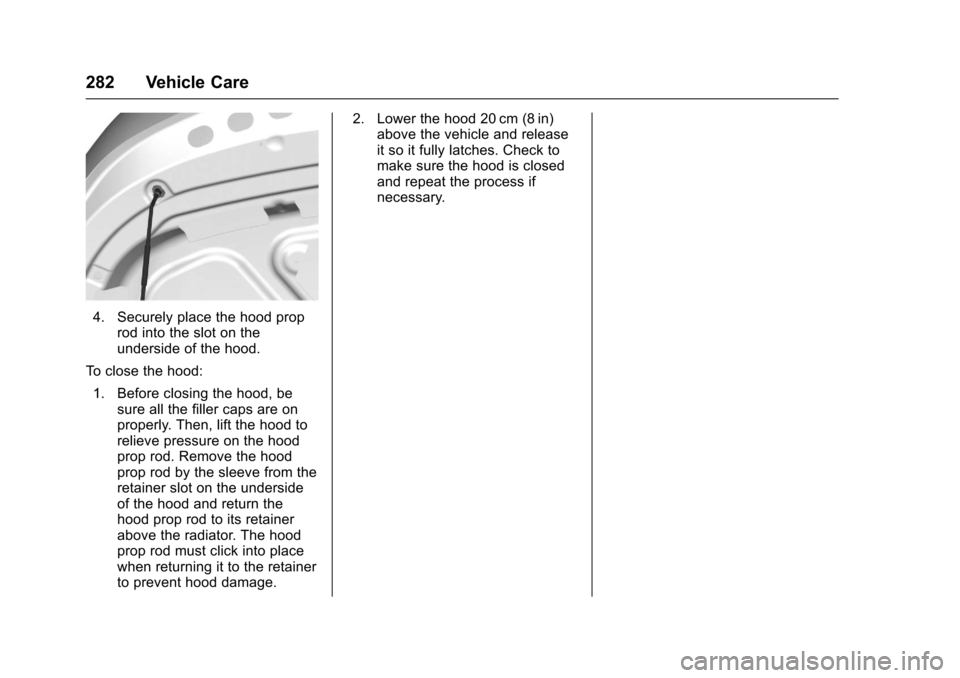
4. Securely place the hood proprod into the slot on theunderside of the hood.
To c l o s e t h e h o o d :
1. Before closing the hood, besure all the filler caps are onproperly. Then, lift the hood torelieve pressure on the hoodprop rod. Remove the hoodprop rod by the sleeve from theretainer slot on the undersideof the hood and return thehood prop rod to its retainerabove the radiator. The hoodprop rod must click into placewhen returning it to the retainerto prevent hood damage.
2. Lower the hood 20 cm (8 in)above the vehicle and releaseit so it fully latches. Check tomake sure the hood is closedand repeat the process ifnecessary.
Page 294 of 419
Chevrolet Malibu Owner Manual (GMNA-Localizing-U.S./Canada/Mexico-10122664) - 2017 - crc - 5/23/16
Vehicle Care 293
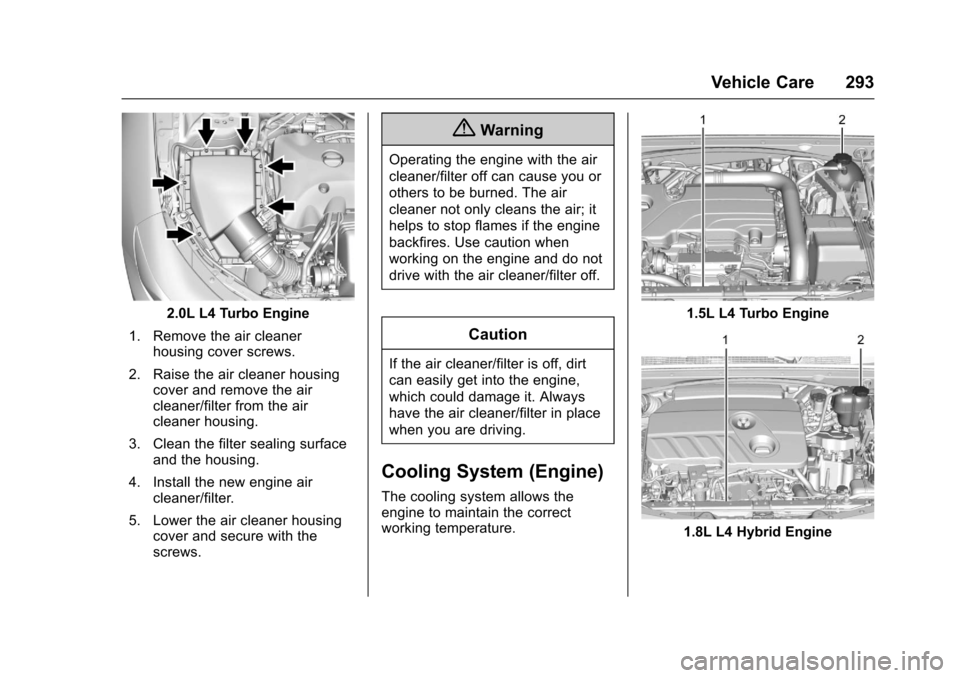
2.0L L4 Turbo Engine
1. Remove the air cleanerhousing cover screws.
2. Raise the air cleaner housingcover and remove the aircleaner/filter from the aircleaner housing.
3. Clean the filter sealing surfaceand the housing.
4. Install the new engine aircleaner/filter.
5. Lower the air cleaner housingcover and secure with thescrews.
{Warning
Operating the engine with the air
cleaner/filter off can cause you or
others to be burned. The air
cleaner not only cleans the air; it
helps to stop flames if the engine
backfires. Use caution when
working on the engine and do not
drive with the air cleaner/filter off.
Caution
If the air cleaner/filter is off, dirt
can easily get into the engine,
which could damage it. Always
have the air cleaner/filter in place
when you are driving.
Cooling System (Engine)
The cooling system allows theengine to maintain the correctworking temperature.
1.5L L4 Turbo Engine
1.8L L4 Hybrid Engine
Page 298 of 419
Chevrolet Malibu Owner Manual (GMNA-Localizing-U.S./Canada/Mexico-10122664) - 2017 - crc - 5/23/16
Vehicle Care 297
The coolant surge tank pressurecap can be removed when thecooling system, including the surgetank pressure cap and upperradiator hose, is no longer hot.
1. Turn the pressure cap slowlycounterclockwise. If a hiss isheard, wait for that to stop.Ahissmeansthereisstillsome pressure left.
2. Keep turning the cap andremove it.
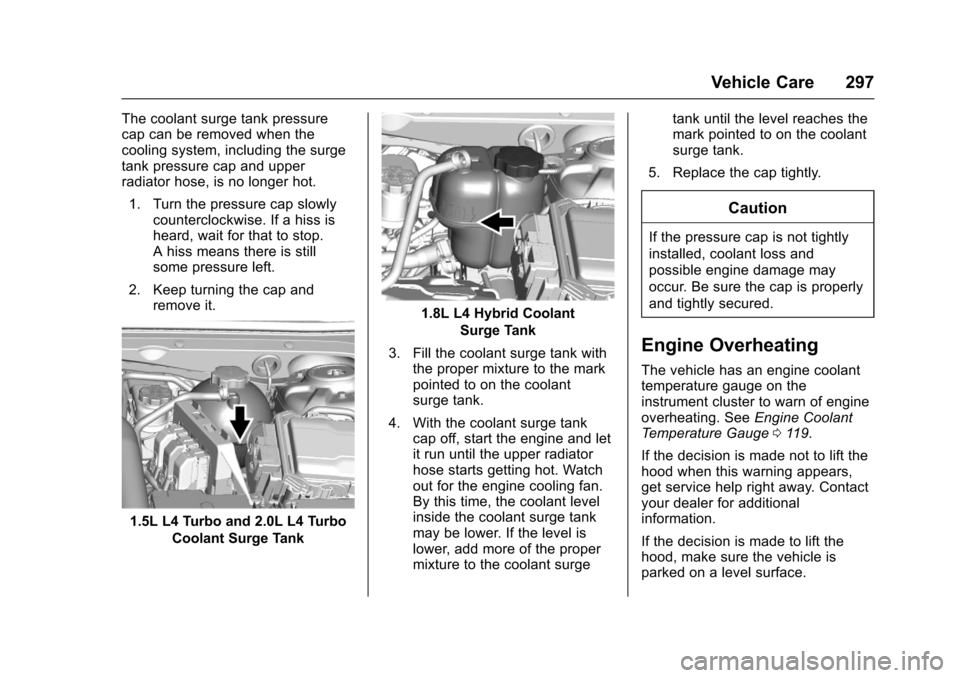
1.5L L4 Turbo and 2.0L L4 Turbo
Coolant Surge Tank
1.8L L4 Hybrid Coolant
Surge Tank
3. Fill the coolant surge tank withthe proper mixture to the markpointed to on the coolantsurge tank.
4. With the coolant surge tankcap off, start the engine and letit run until the upper radiatorhose starts getting hot. Watchout for the engine cooling fan.By this time, the coolant levelinside the coolant surge tankmay be lower. If the level islower, add more of the propermixture to the coolant surge
tank until the level reaches themark pointed to on the coolantsurge tank.
5. Replace the cap tightly.
Caution
If the pressure cap is not tightly
installed, coolant loss and
possible engine damage may
occur. Be sure the cap is properly
and tightly secured.
Engine Overheating
The vehicle has an engine coolanttemperature gauge on theinstrument cluster to warn of engineoverheating. SeeEngine CoolantTe m p e r a t u r e G a u g e011 9.
If the decision is made not to lift thehood when this warning appears,get service help right away. Contactyour dealer for additionalinformation.
If the decision is made to lift thehood, make sure the vehicle isparked on a level surface.
Page 303 of 419
Chevrolet Malibu Owner Manual (GMNA-Localizing-U.S./Canada/Mexico-10122664) - 2017 - crc - 5/23/16
302 Vehicle Care
{Warning
Damage to the high voltage
battery or high voltage system
can create a risk of electric shock,
overheating, or fire.
If the vehicle is damaged from a
moderate to severe crash, flood,
fire, or other event, the vehicle
should be inspected as soon as
possible. Until the vehicle has
been inspected, store it outside at
least 15 m (50 ft) from any
structure or anything that can
burn. Ventilate the vehicle by
opening a window or a door.
Contact Customer Assistance as
soon as possible to determine
whether an inspection is needed.
SeeCustomer Assistance
Offices0385.
Stop/Start System
If equipped with the 1.5L L4 engine,the vehicle has a stop/start systemto shut off the engine to helpconserve fuel. SeeStarting theEngine0227.
Vehicles with a 1.5L engine have anAbsorbed Glass Mat (AGM) 12-voltbattery. Installation of a standard12-volt battery will result in reduced12-volt battery life.
When using a 12-volt batterycharger on the 12-volt AGM battery,some chargers have an AGMbattery setting on the charger.If available, use the AGM setting onthe charger, to limit charge voltageto 14.8 volts.
{Warning
WA R N I N G :Battery posts,
terminals, and related
accessories contain lead and lead
compounds, chemicals known to
the State of California to cause
cancer and birth defects or other
(Continued)
Warning (Continued)
reproductive harm. Batteries also
contain other chemicals known to
the State of California to cause
cancer.WASH HANDS AFTER
HANDLING.
SeeCalifornia Proposition
65 Warning0279.
Vehicle Storage
{Warning
Batteries have acid that can burn
you and gas that can explode.
Yo u c a n b e b a d l y h u r t i f y o u a r e
not careful. SeeJump Starting -
North America0352for tips on
working around a battery without
getting hurt.
Infrequent Usage: Remove the12-volt battery black, negative (✓)cable from the battery to keep thebattery from running down.
Page 339 of 419
Chevrolet Malibu Owner Manual (GMNA-Localizing-U.S./Canada/Mexico-10122664) - 2017 - crc - 5/23/16
338 Vehicle Care
Caution (Continued)
Install them on the tires of the
front axle. Don't use chains on the
tires of the rear axle. Tighten
them as tightly as possible with
the ends securely fastened. Drive
slowly and follow the chain
manufacturer's instructions. If the
chains contact the vehicle, stop
and retighten them. If the contact
continues, slow down until it
stops. Driving too fast or spinning
the wheels with chains on will
damage the vehicle.
If a Tire Goes Flat
It is unusual for a tire to blow outwhile driving, especially if the tiresare maintained properly. SeeTires0317.Ifairgoesoutofatire,itismuch more likely to leak out slowly.But if there is ever a blowout, hereare a few tips about what to expectand what to do:
If a front tire fails, the flat tirecreates a drag that pulls the vehicletoward that side. Take your foot off
the accelerator pedal and grip thesteering wheel firmly. Steer tomaintain lane position, and thengently brake to a stop, well off theroad, if possible.
Arearblowout,particularlyonacurve, acts much like a skid andmay require the same correction asused in a skid. Stop pressing theaccelerator pedal and steer tostraighten the vehicle. It may bevery bumpy and noisy. Gently braketo a stop, well off the road,if possible.
{Warning
Driving on a flat tire will cause
permanent damage to the tire.
Re-inflating a tire after it has been
driven on while severely
underinflated or flat may cause a
blowout and a serious crash.
Never attempt to re-inflate a tire
that has been driven on while
severely underinflated or flat.
Have your dealer or an authorized
(Continued)
Warning (Continued)
tire service center repair or
replace the flat tire as soon as
possible.
{Warning
Lifting a vehicle and getting under
it to do maintenance or repairs is
dangerous without the
appropriate safety equipment and
training. If a jack is provided with
the vehicle, it is designed only for
changing a flat tire. If it is used for
anything else, you or others could
be badly injured or killed if the
vehicle slips off the jack. If a jack
is provided with the vehicle, only
use it for changing a flat tire.
If a tire goes flat, avoid further tireand wheel damage by driving slowlyto a level place, well off the road,if possible. Turn on the hazardwarning flashers. SeeHazardWarning Flashers0166.
Page 352 of 419
Chevrolet Malibu Owner Manual (GMNA-Localizing-U.S./Canada/Mexico-10122664) - 2017 - crc - 5/23/16
Vehicle Care 351
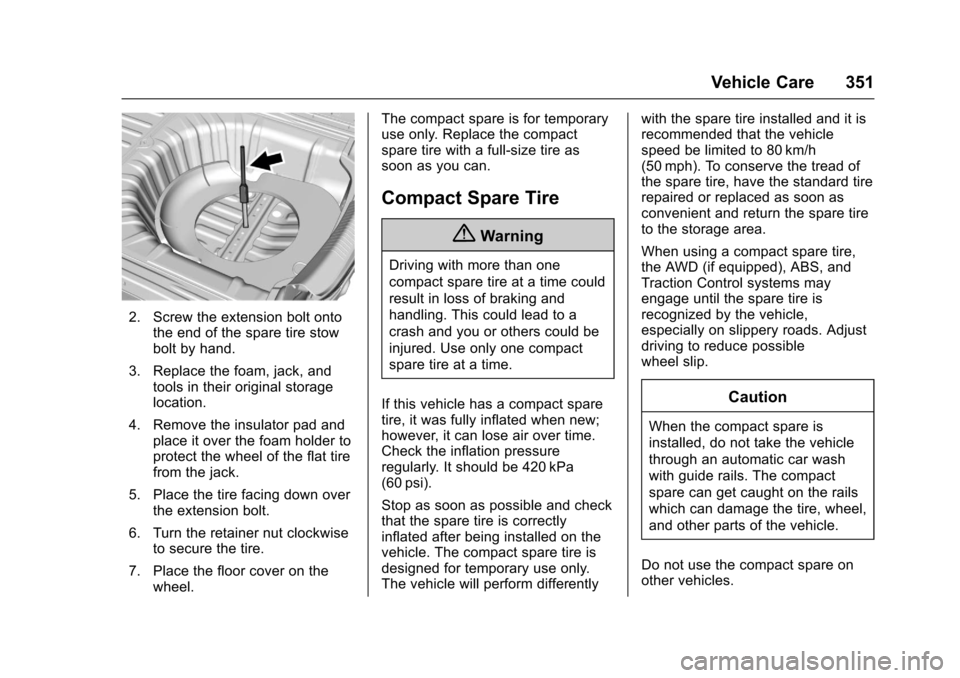
2. Screw the extension bolt ontothe end of the spare tire stowbolt by hand.
3. Replace the foam, jack, andtools in their original storagelocation.
4. Remove the insulator pad andplace it over the foam holder toprotect the wheel of the flat tirefrom the jack.
5. Place the tire facing down overthe extension bolt.
6. Turn the retainer nut clockwiseto secure the tire.
7. Place the floor cover on thewheel.
The compact spare is for temporaryuse only. Replace the compactspare tire with a full-size tire assoon as you can.
Compact Spare Tire
{Warning
Driving with more than one
compact spare tire at a time could
result in loss of braking and
handling. This could lead to a
crash and you or others could be
injured. Use only one compact
spare tire at a time.
If this vehicle has a compact sparetire, it was fully inflated when new;however, it can lose air over time.Check the inflation pressureregularly. It should be 420 kPa(60 psi).
Stop as soon as possible and checkthat the spare tire is correctlyinflated after being installed on thevehicle. The compact spare tire isdesigned for temporary use only.The vehicle will perform differently
with the spare tire installed and it isrecommended that the vehiclespeed be limited to 80 km/h(50 mph). To conserve the tread ofthe spare tire, have the standard tirerepaired or replaced as soon asconvenient and return the spare tireto the storage area.
When using a compact spare tire,the AWD (if equipped), ABS, andTraction Control systems mayengage until the spare tire isrecognized by the vehicle,especially on slippery roads. Adjustdriving to reduce possiblewheel slip.
Caution
When the compact spare is
installed, do not take the vehicle
through an automatic car wash
with guide rails. The compact
spare can get caught on the rails
which can damage the tire, wheel,
and other parts of the vehicle.
Do not use the compact spare onother vehicles.