2017 CHEVROLET MALIBU Battery
[x] Cancel search: BatteryPage 230 of 419
Chevrolet Malibu Owner Manual (GMNA-Localizing-U.S./Canada/Mexico-10122664) - 2017 - crc - 5/23/16
Driving and Operating 229
Warning (Continued)
however, once the brake pedal is
released, the engine will start up
again.
Shift to P (Park) and turn the
ignition to LOCK/OFF, before
exiting the vehicle.
If equipped with the 1.5L L4 engine,the vehicle has a fuel saving stop/start system to shut off the engine tohelp conserve fuel.
Auto Engine Stop/Start
When the brakes are applied andthe vehicle is at a complete stop,the engine may turn off. Whenstopped, the tachometer displaysAUTO STOP. SeeTa c h o m e t e r(Non-Hybrid)011 7.Whenthebrakepedal is released or the acceleratorpedal pushed, the engine willrestart.
Auto Stop may be deactivated if:
.Aminimumvehiclespeedisnotreached.
.The engine or transmission isnot at the required operatingtemperature.
.The outside temperature is notin the required operating range,typically below✓10 °C (14 °F) orabove 50 °C (122 °F).
.The shift lever is in any gearother than D (Drive).
.The battery has been recentlydisconnected.
.The battery charge is low.
.The interior comfort level has notreached the required level forthe climate control system ordefog settings. Use the eco(green indicator on) airconditioning mode for betterefficiency. SeeClimate ControlSystems0205andDualAutomatic Climate ControlSystem0208.
.The Auto Stop time is greaterthan two minutes.
Engine Heater
The engine coolant heater,if available, can help in cold weatherconditions at or below✓18 °C (0 °F)for easier starting and better fueleconomy during engine warm-up.Plug in the coolant heater at leastfour hours before starting thevehicle. An internal thermostat inthe plug end of the cord will preventengine coolant heater operation attemperatures above✓18 °C (0 °F).
To Use the Engine Coolant
Heater
1. Turn off the engine.
2. Open the hood and unwrap theelectrical cord.
Page 232 of 419
Chevrolet Malibu Owner Manual (GMNA-Localizing-U.S./Canada/Mexico-10122664) - 2017 - crc - 5/23/16
Driving and Operating 231
Leaving the Vehicle with the
Engine Running
{Warning
It can be dangerous to leave the
vehicle with the engine running.
It could overheat and catch fire.
It is dangerous to get out of the
vehicle if the shift lever is not fully
in P (Park) with the parking brake
firmly set. The vehicle can roll.
Do not leave the vehicle when the
engine is running. If you have left
the engine running, the vehicle
can move suddenly. You or others
could be injured. To be sure the
vehicle will not move, even when
you are on fairly level ground,
always set the parking brake and
move the shift lever to P (Park).
SeeShifting Into Park0230.
If you have to leave the vehicle withthe engine running, be sure thevehicle is in P (Park) and theparking brake is firmly set beforeyou leave it. After you have moved
the shift lever into P (Park), hold theregular brake pedal down. Then,see if you can move the shift leveraway from P (Park) without firstpressing the button.
If you can, it means that the shiftlever was not fully locked inP(Park).
Torque Lock
To r q u e l o c k i s w h e n t h e w e i g h t o fthe vehicle puts too much force onthe parking pawl in thetransmission. This happens whenparking on a hill and shifting thetransmission into P (Park) is notdone properly, then it is difficult toshift out of P (Park). To preventtorque lock, set the parking brakeand then shift into P (Park). To findout how, see“Shifting Into Park”listed previously.
If torque lock does occur, yourvehicle may need to be pusheduphill by another vehicle to relievethe parking pawl pressure, so youcan shift out of P (Park).
If you are towing a trailer andparking on a hill, seeDrivingCharacteristics and TowingTips0272.
Shifting out of Park
This vehicle is equipped with anelectronic shift lock release system.The shift lock release is designed toprevent movement of the shift leverout of P (Park), unless the ignition isin ON/RUN and the brake pedal isapplied.
The shift lock release is alwaysfunctional except in the case of anuncharged or low voltage (less than9-volt) battery.
If the vehicle has an unchargedbattery or a battery with low voltage,try charging or jump starting thebattery. SeeJump Starting - NorthAmerica0352.
To s h i f t o u t o f P ( P a r k ) :
1. Apply the brake pedal.
2. Place the ignition in ON/RUN.
3. Press the shift lever button.
Page 235 of 419
Chevrolet Malibu Owner Manual (GMNA-Localizing-U.S./Canada/Mexico-10122664) - 2017 - crc - 5/23/16
234 Driving and Operating
Warning (Continued)
Do not leave the vehicle when the
engine is running. If you have left
the engine running, the vehicle
can move suddenly. You or others
could be injured. To be sure the
vehicle will not move, even when
you are on fairly level ground,
always set the parking brake and
move the shift lever to P (Park).
SeeShifting Into Park0230.
Make sure the shift lever is fully inP(Park) before starting the engine.The vehicle has an automatictransmission shift lock controlsystem. The brake pedal must befully applied, then press the shiftlever button before shifting fromP(Park) while the ignition is in ON/RUN. If the vehicle will not shift outof P (Park), ease pressure on theshift lever and push the shift leverall the way into P (Park) whilemaintaining brake application. Thenmove the shift lever into anothergear. SeeShifting out of Park0231.
R:Use this gear to back up.
Caution
Shifting to R (Reverse) while the
vehicle is moving forward could
damage the transmission. The
repairs would not be covered by
the vehicle warranty. Shift to
R(Reverse) only after the vehicle
is stopped.
To r o c k t h e v e h i c l e b a c k a n d f o r t h t oget out of snow, ice, or sand withoutdamaging the transmission, seeIfthe Vehicle Is Stuck0221.
N:In this position, the engine doesnot connect with the wheels. Torestart the engine when the vehicleis already moving, useN(Neutral) only.
If equipped with the 1.8L Hybridengine and the hood is openedwhile in N (Neutral), the vehicle willshut down. The vehicle will have tobe restarted after closing the hood.
{Warning
Shifting into a drive gear while the
engine is running at high speed is
dangerous. Unless your foot is
firmly on the brake pedal, the
vehicle could move very rapidly.
Yo u c o u l d l o s e c o n t r o l a n d h i t
people or objects. Do not shift
into a drive gear while the engine
is running at high speed.
Caution
Shifting out of P (Park) or
N(Neutral) with the engine
running at high speed may
damage the transmission. The
repairs would not be covered by
the vehicle warranty. Be sure the
engine is not running at high
speed when shifting the vehicle.
For hybrid vehicles, the engine willalways be off while in N (Neutral).The vehicle cannot charge the highvoltage battery while the shift lever
Page 236 of 419
Chevrolet Malibu Owner Manual (GMNA-Localizing-U.S./Canada/Mexico-10122664) - 2017 - crc - 5/23/16
Driving and Operating 235
is in N (Neutral). Only useN(Neutral) when required. If thehigh voltage battery state of chargeis low, the Driver Information Center(DIC) will display a message to shiftout of N (Neutral). Shift to P (Park),R(Reverse), D(Drive), or L(Low)depending on the situation. If thehigh voltage battery is depleted toofar, the vehicle will shut down,requiring a shift to P (Park) to restartthe vehicle.
D:This position is for normaldriving. It provides the best fueleconomy. If you need more powerfor passing, and you are:
.Accelerating slowly ormaintaining a constant speed,push the accelerator pedal abouthalfway down.
.Accelerating quickly or passing,push the accelerator all theway down.
L:This position allows you tochange gears similar to a manualtransmission. If the vehicle has thisfeature, seeManual Mode0235.
Operating Modes
The transmission may operate in alower gear than normal to improvevehicle performance. The enginespeed may be higher and there maybe an increase in noise during thefollowing conditions:
.When climbing a grade.
.When driving downhill.
.When driving in hottemperatures or at high altitude.
Manual Mode
Electronic Range Select
(ERS) Mode
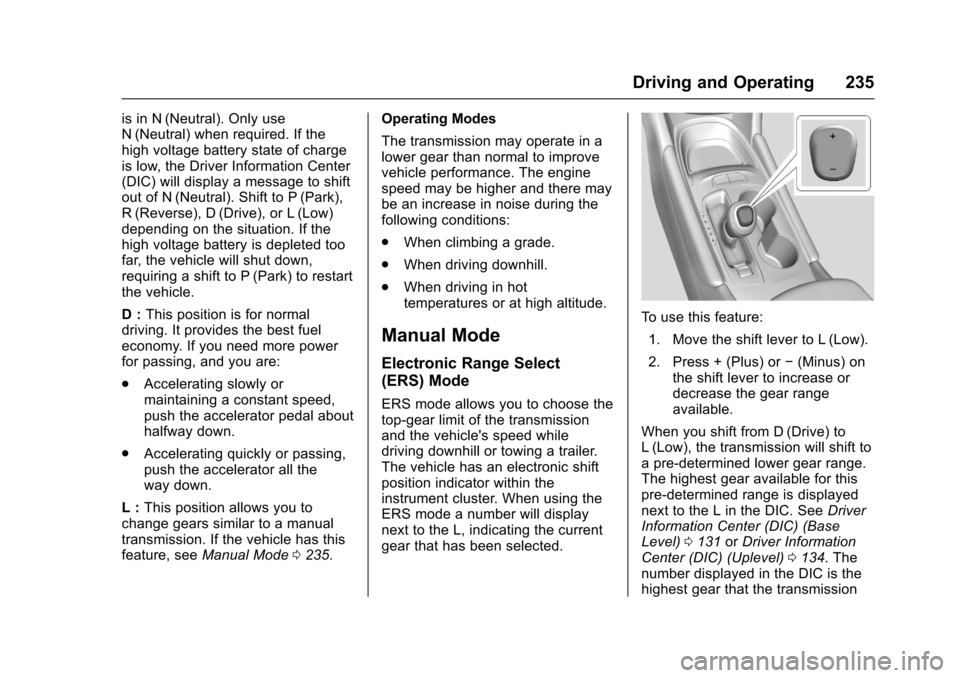
ERS mode allows you to choose thetop-gear limit of the transmissionand the vehicle's speed whiledriving downhill or towing a trailer.The vehicle has an electronic shiftposition indicator within theinstrument cluster. When using theERS mode a number will displaynext to the L, indicating the currentgear that has been selected.
To u s e t h i s f e a t u r e :
1. Move the shift lever to L (Low).
2. Press + (Plus) or✓(Minus) onthe shift lever to increase ordecrease the gear rangeavailable.
When you shift from D (Drive) toL(Low), the transmission will shift toapre-determinedlowergearrange.The highest gear available for thispre-determined range is displayednext to the L in the DIC. SeeDriverInformation Center (DIC) (BaseLevel)0131orDriver InformationCenter (DIC) (Uplevel)0134.Thenumber displayed in the DIC is thehighest gear that the transmission
Page 237 of 419
Chevrolet Malibu Owner Manual (GMNA-Localizing-U.S./Canada/Mexico-10122664) - 2017 - crc - 5/23/16
236 Driving and Operating
will be allowed to operate in. Thismeans that all gears below thatnumber are available. For example,when 4 (Fourth) is shown next to theL, 1 (First) through 4 (Fourth) gearsare automatically shifted by thevehicle. The transmission will notshift into 5 (Fifth) until the + (Plus)button is used or you shift back intoD(Drive).
While in L (Low), the transmissionwill prevent shifting to a lower gearrange if the engine speed is toohigh. You have a brief period of timeto slow the vehicle. If vehicle speedis not reduced within the timeallowed, the lower gear range shiftwill not be completed. You mustfurther slow the vehicle, then pressthe✓(Minus) button to the desiredlower gear range.
Hybrid Low Mode
L2 (Low 2) provides the ability toslow the vehicle without using thebrakes. L1 (Low 1) providesmaximum braking below 80 km/h(50 mph). Use L (Low) whendescending steep grades or in
stop-and-go traffic. When thebattery reaches full charge theengine may run to maintain braking.
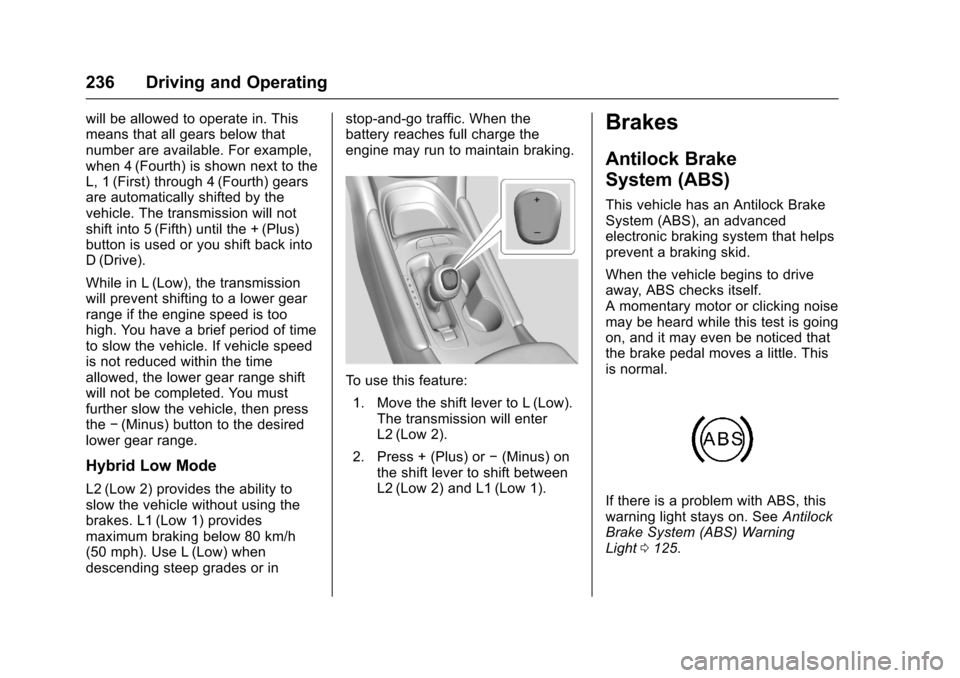
To u s e t h i s f e a t u r e :
1. Move the shift lever to L (Low).The transmission will enterL2 (Low 2).
2. Press + (Plus) or✓(Minus) onthe shift lever to shift betweenL2 (Low 2) and L1 (Low 1).
Brakes
Antilock Brake
System (ABS)
This vehicle has an Antilock BrakeSystem (ABS), an advancedelectronic braking system that helpsprevent a braking skid.
When the vehicle begins to driveaway, ABS checks itself.Amomentarymotororclickingnoisemay be heard while this test is goingon, and it may even be noticed thatthe brake pedal moves a little. Thisis normal.
If there is a problem with ABS, thiswarning light stays on. SeeAntilockBrake System (ABS) WarningLight0125.
Page 241 of 419
Chevrolet Malibu Owner Manual (GMNA-Localizing-U.S./Canada/Mexico-10122664) - 2017 - crc - 5/23/16
240 Driving and Operating
Hill Start Assist (HSA)
The Hill Start Assist (HSA) featurewill activate when the vehicle isstopped on a moderate to steepgrade to help prevent it from rollingin an unintended direction. After thebrake pedal has been released andbefore the accelerator pedal hasbeen pressed, HSA uses brakingpressure to hold the vehiclestationary. If HSA is holding thevehicle, a DIC message displays.HSA will not activate in a forwarddrive gear when facing downhill,or in R (Reverse) when facing uphill.
Extended Hill Start
Assist (EHSA)
Select the duration of the HSAfeature on the center stacktouchscreen by choosing thesubmenu for Hill Start Assist orExtended Hill Start Assist (EHSA).See“Extended Hill Start Assist"under“Comfort and Convenience”inVehicle Personalization0147.When Standard Hold is selected,the vehicle is held stationary for upto two seconds after the brake pedalis released. When Extended Hold is
selected, the vehicle is heldstationary for up to five minutesafter the brake pedal is released. Ineither case, override the holdfeature by pressing the acceleratorpedal and attempting to drive away.
If Hill Start Assist is selected in theSettings menu, it will hold thevehicle for two seconds unless thedriver door is opened or the driversafety belt is unbuckled afterreleasing the brake pedal.If Extended Hill Start Assist isselected, it will hold the vehicle forfive minutes unless the driver dooris opened and the driver safety beltis unbuckled prior to releasing thebrake pedal. When EHSA isdeactivated after five minutes, or if itis deactivated when the driversafety belt is unlatched or the driverdoor is opened, the Electric ParkingBrake will engage to prevent vehiclemovement.
When EHSA is active on a hill,apply enough brake pressure tokeep the vehicle stationary. If this isnot done, a pump noise may beheard.
Regenerative Braking
(Hybrid Only)
Regenerative braking takes some ofthe energy from the moving vehicleand turns it back into electricalenergy. This energy is then storedback into the high voltage batterysystem, contributing to increasedenergy efficiency.
The hydraulic disc brakes work withthe regenerative braking to ensureeffective braking, such as when ahigh braking demand is requested.
The braking system is computercontrolled and blends theregenerative braking with theconventional hydraulic disc brakesto meet any requirements fordeceleration. The controllerinterprets the braking request anduses regenerative braking,conventional hydraulic braking, or acombination of both as necessary.Because the hydraulic brakingsystem uses an electronic boosterfor boost assist on demand, undercertain conditions a motor noisemay be heard. This is normaloperation.
Page 278 of 419
Chevrolet Malibu Owner Manual (GMNA-Localizing-U.S./Canada/Mexico-10122664) - 2017 - crc - 5/23/16
Driving and Operating 277
carbon monoxide (CO) from theexhaust can get into the vehicle.SeeEngine Exhaust0232.
Safety Chains
Always attach chains between thevehicle and the trailer. Cross thesafety chains under the tongue ofthe trailer to help prevent the tonguefrom contacting the road if itbecomes separated from the hitch.Leave enough slack so the rig canturn. Never allow safety chains todrag on the ground.
Trailer Brakes
Does the trailer have its ownbrakes? Be sure to read and followthe instructions for the trailer brakesso they are installed, adjusted, andmaintained properly.
Because the vehicle has antilockbrakes, do not tap into the vehicle'sbrake system. If this is done, bothbrake systems will not work well orat all.
Conversions and
Add-Ons
Add-On Electrical
Equipment
{Warning
The Data Link Connector (DLC) is
used for vehicle service and
Emission Inspection/Maintenance
testing. SeeMalfunction Indicator
Lamp (Check Engine Light)
0122.Adeviceconnectedtothe
DLC—such as an aftermarket
fleet or driver-behavior tracking
device—may interfere with
vehicle systems. This could affect
vehicle operation and cause a
crash. Such devices may also
access information stored in the
vehicle’ssystems.
Caution
Some electrical equipment can
damage the vehicle or cause
components to not work and
would not be covered by the
vehicle warranty. Always check
with your dealer before adding
electrical equipment.
Add-on equipment can drain thevehicle's 12-volt battery, even if thevehicle is not operating.
The vehicle has an airbag system.Before attempting to add anythingelectrical to the vehicle, seeServicing the Airbag-EquippedVehicle081andAdding Equipmentto the Airbag-EquippedVehicle081.
Page 279 of 419
Chevrolet Malibu Owner Manual (GMNA-Localizing-U.S./Canada/Mexico-10122664) - 2017 - crc - 5/23/16
278 Vehicle Care
Vehicle Care
General Information
General Information . . . . . . . . . . 279California Proposition65 Warning . . . . . . . . . . . . . . . . . 279California PerchlorateMaterials Requirements . . . . . 279Accessories andModifications . . . . . . . . . . . . . . . . 280
Vehicle Checks
Doing Your OwnService Work . . . . . . . . . . . . . . . 280Hood . . . . . . . . . . . . . . . . . . . . . . . . . 281Engine CompartmentOverview . . . . . . . . . . . . . . . . . . . . 283Engine Oil . . . . . . . . . . . . . . . . . . . . 288Engine Oil Life System . . . . . . . 291Automatic TransmissionFluid . . . . . . . . . . . . . . . . . . . . . . . . 292Engine Air Cleaner/Filter . . . . . . 292Cooling System (Engine) . . . . . 293Cooling System (PowerElectronics) . . . . . . . . . . . . . . . . . 294Engine Coolant . . . . . . . . . . . . . . . 295Engine Overheating . . . . . . . . . . 297Washer Fluid . . . . . . . . . . . . . . . . . 299Brakes . . . . . . . . . . . . . . . . . . . . . . . 299Brake Fluid . . . . . . . . . . . . . . . . . . . 300
Battery - North America . . . . . . 301Starter Switch Check . . . . . . . . . 303Automatic Transmission ShiftLock Control FunctionCheck . . . . . . . . . . . . . . . . . . . . . . . 303Park Brake and P (Park)Mechanism Check . . . . . . . . . . 303Wiper Blade Replacement . . . . 304
Headlamp Aiming
Headlamp Aiming . . . . . . . . . . . . 305
Bulb Replacement
Bulb Replacement . . . . . . . . . . . . 305Halogen Bulbs . . . . . . . . . . . . . . . . 305LED Lighting . . . . . . . . . . . . . . . . . 305Headlamps, Front Turn Signal,Sidemarker, and ParkingLamps . . . . . . . . . . . . . . . . . . . . . . 305Ta i l l a m p s , T u r n S i g n a l ,Stoplamps, and Back-UpLamps (LS and LT) . . . . . . . . . . 307Ta i l l a m p s , T u r n S i g n a l ,Stoplamps, and Back-UpLamps (LTZ) . . . . . . . . . . . . . . . . 308License Plate Lamp . . . . . . . . . . 308Replacement Bulbs . . . . . . . . . . . 309
Electrical System
High Voltage Devices andWiring . . . . . . . . . . . . . . . . . . . . . . . 309Electrical System Overload . . . 310
Fuses . . . . . . . . . . . . . . . . . . . . . . . . 310Engine Compartment FuseBlock . . . . . . . . . . . . . . . . . . . . . . . . 311Instrument Panel FuseBlock . . . . . . . . . . . . . . . . . . . . . . . . 315
Wheels and Tires
Tires . . . . . . . . . . . . . . . . . . . . . . . . . . 317All-Season Tires . . . . . . . . . . . . . . 318Winter Tires . . . . . . . . . . . . . . . . . . 318Low-Profile Tires . . . . . . . . . . . . . 319Summer Tires . . . . . . . . . . . . . . . . 319Tire Sidewall Labeling . . . . . . . . 320Tire Designations . . . . . . . . . . . . . 322Tire Terminology andDefinitions . . . . . . . . . . . . . . . . . . 322Tire Pressure . . . . . . . . . . . . . . . . . 325Tire Pressure for High-SpeedOperation . . . . . . . . . . . . . . . . . . . 326Tire Pressure MonitorSystem . . . . . . . . . . . . . . . . . . . . . . 327Tire Pressure MonitorOperation . . . . . . . . . . . . . . . . . . . 328Tire Inspection . . . . . . . . . . . . . . . . 331Tire Rotation . . . . . . . . . . . . . . . . . 331When It Is Time for NewTires . . . . . . . . . . . . . . . . . . . . . . . . 332Buying New Tires . . . . . . . . . . . . . 333Different Size Tires andWheels . . . . . . . . . . . . . . . . . . . . . . 334