2017 CHEVROLET LOW CAB FORWARD brake
[x] Cancel search: brakePage 171 of 414

Chevrolet Low Cab Forward Owner Manual (GMNA-Localizing-U.S.-
10716700) - 2017 - crc - 12/6/16
170 Driving and Operating
1 second when the engine is
warm, to about 10 seconds
when the engine is cold.
3. After confirming that the wait-to-start light has gone out,
turn the engine control switch
to the START position to start
the engine. Release the engine
control switch as soon as the
engine starts.
4. Do not crank the engine for more than 10 seconds at a
time. If the engine does not
start, wait 20 to 30 seconds
with the engine control switch
in the LOCK or ACC position
before trying to start again.
It is normal for the vacuum warning
buzzer to sound for a few seconds
after the engine has started.
After the engine has started, check
to be sure the selector lever is still
in the P position.
This engine has an automatic
warm-up system that increases
engine idle speed and applies the
exhaust brake. Allow sufficient time
to let the engine circulate lubricant oil before driving. This usually
requires 30 seconds to 2 minutes
depending on ambient conditions.
See
Brake System Warning Light
(Parking Brake Light) 084.
The turbocharged engine should be
started in a way which ensures the
bearings supporting the rotating
parts of the turbocharger are
sufficiently lubricated. Do not race a
cold engine.
At low ambient temperatures, a cold
engine may emit more smoke than
usual.
Do not drive the truck until the
engine has had sufficient time to
circulate the lubricant oil. This
usually requires 30 seconds to
2 minutes depending on ambient
conditions. This will help reduce
white start-up smoke.
Preheating : Diesel engines are
compression ignited, which makes
them difficult to start when they are
cold because the compression
alone cannot create a temperature
high enough for fuel to ignite. Preheating means warming the
compressed air inside the
combustion chambers to facilitate
engine starting. Be sure to start the
engine after the wait-to-start light
has gone out.
Start :
Do not press the accelerator
pedal at the engine start. The
accelerator opening degree at the
engine start is electronically
controlled.
Warm-up : Do not race the engine
to speed warm-up.
Cold Weather Starting
If you plan ahead for cold weather,
starting and driving your vehicle
should be no problem. The following
tips will help ensure good starting in
cold weather.
Oil gets thicker as it gets colder,
which slows down the engine
cranking speed. For diesel vehicles,
the diesel engine functions by the
heat of compression (and glow
plugs when cold), rather than
through the use of spark plugs as in
Page 172 of 414

Chevrolet Low Cab Forward Owner Manual (GMNA-Localizing-U.S.-
10716700) - 2017 - crc - 12/6/16
Driving and Operating 171
a gasoline engine. So, your engine
must crank faster than a gasoline
engine before it will start.
To be sure the engine can turn fast
enough to start, use SAE 10W-40
viscosity engine oil when prevailing
temperatures drop below 0 °C (32 °
F). See the oil quality and oil
viscosity recommendations. Using
the proper viscosity oil will make
starting easier down to -23 °C (-10 °
F). When prevailing temperatures
drop below -23 °C (-10 °F), the
optional engine block heater may be
needed for starting.
Maintenance Items to Aid Cold
Weather Starting
Since the basic principle of diesel
engine ignition is based on
compression, the diesel engine is
somewhat harder to start than a
gasoline engine when the
temperature is below freezing.
To help prevent hard starting
problems, special attention should
be given to following normal
maintenance items:1. Neglecting to have the fuel
filter and water separator
serviced can be one of the
major contributors to hard
starting. If water is permitted to
accumulate in the primary filter,
it will freeze and make starting
the engine impossible.
2. Make sure the fuel tank vent is open.
3. Always refuel at the end of a day's operation. Moisture will
condense in an empty tank;
therefore, the tank should be
filled before leaving the vehicle
standing for an extended
period.
Do not use starting aids in the air
intake system. Such aids can cause
immediate engine damage. See
Fuel for Diesel Engines 0232.
Stopping the Engine
When stopping the diesel engine,
take the following steps: 1. Bring the vehicle to a complete stop.
2. Firmly apply the parking brake. 3. Move the selector lever to the
P position and make sure that
the shift indicator shows P.
4. Allow the engine to idle for approximately 3 minutes.
5. Turn the engine control switch to the ACC or LOCK position.
Do not shut down the engine
immediately after driving the vehicle.
Otherwise, a seizure or other
failures may result.
To prevent the battery from going
dead, turn the engine control switch
to the ACC or LOCK position after
stopping the engine. If you leave the
vehicle for an extended period of
time, place the engine control switch
in the LOCK position.
Let the engine idle for 3 minutes
before shutting off the engine. This
allows the turbocharger to slow
down while keeping the bearings
lubricated.
Page 173 of 414

Chevrolet Low Cab Forward Owner Manual (GMNA-Localizing-U.S.-
10716700) - 2017 - crc - 12/6/16
172 Driving and Operating
If the Vehicle Has Not Been Used
for a Long Period
If a diesel vehicle has been
standing for an extended period of
time, the turbocharger bearings
should be pre-lubricated prior to
starting. See your authorized dealer
for more detailed information.
Before using a vehicle that has not
been driven for a long period, check
the engine and transmission for oil
leakage, and make sure the oil is at
the required levels. If there is
insufficient oil, it will not adequately
reach and lubricate components,
and a breakdown will result.
Start the engine and allow it to idle
for at least five minutes. Check for
abnormal noises.
For instructions on warming up the
engine, refer to“Starting the Engine”
previously in this section.
For diesel vehicles, if 1 year has
passed since the diesel exhaust
fluid (DEF) in the DEF tank was
added, the DEF in the tank should
be replaced. Be careful not to inhale
the ammonia odor when replacing the DEF. Also, please contact your
nearest dealer about the
replacement work.
Operating Temperature
Recommendations for Warming
Up the Engine
The engine is sufficiently warmed
up when the needle of the engine
coolant temperature gauge starts
to move.
Do not race the engine or quickly
accelerate before the engine has
sufficiently warmed up. Oil would
not have adequately reached and
lubricated components, and a
breakdown may result.
The exhaust pipe becomes
extremely hot while the engine is
idling. Before warming up the
engine, make sure there is no
flammable material, such as grass,
waste paper, oil, or old tires near the
exhaust pipe.
Engine Warm-up System
During cold ambient conditions, the
automatic engine warm-up system
operates to reduce engine warm-up
time during idling.
Automatic Engine Warm-up :
When the engine is idling with the
engine coolant temperature below
62 °C (144 °F), the engine warm-up
system automatically closes the
exhaust brake and increases engine
idle speed so that the engine is
warmed more quickly. Warm-up is
cancelled when the accelerator
pedal is pressed, and resumed
when the pedal is released.
Warm-up is automatically cancelled
entirely after the engine coolant
temperature rises above 65 °C
(149 °F).
Winter Cover
.
Do not cover the front of the
radiator with newspapers,
cardboard or any other
flammable material to raise the
engine coolant temperature.
Page 176 of 414
Chevrolet Low Cab Forward Owner Manual (GMNA-Localizing-U.S.-
10716700) - 2017 - crc - 12/6/16
Driving and Operating 175
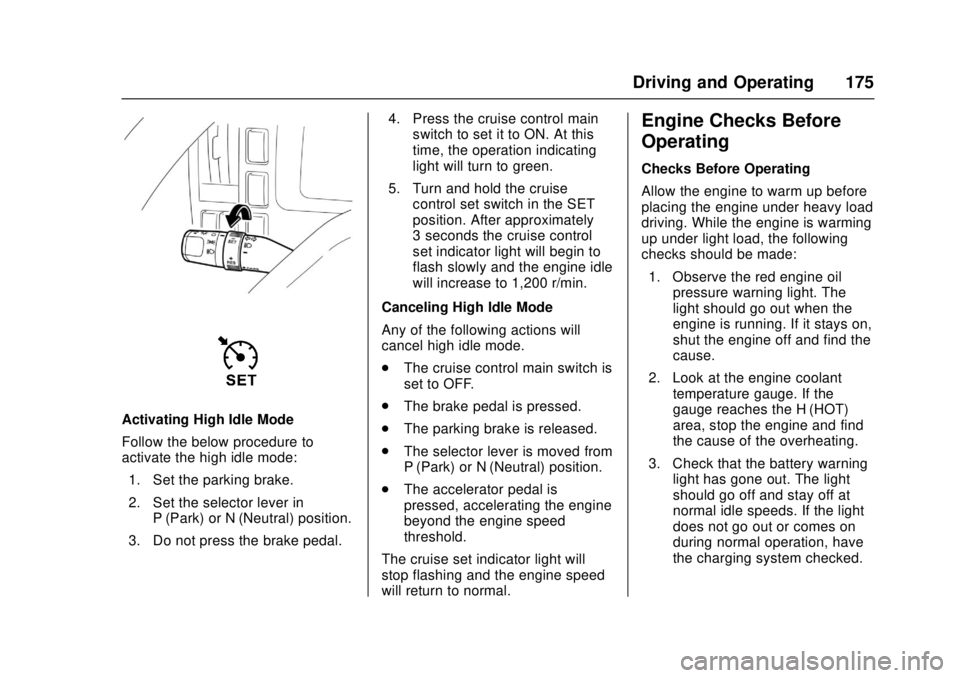
Activating High Idle Mode
Follow the below procedure to
activate the high idle mode:1. Set the parking brake.
2. Set the selector lever in P (Park) or N (Neutral) position.
3. Do not press the brake pedal. 4. Press the cruise control main
switch to set it to ON. At this
time, the operation indicating
light will turn to green.
5. Turn and hold the cruise control set switch in the SET
position. After approximately
3 seconds the cruise control
set indicator light will begin to
flash slowly and the engine idle
will increase to 1,200 r/min.
Canceling High Idle Mode
Any of the following actions will
cancel high idle mode.
. The cruise control main switch is
set to OFF.
. The brake pedal is pressed.
. The parking brake is released.
. The selector lever is moved from
P (Park) or N (Neutral) position.
. The accelerator pedal is
pressed, accelerating the engine
beyond the engine speed
threshold.
The cruise set indicator light will
stop flashing and the engine speed
will return to normal.
Engine Checks Before
Operating
Checks Before Operating
Allow the engine to warm up before
placing the engine under heavy load
driving. While the engine is warming
up under light load, the following
checks should be made:
1. Observe the red engine oil pressure warning light. The
light should go out when the
engine is running. If it stays on,
shut the engine off and find the
cause.
2. Look at the engine coolant temperature gauge. If the
gauge reaches the H (HOT)
area, stop the engine and find
the cause of the overheating.
3. Check that the battery warning light has gone out. The light
should go off and stay off at
normal idle speeds. If the light
does not go out or comes on
during normal operation, have
the charging system checked.
Page 177 of 414

Chevrolet Low Cab Forward Owner Manual (GMNA-Localizing-U.S.-
10716700) - 2017 - crc - 12/6/16
176 Driving and Operating
4. Check that the brake lowvacuum warning light is out
and that the vacuum buzzer is
not sounding. It is normal for
the warning buzzer to sound
for a few seconds after the
engine starts. If the light and
buzzer remain on, do not drive
the vehicle until the cause has
been found and corrected.
5. Look at the brake system warning light. It should be out
when the parking brake is
released and the engine is
running. If it stays on, it could
mean that the brake fluid level
is low. Check the brake fluid
reservoir. This condition must
be corrected before moving the
vehicle.
{Warning
To reduce the chance of personal
injury and/or vehicle damage due
to engine overheating, never
leave the engine idling without an
alert driver present. If the engine
(Continued)
Warning (Continued)
should overheat, as indicated by
the engine coolant temperature
gauge, immediate action is
required to correct the condition.
Continued operation of the
engine, even for a short time, may
result in a fire.
For vehicles with a diesel engine,
do not engage the exhaust brake
while the engine is idling as this
may cause engine overheating.
You and others could be seriously
injured.
Avoid Unnecessary Idling of the
Diesel Engine
If the diesel engine idles too long,
the engine coolant temperature will
fall below the operating range. Low
engine operating temperature
causes several conditions that are
harmful to engine operation and life.
Incomplete combustion of fuel in an
engine that is not fully warmed-up
causes crankcase dilution and
forms lacquer and gummy deposits on valves, pistons, and rings. It also
causes rapid accumulation of
sludge within the engine.
Parking over Things
That Burn
{Warning
Exhaust parts and gases become
very hot when the DPF is being
regenerated.
Parking over flammable items
could allow them to touch hot
exhaust parts under your vehicle
and cause them to ignite. Do not
park over papers, leaves, grass
or other things that can burn. You
and others could be seriously
injured.
Keep Flammable Material Away
from the Vehicle
The exhaust pipe is extremely hot
immediately after vehicle operation.
Before parking, make sure the area
is free of flammable material (for
Page 180 of 414

Chevrolet Low Cab Forward Owner Manual (GMNA-Localizing-U.S.-
10716700) - 2017 - crc - 12/6/16
Driving and Operating 179
Warning (Continued)
or corroded exhaust system or
cab. Do not run the engine in
confined areas (such as garages,
next to a building or near another
stopped vehicles with engine
running) any more than needed to
move the vehicle.
When the vehicle has to be
stopped in an unconfined area
with the engine running for any
more than a few minutes, take the
following steps:. Adjust the heating or cooling
system to force outside air
into the cab.
. With temperature and outlet
selector knob in any
position:
. Set the air selector lever to
the fresh air position.
. Set the fan speed control
knob to the maximum speed
position.
(Continued)
Warning (Continued)
.Keep the exhaust tailpipe
area clear of snow and
other material to help
reduce the buildup of
exhaust gases under the
vehicle.
This is particularly important when
parked in blizzard conditions. You
and others could be seriously
injured.
See Climate Control Systems 0126
and Maintenance Schedule 0345.
Running the Vehicle
While Parked
Caution
To reduce the chance of personal
injury and/or vehicle damage due
to engine overheating, never
leave the engine idling without an
alert driver present. If the engine
(Continued)
Caution (Continued)
should overheat, as indicated by
the engine coolant temperature
gauge, immediate action is
required to correct the condition.
Continued operation of the
engine, even for a short time, may
result in a fire. Do not engage the
exhaust brake while the engine is
idling as this may cause engine
overheating.
Avoid Unnecessary Idling of the
Diesel Engine
If the engine idles too long, the
engine coolant temperature will fall
below the operating range. Low
engine operating temperature
causes several conditions that are
harmful to engine operation and life.
Incomplete combustion of fuel in an
engine that is not fully warmed-up
causes crankcase dilution and
forms lacquer and gummy deposits
on valves, pistons, and rings. It also
causes rapid accumulation of
sludge within the engine.
Page 182 of 414

Chevrolet Low Cab Forward Owner Manual (GMNA-Localizing-U.S.-
10716700) - 2017 - crc - 12/6/16
Driving and Operating 181
The selectable (switch) regeneration
required warning light (amber) will
turn on when regeneration cannot
be completed automatically. Perform
Running or Switch regeneration in
accordance with the proper
procedure. This is to restore DPF
function and is normal.
The exhaust pipe mixes air with the
exhaust gas to lower its temperature
before it leaves the exhaust pipe.
The frequency of regeneration
increases especially under the
following environments:
‐Midwinter.
‐ Continuous low-speed driving for
long hours (The frequency of
regeneration increases
particularly with special
equipment vehicles such as
sweeper vehicles which mainly
travel at low speed. The
frequency of regeneration is
higher as compared to delivery
vehicles which mainly travel at
standard high speed). Automatic regeneration is performed
under normal driving conditions
(DPF soot accumulation status level
5, and in rare cases, may be
performed at continuously
low-speeds for long hours, except
PM level 5); however, the
regeneration required warning light
(amber) may be displayed in the
DIC under the following driving
conditions:
‐
When only low-speed driving at/
under vehicle speed of 15 km/h
(9 MPH) is performed.
‐ When frequent engine start and
stop are performed.
‐ When the engine stops every
time before the engine is
warmed up.
‐ When continuous idling (over
1 hour) is frequently performed.
If the vehicle is stationary with the
engine idling during DPF
regeneration, the exhaust brake or
exhaust throttle operates. Operating
sounds will be heard when the exhaust brake or exhaust throttle is
activated or deactivated. The
sounds do not indicate a fault.
White smoke could be emitted
briefly from the exhaust pipe in the
following situations, but it is not
indicating a fault.
‐
Combustion of PM during DPF
regeneration.
‐ During DPF regeneration of a
new vehicle which has been
driven a certain distance. The
vehicle may not emit white
smoke during its initial operation
when new.
‐ Long continuous idling.
The exhaust brake may
automatically be activated in order
to prevent emission of white smoke
if the engine idles continuously over
an extended period of time.
White smoke may be produced
during switch regeneration; do not
perform switch regeneration in any
poorly ventilated indoor place.
On vehicles with a 5.2L diesel
engine, white smoke may be
produced during DPF regeneration
Page 183 of 414

Chevrolet Low Cab Forward Owner Manual (GMNA-Localizing-U.S.-
10716700) - 2017 - crc - 12/6/16
182 Driving and Operating
when a new vehicle has been driven
a certain distance, but this is not a
malfunction. The vehicle may not
emit white smoke immediately after
purchase.
DPF PM Accumulation Level
This green display only indicates
DPF soot accumulation status. The
DIC can display the PM
accumulation level in green. The L
indicates Low accumulation of PM
and the H indicates High
accumulation of PM in the DPF.
As PM accumulation increases
inside the DPF, the DIC will display
additional bars increasing from L to
H to show the approximate level of
PM accumulation. SeeDriver
Information Center (DIC) (Diesel
Only) 093. DPF Regeneration Status
This amber display indicates the
DPF is regenerating. During DPF
regeneration, the DIC can display
the status of PM reduction in amber.
The highest accumulation level bar
will be flashing as indication of the
regeneration process.
As PM levels decrease in the DPF
during the regeneration process, the
DIC will decrease the number of
bars from H to L. See
Driver
Information Center (DIC) (Diesel
Only) 093. Automatic Regeneration of DPFThe DPF will regenerate itself as
part of normal operation.
The engine control module (ECM)
controls this function based on
several factors including hours of
operation and mileage. When
automatic regeneration starts, the
regeneration in progress indicator
light (amber) is displayed on
the DIC.
During regeneration the engine idle
speed will increase and the exhaust
brake may activate when the vehicle
is idling while stopped or parked.
Regeneration is normally completed
in about 20 minutes. See
Driver
Information Center (DIC) (Diesel
Only) 093.