2017 AUDI S3 SEDAN tire pressure
[x] Cancel search: tire pressurePage 335 of 400

CX> CX> ... N .... N ... 0 N > a:,
Rim
means a metal support for a tire
or a tire and tube assembly upon
which the tire beads are seated.
Rim di amet er
means nominal diameter of the
bead seat. If you change your
wheel size, you will have to pur
chase new tires to match the new
rim diameter.
Rim size designation
means rim diameter and width.
Rim width
means nominal distance between
rim flanges.
Sidewall
means that portion of a tire be
tween the tread and bead.
Speed rating (letter code )
means the speed at wh ich a tire is
designed to be driven for extend
ed periods of time . The ratings
range from 93 mph (150 km/h)
to 186 mph (298 km/h)
¢ table
on page 329.
You may not find
this information on all tires be
cause it is not required by law.
The speed rating letter code,
where applicable, is molded on
the tire sidewall and indicates the
Wheels
maximum permissible road
speeds
¢ A in Winter tires on
page 342.
T ire pressure mon itoring
system *
means a system that detects
when one or more of a vehicle's
tires are underinflated and illumi
nates a low tire pressure warning
telltale.
T read
means that portion of a tire that
comes into contact with the road .
Tread separation
means pulling away of the tread
from the tire carcass.
Treadwear indicators (TWI )
means the projections within the
principal grooves designed to give
a visual indication of the degrees
of wear of the tread. See
¢ page 336, Treadwear indicator
for more information on measur
ing tire wear .
Uniform Tire Quality Grading
is a tire information system devel
oped by the United States Nation
a l Highway Traffic Safety Admin
istration (NHTSA) that is designed
to help buyers make relative
333
..
Page 338 of 400
Wheels
-Inflation pressure that is too low or high can in
crease tire wear considerab ly.
-Driving quickly through curves, rap id accelera
tion and heavy b raking increase tire wear .
-Have an authorized A udi dealer or au thorized
Audi Se rvice Facility check the wheel alignment
if there is unusual wear.
-Have the whee ls rebalanced i f an imbalance is
causing noticeab le vib ration in the steering
whee l. If you do not, the tires and other veh icle
components could wear more quickly.
Treadwear indicator
O rigina l equ ipment t ires conta in treadwe ar indi
cators in the tread pattern, which are b ars that
are 1/16 in. (1.6 mm) h igh and are spaced evenly
aro und the tire perpendic ular to the runn ing d i
rection¢ fig. 279. The letters "TWI" or triangles
on the tire sidewall indicate the locat ion of the
treadwear indicators.
The tires have reached the mi nimum tread
dept h
ll when they have worn down to the tread
wear ind icators. Replace the tires with new ones
¢ .&, .
Tire rotation
Rotating t he tires regular ly is recommended to
ensure the tires wear even ly. To rotate the tires,
install the tires from the rear ax le on the front
axle and v ice versa. This will allow the tires to
have approx imately the same length of service
life.
For unidirectional tires, make sure the tires are
installed according to the running direction indi
cated on the tire
sidewall¢ page 361 .
Hidden damage
Damage to tires and r ims can often occur i n loca
tions that are hidden . Unus ua l vibrations in the
veh icle or pulling to one s ide may indicate that
there is tire damage. Reduce your speed immedi
ately. Check the t ires for damage .
If no damage
is visible from the outside, drive s lowly and care
fully to the nearest authorized Aud i dealer or au-
l) Obey any applicable reg ulations in you r country.
336
thorized Audi Service Facility to have t he ve hicle
inspected.
A WARNING
Tread that has worn too low or different tread depths on the tires can reduce driving safety.
This can increase the risk of an accident be
cause it has a negative effect on handling,
d riving through curves, and b raking, and be
cause it increases the r isk of hydroplaning
when dr iving th rough dee p puddles.
Tire pressure
Fig. 280 Driver's side B-pi llar (e xamp le) :
t ire p ress ure label
;; ~ ~ ~-----------------,:,
• (=~ ~~I: I:. I)@ ::g
»-OOIMING...-ol~..SAflO.....,....,--.d . ... _k Le«-h,...a .. ~etdudw,.uWl>l!tdollil,.._~ 'eou lb.
tw: SIU COI.O TR PRESSURE PNE U lailEHSl0HS "'lSSION OU PNEUS AFRQID
-AVANT -KPA. • PS I
Fig. 281 Tire pressure label
SEE OWNER"S MANUAL FOR ADOrTlONAL INFORMATK>N
VOIR L£ MANUa DU PROPRIETAIRE POUR PLUS DE RENSEIGNEMENTS
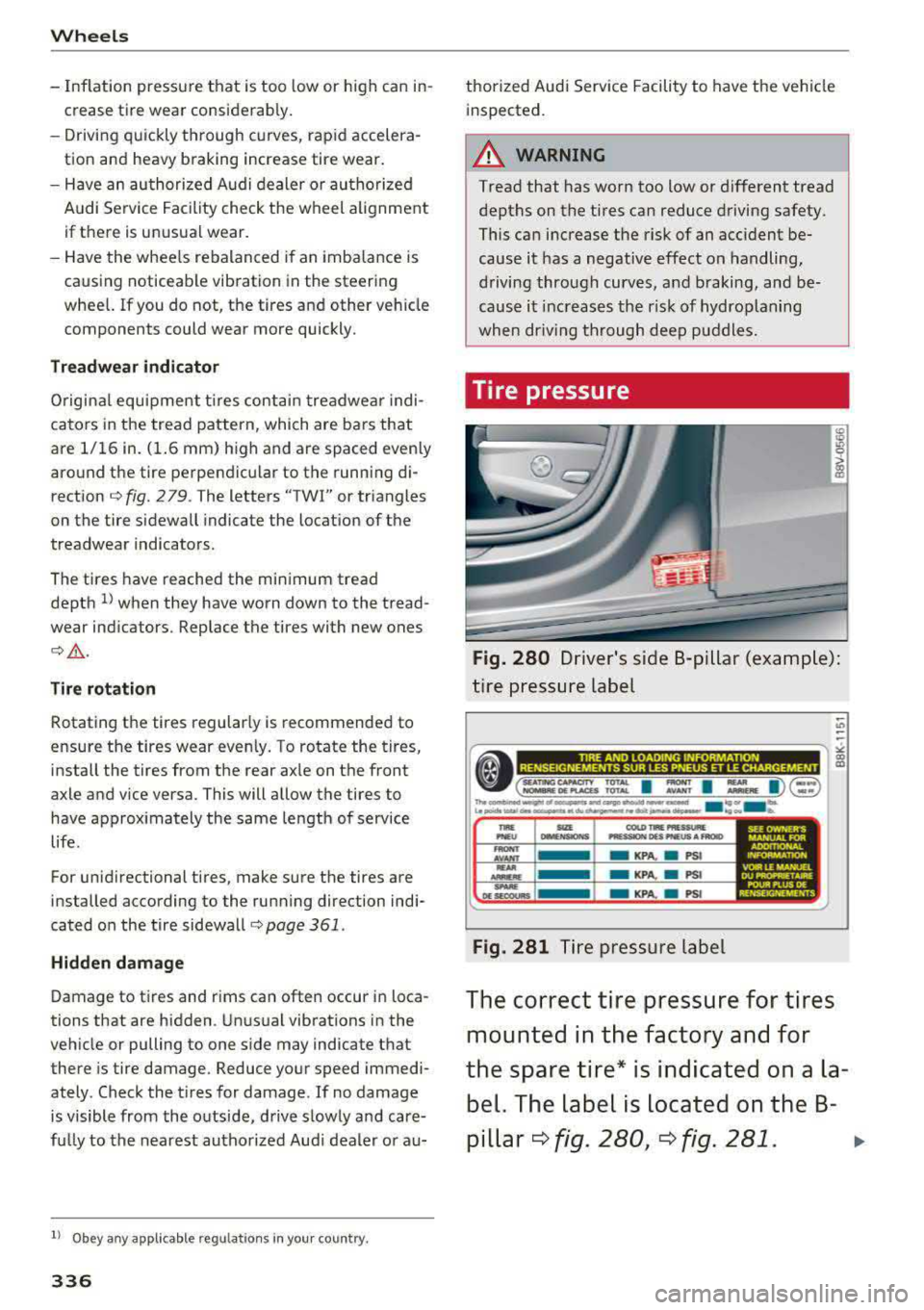
The correct tire pr essure for tires
mounted in the fa ctory and for
th e s pare tire * is ind icated on a la
bel. The label i s located on th e B-
pillar
¢ f ig . 280, ¢ fig. 2 81 . ..,
Page 339 of 400

CX> CX> ... N .... N ... 0 N > a:,
When the vehicle is partially loaded (up to 3 peop le), use the tire
pressure specified for normal
loads
c::> table on page 338. If
driving the vehicle when fully
loaded, you m ust increase the t ire
pressure to the maximum speci
fied pressure
c::> ,A .
Checking /correcting ti re
pressure
.,.. Check the tire pressure at least
once per month and also check it before every long drive.
.,.. Always check the tire pressure
when the tires are
cold. Do not
reduce the pressure if it increas
es when the tires are warm .
.,..Check the label c::> fig. 281 for
the correct tire pressure based
on vehicle load.
.,.. Correct the tire pressure if nec
essary.
.,.. Vehicles with Tire P ressure Mon
itoring System*: store the modi
fied tire pressure in the Infotain ment system
c::> page 346.
.,.. Check the pressure in the emer
gency tire*/spare tire*. Always
maintain the maximum temper
ature that is specified for the
tire .
Wheels
.&_ WARNING
Always adapt the tire pressure
to your driving style and vehicle
load.
- Overloading can lead to loss of
vehicle control and increase the risk of an accident. Read
and follow the important safe
ty precautions in
c::> page 339,
Tires and vehicle load limits.
- The tire must flex more if the
tire pressure is too low or if
the vehicle speed or load are
too high. This heats the tire up
too much. This increases the
risk of an accident because it
can cause the tire to burst and
result in loss of vehicle con
trol.
-Incorrect tire pressure in
creases tire wear and has a negative effect on driving and
braking behavior, which in
creases the risk of an accident .
(D Note
Replace lost valve caps to re
duce the risk of damage to the
tire valves .
@) Fo r th e sa ke of t he e nvi ro nm ent
Tire pressure that is too low in-
creases fuel consumption.
.,.
337
Page 340 of 400

Wheels
(D Tips
Audi recommends using the
tire pressure specified for a normal load
¢ table on
Tire pressure table
Please note that the information
contained in the following table
was correct at the time of print
ing , and the information is sub
ject to change. If there are differ
ences between this information
and the tire pressures specified
on the label on the driver's side B
pillar, always follow the specifica
tion on the B-pillar label
¢ page 336~ f ig. 280.
Model/ Tire designation
Engine
page 338 or for a full load
when the vehicle is partially loaded .
Make sure that the tire designa
tion on your tire matches the des ignation on the tire pressure label
and the tire pressure table.
The following table li sts recom
mended tire pre ssur es in cold
tires according to the load and
the size of the tires in stalled.
Tire pressure
Normal load Maximum load
(up to 3
people)a l
front rear front rear
PSI kPA PSI kPA PSI kPA PSI kPA
A3 sedan: 225/40 R18 92Y
35 240
32 220 36 250 36 250 2.0 L High Performance
4-cylinder 225/45 R17 91H
All Season
33 230 30 2 10 4 1 280 41 280
225/40 R18 92H
36 250
33 230 41 280 41
280 All Season
235 /35 R19 91 Y
33 230 30 210 38 260 280 High Performance
41
53 sedan: 225/40 R18 92Y
3 8 2 60 35 2 40 42 2 90 42 290 2.0L High Performance
4 cylinders 225/40 R18 92H
All Season
38 260 35 240 41
280 41
280
235/35 R19 91 Y
39 270 36 25 0 44
300 44 300 High Performance
338
Page 341 of 400

CXl CXl .... N ,.__
N .... 0 N > 00
Wheels
Model/ Tire designation Tire pressure
Engine Normal load Maximum load
(up to 3
people)a)
front rear front rear
PSI
A3 Cabrio- 225/40 Rl8 92Y
let: High Performance
3 5
2.0 L 225/45 Rl 7 91H
4-cylinder All Season
33
225/40 Rl8 92H
All Season 38
235/35 Rl9 91 Y
High Performance 42
A3 Sportb 205/55 Rl6 91 V
ack e-tron: High Performance
35
1.4 L 225/40 Rl8 92Y
4-cylinder High Performance
33
225/45 Rl 7 91H
All Season
3 3
225/40 Rl8 92H
All Season
36
a) 2 peopl e in the front , 1 person in the rear
/!\. WARNING
Please note the important safe
ty precautions regarding tire pressure
¢ page 336 and load
limits¢ page 339.
Tires and vehicle load limits
There are limits to the amount of
load or weight that any vehicle
and any tire can carry. A vehicle
that is overloaded will not handle
well and is more difficult to stop.
Overloading can not only lead to
loss of vehicle control, but can al
so damage important parts of the
kPA PSI kPA PSI kPA PSI kPA
240
32 2 20 38 260 3 8 260
230 30 210 39 270 39 270
2 60 35 240 41 280 41 280
29 0 39 27
0 45
310 45
310
240 35 240 36 250 39 270
2 30
33 23
0
36 250
39 2
70
230 33 2 30 38 260 38 260
250 36 250 41 280 41 280
vehicle and can lead to sudden
tire failure, including a blowout
and sudden deflation that can
cause the vehicle to crash.
Your safety and that of your pas
sengers also depends on making
sure that load limits are not ex
ceeded. Vehicle load includes ev
erybody and everything in and on
the vehicle. These load limits are
technically referred to as the vehi
cle's
Gross Vehicle Weight Rat-
ing
("GVWR"). .,.
339
Page 343 of 400

CX> CX> ... N .... N ... 0 N > a:,
including the weight of a trail
er hitch and the tongue
weight of a loaded trailer
-
does not make the vehicle heavier than the vehicle's
Gross Vehicle Weight Rating.
Determining correct load
limit
Use the example below to calcu
late the total weight of the pas
sengers and luggage or other
things that you plan to transport
so that you can make sure that
your vehicle will not be overload ed.
Steps for Determining Correct Load Limit
1. Locate the statement "THE
COMBINED WEIGHT OF OCCU
PANTS AND CARGO SHOULD
NEVER EXCEED XXX KG OR XXX
LBS" on your vehicle's placard
(tire inflation pressure label)
¢ page 336, fig. 280.
2. Determine the combined
weight of the driver and pas
sengers that will be riding in
your vehicle.
3. Subtract the combined weight
of the driver and passengers
from
"XXX" kilograms or "XXX"
Wheels
pounds shown on the sticker
¢ page 336, fig. 280.
4. The resulting figure equals the
available amount of cargo and luggage load capacity. For ex
ample, if the
"XXX" amount
equals
1400 lbs. and there will
be five
150 lbs . passengers in
your vehicle, the amount of
available cargo and luggage
load capacity is
650 lbs.
(1400-750 (5 X 150) =
650 lbs.)
S. Determine the combined weight of luggage and cargo
being loaded on the vehicle.
That weight may not safely ex
ceed the available cargo and
luggage load capacity calculat
ed in Step 4.
6. If your vehicle will be towing a trailer, load from your trailer
will be transferred to your ve hicle. Consult this manual to
determine how this reduces
the available cargo and lug
gage load capacity of your vehi
cle.
.,.Check the tire sidewall
(¢page 328, fig . 278) to deter
mine the designated load rating
for a specific tire.
341
Page 344 of 400

Wheels
Wheel bolts and rims
Wheel bolts
Wheel bolts must be clean and loosen/tighten
easily .
Rims
Rim s with a bolted r im ring * or with bolted wheel
covers* consist of multiple pieces. These compo
nents were bolted together using special bolts
and a special procedure . You must not repair or
disassemble
them ¢_&. .
..&, WARNING
Wheel bolts that are tightened or repaired in
correctly can become loose and result in loss
of vehicle control , which increases the risk of
an accident. For the correct tightening specifi
cation, see
¢ page 35 7, After changing a
wheel.
- Always keep the wheel bolts and the
threads in the wheel hub clean and free of
grease.
- Only use wheel bolts that fit the rim.
- Always have damaged rims repaired by an
authorized Audi dealer or authorized Audi
Service Facility. Never repair or disassemble
rims yourself, because this increases the risk
of an accident .
Winter tires
Winter tires significantly improve the vehicle 's
handling when driving in winter conditions. Be
cause of their construction (width, compound,
tread pattern) , summer tires provide less trac
tion on ice and snow.
.,. Use winter tires on all four wheels .
.,. Only use winter tires that are approved for your
vehicle.
.,. Please note that the maximum permitted
speed may be lower with winter tires
¢ _&. .An
authorized Audi dealer or authorized Audi Serv
ice Facility can inform you about the maximum
permitted speed for your tires.
.. Check the tire pressure after installing wheels
¢ page 336.
342
The effectiveness of winter tires is reduced great
ly when th e tread is worn down to a depth of
0.157 inch (4 mm). The characteristics of winter
tires also decrease greatly as the tire ages, re
gardless of the remaining tread.
'
..&, WARNING
- Never drive faster than the maximum per
mitted speed for your tires. This could cause
the tires to heat up too much. This increases
the risk of an accident because it can cause
the tire to burst .
- Always adapt your driving to the road and
traffic conditions . Drive carefully and reduce
your speed on icy or slippery roads . Even
winter tires can lose traction on black ice.
{® For the sake of the environment
Reinstall summer tires at the appropriate
time, because they provide better handling
when roads are free of snow and ice. Summer
tires cause less road noise, tire wear and fuel
consumption.
(D Tips
You can also use all season tires instead of
winter tires. Please note that in some coun
tries where winter tires are required, only
winter tires with the
& symbol may be per
mitted.
Snow chains
-
Snow chains not only improve the driving in win
ter road conditions, but also the braking.
.. Only install snow chains on the front wheels.
This applies also to vehicles with all wheel drive* .
.. Check and correct the seating of the snow
chains after driving a few feet, if necessary . Fol
low the instructions from the manufacturer .
.,. Note the maximum speed of 30 mph (SO km/
h). Note the local regulations.
Use of snow chains is only permitted with certain
rim/tire combinations due to technical reasons.
.,.
Page 345 of 400

CXl CXl .... N ,.__
N .... 0 N > 00
Check with an authorized Audi dealer or author
ized Audi Service Facility to see if you may use
snow chains .
Use
fine-mesh snow chains . They must not add
more than 0.53 inch (13 .5 mm) in height, includ
ing the chain lock.
You must remove the snow chains on roads with
out snow. Otherw ise, you could impair driving
ability and damage the tires.
~ WARNING
Using incorrect snow chains or installing snow
chains incorrectly can result in loss of vehicle
control, which increases the risk of an acc i
dent.
0 Note
Snow chains can damage the rims/wheel cov
ers * if the chains come into direct contact
w ith them. Remove the wheel covers * first.
Use coated snow chains.
(D Tips
When using snow cha ins, it may be useful to
sw itch on sport mode
¢page 152.
Low aspect ratio tires
Your Aud i is factory-equipped with low aspect ra
tio tires. These t ires have been thoroughly tested
and been selected specifically for you r model for
their superb performance, road feel and handling
under a va riety of driving conditions. As k your au
thorized Audi dealer for mo re de tails.
The low aspect ratio of these tires is indicated by
a numera l of
55 or less in the tire's size designa
tion . The numeral represents the ratio of the
tire's sidewall height in relation to its tread width
expressed in percentage. Conventional tires have
a height/w idth rat io of 60 or more .
The performance of low-aspect-ratio tires is par
ticularly sensitive to improper inflation pres
sure. It is therefore important that low aspect
ratio tires are inflated to the specified pressure
and that the inflation pressure is regularly
checked and maintained. Tire pressures should
Wheels
be checked at least once a month and always
before a long trip
¢ page 336 .
What you can do to avoid tire and rim
damage
Low aspect ratio tires can be damaged more easi
ly by impact w ith potholes, curbs, gullies or
ridges on the road, particularly if the tire is un
der inflated.
In order to minimize the occurrence o f impact
damage to the tires of your vehicle, we recom
mend that you observe the following precau
t ions:
-Always maintain recommended inflation pres
sures . Check your tire pressure every
2,000 miles (3,000 km) and add air if necessa
ry.
-Drive carefully on roads with potholes, deep
gullies or ridges. The impact from driving
through or over such obstacles can damage
your tires. Impact with a curb may also cause damage to your tires.
-After any impact, immediate ly inspect your
tires or have them inspected by the nearest au
thorized Audi dealer . Replace a damaged tire as
soon as possible .
-Inspect your tires every 2,000 m iles (3,000 km)
for damage and wear . Damage is not a lways
easy to see. Damage can lead to loss of air and
unde rinflation, w hich could even tually cause
t ire fa ilure.
If yo u bel ieve that a tire may have
been damaged, replace the tire as soon as pos
sible.
-These tires may wear more quickly than others.
-Please also remember that, while these tires
deliver responsive handlin g, they may ride less
comfortably and make more noise than other
choices.
Reduced performance in winter/cold season
conditions
All tires are designed for certain purposes. The
low aspect ratio, ultra high performance tires
origina lly installed on your vehicle are intended
for maximum dry and wet road performance and
handling. They are not suitable for cold, snowy or
icy weather conditions. If you drive under those
c ir cumstances, you should equip your vehicle
..,.
343