2017 AUDI Q5 oil
[x] Cancel search: oilPage 244 of 296

Wheels
Model/ Tire designation Tire pressure
Engine Normal load
Maximum load
(up to
3 people)a)
front rear front rear
PSI
235/60 Rl8 103H
29 Q5:
All Season
2.0L 235/55 Rl9 101H
4 cylinders
All Season
30
and
Q5: 235/55 Rl9
101 W 29 High Performance
3.0L
6 cylinders 255/45 R20 101W
29 High Performance
255/45R20101W
39 SQ5:
High Performance
3.0L
6 cylinders 255/40
R21102Y
41 High Performance
a) 2 people in the front, 1 perso n in the r ear
A WARNING
Please note the important safe
ty precautions regarding tire pressure ¢
page 240 and load
limits ¢
page 242.
Tires and vehicle load limits
There are limits to the amount of
load or weight that any vehicle
and any tire can carry . A vehicle
that is overloaded will not handle
well and is more difficult to stop.
Overloading can not only lead to
loss of vehicle control, but can al
so damage important parts of the
vehicle and can lead to sudden
tire failure, including a blowout
242
kPA PSI kPA PSI kPA PSI
200 29 2 00 32 220 32
210 30 210 33 230 33
200 29 200 33 230 33
2 00 29 2 00 3 3 230 33
270 39 270 41 280 41
2 80
36 2
50 41
28 0 42
and sudden deflation
that can
cause the vehicle to crash.
kPA
220
230
230
230
280
2 9 0
Your safety and that of your pas
sengers also depends on making
sure that load limits are not ex
ceeded. Vehicle load includes ev
erybody and everything in and on
the vehicle. These load limits are
technically referred to as the vehi
cle's
Gross Vehicle Weight Rat
ing
("GVWR") .
The "GVWR" includes the weight
of the basic vehicle, all factory in
stalled accessories , a full tank of
fuel, oil, coolant and other fluids
plus maximum load. The maxi
mum load includes the number of
11-
Page 255 of 296

a,
a,
..... N r-N ..... 0 0
0:
co
Tire mobility kit
General information and safety precautions
Appl ies to: ve hicles with tire repair kit
The tire repair is only meant for temporary use.
Fig. 212 T ire damage, for which the ti re repair kit is not
su itable
N
-r--0 ci: co ID
Your veh icle is equipped with a tire repair kit (Tire
Mobility System) .
In the event of a flat tire, the tire repair kit is
found in the luggage compartment behind the right side trim panel, and is made up of tire seal
ant and a compressor¢
page 107 , fig. 121 .
Only tire damage caused by foreign objects up to
approx imately 0.16 in
( 4 mm ) in diameter can be
safely sealed with the tire repair kit.
The foreign object can stay in the tire .
The tire sealant may not be used :
-If the t i re has cuts or punctures that are larger
than 0.16 in (4 mm)
,=;,fig. 212@.
-If the rim is damaged @.
- If you drove with very low t ire pressure or with-
out air in the tire@.
Tire repair kit usage is described in
Performing
t he repai r
c;, page 254 and in the instructions
with the sealant bottle .
The tire repair kit is able to be used at tempera
tures as low as -4
°F ( -20 °().
A WARNING
Pay attent ion to the following after repairing
the tire:
- Do not drive faster than SO mph (80 km/h).
Em ergen cy a ssis tanc e
-Avoid hard acce leration, braking sharply,
and fast cornering .
- The vehicle may become more difficult to
control.
- Tires sealed with the tire repair kit are only
meant to be used
t e mpo ra ril y . Damaged
tires must be replaced.
- The tire repa ir k it may
NO T be used
- If the t ire has cuts or punctures that are
larger than 0.16 in (4 mm) .
- If the rim is damaged.
- If you drove with very low tire pressure or
without air in the tire.
- Obta in qualified help if it is not possible to
perform the repair with the tire sealant.
- The tire sealant must not come in contact
with skin, eyes, or clothes.
- If tire sealant gets in your eyes or on your
skin, thoroughly rinse the affected area im
mediately with clean water .
- Change your clothes immediately if they get
tire sealant on them.
- Do not inha le the fumes .
- If the tire sea la nt is swallowed, thoro ughly
rinse out your mouth and drink lots of wa
ter .
- Do not induce vomiting . Seek medical atten
tion immediately.
- If an a llergic reaction occurs, seek immedi
ate med ica l attent ion .
- Keep the t ire sealant away from child ren.
@ For the sake of the environment
Used sealant bottles may be returned to yo ur
authorized Audi dea le r fo r disposal.
@ Tips
- If sealant has spilled out, let it dry and then
you ca n remove it by pee ling it away like a
foil.
- Note the expiration date on the sealant bot
tle. Rep lace the ti re sealant at an a utho r
ized Aud i dea le rship.
- Radio reception may be impaired when the
compressor is in use .
253
Page 256 of 296

Emergency assistance
Performing the repair
Applies to: vehicles w ith tire repair k it
Fig. 213 Performing the repair
Preparations
.,. Park the vehicle as far as possible from moving
traffic in the event of a flat tire.
.,. Set the
parking brake to prevent the vehicle
from ro lling un intent ionally.
.,. Sh ift the
selector lever into the P po sition .
.,. Determ ine whether a repair with the tire repair
kit is possible or not¢
page 253.
.,. Let all of the passengers
exit the vehicle and
move a safe distance away¢_&. .
.,. Take the
sealant bottle and the compressor
out of the luggage compartment ¢ page 107,
fig. 121.
.,. Affix the label "max. 50 mph (80 km/h)", found
on the sealant bottle, to the instrument cluster
where it can be seen by the driver.
Filling a tire
.,. Shake the bottle thoroughly before fi lling.
.,. Screw the accompanying filling hose complete
ly onto the bottle. This breaks through the foil
seal automatically at the connection .
.,. Remove the valve cap from the tire valve and
unscrew the valve insert using the accompany
ing valve insert tool
~fig. 213 .
.,. Lay the valve insert on a clean surface .
.,. Remove the sealing plug from the filling hose
and connect the hose to the tire valve .
.,. Hold the bottle with the bottom facing upward
and empty the entire contents into the tire .
.,. Then pull out the hose and screw the valve in
sert tightly back into the tire valve.
254
Inflating a tire
.,. Screw the filling hose for the compressor onto
the tire valve and insert the connector into the
cigarette lighter.
.. Inflate the tire to between 29 PSI (200 kPA)
and 36 PSI (250 kPA) and read the pressure on
the gauge .
.,. If this tire pressure is not reached, drive your
veh icle approximately 33
ft (10 meters) for
ward or backward so that the sealant can be re
distr ibuted inside the tire. If at this time the re
qui red air press ure st ill cannot be reached, the
tire is too badly damaged and cannot be re
pa ired with the tire sealant .
Final inspection
.,. Stop the vehicle after dr iv ing for about 10 mi
nutes and check the tire pressure.
.,. If the tire pressure is lower than 19 PSI
(130 kPA), then the t ire is too severely dam
aged . Do not continue driving . Please seek pro
fessional ass istance .
&_ WARNING
- Turn on the emergency flashers if you have a
flat tire while in moving traffic. This is for
your protection and the for the safety of
other drivers.
- Take care to move all of the passengers to a
safe place (behind a guard rail for example) .
- Read and follow the manufacturer's safety
precaut ions on the compressor and in the
instructions on the bottle of sealant!
- If a tire pressure of 29 PSI (200 kPA) cannot
reached after inflating for 12 minutes, then
the tir e is too severely damaged. Do not
continue driving.
- Obta in qualified help if it is not possible to
pe rform the repair with the tire sealant .
- If the tire pressure is less than 19 PSI
(130 kPA) after 10 minu tes of driv ing, then
the tire is too severely damaged . Do not
con tinue driv ing. Seek profess ional assis
ta nce.
Page 257 of 296

CD
CD
.... N ,-... N ..... 0 0 C<'. 00
(D Note
Special care is required if you are repairing
the tire on a steep incline.
@ Tips
- Do not operate the compressor for more
than 12 minutes continuously, otherwise it
can overheat. Once the compressor has
cooled, you can continue to use it.
- If sealant has spi lled out, let it dry and then
you can remove it by peeling it away like a
foil.
- Remember to obtain a new bott le of sealant
from your authorized Audi dealer after re
pair ing a tire. After this, the functionality of
the tire repair set is restored .
- Obey all laws.
Replacing wheels
Before changing a wheel
Observe the following precautions for your own
and your passenger's safety when changing a
wheel.
"" After you experience a tire failure, pull the car
well away from moving traff ic and try to reach
level ground before you stop¢_& .
.. All passengers sho uld
leave the car and move
to a safe location (fo r instance, behind the
guardrai l) ¢ .&_ .
.. Engage the
par king b rake to prevent yo ur vehi
cle from roll ing unintentionally ¢&_ .
.. Move
selecto r le ver to po sitio n P ¢ &_ .
"" If you are towing a trailer: unh itch the trailer
from your veh icle.
"" Block the diagonally opposite wheel with the
folding chocks o r other objects .
""T ake the
jac k* and the inflatable spa re tir e*
out of the luggage compartment¢ page 250 .
A WARNING
You or your passengers cou ld be inj ured while
changing a wheel if you do not follow these
safety precautions:
- If you have a flat tire, move a safe distance
off the road. Turn off the engine, turn the
Em ergenc y ass is tanc e
emergency flashers on and use other wa rn
ing dev ices to alert other motorists.
- Make sure that passengers wait in a safe
place away from the vehicle and well away
from the road and traff ic.
- To help prevent the veh icle from moving
suddenly and possib ly slipping off the jack*,
always fully set the parking brake and block
the wheel diagonally opposite the wheel be i n g changed with the fold ing c hocks or oth
er objects . When one front whee l is lifted
off the ground, placing the Automatic
Transmission in P (Park) w ill
not prevent the
veh icle from moving.
- Before you change a wheel, be sure the
gro und is leve l and firm.
If necessary, use a
sturdy board under the jack*.
- Always s tore the vehicle too l kit, the jack*
and the replaced tire in the lugg age com
partment
¢ page 136.
Changing a wheel
When you change a wheel, follow the sequence
described below s tep-by -step and in exactly that
order.
1. Remove the de corative wheel cover* . For
more detai ls see also
¢page 256, Decaro-
tive wheel covers
o r r::!> poge 256, Wheels
with wheel bolt cops .
2. Loosen the w
heel bolts¢ page 256 .
3. Locate the proper mounting point for the
jack* and align the jack* below that point
¢ page 257.
4. Li ft the car with the jack*¢ page 257.
s. Remove the wheel with th e flat tire and then
insta ll the
inflatable spar e tire*
¢ page 258.
6. Tighte n all whee l bolts lightly.
7 .
Lo wer the vehicle wi th the jack *.
8 . Use the whee
l bolt wrench and
firml y tighten
all wheel bo lts
r::!> poge 256 .
9. Replace the decorat ive wheel co ver* .
255
...
Page 273 of 296

mount ing point q fig . 23 2. Do not lift the vehi
cle at the vertical sill reinforcement.
Rear lifting point
The lift ing po int is located on the vert ica l re in
for ceme nt of the lower si ll fo r the on bo ar d ja ck*
q fig . 233 .
Lifting with vehicle jack*
Refer to qpage 257 .
A WARNING
- To reduce the risk of serio us in ju ry and vehi
cl e d amage.
- Always lift t he vehicle only at the s pecial
wo rksho p ho ist and floo r jack lift po ints
il
lustrated q fig. 232 and ¢fig. 233.
- Fa ilur e to li ft the vehicle at these points
could cause the vehicle to ti lt or fall from
a lift if there is a change in vehicle weight
d istr ibut ion a nd balance . This might hap
pen, for exam ple, when heavy compo
n ents su ch as th e engi ne b lock or trans
m iss io n ar e rem ove d.
- W hen removing heavy components like
th ese, a nch or vehicle to hoist o r add corre
s po nding weigh ts to mainta in t he cente r of
gr avity. Otherwise, the vehicle mi ght tilt or
s lip o ff the hoi st, causing ser ious persona l
injury .
(D Note
- Be aware o f the follo wi ng po ints b efore lift
i n g th e ve hicle:
-The vehicle should never be lifted or
jacked up from underneath the engine oil
pan, the transmission housing, the front
or rear axle or the body side members .
This could lead to serious damage .
- To avoid damage to the underbody or
chassis frame, a rubber pad must be in
serted between the floor jack and the lift
points.
- Before driving over a workshop hoist,
~ check that the vehicle weight does not ....
~ exceed the permissible lifting capacity of
~ the hoist . 0 0 C<'. 00
Emergency situations
-Before driv ing over a workshop hoist, en
sure that the re is sufficient clearance be
tween the hoist and low parts of the ve
h icle.
271
Page 274 of 296

Technical data
Technical data
Vehicle identification
Fig. 234 Vehicle Ident if ication Numbe r (VlN) plate : loca·
tio n on d river 's side dash panel
XXXXX XX -X -XX XX XXX XX
@-+ ~J:~t::1 ::: xxxxxxxx xx x xxxx xxx x
IYP lf'VPE XXX X XX
xx xxxxxxx xx xx xx
XXX KW
XXX
EM:. COil / fAANS , COOE xxxx XXX XXX ®i MOIOlll
©-+ IAC KIIR . / tN NEN AIJSSt
XXXX I XXXX XXX I XX PAI NT NO./ WT£Jldl
II. -AUSST . / OPTIO NS
E0 A 7D5 4UB 6X
M SSG SR W
2EH JOZ lLB lAS
lBA
3FC SM U 7 X1
F0 A
9G3 0
G7 0Y H
0JF
TL 6 3 KA 8EH UlA X 9B Q
Z7
1 XW
803 908
824 020
7T6 C V7 7 K0 4X3 2K2
3L4 4KC 3Y0 413
502
lS A 7GB 01A
4G0
XX X XX X
XX X xxxx
Fig. 235 Vehicle identificat ion labe l: in side the luggage
compart ment
Vehicle Identification Number (VlN)
The Vehicle Identification Number is located in
different places :
- under the windshield on the driver's side
¢fig . 234.
-in the radio or in the MMI*: Select: !CAR i func·
tion button
> Vehicle ID number (VIN) or se·
Leet
I CAR ! function button > Car systems* con·
trol button
> Servicing & checks > VIN num
ber .
-on the vehicle identification label.
272
Vehicle identification label
The vehicle identification label is located in the
luggage compartment above the compartment
for the vehicle tools.
The label ¢
fig. 235 shows the following vehicle
data:
(D Vehicle Identification Number (VIN)
@ Vehicle type, engine output, transmission
® Engine and transmission code
@ Paint number and interior
® Optional equipment numbers
The information of the vehicle identification label
can also be found in your Warranty
& Mainte·
nance booklet.
Safety compliance sticker
The safety compliance sticker is yo ur ass urance
that your new vehicle complies with all applicable
Federal Motor Vehicle Safety Standards which
were in effect at the time the vehicle was manu
factured. You can find this sticker on the door
jamb on the driver's side. It shows the month and
year of production and the vehicle identification
number of your vehicle (perforation) as well as
the Gross Vehicle Weight Rating (GVWR) and the
Gross Axle We ight Rating (GAWR).
High voltage warning label
The high voltage warning label is located in the
engine compartment next to the engine hood re·
lease. The spark ignition system complies w ith
the Canadian standard ICES-002 .
Weights
Gross Vehicle Weight Rating
The Gross Vehicle Weight Rating (GVWR), and
the Gross Axle Weight Rating (GAWR) for front
and rear are listed on a sticker on the door jamb
on the dr iver's side .
The Gross Vehicle Weight Rating includes the
weight of the basic vehicle plus full fuel tank, oil
and coolant, plus maximum load, which includes
passenger weight (150 lbs/68 kg per designated
seat ing position) and luggage weight¢,&. .
Page 276 of 296

Tech nical data
Gasoline engines
QS 2.0, 4 cylinder
Maximum output SAE net hp@ rpm 220 @ 4450 -6000
Max imum torq ue SAE net lb-ft@ rpm 258@ 1500 - 4300
Displacement CID (cm
3
) 121.1 (1984)
Engine oil with filter change
1>
Fuel Premium unl ead ed (9 1 A KI) c::> page 209, Fuel
or Bio-ethanol (E85 ) c::> page 210, Ethanol fuel (Bio-etha-
no[) .
QS 2.0 hybrid, 4 cylinder
Maximum output SAE net hp@ rpm 211 @4300 -6000
Maximum torque SAE net lb-ft@ rpm 258 @ 1500 - 4200
Displacement C
ID (cm
3
) 1 21.1 (1984)
Engine oil with filter change
1
)
Fuel Premium unleaded (91 AKI) , c::> page 209, Fuel
Electr ic output (short-term)
hp 54
E lectr ic to rque (short-te rm) lb-ft
155
Total output (short-term) hp 245
T otal torq ue (short-term)
lb-ft 354
Battery type Lithium-ion
Battery energy conten t kWh 1.3
QS 3.0, 6 cylinder
Max imum ou tput SA E net hp@ rpm 2
72@ 4780 -6500
Maximum torque SAE net lb-ft@ rpm 295 @2150 -4780
Displacement C
ID (cm
3
) 1 82 .8 (2995)
Engine oil with filter change
1l
Fuel Premium unleaded
(91 AKI) ,
c::> page 209, Fuel
SQS 3.0, 6 cylinder
Maximum ou tpu t SA E ne t hp@ rpm 354@ 6000
-6500
Max imum torq ue SA E net lb-ft@ rpm 347 @4000 -4500
Displacement C
ID (cm
3
) 1 82.8 (2995)
E ngine o il with f ilter change
1l
Fuel Premium unleaded
(91 AKI) ,
c::> page 209, Fuel
274
Page 277 of 296
CD
CD
.... N ,-... N ..... 0 0 C<'. 00
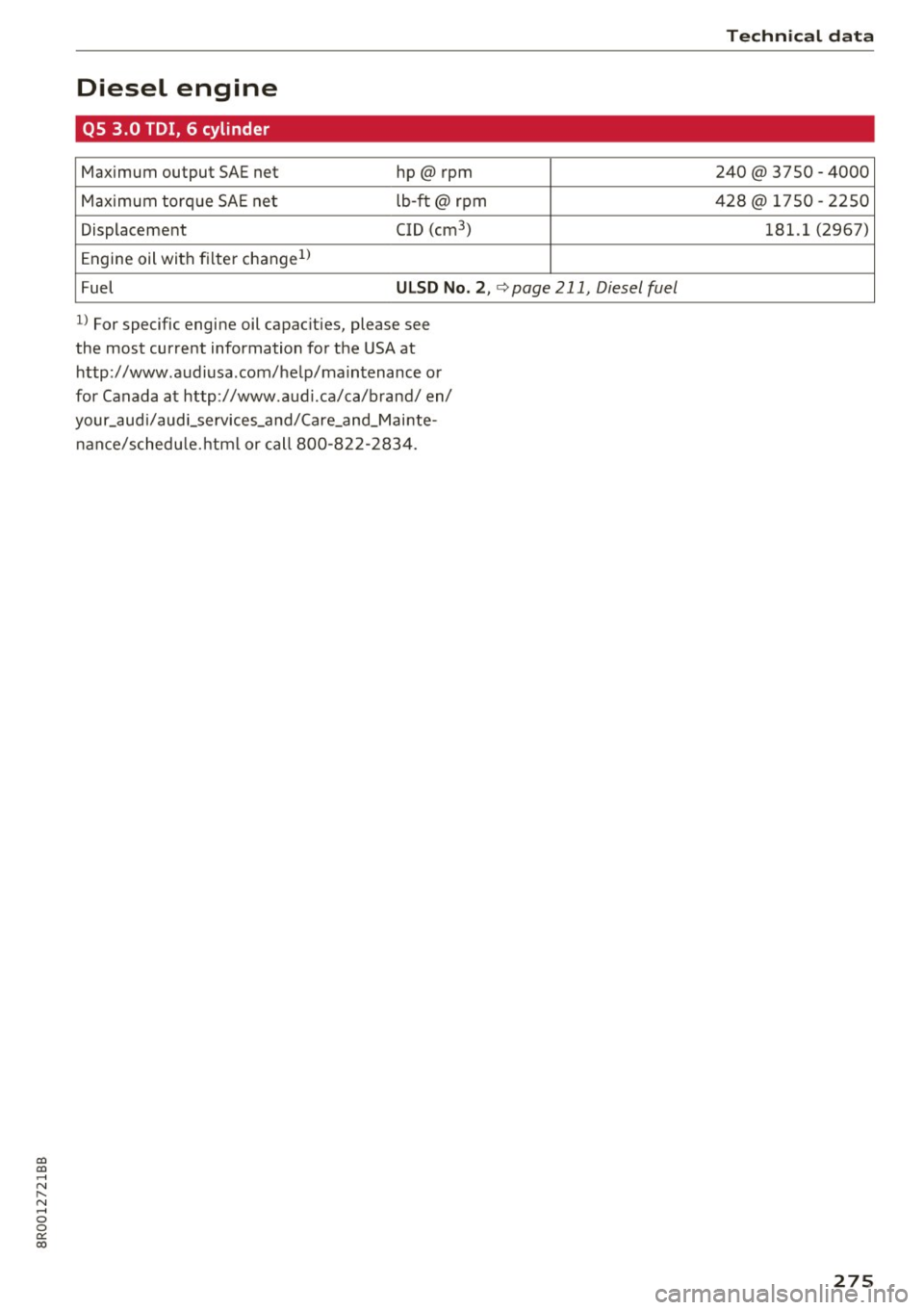
Diesel engine
QS 3.0 TOI, 6 cylinder
Maximum output SAE net hp@rpnn
Maximum torque SAE net lb-ft@ rpm
Displacement CID (cm
3
)
Engine oil with filter change1>
Fuel U LS D No . 2, c::> page 211, Diesel fuel
ll For specific engine oil capacities, please see
the most current information for the USA at
http:/ /www.audiusa.com/help/maintenance or
for Canada at http:/ /www.audi.ca/ca/brand/ en/
your _aud i/ aud i_services_a nd/Care_and_M a i nte
n a nce/ schedu le.html or call 800-822-2834.
Techn ical dat a
240@ 3750 -4000
428@ 1750 -2250
181.1 (2967)
275