2017 AUDI Q5 cooling
[x] Cancel search: coolingPage 203 of 296
CD
CD
.... N ,-... N ..... 0 0 C<'. 00
Operating instructions
6" r-2
~·~
1/2"
1·1/2"
ill
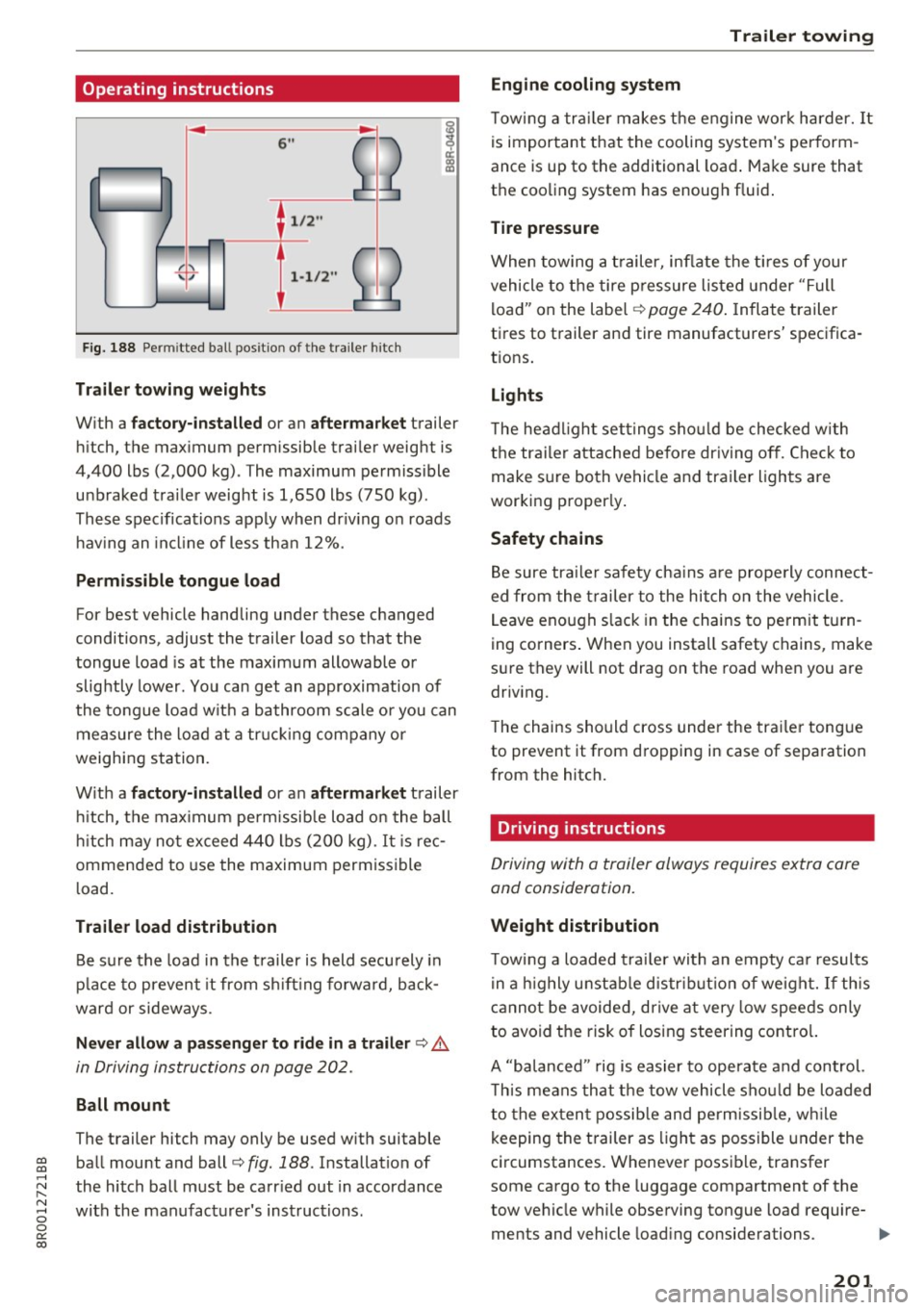
Fig. 188 Permi tted ba ll pos it io n of the trailer h itch
Trailer towing weights
With a
factory-installed or an aftermarket trailer
hitch, the maximum permissible trailer weight is
4,400 lbs (2,000 kg) . The maximum permissible
unbraked trailer weight is 1,650 lbs (750 kg).
These specifications apply when driving on roads having an incline of less than 12%.
Permissible tongue load
For best vehicle handling under these changed
conditions, adjust the trailer load so that the
tongue load is at the maximum allowable or
slightly lower. You can get an approximation of
the tongue load with a bathroom scale or you can
measure the load at a trucking company or
weighing station.
With a
factory-installed or an aftermarket trailer
hitch, the maximum permissible load on the ball
hitch may not exceed 440 lbs (200 kg) .
It is rec
ommended to use the maximum permissible
load.
Trailer load distribution Be sure the load in the trailer is held securely in
place to prevent it from shifting forward, back
ward or sideways.
Never allow a passenger to ride in a trailer ¢.&.
in Driving instructions on page 202.
Ball mount
The trailer hitch may only be used with suitable ball mount and ball¢
fig. 188 . Installation of
the hitch ball must be carried out in accordance
with the manufacturer's instructions .
Trailer towing
Engine cooling system
Towing a trailer makes the engine work harder. It
is important that the cooling system's perform
ance is up to the additional load. Make sure that
the cooling system has enough fluid.
Tire pressure
When towing a trailer, inflate the tires of your
vehicle to the tire pressure listed under "Full
load" on the label¢
page 240. Inflate trailer
tires to trailer and tire manufacturers' specifica
tions.
Lights
The headlight settings should be checked with
the trailer attached before driving off. Check to
make sure both vehicle and trailer lights are
working properly.
Safety chains
Be sure trailer safety chains are properly connect
ed from the trailer to the hitch on the vehicle .
Leave enough slack in the chains to permit turn
ing corners. When you install safety chains, make
sure they will not drag on the road when you are
driving.
The chains should cross under the trailer tongue
to prevent it from dropping in case of separation
from the hitch.
· Driving instructions
Driving with a trailer always requires extra care
and consideration.
Weight distribution
Towing a loaded trailer with an empty car results
in a highly unstable distribution of weight. If this
cannot be avoided, drive at very low speeds only
to avoid the risk of losing steering control.
A "balanced " rig is easier to operate and control.
This means that the tow vehicle should be loaded
to the extent possible and permissible, while
keeping the trailer as light as possible under the
circumstances. Whenever possible, transfer
some cargo to the luggage compartment of the
tow vehicle while observing tongue load require-
ments and vehicle loading considerations. .,.
201
Page 225 of 296

CD
CD
.... N ,-... N ..... 0 0 C<'. 00
Cooling system
Coolant
The engine cooling system is filled with a mixture
of purified water and coolant additive at the fac
tory. This coo lant must not be not changed.
The coolant level is monitored through the. in
dicator light
¢page 26. However , we do recom
mend occasionally check ing the coo lant level
manually.
If you must add coolant, use a mixture of water
and coolant addit ive. Mixing the coolant additive
with distilled water is recommended.
Coolant additive
The coolant additive is made of anti-freez ing and
corros ion protection agents. Only use the follow
ing coolant addit ives . These additives may be
mixed with each other.
Coolant additive Specification
G13
TL 774 J
G12++ TL 774 G
The amount of coo lant add itive that needs to be
mixed with water depends on the climate where
the vehicle will be operated.
If the coolant addi
tive percentage is too low, the coolant can freeze
and damage the engine.
Coolant Freeze protec-
additive tion
Warm min. 40% m in. -13 °F
regions max. 45% (-25 °C)
Cold min. 50% max
. -40 °F
regions max. 55% (-40 °C)
(D Note
-Before the start of winter, have your author
ized Audi dealer or authorized Audi Service
Facility check if the coolant additive in your
vehicle matches the percentage appropriate
for the climate . Th is is especially important
when driving in colder climates.
- If the appropriate coolant additive is not
available in an emergency, do not add any
other additive . You could damage the en-
Checking and Filling
gine. If this happens, only use water and re
store the correct mixture ratio with the
specified coolant add it ive as soon as possi
ble.
- Only refill with new coolant .
- Radiator sealant must not be mixed with
the coolant.
Adding coolant
Fig. 198 Engine compartment: coolant expansio n ta nk
cover
Checking the engine coolant level
.,. Park your vehicle on a level surface.
.,. Switch the ignit ion off.
-N
-N
"" CD co
.,. Read the coolant level on the coolant expansion
tank
¢ page 219, fig . 196. The coolant level
must be between the MIN and MAX mark ings
when the engine in cold. When the engine is
warm it can be slightly above the MAX marking.
Adding coolant
Requirement: there must be a residual amount of
coolant in the expansion tank
¢(D .
.,. Let the engine cool down.
.,. Place a cloth over the coolant expansion tank
cap and unscrew the cap counterclockw ise
¢ _& .
.,. Add coo lant mixed in the correct rat io
¢ page 223 up to the MAX marking .
.,. Make sure that the fluid level remains stable.
Add more coolant if necessary .
.,. Close the cap securely.
Coolant loss usually indicates there is a lea k. Im
mediately drive your vehicle to an authorized
Audi dealer or authorized Audi Service Facility
and have the cooling system inspected.
If the
223
Page 226 of 296

Checking and Filling
cooling system is not leakin g, a loss can come
from t he coolant boiling through overheat ing
an d be ing pushed out o f the coo ling system .
A WARNING
-
-The cooling system is under pressure. Do
not open t he coolant expansion tank ca p
when the eng ine is hot. This inc reases the
risk of bu rns .
- The coolant add itive and the coolant can be
dangerous to your health. For this reason,
keep the coolant in the o rigina l container
and away from children. There is a risk of
po isoning .
- When working in the eng ine compartmen t,
r emembe r that the rad iator fan ca n switch
on even if the ign ition is swi tc h ed off, which
in creases the risk of in jury.
(D Note
Do not add coolant if the expansion tank is
empty. Air could enter the cooling system and
damage the engine. If this is the case , do no t
cont inue driv ing. See an authorized Audi deal
er or author ized Audi Se rvice Facility for assis
tance .
Brake fluid
Checking brake fluid level
The brake fluid level can be checked with a quick
glance.
F ig. 19 9 En gi ne co mpa rtme nt: cove r on the brak e fluid
r ese rvoi r
N N
-N
" "' IX)
Before you check anyth ing in the eng ine compart
ment,
a lways read and h eed all WARNING S
224
¢.&. in Working in the engine compartment on
page 217.
.,. Read the bra ke fluid level from the brake f lu id
reservoir ¢
fig. 199, ~ page 219, fig. 196. The
brake fluid leve l must be between the "M IN"
and "MAX" markings.
The brake flu id reservoir is located a t the rear
partition of the engine compartment on the left
side
¢ page 219.
The fluid level may drop slightly afte r some t ime
due to t he automatic adjustme nt of the brake
pads. This is not ca use for a larm.
If the brake fluid level falls considerably below
the
" M IN " mark, the bra ke warn ing/ indica tor
li gh t (U.S. models:
11111 . Canadian models: .
will come on ¢
page 15 and¢ page 25. Do not
continue to ope rate the veh icle. The comp lete
brake system shou ld be thoroughly checked by an
a uthor ized Audi dealer or qualified workshop and
the cause corrected. If the brake fluid level is too l ow, the brake warn ing/ indicator light w ill illumi
nate. Contact a n author ized Audi dealer
immedi
ately .
Chang ing brake fluid
Have the brake fluid changed by an experienced
technician .
Brake fluid absorbs moisture from the air. If the
water content in the brake fluid is too high, cor
rosion in the brake system may result after ape
riod of time . The boiling po int of the brake fluid
will a lso decrease considerably and decrease
bra king pe rformance.
Therefore, the brake fluid must be changed
every
two years .
Always use new brake f lu id which con
fo rms to Federa l Moto r Vehicle S tandard " FMVSS
116 DO T 4".
The brake fluid reservoir can be diff icult to reach,
therefore, we recommend that you have the
brake fluid changed by your author ized
Audi
dealer .
Your dealer has the correct tools, the
right brake fluid a nd the know -how to do t his for
you . ..,.
Page 284 of 296

Index
Child safety . . . . . . . . . . . . . . . . . . . . . . . . . . 168
Important safety instructions for using child
safety seats . . . . . . . . . . . . . . . . . . . . . . . .
171
Installing a child restraint using the LATCH
system . . . . . . . . . . . . . . . . . . . . . . . . . . . .
182
Mounting and releasing the anchorage
hook
. ... .. .. .. ... ... ... .... .. .. .. . 182
Tether anchors .. ................ ... . 183
Tether straps ... .... ......... .... .. . 183
Child safety locks
Rear doors . . . . . . . . . . . . . . . . . . . . . . . . . . 42
Child safety seats
Booster seats . . . . . . . . . . . . . . . . . . . . . . .
176
Convertible child seats . . . . . . . . . . . . . . . 175
Danger of using child restraints in the front
seat ..... .. .... .......... ...... ... .
149
How do I properly install a child safety seat
. h' l ? in myve 1c e .... ................ ... . 171
Infant seats . . . . . . . . . . . . . . . . . . . . . . . . 17 4
L ATCH system . . . . . . . . . . . . . . . . . . . . . .
182
Lower anchorages ............ .... .. .
Safety instructions .................. .
Unused safety belts on the rear seat ... .
Ch ild seats 182
171
173
174
Securing . . . . . . . . . . . . . . . . . . . . . . . . . . . 178
Cigarette lighter . . . . . . . . . . . . . . . . . . . . . . . 73
Cleaning . . . . . . . . . . . . . . . . . . . . . . . . . . . 204
Cleaning/removing ice from windows . . . . .
206
Cleaning Alcantara . . . . . . . . . . . . . . . . . . . . 207
Clean ing artificial leather. . . . . . . . . . . . . . . 207
Cleaning carbon parts . . . . . . . . . . . . . 206, 207
Cleaning controls . . . . . . . . . . . . . . . . . . . . . 206
Clean ing decorative parts/trim . . . . . . . . . . 206
Cleaning displays . . . . . . . . . . . . . . . . . . . . . 206
Cleaning exhaust tail pipes . . . . . . . . . . . . . 205
Cleaning plastic parts . . . . . . . . . . . . . . . . . . 206
Cleaning rims 205
Clean ing textiles . . . . . . . . . . . . . . . . . . . . . . 207
Climate control
Air vents . . . . . . . . . . . . . . . . . . . . . . . . . . . .
79
Automatic recirculation . . . . . . . . . . . . . . . . 79
Operation . . . . . . . . . . . . . . . . . . . . . . . . . . . 78
Setup . . . . . . . . . . . . . . . . . . . . . . . . . . . . . . 79
Supplementary . . . . . . . . . . . . . . . . . . . . . . . 80
Synchronizing . . . . . . . . . . . . . . . . . . . . . . . . 79
Climate control system . . . . . . . . . . . . . . . . . 77
Climatized cupholder . . . . . . . . . . . . . . . . . . .
72
282
Clock 10
Closing
Panoramic sliding sunroof. . . . . . . . . . . . . . 44
Coat hooks . . . . . . . . . . . . . . . . . . . . . . . . . . .
76
Compass mirror . . . . . . . . . . . . . . . . . . . . . . . 58
Compliance . . . . . . . . . . . . . . . . . . . . . . . . . . 279
Consumer information . . . . . . . . . . . . . . . . . 276
Consumer Information . . . . . . . . . . . . . . . . . 138
Contacting NHTSA . . . . . . . . . . . . . . . . . . . . 138
Convenience
Closing . . . . . . . . . . . . . . . . . . . . . . . . . . . . . 44
Opening . . . . . . . . . . . . . . . . . . . . . . . . . . . . 44
Convenience key . . . . . . . . . . . . . . . . . . . . . . . 3 7
Indicator lights . . . . . . . . . . . . . . . . . . . . . .
85
Locking and unlocking vehicle . . . . . . . . . . . 37
Starting engine (START ENGINE STOP but-
ton) . . . . . . . . . . . . . . . . . . . . . . . . . . . . . . . .
84
Stopping the engine (START ENGINE STOP
button) . . . . . . . . . . . . . . . . . . . . . . . . . . . . .
85
Switching on ignition . . . . . . . . . . . . . . . . . . 84
Convertible child safety seats . . . . . . . . . . . 175
Convertible locking retractor
Activating . . . . . . . . . . . . . . . . . . . . . . . . . .
180
Deactivating . . . . . . . . . . . . . . . . . . . . . . . . 180
Using to secure a child safety seat . . . . . . 180
Cooled cupholder . . . . . . . . . . . . . . . . . . . . . . 72
Cooling box in glove compartment . . . . . . . . 75
Cooling mode (climate control) . . . . . . . . . . . 78
Cooling system
Adding coolant . . . . . . . . . . . . . . . . . . . . . .
223
Coolant . . . . . . . . . . . . . . . . . . . . . . . . . . . . 223
Coolant level checking . . . . . . . . . . . . . . . . 223
Cornering light . . . . . . . . . . . . . . . . . . . . . . . . 51
Cruise control
Changing speed . . . . . . . . . . . . . . . . . . . . . .
93
Preselect speed . . . . . . . . . . . . . . . . . . . . . . 93
Switching off . . . . . . . . . . . . . . . . . . . . . . . . 93
Switching on . . . . . . . . . . . . . . . . . . . . . . . . . 92
Warning/indicator lights . . . . . . . . . . . . . . . 14
Cruising range . . . . . . . . . . . . . . . . . . . . . . . . . 19
(upholders . . . . . . . . . . . . . . . . . . . . . . . . 71, 73
Heated and cooled . . . . . . . . . . . . . . . . . . . . 72
D
Data recorder
Date display 188
10
Page 294 of 296

Index
Wheels 230
Cleaning . . . . . . . . . . . . . . . . . . . . . . . . . . . 205
Glossa ry of tire and load ing termino logy . 232
Replac ing . . . . . . . . . . . . . . . . . . . . . . . . . . 255
Tires and vehicle load limits . . . . . . . . . . . 242
When must a sa fety belt be replaced? . . . . 14 2
When must the airbag system be inspected? 1.58
Where are lower anchorages located? . . . . 182
W indow reg ulators . . . . . . . . . . . . . . . . . . . . . 43
M alfunct ions . . . . . . . . . . . . . . . . . . . . . . . . 4 4
P ower locks . . . . . . . . . . . . . . . . . . . . . . . . . 4 4
W indows
C lea ning/ remov ing ice . . . . . . . . . . . . . . . . 206
D efrost ing . . . . . . . . . . . . . . . . . . . . . . . . . . 79
W indshield
Defrost ing . . . . . . . . . . . . . . . . . . . . . . . . . . 79
Windshield washe r fluid
Low level . . . . . . . . . . . . . . . . . . . . . . . . . . . . 30
W indshield wipe rs . . . . . . . . . . . . . . . . . . . . . 54
C lean ing . . . . . . . . . . . . . . . . . . . . . . . . . . . . 55
F au lty . . . . . . . . . . . . . . . . . . . . . . . . . . . . . . 31
F olding up . . . . . . . . . . . . . . . . . . . . . . . . . . 55
Replac ing the rear w iper blade . . . . . . . . . . 56
Replac ing windsh ield wiper b lades . . . . . . . 55
Washer reservoir . . . . . . . . . . . . . . . . . . . . 229
Winter driving Snow chains . . . . . . . . . . . . . . . . . . . . . . . . 245
Tires . . . . . . . . . . . . . . . . . . . . . . . . . . . . . . 245
W inte r o per ation
Ba ttery . . . . . . . . . . . . . . . . . . . . . . . . . . . . 225
Cooling system . . . . . . . . . . . . . . . . . . . . . . 223
Defrosting windows . . . . . . . . . . . . . . . . . . . 79
Seat heating . . . . . . . . . . . . . . . . . . . . . . . . . 79
Tires . . . . . . . . . . . . . . . . . . . . . . . . . . . . . . 192
W inte r ti res . . . . . . . . . . . . . . . . . . . . . . . . . . 24 5
W inter use
Ca r washes . . . . . . . . . . . . . . . . . . . . . . . . . 204
R emoving i ce from w indows
W iper blades
refer to Windsh ield wipers
X
206
.. ... .. .. .. .. 56
Xenon-Lights . .. ............... .... 51, 264
y
Yellow symbo ls . . . . . . . . . . . . . . . . . . . . . . . . 28
292