2017 AUDI A5 CABRIOLET transmission
[x] Cancel search: transmissionPage 196 of 266

Checking and Filling
compartment. Wait until no steam or cool
ant can be seen or heard before carefully
opening the hood.
- Keep children away from the engine com
partment.
- Never spill fluids on hot engine compo
nents. They can cause a fire.
- Never touch the radiator fan. The auxiliary
electric fan is temperature controlled and
can switch on suddenly.
- Never open the coolant reservoir cap when
the engine is still warm . The coolant system
is pressurized and hot coolant could spray
out.
- Protect your face, hands and arm from
steam or hot engine coolant by placing a
thick rag over the cap when you open the coolant reservoir .
- Do not remove the engine cover under any
circumstances . This increases the risk of
burns.
- If work on the fuel system or the electrical
system is necessary:
= Always disconnect the battery.
- Never smoke or work near heaters or open
flames. Fluids in the engine compartment
could start a fire.
- Keep an approved fire extinguisher imme
diately available.
- To avoid electrical shock and personal injury
while the engine is running or being started,
never touch:
- Ignition cables
- Other components of the high voltage
electronic ignition system.
- If you must perform a check or repair with
the engine running:
- First, fully apply the parking brake, move
selector lever of automatic transmission
to "P" (Park).
- Always use extreme caution to prevent
clothing , jewelry, or long hair from get-
194
ting caught in the radiator fan, V-belts or
other moving parts, or from contacting
hot parts. Tie back hair before starting,
and do not wear clothing that will hang or
droop into the engine.
- Minimize exposure to emission and chemi
cal hazards
c::> &.
A WARNING
California Proposition 65 Warning:
- Engine exhaust, some of its constituents,
and certain vehicle components contain or
emit chemicals known to the State of Cali
fornia to cause cancer and birth defects and
reproductive harm. In addition, certain flu
ids contained in vehicles and certain prod
ucts of component wear contain or emit
chemicals known to the State of California
to cause cancer and birth defects or other
reproductive harm .
- Battery posts, terminals and related acces
sories contain lead and lead compounds,
chemicals known to the State of California
to cause cancer and reproductive harms.
Wash hands after handling.
([) Note
When adding fluids, always make sure that
they are poured into the proper container or
filler opening, otherwise serious damage to
vehicle systems will occur.
@ For the sake of the environment
To detect leaks in time, inspect the vehicle
floor pan from underneath regularly. If you
see spots from oil or other vehicle fluids, have
your vehicle inspected by an authorized Audi dealer .
Page 231 of 266

always fully set the parking brake and block
the wheel diagonally opposite the wheel be ing changed with the folding chocks or oth
er objects. When one front wheel is lifted
off the ground, placing the Automatic
Transmission in "P" (Park) will
not prevent
the vehicle from moving.
- Before you change a wheel, be sure the
ground is level and firm. If necessary, use a
sturdy board under the jack.
- Always store the vehicle tool kit, the jack*
and the replaced tire in the luggage com
partment
r::!>page 116.
(D Note
If you are changing the wheel on a steep in
cline, use a rock or similar object to block the
opposite wheel to prevent the vehicle from
moving.
(D Tips
Obey all laws.
Changing a wheel
When you change a wheel, follow the sequence
described below step-by-step and in exactly that
order.
1.
Remove the decorative wheel cover* or the
wheel bolt caps*. For more details see also
r::!> page 229, Decorative wheel covers or
r::!> page 230, Wheels with wheel bolt caps .
2. Loosen the wheel bolts~ page 230.
3. Locate the proper mounting point for the
jack and align the jack below that point
r::!> page 2 31.
4. lift the car with the jack r::!> page 231.
5. Remove the wheel with the flat tire and then
in stall the
spare tire r::::> page 232.
6. Tighten all wheel bolts lightly .
7 .
lower the vehicle with the jack.
8 . Use the wheel bolt wrench and
firmly tighten
all wheel bolts in a crisscross pattern
r::!> page 230.
~ 9. Replace the decorative wheel cover* or the ......
~ wheel bolt caps*. N ...... 0
0
LL co
Emergency assistance
A WARNING
-Always read and follow all WARNINGS and in-
formation
r::!> .&. in Raising the vehicle on
page231
and r::::> page233.
After changing a wheel
A wheel change is not complete without the do
ing the following.
.. Always store the vehicle tool kit, the jack*, and
the replaced tire in the luggage compartment
r::::>page 116.
.. Check the tire pressure of the spare tire as soon
as possible .
.. As soon as possible, have the
tightening tor
ques
on all wheel bolts checked with a torque
wrench. The correct tightening torque is 90 ft
lbs .
(120 Nm).
.. Have the flat tire
replaced as soon as possible.
@ Tips
-If you notice that the wheel bolts are cor
roded and difficult to turn while changing a
tire, they should be replaced before you
check the tightening torque.
- Drive at reduced speed until you have the tightening torques checked.
Decorative wheel covers
Applies to: vehicles wit h deco rative w heel covers
The decorative wheel covers must be removed
first to access the wheel bolts.
Fig. 18S C ha nging a wheel: removing the wheel cover
229
Page 240 of 266

Emergency situations
Emergency situations
General
This chapter is intended for trained emergency crews and working personnel who have the nec
essary tools and equipment to perform these
operations.
Starting by pushing or
towing
(D Note
Vehicles with an automatic transmission
cannot be started by pushing or towing.
Starting with jumper
cables
If necessary, the engine con be started by con
necting it to the battery of another vehicle .
If the engine should fail to start because of a dis
charged or weak battery, the battery can be con
nected to the battery of
another vehicle, using a
pair of jumper cables to start the engine.
Jumper cables
Use only jumper cables of sufficiently largecross
section
to carry the starter current safely. Refer
to the manufacturer's specifications.
Use only jumper cables with
insulated terminal
clamps which are distinctly marked :
plus(+) cable in most cases colored red
minus(-) cable
in most cases colored black .
A WARNING
Batteries contain electricity, acid, and gas.
Any of these can cause very serious or fatal in
jury. Follow the instructions below for
safe
handling of your vehicle's battery .
-Always shield your eyes and avoid leaning
over the battery whenever possible.
-A dead battery can freeze at temperatures
around 32 °F (0 °C) . If the vehicle battery is
frozen, you must thaw it before connecting
the jump start cables.
If you do not, this in-
238
creases the risk of an explosion and chemi
cal burns. After jump starting the vehicle,
drive to an authorized Audi dealer or author
ized Audi Service Facility immediately to
have the vehicle battery checked.
- Do not allow battery acid to contact eyes or
skin . Flush any contacted area with water
immediately.
- Improper use of a booster battery to start a
vehicle may cause an explosion .
- Vehicle batteries generate explosive gases.
Keep sparks, flame and lighted cigarettes
away from batteries.
- Do not try to jump start any vehicle with a
low acid level in the battery .
- The voltage of the booster battery must also
have a 12 -Volt rating . The capacity (Ah) of
the booster battery should not be lower
than that of the discharged battery. Use of
batteries of different voltage or substantial
ly different "Ah" rating may cause an explo
sion and personal injury.
- Never charge a frozen battery. Gas trapped
in the ice may cause an explosion.
- Never charge or use a battery that has been
frozen . The battery case may have be weak
ened.
- Use of batteries of different voltage or sub
stantially different capacity (Ah) rating may
cause an explosion and injury. The capacity (Ah) of the booster battery should not be
lower than that of the discharged battery.
- Before you check anything in the engine
compartment, always read and heed all
WARNINGS
r=> poge 193.
([) Note
-Applying a higher voltage booster battery
will cause expensive damage to sensitive electronic components, such as control
units, relays, radio, etc.
- There must be no electrical contact between
the vehicles as otherwise current could al
ready start to flow as soon as the positive
(+) terminals are connected .
Page 241 of 266

a:,
a:,
...... N
" N .... 0
0
LL co
@ Tips
The discharged battery must be properly con
nected to the vehicle's electrical system .
When jump starting or charg ing the battery,
never connect the negative ground cable to
the battery negative post because the battery
manager system must be able to detect the
battery's state of charge. Always connect the
negative ground cable to the negative ground
post of the battery manager control unit.
Use of jumper cables
Make sure to connect the jumper cable clamps in
exactly the order described below!
Fig. 196 Engine compartment: Connectors fo r jumper ca
bles and charger
Fig. 197 Jump starting with the battery of another vehicle:
@ booster battery, @ discharged vehicle battery
The procedure described below for connecting
jumper cables is intended to provide a jump start
for your vehicle.
Vehicle with discharged battery: .. Turn off lights and accessories, move lever of
automatic transmission to N (Neutral) or P
(Park) and set parking brake.
Emergency situations
Connect POSITIVE(+) to POSITIVE (+) (red)
.. Remove the cover above the jump start connec
tion.
.. Open the cover on the positive pole
c;, fig. 196.
1. Connect one end of the red positive cab le on
the jump start bolt
c;, fig. 197@ (Bolts un
der cover= "positive") of the vehicle to be
started @.
2. Connect the other end to the positive termi-
nal @ of the booster battery @.
Connect NEGATIVE(-) to NEGATIVE(-) (black)
3. Connect one end of the black negative cable
to the negative te rm i nal @of the booster
battery @.
4. Connect the other end to the jump start bolt
@ (Bolts with hex head= "negative") of the
vehicle to be started @.
Starting the engine
"' Start the engine of the vehicle with the booster
battery @. Run the engine at a moderate
speed.
"' Start engine w ith discharged vehicle battery@
in the usual manner.
"' If the eng ine fails to start: do not keep the
starter cranking for longer than 10 seconds.
Wait for about 30 seconds and then try again.
"' With engine running, remove jumper cables
from both vehicles in the exact
reverse order .
"' Close the cover on the positive pole.
The battery is vented to the outside to prevent gases from entering the vehicle interior. Make
sure that the jumper clamps are well connected
with their
metal parts in full contact with the
battery term inals.
_&. WARNING
To avoid serious personal injury and damage
to the veh icle, heed all warnings and instruc
tions of the jumper cable manufacturer. If in
doubt, call for road service.
- Jumper cables must be long enough so that
the vehicles do not touch. ""
239
Page 242 of 266

Emergency situations
-When connecting jumper cables, make sure
that they cannot get caught in any moving
parts in the engine compartment.
- Do not bend over the batteries -danger of
chemical burns!
- The battery cell locking screws must be
tightened securely.
- Before you check anything in the engine
compartment, always read and heed all
WARNINGS
i=> page 193.
(D Note
Improper hook-up of jumper cables can ruin
the generator.
- Always connect POSITIVE(+) to POSITIVE
(+), and NEGATIVE(-) to NEGATIVE(-)
ground post of the battery manager control
unit.
- Check that all screw p lugs on the battery
cells are screwed in firmly. If not, tighten
plugs prior to connect ing clamp on negative
battery terminal.
- Please note that the procedure for connect
i ng a jumper cable as described above ap
plies specifically to the case of your vehicle
being jump started . When you are giving a
ju mp start to another vehicle, do
not con
nect the negative (-) cable to the negative
(-) terminal on the discharged batte ry @
c> fig. 197. Instead, securely connect the
negative( -) cab le to either a solid metal
component that is firm ly bolted to the en
gine block or to the engine block itself. If
the battery that is being charged does not
vent to the outside, escap ing battery gas
could ignite and explode!
Towing with a tow truck
General hints
Your Audi requires special handling for towing.
The following information is to be used by com
mercial tow truck operators who know how to op
erate the ir equipment safely.
-Never tow your Audi, towing will cause dam
age to the engine and transmission.
240
-Never wrap the safety chains or winch cables
around the brake lines .
- To prevent unnecessary damage, your Audi
must be transported with a flat bed truck .
- To load the vehicle on to the flat bed, use the
towing loop found in the vehicle tools and at
tach to the front or rear anchorage
i=> page 240 and c> page 241 .
A WARNING
A vehicle being towed is not safe for passen
gers. Never allow anyone to ride in a vehicle
being towed, for any reason.
Front towing loop
Do not install the front towing loop until it is
needed.
Fig. 198 Front bumper: removing the cover cap
Fig. 199 Front bumper : sc rew ing in t he towing loop
The towing loop fits into the threaded hole locat
ed on the right side o f the front bumper and cov
ered by a small cover when not in use .
.,. Remove the towing loop from the vehicle tool
ki t
c> page 227 .
.,. Press the cover in by applying short strong
pressure to the bottom part to release it from
the bumper
c> fig . 198 . Ill>
Page 244 of 266

Emergency situations
Raising the vehicle
Lifting with workshop hoist and with floor
jack
Th e vehicle may only b e lift ed at the lifting
poin ts illust rated.
F ig .. 203 F ro nt lift ing po int
F ig. 204 Rea r lifti ng po int
.,. Read and heed WARNING ¢ A-
.,. Locate lifti ng po ints ¢ fig . 203 and ¢ fig. 204 .
.,. Adjust lifting arms of wo rkshop hoist or floor
jack to match veh icle lifting points.
.,. In se rt a rubb er pad between t he floor jack/
wor kshop hoist a nd the lif ting poin ts .
If you must lift your vehicle with a floor jack to
work underneath, be sure the vehicle is safely
supported on stands intended for this purpose .
Front lifting point
The lift ing po int is located on the floo r pan re in
forcement about at the same leve l as the jack
mo unt ing point ¢
fig. 203 . Do not lift the vehi
cle at the vertical sill rei nforcement.
Rear lifting point
The lift ing po int is located on the vertica l re in
for cement of the lower sill fo r the on board jack
¢fig. 204.
242
Lifting with vehicle jack
Refer to ~ page 231.
A WARNING
- To re duce the r is k of serious injury and vehi
cle dama ge .
- Always lift the vehicle o nly at the special
workshop hois t an d floor jack lift points il
l ustrat ed
~ fig. 203 and ~ fig. 2 04 .
-Failure to lift the v ehicle at these points
could ca use the veh icle to tilt or fall from
a lift if the re is a cha ng e i n ve hicle weigh t
dis tribu tion and ba lan ce . T his mig ht hap
p en, for examp le, whe n he avy co mpo
n en ts such as the engine block o r tr an s
mission are removed.
- W hen re m ov in g h eavy com ponen ts like
these, an cho r veh icle to hoist or ad d co rre
spond ing weights to ma inta in the ce nter of
gravity . Othe rw ise, the vehicle mi ght t ilt o r
slip off t he hoist, causing serious pe rsonal
in jur y.
(D Note
- Be aware of the fo llowing po ints befo re lift
ing the vehicle:
- The vehicle should never be lifted or
jacked up from underneath the engine oil pan, the transmission housing, the front
or rear axle or the body side members .
This could lead to serious damage .
- To avoid damage to the underbody or
chassis frame, a rubber pad must be in
serted between the floor jack and the lift
points.
- Before driving over a workshop hoist,
check that the vehicle weight does not
exceed the permissible lifting capacity of
the hoist.
- Before driving over a workshop hoist , en
sure that there is sufficient clearance be
tween the hoist and low parts of the ve
h icle .
Page 245 of 266
a:,
a:,
.... N
" N .... 0
0
LL co
Technical data
Vehicle identification
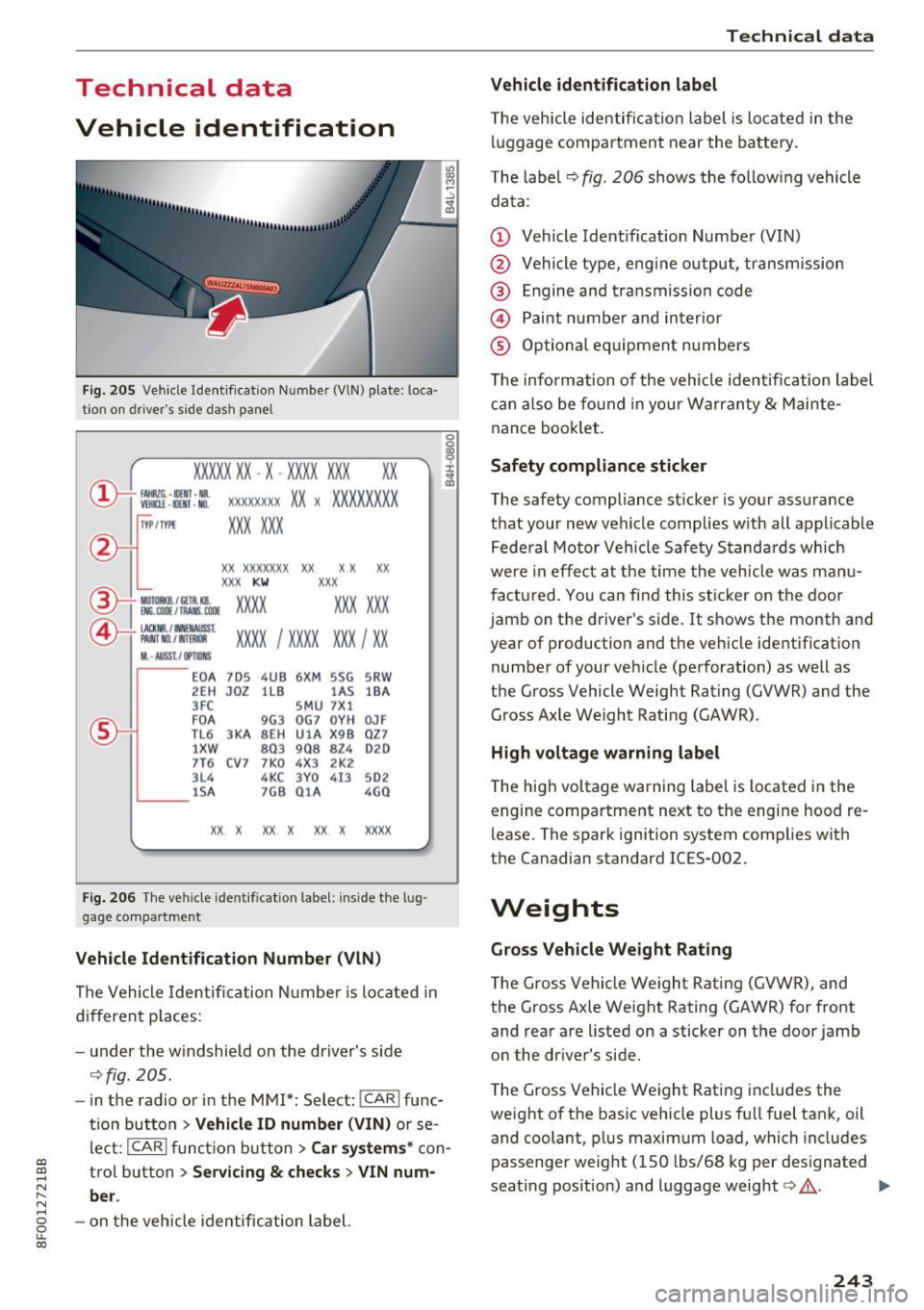
F ig . 2 05 Vehi cle Ident if ica tio n Number (VlN) plate: loca·
t ion on driver 's side dash pane l
XXXXX XX -X -XX XX X XX XX
CD+ ~t :1:: xxxxxxxx xx x xx xxx xxx
TVP/fffl XXX XXX
XX XXXXXXX XX X X xx
XXX KW XXX
®i ~:J ·f lfils~~ XXXX XXX XXX
®-+ ~ N:a=i~l xxxx ; xxxx xx x ; xx
II. · AUSS, I OPTIONS
,__ __
E0 A 7D 5
2EH J0Z
3FC
F 0 A
TL 6 3KA
lXW
7T6 C V7
3L4
lS A 4UB
6XM 5SG
llB l AS
S M U 7Xl
9G3 0G7 0YH
8E H
UlA X98
803 908 824
7 K0 4 X3 2K2
4KC 3Y0 413
7GB
01 A
5R W
18A
0JF
Q Z7
020
502
4G0
XX . X XX X XX X XXXX
Fig. 206 Th e ve hicle identifica tion label: inside the lu g·
gage compartment
Veh icle Identification Number (VlN )
The Vehicle Identific ation N umbe r is locate d in
d if f eren t places:
- u nder the w indshield on the dr iver's side
~ fig . 205.
-in the radio or i n the MMI*: Select: !CAR! func
t io n but ton
> Vehicle ID number (VIN) or se
l e ct:
I CAR ! funct ion button > Car system s* con
t rol but ton
> Servicing & che cks > VIN num
ber .
-on the vehicle identific ation label.
Technical data
Vehicle identification label
T he vehicle identi fica tion label is lo cate d in t he
l uggage compa rtment near the ba ttery.
T he labe l
~ fig. 206 shows the fo llow ing vehicle
da ta:
(D Vehicle Identification Number (VIN)
@ Vehicle type, eng ine output, transm ission
@ Engine and transmission code
@ Paint number and interior
® Optional equipment numbers
T he information of the veh icle identification label
c an also be fo und in your Warran ty
& Mainte
nance booklet.
Safety compliance sticker
The safety compliance sticker is yo ur ass urance
t h at your n ew vehi cle complies w ith all appli cable
Fede ral Motor Vehicle Safety Stand ard s which
we re in effe ct at the time the veh icle w as m anu
fac tured. Yo u ca n fi nd this sticker on the door
jamb on the driver 's side. It shows the month and
year of production and t he ve hicle identification
number of your ve hicle (perforation) as well as
t h e Gross Vehicle Weight Rat ing (GVWR) and the
G ross Axle We ight Rati ng (GAWR).
H igh vo ltage warning label
T he hig h voltage warning label is located in the
engine compartment next to the engine hood re
lease. The spark ignition system complies with
the Canadian standard ICES-002.
Weights
Gross Vehicle W eight Rating
The Gross Vehicle Weight Rating (GVWR), and
the Gross Axle Weight Rating (GAWR) for front
and rear a re listed on a sticker on the door jamb
o n the driver 's side .
T he Gross Vehicle Weight Rating includes the
weight o f the basic vehicle plus fu ll fuel tank, oil
and coolant, p lus maxim um load, which includes
passenger weight (150 lbs/68 kg per des ignated
seat ing pos ition) and luggage weight
c:> .&, . .,.
243
Page 249 of 266

a:,
a:,
...... N r--. N ...... 0
0
LL 00
today's automobiles, have steadily reduced the
scope of maintenance and repairs which can be
carried out by veh icle owners.
Also , sa fet y a nd
en vironmental
concerns place very strict limits
on the nature of repairs and adjustments to en
g ine and transm ission parts wh ich an owner can
pe rform .
Maintenance, adjustments and repairs usually re
qu ire special tools, test ing devices and other
equ ipment available to specially trained work
shop perso nnel i n order to assure proper per
formance, re liability a nd safety of the ve hicle and
its many systems.
Improper maintenance, adjustments and repairs
can impair the operation and re liab il ity of you r
vehi cle and eve n void your vehicle warra nty .
Therefo re, proof of se rvicing in accordance with
the m aintenance schedule may be a condition fo r
upho ld ing a possib le warranty claim made wi thin
the warranty period.
Above all , ope rational safety can be adversely af
fected, cre ati ng u nnecessa ry risks fo r yo u and
your passengers.
I f in doubt about any se rvicing, have it done by
your author ized Audi dealer or any properly
eq uipped and qua lified workshop. We strongly
urge you to g ive your author ized Audi dealer the
opportunity to perform a ll scheduled mainte
nance and necessary repairs. Your dealer has the
fac ilities, original parts and tra ined specialists to
keep your veh icle running properly .
Performing limited ma intenance yourself
The fo llow ing pages describe a limited number of
procedures which can be performed on your vehi
cle with o rdinary tools, should the need arise and
tra ined personnel be unavailable. Before per
forming any of these procedures, always thor
ough ly read a ll of the app licab le text and careful
l y follow the instructions g iven . Always rigorously
observe the
WARNINGS prov ided .
Before you check an ything in the eng ine com
partment, alw ays read and heed all WARNINGS
c::> .&. and c::> .&. in Working in the engine compart
ment on page 193 . Con
sumer inf ormation
A WARNING
- Ser ious personal in jury may occur as a result
of improperly performed maintenance, ad
justments or repairs .
- Always be extremely careful when work ing
on the vehicle. Always follow commonly ac
cepted safety practices and general com mon sense. Never risk pe rsonal in jury.
- Do not attempt any of the maintenance,
checks or repairs described on the following pages if you are not fu lly familiar wi th these
or other proce dures with respect to t he ve
h icle, o r are uncerta in how to pro ceed.
- Do not do a ny work withou t the proper tools
a nd equ ipment. Have the nece ssary wo rk
done by your authorized Audi dealer or any
p roper ly equipped and qualifie d wo rkshop.
- T he engine compa rtment of any motor veh i
cle is a potent ially hazardous area . Never
reach into the area around or touc h the radi
ator fan. It is temperature controlled and
can switch on suddenly - even when the en
g ine is off and the ignition key has been re
moved . The rad iator fan switches on auto
mat ically when the coo lant reaches a certain
temperature and will con tinue to ru n until
the coolant temperat ure drops.
- Always remove the igni tion key befo re any
one gets under the vehicle.
- Always support your veh icle with safety
stands if it is necessary to work underneat h
the vehicle . The jack supplied with the veh i
cle is no t adequ ate for t his pu rpose and
could collapse c ausing se riou s personal in
jury .
- If you mu st wor k unde rne ath t he vehicle
with the wheels on the ground, always make
sure the vehicle is on level ground, that the
wheels a re always sec urely blocked and that
the engine cannot be started.
- Always make sure the transmission se lector
lever (a utomatic t ransmiss ion) is in "P"
(Park position) and the park brake is firmly
applied.
247