2017 AUDI A5 CABRIOLET engine oil
[x] Cancel search: engine oilPage 199 of 266

a:,
a:,
...... N
" N ...... 0
0
LL co
@ Tips
-The oil pre ssure w arning display. i s not
an indicator of the oil level. Do not rel y on
it. Instead , check the oil level in your en
gine at regular inte rval s, preferably each
t ime you refuel , and alway s befo re going
on a long trip.
- If you have the impression your engine con
sumes excessive amounts of oil, we recom
mend that you cons ult an autho rized Aud i
dealer to have the cause of your concern properly d iagnosed. Keep in mind that the
accurate measurement of oil consump tion
requi res great care and may take some
time. An a uthorized Audi dea ler has instruc
tions about how to measure oil consump
tion accurately.
Checking the engine oil level
Fig. 172 MM I D isp lay: O il leve l in dicator
Read oil level
.. Park yo ur vehicle so that it is hor izontally level.
.. Shu t the engine off w hen it is at operat ing tem-
perature.
.. Switch only the ignition back on.
.. Wait approx . two mi nutes .
.. Se lect : Function button
~IC~A~R~I > Oil le vel. Or
.. Select : Funct ion button
ICARI > C ar sy stems *
contro l button > S ervici ng & checks > Oil leve l.
.. Read the oil level in the MMI* Display
¢fig . 172. Add engine o il if the bar of the oil
level indicator is near "min"
r::;, page 197
Depending on the way the vehicle is driven and
the operating cond itions, o il cons umption can be
up to a 1/2 quart per 600 m iles (0.5 liter per
Checking and Filling
1,000 km) . Consumptio n may be higher w ithin
the first 3,000 mi les (5,000 km).
(D Tips
The oil leve l indicato r in the M MI * Display is
on ly an information display. If the oi l level is
too low, a minimum oil warning appears in
the instr ument cluster . Add oil¢
page 197 .
If the hood has been opened, the current oil
l evel is shown in the instrument cluster the
next time the ignit ion is switched on.
"l=:7: Adding engine oil
Fig. 173 En g in e compartment: Cover on the oil filler nec k
.. Before you check anything in the eng ine com
partment,
a lwa ys read and heed all WARN
INGS
r::;, .&. in Working in the engine compart
ment on page 193 .
.. Shu t the eng ine off .
.. Uns crew the cap
't=;,: to the engine oil filling
hole
r::;, fig. 173, r::;,page 195, fig. 171 .
.. Carefully top o ff wi th 0.5 quarts (0.5 liters) of
the appropriate oil
r::;, page 195 .
.. Check the oil level again after two minutes
r::;, page 197, Checking the engine oil level.
.. Top off the o il again, if necessary .
.. Screw the cap back on the filling hole .
A WARNING
-- Wh ile topping off, the o il must not come in
con tact w ith ho t engine parts - fi re hazard!
- The oil filler cap must be p roper ly secured
to p revent o il from being sprayed on t he ho t
engine and exhaust system when the engine
is running - fi re ha zard!
~
197
Page 200 of 266

Check ing and F illing
- If your skin has come in contact with the en
gine oil, you must subsequently cleanse it
thoroughly .
@ Note
-Check the oil level using the radio or MMI*.
If the message
Pleas e reduce oil le vel a p
pears, contact your authorized Audi dea ler
or qualified workshop to have excess oil ex
tracted if necessary .
-Audi does not recommend the use of o il
add it ives. They may damage the eng ine
and adve rsely affect your N ew Vehicl e
Warranty .
@ For the sake of the environment
-Under no circumstances can the oil come in
contact with the sewage network o r the soil.
- Observe and follow legal regulations when
dispos ing of empty oil conta ine rs .
Changing the engine oil
We recommend tha t have your oil changed by an
authorized Audi dealer or a qualified service s ta
tion .
Befo re you check anyth ing in the eng ine compart
ment,
alway s read and heed all WARNINGS¢.&
in Working in the engine compartment on
page 193 .
The engine oil must be changed accord ing to the
intervals specif ied in your Warranty
& Mainte
nance booklet. This is very important because the
lubricat ing propert ies of o il d iminish gradually
du ring normal vehicle use .
Under some circumstances the eng ine o il should
be changed more frequently . Change oil more of
ten if you d rive mostly short distances, operate
the vehicle in dusty areas or under predominant ly
stop-and-go traffic cond it ions , or have yo ur vehi
cle where temperat ures remain below freezing
for extended periods.
D etergent addi tives in the oil will make fresh o il
loo k da rk afte r th e eng ine has been ru nning fo r a
short t ime. This is no rma l and is not a re ason to
change the oil more o ften than re commended.
198
Because of the p roblem of prope r disposa l, along
with the specia l too ls and necessary expertise re
quired, we strongly recommend that yo u have
yo ur oi l changed by an authori zed
Audi deale r or
a qual ified service station.
If you choose to change you r oil yourself , please
note the fo llow ing important information:
A WARNING
To reduce the risk of persona l injury if you
must change the eng ine oil in your vehicle
yourself:
- Wea r eye protect ion.
- To reduce the r is k of burns from hot engine
oil, let the engine cool down to the touch.
-
- W hen removin g the oil drain plug with your
fingers, stay as far away as possible. Always
keep your forearm pa rallel to the gro und to
he lp prevent hot oil from run ning down your
arm .
- Drain the oil into a container designed for
this purpose, one la rge enough to hold at
least the tota l amount of oi l in you r engine.
- Engine oil is poisonous. Keep it well out of
the reach of childre n.
- Continuous contact with used eng ine o il is
harmf ul to your skin . Always protect your
skin by washi ng oil off thoroughly with soap
a nd wate r.
@ Note
N eve r mix oil additives with your engine oil.
These additives can damage your engine and
adverse ly affect you r Audi Limi ted New Vehi
cle Warranty .
@ For the sake of the environment
-Before chang ing your oi l, first make s ure
you know where you can properly dispose o f
the used oil.
- Always dispose of used e ngine o il pro perly .
Do not dump i t on garden soil, wooded
areas, into open streams o r down sewage
dr ains.
- Recycle used e ngine o il by tak ing it to a used
eng ine oil collect ion fac ility in yo ur area, o r
c ont act a servi ce st ation.
Page 201 of 266

a:,
a:,
...... N r--. N ...... 0
0
LL 00
Cooling system
Coolant
The engine coolant performs two functions: it
keeps the engine from overheating and it pro
tects the engine from freezing in the winter .
The cooling system is sealed and generally re
quires little attention.
T he cooling system has been filled at the factory
with a permanent coolant which does not need to
be changed . The coolant consists of a mixture of
specially condit ioned water and the manufactur
er's glycol-basedcoolant add itive G 13 antifreeze
with anticorrosion additives (SO% for USA mod
e ls; 60% for Canadian mode ls). This m ixture
both ass ures the necessa ry frost protection and
protects metal components in the engine's coo l
ing system from corrosion and scaling .
It also
raises the boiling point of the coolant.
Do not red uce the concent ration of the coolant in
the summer by adding p lain water.
The propor
tion of coolant addit ive mu st be at least 50 %
but not more than 60 %
to mainta in antifreeze
protection and cooling efficiency. If the coolant
frost protection is too low, the coolant could
freeze and damage the vehicle heating and en
g ine cooling system .
For year-round driving, antifree ze is added at the
factory for temperatures down to :
- -31° F(- 3S°C)USA
- - 40 ° F ( - 40 °C) Canada.
If you must add coolant, use a m ixture of water
and coolant addit ive. M ixing the coolant additive
with d istilled water is recommended .
_& WARNING
Before you check anythi ng i n t he engine com
partment, always read and heed all WARN
INGS
¢ .&. in Working in the engine compart
ment on page 193 .
(D Note
-Befo re winter se ts in, have the coo lant
checked to see if the coolant additive in your
vehicle is sufficient to meet the cl imate con -
Check ing and Filling
ditions. This is especially important if you
live in a region where the winter is extreme
ly cold. If necessary, increase the proportion
of coolant additive to 60%.
- When adding coolant additive to your cool
ing system, remember :
- We recommend us ing only coolant add i
tive G12+ + or G13 for yo ur vehicle. This
coolant addit ive is avai lab le at aut horized
A udi dealers . O ther types of antifree ze can
significantly reduce corrosion pro tect ion .
The resulting corrosion can cause a loss of
coolant and serious engine damage.
- Do not add any type of radiator leak sealant
to your vehicle's engine coolant. Adding ra
diator repair fluid may adversely affect the
function and performance of your cooling system and cou ld resu lt in damage not cov
ered by your New Veh icle Limited Warra nty .
Checking the engine coolant level
The engine coolant level can be checked with a
quick glance.
Fi g. 1 74 Engin e compar tmen t: Cover o n the coo la n t ex
pansion tank
.. Before you check anything in the eng ine com
partment,
always r ead and heed all WARN
INGS ¢ ,A in Working in the engine compart
ment on page 193 .
.. Par k your veh icle on a leve l sur face.
.. Tur n off t he ignit io n .
.. Read the eng ine coolan t leve l from the coo lant
expansion tank
¢ fig . 174, ¢page 195,
fig. 171 .
With a cold engine, the coo lant level
should be b etween the "MIN" and "MAX" mark
ings. When the eng ine is warm, the level may
be slightly above the "MAX" marking. .,..
199
Page 204 of 266

Checking and Filling
Brake fluid
Checking brake fluid level
The brake fluid level can be checked with a quick
glance.
Fig. 175 Engine compartment: Cover on the brake fluid
r eservoir
Before you check anything in the engine compart
ment,
always read and heed all WARNINGS
¢ A in Working in the engine compartment on
page 193.
., Read the brake fluid level from the brake fluid
reservoir
<=> fig . 175, ¢page 195, fig . 171 . The
brake fluid level must be between the
" MIN"
and "MAX " markings.
The brake fluid reservoir is located at the rear
partition of the engine compartment on the left
side
¢ page 195.
The fluid level may drop slightly after some time
due to the automatic adjustment of the brake
pads . This is not cause for alarm .
If the brake fluid level falls
considerably below
the ' 'MIN" mark, the brake warning/indicator
light (U .S. models:
1111 , Canadian models: 1111)
will come on¢ page 13 . Do not continue to oper
ate the vehicle . The complete brake system
should be thoroughly checked by an authorized
Aud i dealer or qualified workshop and the cause
corrected . If the brake fluid level is too low, the
brake warning/indicator light w ill illuminate.
Contact an author ized Audi dealer
immediately.
(D} Tips
The brake fluid reservoir is located under
neath the cover.
202
Changing brake fluid
Have the brake fluid changed by an experienced
technician .
Brake fluid absorbs moisture from the air. If the
water content in the brake fluid is too high, cor
rosion in the brake system may result after ape
riod of time . The boiling po int of the brake fluid
will a lso decrease considerably and decrease
braking performance.
Therefore , the brake fluid must be changed
every
two years .
Always use new brake fluid which con
forms to Feder-al Motor Vehicle Standard "FMVSS
116 DOT 4 ".
The brake fluid reservoir can be difficult to reach ,
therefore, we recommend that you have the
brake fluid changed by your author ized
Audi
dealer .
Your dealer has the correct tools, the
right brake fluid and the know-how to do this for
you.
A WARNING
- Brake fluid is poisonous. It must be stored
only in the closed original container out of
the reach of children!
- Brake fai lure can result from o ld or inappro
priate brake fluid. Observe these precau
tions:
- Use only brake fluid that meets SAE speci
fi cation
J 1703 and conforms to Federal
Motor Veh icle Standard 116. Always check
with your authorized Audi dealer to make
sure you are using the correct brake f luid .
The correct type of brake f luid is also indi
cated on the brake fluid reservoir.
- The brake fluid must be new . Heavy use of
the brakes can cause a vapor lock if the
brake fluid is left in the system too long .
This can seriously affect the efficiency of
the brakes as well as your safety. This
could result in an accident.
(D Note
Brake fluid will damage the paint of your vehi-
cle .
lilJJ,
Page 221 of 266

Wheels
Model Tire designation Tire pressure
Engine normal load condition full load condition
(up to 2 occupants)a)
front rear front rear
PSI kPA PSI kPA PSI kPA PSI kPA
AS Cabriolet: 225/50 Rl 7 94H
33 230 30 210 36 250 39 270 2.0 liter All Season
4-cylinder 245/40 Rl8 93H
All Season
35 240 32 220 38 260 41 280
245/45 Rl7 95H 32 220 29 200 35 240 38 260
All Season
255/35 Rl9 96Y
32 220 32 220 35 240
38 260 High Performance
SS Cabriolet: 245/40 Rl8 97Y
39 270 35 240 42 290 44 300 3.0 liter High Performance
6-cylinder
255/35 Rl9 96Y
High Performance
39 270
35 240 42 290 44 300
XL= reinforced or extra
load tire. It may also appear as xl, EXTRA LOAD, or RF on the tire sidewall.
a) 2 people in the front
A WARNING
Please note the important safe
ty precautions regarding tire pressure
¢ page 217 and load
limits
¢ page 219.
Tires and vehicle load limits
There are limits to the amount of
load or weight that any vehicle
and any tire can carry. A vehicle
that is overloaded will not handle
well and is more difficult to stop. Overloading can not only lead to
loss of vehicle control, but can al
so damage important parts of the
gi vehicle and can lead to sudden ...... N
~ tire failure, including a blowout
0
0
LL 00
and sudden deflation that can
cause the vehicle to crash.
Your safety and that of your pas sengers also depends on making
sure that load limits are not ex
ceeded. Vehicle load includes ev
erybody and everything in and on
the vehicle. These load limits are
technically referred to as the vehi cle's
Gross Vehicle Weight Rat
ing
("GVWR").
The "GVWR" includes the weight of the basic vehicle, all factory in
stalled accessories, a full tank of
fuel, oil, coolant and other fluids plus maximum load. The maxi
mum load includes the number of..,.
219
Page 244 of 266

Emergency situations
Raising the vehicle
Lifting with workshop hoist and with floor
jack
Th e vehicle may only b e lift ed at the lifting
poin ts illust rated.
F ig .. 203 F ro nt lift ing po int
F ig. 204 Rea r lifti ng po int
.,. Read and heed WARNING ¢ A-
.,. Locate lifti ng po ints ¢ fig . 203 and ¢ fig. 204 .
.,. Adjust lifting arms of wo rkshop hoist or floor
jack to match veh icle lifting points.
.,. In se rt a rubb er pad between t he floor jack/
wor kshop hoist a nd the lif ting poin ts .
If you must lift your vehicle with a floor jack to
work underneath, be sure the vehicle is safely
supported on stands intended for this purpose .
Front lifting point
The lift ing po int is located on the floo r pan re in
forcement about at the same leve l as the jack
mo unt ing point ¢
fig. 203 . Do not lift the vehi
cle at the vertical sill rei nforcement.
Rear lifting point
The lift ing po int is located on the vertica l re in
for cement of the lower sill fo r the on board jack
¢fig. 204.
242
Lifting with vehicle jack
Refer to ~ page 231.
A WARNING
- To re duce the r is k of serious injury and vehi
cle dama ge .
- Always lift the vehicle o nly at the special
workshop hois t an d floor jack lift points il
l ustrat ed
~ fig. 203 and ~ fig. 2 04 .
-Failure to lift the v ehicle at these points
could ca use the veh icle to tilt or fall from
a lift if the re is a cha ng e i n ve hicle weigh t
dis tribu tion and ba lan ce . T his mig ht hap
p en, for examp le, whe n he avy co mpo
n en ts such as the engine block o r tr an s
mission are removed.
- W hen re m ov in g h eavy com ponen ts like
these, an cho r veh icle to hoist or ad d co rre
spond ing weights to ma inta in the ce nter of
gravity . Othe rw ise, the vehicle mi ght t ilt o r
slip off t he hoist, causing serious pe rsonal
in jur y.
(D Note
- Be aware of the fo llowing po ints befo re lift
ing the vehicle:
- The vehicle should never be lifted or
jacked up from underneath the engine oil pan, the transmission housing, the front
or rear axle or the body side members .
This could lead to serious damage .
- To avoid damage to the underbody or
chassis frame, a rubber pad must be in
serted between the floor jack and the lift
points.
- Before driving over a workshop hoist,
check that the vehicle weight does not
exceed the permissible lifting capacity of
the hoist.
- Before driving over a workshop hoist , en
sure that there is sufficient clearance be
tween the hoist and low parts of the ve
h icle .
Page 245 of 266
a:,
a:,
.... N
" N .... 0
0
LL co
Technical data
Vehicle identification
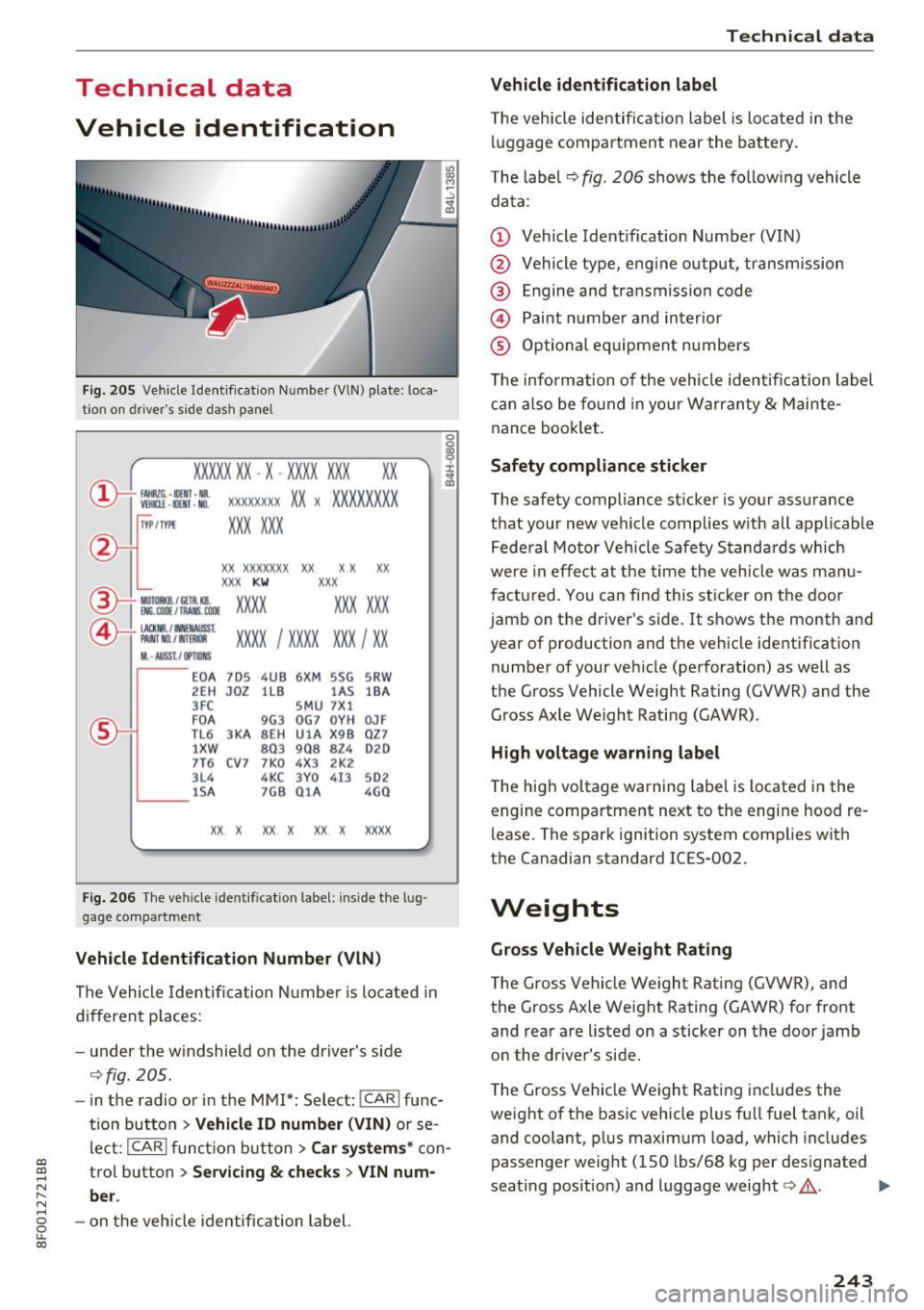
F ig . 2 05 Vehi cle Ident if ica tio n Number (VlN) plate: loca·
t ion on driver 's side dash pane l
XXXXX XX -X -XX XX X XX XX
CD+ ~t :1:: xxxxxxxx xx x xx xxx xxx
TVP/fffl XXX XXX
XX XXXXXXX XX X X xx
XXX KW XXX
®i ~:J ·f lfils~~ XXXX XXX XXX
®-+ ~ N:a=i~l xxxx ; xxxx xx x ; xx
II. · AUSS, I OPTIONS
,__ __
E0 A 7D 5
2EH J0Z
3FC
F 0 A
TL 6 3KA
lXW
7T6 C V7
3L4
lS A 4UB
6XM 5SG
llB l AS
S M U 7Xl
9G3 0G7 0YH
8E H
UlA X98
803 908 824
7 K0 4 X3 2K2
4KC 3Y0 413
7GB
01 A
5R W
18A
0JF
Q Z7
020
502
4G0
XX . X XX X XX X XXXX
Fig. 206 Th e ve hicle identifica tion label: inside the lu g·
gage compartment
Veh icle Identification Number (VlN )
The Vehicle Identific ation N umbe r is locate d in
d if f eren t places:
- u nder the w indshield on the dr iver's side
~ fig . 205.
-in the radio or i n the MMI*: Select: !CAR! func
t io n but ton
> Vehicle ID number (VIN) or se
l e ct:
I CAR ! funct ion button > Car system s* con
t rol but ton
> Servicing & che cks > VIN num
ber .
-on the vehicle identific ation label.
Technical data
Vehicle identification label
T he vehicle identi fica tion label is lo cate d in t he
l uggage compa rtment near the ba ttery.
T he labe l
~ fig. 206 shows the fo llow ing vehicle
da ta:
(D Vehicle Identification Number (VIN)
@ Vehicle type, eng ine output, transm ission
@ Engine and transmission code
@ Paint number and interior
® Optional equipment numbers
T he information of the veh icle identification label
c an also be fo und in your Warran ty
& Mainte
nance booklet.
Safety compliance sticker
The safety compliance sticker is yo ur ass urance
t h at your n ew vehi cle complies w ith all appli cable
Fede ral Motor Vehicle Safety Stand ard s which
we re in effe ct at the time the veh icle w as m anu
fac tured. Yo u ca n fi nd this sticker on the door
jamb on the driver 's side. It shows the month and
year of production and t he ve hicle identification
number of your ve hicle (perforation) as well as
t h e Gross Vehicle Weight Rat ing (GVWR) and the
G ross Axle We ight Rati ng (GAWR).
H igh vo ltage warning label
T he hig h voltage warning label is located in the
engine compartment next to the engine hood re
lease. The spark ignition system complies with
the Canadian standard ICES-002.
Weights
Gross Vehicle W eight Rating
The Gross Vehicle Weight Rating (GVWR), and
the Gross Axle Weight Rating (GAWR) for front
and rear a re listed on a sticker on the door jamb
o n the driver 's side .
T he Gross Vehicle Weight Rating includes the
weight o f the basic vehicle plus fu ll fuel tank, oil
and coolant, p lus maxim um load, which includes
passenger weight (150 lbs/68 kg per des ignated
seat ing pos ition) and luggage weight
c:> .&, . .,.
243
Page 247 of 266

a:,
a:,
...... N r--. N ...... 0
0
LL 00
Technical dat a
Gasoline engines
AS Cabriolet 2.0, 4 cylinder
Maximum output SAE net hp@rpnn 220@ 4450-6000
Maximum torque SAE net lb
-ft@ rpm 259@ 1500-4300
Displacement CID (cm
3
) 121 (1984)
Engine oil with filter change
1>
Fuel Pr emium un lead ed (9 1 AKI )¢ page 188, Fuel
or Bio-ethanol (E S S) ¢ page 189, Ethanol fuel (Bio-etha-
no[) .
55 Cabriolet 3.0, 6 cylinder
Maximum output SAE net
Maximum torque SAE net
Displacement
Engine oil with filter changell
Fuel
1> For specific engine oil capac ities, please see
the most cur rent information fo r the USA at
http ://www.audiusa.com/he lp/ma intenance o r
for Canada at http ://www.audi.ca/ca/brand/ en/
your _aud i/ aud i_services_a nd/Ca re_and_M a i nte
na nce/ schedu le.html or call 800-822-2834. hp@ rpm
333@ 5500-6500
lb-ft@rpm 325@ 2900-5300
CID (cm
3 ) 182.8 (2995)
Pr emium unl ead ed (91 AKI) ¢ page 188, Fuel
245