2017 Alfa Romeo Giulietta fluid
[x] Cancel search: fluidPage 35 of 212
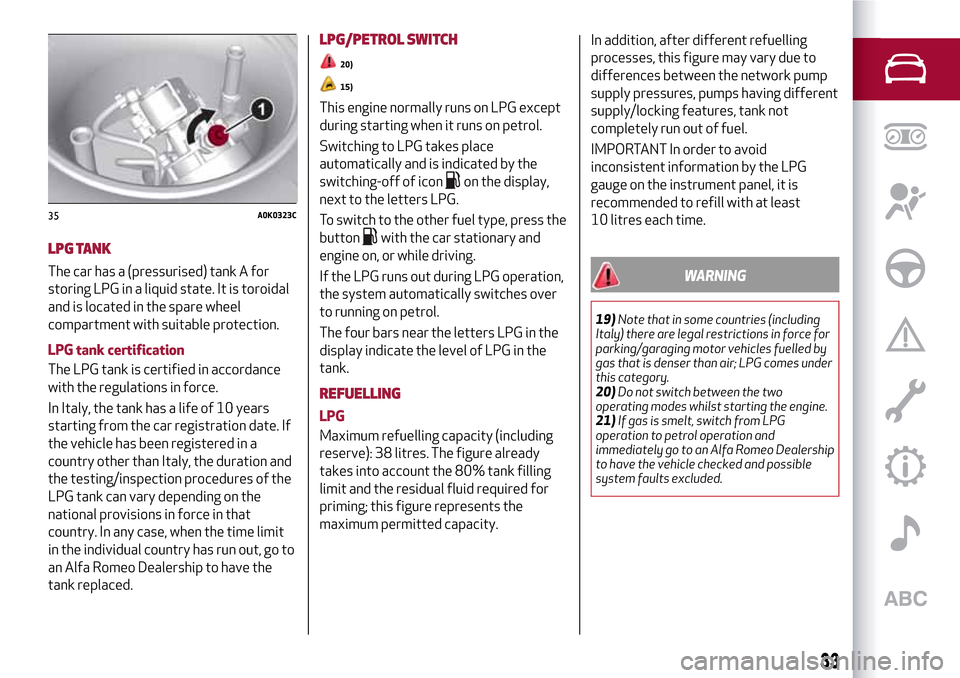
LPG TANK
The car has a (pressurised) tank A for
storing LPG in a liquid state. It is toroidal
and is located in the spare wheel
compartment with suitable protection.
LPG tank certification
The LPG tank is certified in accordance
with the regulations in force.
In Italy, the tank has a life of 10 years
starting from the car registration date. If
the vehicle has been registered in a
country other than Italy, the duration and
the testing/inspection procedures of the
LPG tank can vary depending on the
national provisions in force in that
country. In any case, when the time limit
in the individual country has run out, go to
an Alfa Romeo Dealership to have the
tank replaced.
LPG/PETROL SWITCH
20)
15)
This engine normally runs on LPG except
during starting when it runs on petrol.
Switching to LPG takes place
automatically and is indicated by the
switching-off of icon
on the display,
next to the letters LPG.
To switch to the other fuel type, press the
button
with the car stationary and
engine on, or while driving.
If the LPG runs out during LPG operation,
the system automatically switches over
to running on petrol.
The four bars near the letters LPG in the
display indicate the level of LPG in the
tank.
REFUELLING
LPG
Maximum refuelling capacity (including
reserve): 38 litres. The figure already
takes into account the 80% tank filling
limit and the residual fluid required for
priming; this figure represents the
maximum permitted capacity.In addition, after different refuelling
processes, this figure may vary due to
differences between the network pump
supply pressures, pumps having different
supply/locking features, tank not
completely run out of fuel.
IMPORTANT In order to avoid
inconsistent information by the LPG
gauge on the instrument panel, it is
recommended to refill with at least
10 litres each time.
WARNING
19)Note that in some countries (including
Italy) there are legal restrictions in force for
parking/garaging motor vehicles fuelled by
gas that is denser than air; LPG comes under
this category.
20)Do not switch between the two
operating modes whilst starting the engine.
21)If gas is smelt, switch from LPG
operation to petrol operation and
immediately go to an Alfa Romeo Dealership
to have the vehicle checked and possible
system faults excluded.
35A0K0323C
33
Page 44 of 212

WARNING LIGHTS AND MESSAGES
IMPORTANT The warning light switches on in the instrument panel together with a dedicated message and/or acoustic signal when
applicable. These indications are indicative and precautionary and as such must not be considered as exhaustive and/or alternative
to the information contained in the Owner Handbook, which you are advised to read carefully in all cases. Always refer to the
information in this section in the event of a failure indication.
IMPORTANT Failure indications displayed are divided into two categories: very serious and less serious failures. Serious faults are
indicated by a repeated and prolonged warning "cycle". Less serious faults are indicated by a warning "cycle" with a shorter duration.
The display cycle of both categories can be interrupted. The instrument panel warning light will stay on until the cause of the
malfunction is eliminated.
WARNING LIGHTS ON INSTRUMENT PANEL
Warning lights on
panelWhat it means What to do
LOW BRAKE FLUID/HANDBRAKE ENGAGED
The warning light switches on when the key is turned to
MAR-ON, but it should switch off after a few seconds.
Low brake fluid level
The warning light (or symbol on the display) switches on
when the level of the brake fluid in the reservoir falls
below the minimum level, possibly due to leaks in the
circuit.Restore the brake fluid level, then check that the warning
light has switched off.
If the warning light stays on, contact an Alfa Romeo
Dealership.
Handbrake engaged
The warning light (or symbol on the display) switches on
when the handbrake is engaged. If the car is moving an
acoustic signal is also emitted.Release the handbrake, then check that the warning light
has switched off.
If the warning light (or symbol on the display) stays on,
contact an Alfa Romeo Dealership.
42
KNOWING THE INSTRUMENT PANEL
Page 47 of 212

Warning lights on
panelWhat it means What to do
ENGINE COOLANT TEMPERATURE TOO HIGH
The warning light switches on when the ignition key is
turned to MAR, but it should switch off after a few
seconds. The warning light turns on when the engine is
overheated.
The display shows the dedicated message.In normal driving conditions: stop the car, switch off the
engine and check that the water level in the reservoir is
not below the MIN mark. In this case, wait for the engine
to cool down, then slowly and carefully open the cap, top
up with coolant and check that the level is between the
MIN and MAX marks on the reservoir itself. Also check
visually for any fluid leaks. Should the warning light turn
on again at the next start-up, contact an Alfa Romeo
Dealership.
If the vehicle is used under demanding conditions: (e.g. in
high-performance driving): slow down and, if the warning
light stays on, stop the vehicle. Wait for 2 or 3 minutes
with the engine running and slightly accelerated to
further favour the coolant circulation. Then stop the
engine. Check that the coolant level is correct as
described above.
IMPORTANT Over demanding routes, it is advisable to
keep the engine on and slightly accelerated for a few
minutes before switching it off.
ALFA TCT FAILURE
(for versions/markets, where provided)
The warning light switches on when the ignition key is
turned to MAR, but it should switch off after a few
seconds.
The warning light flashes (together with a message in the
display and an acoustic signal) to indicate that the
gearbox is faulty.
The warning light can switch on even in the case of
transmission overheating, after a particularly demanding
use. In this case an engine performance limitation is
carried out.Contact an Alfa Romeo Dealership as soon as possible.
If it is necessary to start the engine with a transmission
failure, follow the procedure described in the "Alfa TCT"
paragraph, in chapter "Starting and driving".
45
Page 116 of 212

REPAIR PROCEDURE
Proceed as follows:
stop the car in a position that is not
dangerous for oncoming traffic where
you can carry out the procedure safely.
The ground must be flat and sufficiently
compact;
stop the engine, engage the hazard
warning lights and the parking brake;
wear the reflective safety jacket
before getting out of the car (anyway
comply with the laws in force in the
country you are driving in);
Insert the cartridge 1 containing the
sealant in the proper compartment of the
compressor 2, pressing it down hard
fig. 98. Remove the speed limit sticker
3 and apply it in a clearly visible position
fig. 99;
wear the gloves;
remove the cap from the tyre valve
and connect and firmly tighten the
transparent tube of the sealing fluid 4
fig. 98. If a 250 ml cartridge is present
the housing of the transparent tube is
provided with removable ring to facilitate
extraction. Make sure that the ON-OFF
button 5 fig. 101 is in the off position
(button not pressed);
plug the electric connector 6
fig. 100 into the 12V socket of the
vehicle and start the vehicle engine;
operate the compressor by pressing
the ON-OFF button 5 fig. 101. When the
pressure shown in the "Wheels"
paragraph in the “Technical data” chapter
or on the specific label appears on the
pressure gauge 7, stop the compressor
by pressing the ON-OFF button 5 again;
disconnect the cartridge 1 from the
compressor, by pressing the release
button 8 and lifting the cartridge
1 upwards fig. 102.
If the pressure gauge 7 fig. 101 indicates
a pressure lower than 1.8 bar / 26 psi
15 minutes after starting the
compressor, switch off the compressor,
disconnect the sealing fluid tube 4 from
the tyre valve and remove the cartridge
1 from the compressor fig. 102.
99A0K1306C
100A0K1303C
101A0K1304C
102A0K1305C
114
IN AN EMERGENCY
Page 118 of 212

JUMP STARTING
STARTING THE ENGINE
If the iconstays on constantly on the
instrument panel, contact the Alfa
Romeo Dealership immediately.
JUMP STARTING
If the battery is flat, start the engine
using an auxiliary battery with the same
capacity or a little higher than the flat
one.
38) 39)125)
Proceed as follows to start the vehicle:
connect the positive terminal (+)
fig. 104 of the auxiliary battery only to
the point indicated on the car battery
(writing "OK") and nowhere else;
with a second lead, connect the
negative terminal(−)oftheauxiliary
battery to an earthing point
on the
engine or the gearbox/transmission of
the car to be started;
start the engine; when the engine has
been started, remove the leads reversing
the order above.
If after a few attempts the engine does
not start, contact the Alfa Romeo
Dealership.
JUMP STARTING
(For versions with Start&Stop system)
When jump starting, never connect the
negative lead (–) of the auxiliary battery
to the negative pole 1 fig. 105 of the car
battery, but rather to an engine/gearbox
earth point.
126)
BUMP STARTING
Never, under any circumstances, jump
start the engine by pushing, towing or
coasting downhill.
IMPORTANT
38)Never connect the negative terminals of
the two batteries directly! If the auxiliary
battery is installed on another car, prevent
accidental contact between metallic parts of
the two cars.
39)Never use a fast battery-charger to
start the engine as this could damage the
electronic systems of your vehicle,
particularly the ignition and engine fuel
supply control units.
WARNING
125)This starting procedure must be
performed by expert personnel because
incorrect actions could cause electrical
discharge of considerable intensity.
Furthermore, battery fluid is poisonous and
corrosive: avoid contact with skin and eyes.
Keep naked flames and lighted cigarettes
away from the battery and do not cause
sparks.
126)Before opening the bonnet, make sure
that the engine is off and that the ignition
key is in the STOP position. Please follow the
instructions on the decal near the front
crossmember. We recommend that you
remove the key from the ignition if other
people remain in the vehicle. The vehicle
should always be left after the key has been
removed or turned to the STOP position.
During refuelling, make sure that the engine
is off (and that the ignition key is in the STOP
position).
104A0K0247C
105A0K0755C
116
IN AN EMERGENCY
Page 125 of 212

SCHEDULED MAINTENANCE PLAN
PETROL VERSIONS
The checks listed in the Service Schedule, after reaching 150,000 km (90,000 mi)/10 years, must be cyclically repeated starting
from the first interval, thus following the same intervals as before.
Thousands of miles9 182736455463728190
Thousands of kilometres15 30 45 60 75 90 105 120 135 150
Years12345678910
Check tyre condition/wear and adjust pressure, if necessary;
check the condition/expiry date of the “Fix&Go” repair kit
(for versions/markets, where provided)
Check operation of lighting system (headlights, direction
indicators, hazard warning lights, boot, passenger
compartment, glove compartment, instrument panel warning
lights, etc.)
Check and, if necessary, top up fluid levels (1)
Check exhaust emissions
Use the diagnosis socket to check supply/engine
management systems operation, emissions and, for
versions/markets, where provided, engine oil degradation
(1) Always only use the liquids shown in the handbook for topping up after having checked that the system is not damaged.
123
Page 128 of 212

Thousands of miles9 182736455463728190
Thousands of kilometres15 30 45 60 75 90 105 120 135 150
Years12345678910
Replace air cleaner cartridge (7)
Replace filter inside the pressure regulator (1.4 Turbo
Petrol/LPG 120 HP version)
Replace paper filter (LPG in gaseous state) (1.4 Turbo
Petrol/LPG 120 HP version)
Change brake fluid(8)
Replace the passenger compartment filter (7) (o) (●)
(7) If the car is used in dusty areas, this cleaner must be replaced every 15,000 km.
(8) The brake fluid replacement has to be done every two years, irrespective of the mileage.
(o) Recommended operations
(●) Mandatory operations
126
SERVICING AND MAINTENANCE
Page 129 of 212

DIESEL VERSIONS
The checks listed in the Service Schedule, after reaching 200,000 km (120,000 mi)/10 years, must be cyclically repeated starting
from the first interval, thus following the same intervals as before.
Thousands of miles12 24 36 48 60 72 84 96 108 120
Thousands of kilometres20 40 60 80 100 120 140 160 180 200
Years12345678910
Check tyre condition/wear and adjust pressure, if necessary;
check the condition/expiry date of the “Fix&Go” repair kit
(for versions/markets, where provided)
Check operation of lighting system (headlights, direction
indicators, hazard warning lights, boot, passenger
compartment, glove compartment, instrument panel warning
lights, etc.)
Check and, if necessary, top up fluid levels(1)
Check exhaust emissions
Use the diagnosis socket to check fuel/engine control
systems operation, emissions and engine oil decay (the latter
for versions/markets, where provided)
Visually inspect condition of: exterior bodywork, underbody
protection, pipes and hoses (exhaust, fuel system, brakes),
rubber elements (gaiters, sleeves, bushes, etc.)
(1) Always only use the liquids shown in the handbook for topping up after having checked that the system is not damaged.
127