2017 Alfa Romeo Giulietta check oil
[x] Cancel search: check oilPage 29 of 212

proceed in the same way as described
in points 1 and 2 for the passenger side
door;
make sure that the initialisation is
correct by checking that the windows
work automatically.
IMPORTANT
7)The system conforms to the 2000/4/EC
standard concerning the safety of
passengers leaning out of the passenger
compartment.
WARNING
13)Incorrect use of the electric windows
may be dangerous. Before and during their
operation, ensure that any passengers are
not at risk from the moving glass either by
personal objects getting caught in the
mechanism or by being hit by it directly.
When leaving the car, always remove the key
from the ignition to prevent accidental
operation of the electric windows from being
a hazard for those still on board.
ELECTRIC SUNROOF
(for versions/markets, where provided)
The large electric sun roof comprises two
glass panels; the front one is mobile and
the rear one fixed. These are equipped
with two sun blinds (front and rear) that
can be moved manually.
With the sun roof closed, the blinds can
be placed in any position.
OPERATION
The sun roof can be operated only with
the ignition key turned to MAR.
Controls 1 and 2 fig. 26,on the panel next
to the front roof light control sun roof
opening/closing.Open the sunroof
Press button 1 fig. 26:
First press: the front glass panel will
move to the “spoiler” position.
Second press for more than half a
second: the sun roof glass automatically
moves to an intermediate position
(“Comfort” position).
Third press for more than half a
second: the sun roof will automatically
open fully.
8)
14)
Closing the sun roof
Press button 2 fig. 26.
ANTI-PINCH SAFETY DEVICE
The sun roof has an anti-pinch safety
system capable of detecting the
presence of an obstacle whilst the roof is
closing; when this happens, the system
stops and the movement of the front
glass is immediately reversed.
SUN BLINDS
To open the blinds, grip handle 1 fig. 27,
following the direction indicated by the
arrow until the desired position is
reached.
26A0K0576C
27
Page 46 of 212

Warning lights on
panelWhat it means What to do
LOW ENGINE OIL PRESSURE
When the key is turned to MAR the warning light comes on, but should go out as soon
as the engine is started.
After turning the ignition key to MAR, wait for about 2 seconds before starting the
engine.
The warning light switches on constantly together with a message on the display (for
versions/markets, where provided) when the system detects that engine oil
pressure is low.
IMPORTANT Do not use the vehicle until the failure has been solved.
IMPORTANT To find out the correct oil quantity, always check using the dipstick.
17)
DEGRADED ENGINE OIL (for versions/markets, where provided)
The warning light will turn on flashing together with a dedicated message on the
display (for versions/markets where provided).
Depending on the versions, the warning light flashing modes are as follows:
- for 1 minute every two hours;
- for 3 minute cycles with the warning light off for intervals of 5 seconds until oil is
changed.
After the initial warning, each time the engine is started up, the warning light will
continue to flash in the same mode, until the oil is changed. A specific message will
appear on the display (for versions/markets, where provided) in addition to the
warning light. If the warning light flashes, this does not mean that there is a fault, but
simply informs that it is now necessary to change the oil as a result of regular use of
the car. Engine oil deterioration is accelerated by:
- mainly town use of the car which makes the DPF regeneration process more
frequent;
- use of the vehicle for short drives, in which the engine does not have time to reach
its regular operating temperature;
- repeated interruptions of the regeneration process, signalled by the DPF warning
light switching on.Contact an Alfa Romeo
Dealership as soon as
possible.
24) 25)
44
KNOWING THE INSTRUMENT PANEL
Page 60 of 212

WARNING
22)If thewarning light does not switch on when the ignition device is moved to ON or if it stays on when driving (together with the message on
the display), there might be a fault in the restraint systems; in this case, the airbags or pretensioners may not deploy in the event of an accident or,
in a lower number of cases, they could deploy erroneously. Before proceeding, contact an Alfa Romeo Dealership to have the system checked
immediately.
23)A fault with the warning light
is signalled by illumination of the iconon the instrument panel display and by the flashing of passenger
airbag disabled warning light on the rearview mirror. In addition, the airbag system automatically disables the airbag on the passenger's side (for
versions/markets where provided). In this case, the warning light may not indicate any faults with the restraint systems. Before proceeding,
contact an Alfa Romeo Dealership to have the system checked immediately.
24)If the warning light comes on, the exhausted engine oil should be changed as soon as possible, never drive more than 500 km from the first
switching-on of this warning light. Failure to observe the above may result in severe damage to the engine and invalidate the warranty. Remember
that when this warning light comes on, it does not mean that the level of engine oil is low, so if it flashes you must not top up the engine oil.
25)If the warning light flashes with the car in motion, contact an Alfa Romeo Dealership.
26)If the warning light (or the icon on the display) flashes whilst driving, contact an Alfa Romeo Dealership.
27)Always drive at a speed appropriate to the traffic conditions, the weather and traffic regulations. The engine may be switched off even if the
warning light is on: repeated interruptions of the regeneration process could cause an early deterioration of engine oil. For this reason it is
always advisable to wait for the symbol to go off before turning off the engine, following the instructions above. Do not complete the DPF
regeneration process when the vehicle is stopped.
IMPORTANT
17)If thewarning light switches on when driving, stop the engine immediately and contact an Alfa Romeo Dealership.
18)If, turning the ignition device to MAR, the warning lightdoes not turn on or if it turns on steadily or flashing when travelling (on some
versions together with the message on the display), contact an Alfa Romeo Dealership as soon as possible.
19)The presence of water in the fuel system circuit may cause severe damage to the injection system and irregular engine operation. If the
symbol is displayed contact an Alfa Romeo Dealership as soon as possible to bleed the system. If the above indications come on immediately
after refuelling, water has probably been introduced into the tank: stop the engine immediately and contact an Alfa Romeo Dealership.
58
KNOWING THE INSTRUMENT PANEL
Page 125 of 212

SCHEDULED MAINTENANCE PLAN
PETROL VERSIONS
The checks listed in the Service Schedule, after reaching 150,000 km (90,000 mi)/10 years, must be cyclically repeated starting
from the first interval, thus following the same intervals as before.
Thousands of miles9 182736455463728190
Thousands of kilometres15 30 45 60 75 90 105 120 135 150
Years12345678910
Check tyre condition/wear and adjust pressure, if necessary;
check the condition/expiry date of the “Fix&Go” repair kit
(for versions/markets, where provided)
Check operation of lighting system (headlights, direction
indicators, hazard warning lights, boot, passenger
compartment, glove compartment, instrument panel warning
lights, etc.)
Check and, if necessary, top up fluid levels (1)
Check exhaust emissions
Use the diagnosis socket to check supply/engine
management systems operation, emissions and, for
versions/markets, where provided, engine oil degradation
(1) Always only use the liquids shown in the handbook for topping up after having checked that the system is not damaged.
123
Page 127 of 212
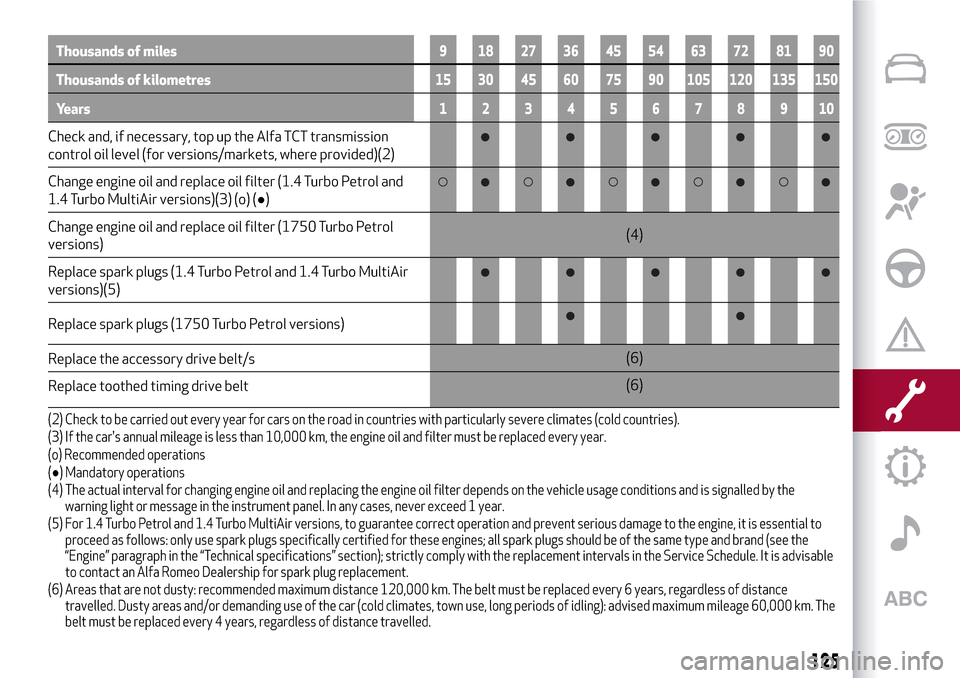
Thousands of miles9 182736455463728190
Thousands of kilometres15 30 45 60 75 90 105 120 135 150
Years12345678910
Check and, if necessary, top up the Alfa TCT transmission
control oil level (for versions/markets, where provided)(2)
Change engine oil and replace oil filter (1.4 Turbo Petrol and
1.4 Turbo MultiAir versions)(3) (o) (●)
Change engine oil and replace oil filter (1750 Turbo Petrol
versions)(4)
Replace spark plugs (1.4 Turbo Petrol and 1.4 Turbo MultiAir
versions)(5)
Replace spark plugs (1750 Turbo Petrol versions)
Replace the accessory drive belt/s(6)
Replace toothed timing drive belt(6)
(2) Check to be carried out every year for cars on the road in countries with particularly severe climates (cold countries).
(3) If the car's annual mileage is less than 10,000 km, the engine oil and filter must be replaced every year.
(o) Recommended operations
(●) Mandatory operations
(4) The actual interval for changing engine oil and replacing the engine oil filter depends on the vehicle usage conditions and is signalled by the
warning light or message in the instrument panel. In any cases, never exceed 1 year.
(5) For 1.4 Turbo Petrol and 1.4 Turbo MultiAir versions, to guarantee correct operation and prevent serious damage to the engine, it is essential to
proceed as follows: only use spark plugs specifically certified for these engines; all spark plugs should be of the same type and brand (see the
“Engine” paragraph in the “Technical specifications” section); strictly comply with the replacement intervals in the Service Schedule. It is advisable
to contact an Alfa Romeo Dealership for spark plug replacement.
(6) Areas that are not dusty: recommended maximum distance 120,000 km. The belt must be replaced every 6 years, regardless of distance
travelled. Dusty areas and/or demanding use of the car (cold climates, town use, long periods of idling): advised maximum mileage 60,000 km. The
belt must be replaced every 4 years, regardless of distance travelled.
125
Page 129 of 212

DIESEL VERSIONS
The checks listed in the Service Schedule, after reaching 200,000 km (120,000 mi)/10 years, must be cyclically repeated starting
from the first interval, thus following the same intervals as before.
Thousands of miles12 24 36 48 60 72 84 96 108 120
Thousands of kilometres20 40 60 80 100 120 140 160 180 200
Years12345678910
Check tyre condition/wear and adjust pressure, if necessary;
check the condition/expiry date of the “Fix&Go” repair kit
(for versions/markets, where provided)
Check operation of lighting system (headlights, direction
indicators, hazard warning lights, boot, passenger
compartment, glove compartment, instrument panel warning
lights, etc.)
Check and, if necessary, top up fluid levels(1)
Check exhaust emissions
Use the diagnosis socket to check fuel/engine control
systems operation, emissions and engine oil decay (the latter
for versions/markets, where provided)
Visually inspect condition of: exterior bodywork, underbody
protection, pipes and hoses (exhaust, fuel system, brakes),
rubber elements (gaiters, sleeves, bushes, etc.)
(1) Always only use the liquids shown in the handbook for topping up after having checked that the system is not damaged.
127
Page 130 of 212

Thousands of miles12 24 36 48 60 72 84 96 108 120
Thousands of kilometres20 40 60 80 100 120 140 160 180 200
Years12345678910
Check windscreen/rear window wiper blade position/wear
Check operation of windscreen washer system and adjust
jets if necessary
Check cleanliness of bonnet and luggage compartment locks,
cleanliness and lubrication of linkage
Check handbrake lever travel and adjust, if necessary
Visually inspect conditions and wear of front and rear disc
brake pads and integrity of pad wear indicator
Visually inspect conditions of the accessory drive belt(s)
Check tension of accessory drive belt (versions without
automatic tensioner)
Visually inspect conditions of toothed timing drive belt
Check and, if necessary, top up the Alfa TCT transmission
control oil level (for versions/markets, where provided)(2)
Change engine oil and replace oil filter(3)
(2) Check to be carried out every year for cars on the road in countries with particularly severe climates (cold countries).
(3) The actual interval for changing engine oil and replacing the engine oil filter depends on the vehicle usage conditions and is signalled by the
warning light or message in the instrument panel. In any case, it must never exceed 2 years. If the car is mainly used in towns and cities, change the
engine oil and filter every year.
128
SERVICING AND MAINTENANCE
Page 132 of 212

PERIODIC CHECKS
Every 1,000 km or before long journeys,
check and, if necessary, top up the
following:
engine coolant, brake fluid and
windscreen washer fluid level;
tyre inflation pressure and condition;
operation of lighting system
(headlights, direction indicators, hazard
warning lights, etc.);
operation of screen wash/wipe system
and positioning/wear of windscreen/
rearscreen wiper blades
Check and top up, if required, the engine
oil level every 3,000 km.
IMPORTANT To find out the correct oil
quantity, always check using the dipstick.
Carry out the check with the vehicle
parked on level ground.
DEMANDING USE OF THE CAR
If the vehicle is used mainly under one of
the following conditions:
towing a trailer or caravan;
dusty roads;
short, repeated journeys (less than
7-8 km) at sub-zero outside
temperatures;
engine often idling or driving long
distances at low speeds or long periods
of inactivity;
the following checks must be carried out
more often than indicated in the
Scheduled Servicing Plan:
check front disc brake pad condition
and wear;
check cleanliness of bonnet and
luggage compartment locks, cleanliness
and lubrication of linkage;
visually inspect condition of: engine,
gearbox, transmission, pipes and hoses
(exhaust - fuel system - brakes) and
rubber elements (boots - sleeves - bushes
- etc.);
check battery charge and battery fluid
level (electrolyte);
visually inspect conditions of the
accessory drive belts;
check and, if necessary, change engine
oil and replace oil filter;
check and, if necessary, replace pollen
filter;
check and, if necessary, replace air
cleaner.
130
SERVICING AND MAINTENANCE