2017 Alfa Romeo Giulietta engine
[x] Cancel search: enginePage 116 of 212

REPAIR PROCEDURE
Proceed as follows:
stop the car in a position that is not
dangerous for oncoming traffic where
you can carry out the procedure safely.
The ground must be flat and sufficiently
compact;
stop the engine, engage the hazard
warning lights and the parking brake;
wear the reflective safety jacket
before getting out of the car (anyway
comply with the laws in force in the
country you are driving in);
Insert the cartridge 1 containing the
sealant in the proper compartment of the
compressor 2, pressing it down hard
fig. 98. Remove the speed limit sticker
3 and apply it in a clearly visible position
fig. 99;
wear the gloves;
remove the cap from the tyre valve
and connect and firmly tighten the
transparent tube of the sealing fluid 4
fig. 98. If a 250 ml cartridge is present
the housing of the transparent tube is
provided with removable ring to facilitate
extraction. Make sure that the ON-OFF
button 5 fig. 101 is in the off position
(button not pressed);
plug the electric connector 6
fig. 100 into the 12V socket of the
vehicle and start the vehicle engine;
operate the compressor by pressing
the ON-OFF button 5 fig. 101. When the
pressure shown in the "Wheels"
paragraph in the “Technical data” chapter
or on the specific label appears on the
pressure gauge 7, stop the compressor
by pressing the ON-OFF button 5 again;
disconnect the cartridge 1 from the
compressor, by pressing the release
button 8 and lifting the cartridge
1 upwards fig. 102.
If the pressure gauge 7 fig. 101 indicates
a pressure lower than 1.8 bar / 26 psi
15 minutes after starting the
compressor, switch off the compressor,
disconnect the sealing fluid tube 4 from
the tyre valve and remove the cartridge
1 from the compressor fig. 102.
99A0K1306C
100A0K1303C
101A0K1304C
102A0K1305C
114
IN AN EMERGENCY
Page 118 of 212

JUMP STARTING
STARTING THE ENGINE
If the iconstays on constantly on the
instrument panel, contact the Alfa
Romeo Dealership immediately.
JUMP STARTING
If the battery is flat, start the engine
using an auxiliary battery with the same
capacity or a little higher than the flat
one.
38) 39)125)
Proceed as follows to start the vehicle:
connect the positive terminal (+)
fig. 104 of the auxiliary battery only to
the point indicated on the car battery
(writing "OK") and nowhere else;
with a second lead, connect the
negative terminal(−)oftheauxiliary
battery to an earthing point
on the
engine or the gearbox/transmission of
the car to be started;
start the engine; when the engine has
been started, remove the leads reversing
the order above.
If after a few attempts the engine does
not start, contact the Alfa Romeo
Dealership.
JUMP STARTING
(For versions with Start&Stop system)
When jump starting, never connect the
negative lead (–) of the auxiliary battery
to the negative pole 1 fig. 105 of the car
battery, but rather to an engine/gearbox
earth point.
126)
BUMP STARTING
Never, under any circumstances, jump
start the engine by pushing, towing or
coasting downhill.
IMPORTANT
38)Never connect the negative terminals of
the two batteries directly! If the auxiliary
battery is installed on another car, prevent
accidental contact between metallic parts of
the two cars.
39)Never use a fast battery-charger to
start the engine as this could damage the
electronic systems of your vehicle,
particularly the ignition and engine fuel
supply control units.
WARNING
125)This starting procedure must be
performed by expert personnel because
incorrect actions could cause electrical
discharge of considerable intensity.
Furthermore, battery fluid is poisonous and
corrosive: avoid contact with skin and eyes.
Keep naked flames and lighted cigarettes
away from the battery and do not cause
sparks.
126)Before opening the bonnet, make sure
that the engine is off and that the ignition
key is in the STOP position. Please follow the
instructions on the decal near the front
crossmember. We recommend that you
remove the key from the ignition if other
people remain in the vehicle. The vehicle
should always be left after the key has been
removed or turned to the STOP position.
During refuelling, make sure that the engine
is off (and that the ignition key is in the STOP
position).
104A0K0247C
105A0K0755C
116
IN AN EMERGENCY
Page 119 of 212

FUEL CUT-OFFSYSTEM
Operation
This intervenes in the case of an impact
causing:
the fuel supply cut-off with the engine
consequently switching off;
the automatic unlocking of the doors;
the switching on of the interior lights.
The intervention of the system is
indicated by a message shown on the
display.
Carefully check the vehicle for fuel leaks,
for instance in the engine compartment,
under the vehicle or near the tank area.
127)
After a collision, turn the ignition key to
STOP to prevent the battery from
running down.
To restore the correct operation of the
car, proceed as follows:
turn the ignition key to the MAR
position;
activate the right direction indicator;
deactivate the right direction
indicator;
activate the left direction indicator;
deactivate the left direction indicator;
activate the right direction indicator;
deactivate the right direction
indicator;
activate the left direction indicator;
deactivate the left direction indicator;
ignition key turned to the OFF
position;
turn the ignition key to the MAR-ON
position.
WARNING
127)If, after an impact, you smell fuel or
notice leaks from the fuel system, do not
reactivate the system to avoid the risk of
fire.
TCT TRANSMISSION - KEY
REMOVAL
The ignition key can be removed only if
the gear lever is in position P (Park).
If the battery is flat and the ignition key is
engaged, the latter is locked in position.
To remove the key manually, proceed as
follows:
apply the handbrake;
dashboard fuses (to remove, insert
your hand in housing 1 fig. 106 and lower
flap 2);
using the Allen key provided (see
fig. 107) unscrew the two top screws 2
fig. 108 securing cover 1;
106A0K0527C
117
Page 122 of 212

"VELOCE" versions or versions with
"Pack sport": detach plug 1 by pressing
on the upper part, take tow hook 2 from
its housing in the tool support and screw
it in fully on the threaded pin (fig. 117 ).
WARNING
128)For versions with key without remote
control, before towing, turn the ignition key
to MAR and then to STOP without removing
it. The steering column will automatically
lock when the key is removed and the wheels
cannot be steered. Also check that the
gearbox is in neutral (on versions equipped
with automatic transmission, check that the
gear lever is in N position). For versions with
electronic key, move the ignition device to
MAR and then to STOP, without opening the
door.129)The brake servo and the
electromechanical power steering will not
work while the vehicle is being towed. You
will therefore need to apply more force on
the brake pedal and steering wheel. Do not
use flexible ropes when towing, and avoid
jerky movements. During towing, make sure
that the trailer hitch does not damage any
components it is touching. When towing the
car, you must comply with all specific traffic
regulations and adopt an appropriate
driving behaviour. Do not start the engine
while towing the car. Before tightening the
ring, clean the threaded housing thoroughly.
Make sure that the ring is fully screwed into
the housing before towing the car.
130)The front and rear tow hooks should be
used only for emergencies on the road. You
are allowed to tow the vehicle for short
distances using an appropriate device in
accordance with the highway code (a rigid
bar), to move the vehicle on the road in
readiness for towing or transport via a
breakdown vehicle. Tow hooks MUST NOT be
used to tow vehicles off the road or where
there are obstacles and/or for towing
operations using cables or other non-rigid
devices. In compliance with the above
conditions, towing must take place with the
two vehicles (one towing, the other towed)
aligned as much as possible along the same
centre line.
117A0K0898C
120
IN AN EMERGENCY
Page 125 of 212

SCHEDULED MAINTENANCE PLAN
PETROL VERSIONS
The checks listed in the Service Schedule, after reaching 150,000 km (90,000 mi)/10 years, must be cyclically repeated starting
from the first interval, thus following the same intervals as before.
Thousands of miles9 182736455463728190
Thousands of kilometres15 30 45 60 75 90 105 120 135 150
Years12345678910
Check tyre condition/wear and adjust pressure, if necessary;
check the condition/expiry date of the “Fix&Go” repair kit
(for versions/markets, where provided)
Check operation of lighting system (headlights, direction
indicators, hazard warning lights, boot, passenger
compartment, glove compartment, instrument panel warning
lights, etc.)
Check and, if necessary, top up fluid levels (1)
Check exhaust emissions
Use the diagnosis socket to check supply/engine
management systems operation, emissions and, for
versions/markets, where provided, engine oil degradation
(1) Always only use the liquids shown in the handbook for topping up after having checked that the system is not damaged.
123
Page 127 of 212
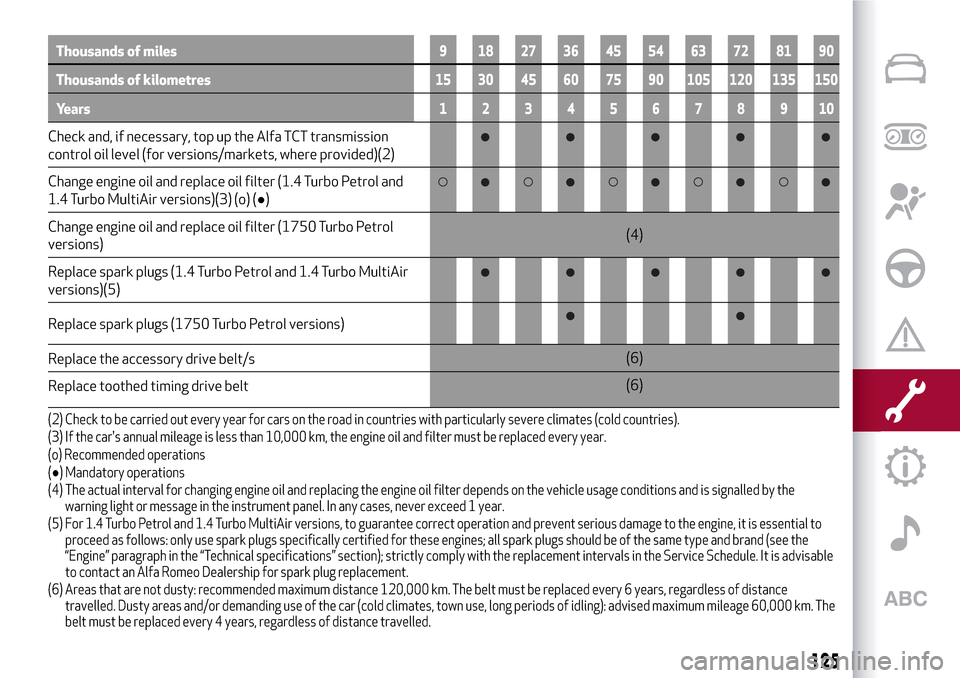
Thousands of miles9 182736455463728190
Thousands of kilometres15 30 45 60 75 90 105 120 135 150
Years12345678910
Check and, if necessary, top up the Alfa TCT transmission
control oil level (for versions/markets, where provided)(2)
Change engine oil and replace oil filter (1.4 Turbo Petrol and
1.4 Turbo MultiAir versions)(3) (o) (●)
Change engine oil and replace oil filter (1750 Turbo Petrol
versions)(4)
Replace spark plugs (1.4 Turbo Petrol and 1.4 Turbo MultiAir
versions)(5)
Replace spark plugs (1750 Turbo Petrol versions)
Replace the accessory drive belt/s(6)
Replace toothed timing drive belt(6)
(2) Check to be carried out every year for cars on the road in countries with particularly severe climates (cold countries).
(3) If the car's annual mileage is less than 10,000 km, the engine oil and filter must be replaced every year.
(o) Recommended operations
(●) Mandatory operations
(4) The actual interval for changing engine oil and replacing the engine oil filter depends on the vehicle usage conditions and is signalled by the
warning light or message in the instrument panel. In any cases, never exceed 1 year.
(5) For 1.4 Turbo Petrol and 1.4 Turbo MultiAir versions, to guarantee correct operation and prevent serious damage to the engine, it is essential to
proceed as follows: only use spark plugs specifically certified for these engines; all spark plugs should be of the same type and brand (see the
“Engine” paragraph in the “Technical specifications” section); strictly comply with the replacement intervals in the Service Schedule. It is advisable
to contact an Alfa Romeo Dealership for spark plug replacement.
(6) Areas that are not dusty: recommended maximum distance 120,000 km. The belt must be replaced every 6 years, regardless of distance
travelled. Dusty areas and/or demanding use of the car (cold climates, town use, long periods of idling): advised maximum mileage 60,000 km. The
belt must be replaced every 4 years, regardless of distance travelled.
125
Page 129 of 212

DIESEL VERSIONS
The checks listed in the Service Schedule, after reaching 200,000 km (120,000 mi)/10 years, must be cyclically repeated starting
from the first interval, thus following the same intervals as before.
Thousands of miles12 24 36 48 60 72 84 96 108 120
Thousands of kilometres20 40 60 80 100 120 140 160 180 200
Years12345678910
Check tyre condition/wear and adjust pressure, if necessary;
check the condition/expiry date of the “Fix&Go” repair kit
(for versions/markets, where provided)
Check operation of lighting system (headlights, direction
indicators, hazard warning lights, boot, passenger
compartment, glove compartment, instrument panel warning
lights, etc.)
Check and, if necessary, top up fluid levels(1)
Check exhaust emissions
Use the diagnosis socket to check fuel/engine control
systems operation, emissions and engine oil decay (the latter
for versions/markets, where provided)
Visually inspect condition of: exterior bodywork, underbody
protection, pipes and hoses (exhaust, fuel system, brakes),
rubber elements (gaiters, sleeves, bushes, etc.)
(1) Always only use the liquids shown in the handbook for topping up after having checked that the system is not damaged.
127
Page 130 of 212

Thousands of miles12 24 36 48 60 72 84 96 108 120
Thousands of kilometres20 40 60 80 100 120 140 160 180 200
Years12345678910
Check windscreen/rear window wiper blade position/wear
Check operation of windscreen washer system and adjust
jets if necessary
Check cleanliness of bonnet and luggage compartment locks,
cleanliness and lubrication of linkage
Check handbrake lever travel and adjust, if necessary
Visually inspect conditions and wear of front and rear disc
brake pads and integrity of pad wear indicator
Visually inspect conditions of the accessory drive belt(s)
Check tension of accessory drive belt (versions without
automatic tensioner)
Visually inspect conditions of toothed timing drive belt
Check and, if necessary, top up the Alfa TCT transmission
control oil level (for versions/markets, where provided)(2)
Change engine oil and replace oil filter(3)
(2) Check to be carried out every year for cars on the road in countries with particularly severe climates (cold countries).
(3) The actual interval for changing engine oil and replacing the engine oil filter depends on the vehicle usage conditions and is signalled by the
warning light or message in the instrument panel. In any case, it must never exceed 2 years. If the car is mainly used in towns and cities, change the
engine oil and filter every year.
128
SERVICING AND MAINTENANCE